

Blossom — Social Investing Community: Real Portfolios, Trades & Market Insights



My space thesis has changed (just as the industry)



I took the hard decision to sell my beloved $RKLB and reallocate into $PL.
Not because I think $RKLB isn’t executing or because I’ve lost confidence, it’s actually quite the opposite!! $RKLB remains one of the companies I’m most bullish on in the space industry and the CEO is the greatest of all time.
It’s just no longer the best fit for my investment thesis as the industry evolves and my investing strategy being to allocate big where I have the most conviction, so having $RKLB at less than 10% of my portfolio did not make sense for my strategy.
I do keep one symbolic $RKLB share in my RRSP bought at $3.72 because it’s where everything started when I started my investing journey 3 years ago.
The focus for space companies now is tilted towards "space applications", like $RKLB acquiring $IRDM for $8 billion to get connectivity into their inventory, satellites monitoring agriculture, $PL providing real-time satellite imagery, etc.
Among these applications, I see a lot of potential in the development of AI infrastructure in space over the next few years and I believe Planet Labs is positioned to benefit from this.
My thesis is that $PL sits at the intersection of satellite infrastructure, Earth observation and AI for both on Earth and potentially in space.
$PL isn’t an in-space data centre company today but it is already a pioneer!
Planet is $GOOGL’s partner on Project Suncatcher, an initiative exploring the deployment of Google’s Tensor Processing Units (TPUs) in orbit to scale AI compute in space. The first two prototype satellites are expected to launch in early 2027, for an envisioned constellation of 81 satellites.
Some benefits of data centres in orbit is that you have unlimited and free power and you do not need water to cool as heat gets radiated out of the satellite into space. It’s essentially a low-latency connectivity satellite like Starlink, but instead of beaming Internet it beams AI results back on Earth.
Planet has also been a pioneer in Earth observation and is now rapidly adding AI into its satellite imagery platform. The company has partnered with Anthropic to incorporate Claude to help customers turn raw satellite imagery into actionable insights more efficiently.
According to a Bloomberg report from last week, $PL is also in discussions to provide satellite-imaging services to help monitor data-centre construction as it expands beyond its defense/government market.
In August, $PL renewed a contract with an undisclosed hyperscaler AI developer to monitor data-centre and semiconductor manufacturing construction globally.
Its Pelican high-resolution imagery is being used to track construction milestones at these facilities.
I like to see how $PL has been diversifying their revenue lately. I would not be surprised to see an acquisition very soon given they have now $860M in cash following their ATM offering.
For FY2027, ending January 31, 2027, Planet expects revenue of $430–441M (+41% YoY) and adjusted EBITDA of $3–10M (-50% YoY)
Have a great long weekend!! read more
Not because I think $RKLB isn’t executing or because I’ve lost confidence, it’s actually quite the opposite!! $RKLB remains one of the companies I’m most bullish on in the space industry and the CEO is the greatest of all time.
It’s just no longer the best fit for my investment thesis as the industry evolves and my investing strategy being to allocate big where I have the most conviction, so having $RKLB at less than 10% of my portfolio did not make sense for my strategy.
I do keep one symbolic $RKLB share in my RRSP bought at $3.72 because it’s where everything started when I started my investing journey 3 years ago.
The focus for space companies now is tilted towards "space applications", like $RKLB acquiring $IRDM for $8 billion to get connectivity into their inventory, satellites monitoring agriculture, $PL providing real-time satellite imagery, etc.
Among these applications, I see a lot of potential in the development of AI infrastructure in space over the next few years and I believe Planet Labs is positioned to benefit from this.
My thesis is that $PL sits at the intersection of satellite infrastructure, Earth observation and AI for both on Earth and potentially in space.
$PL isn’t an in-space data centre company today but it is already a pioneer!
Planet is $GOOGL’s partner on Project Suncatcher, an initiative exploring the deployment of Google’s Tensor Processing Units (TPUs) in orbit to scale AI compute in space. The first two prototype satellites are expected to launch in early 2027, for an envisioned constellation of 81 satellites.
Some benefits of data centres in orbit is that you have unlimited and free power and you do not need water to cool as heat gets radiated out of the satellite into space. It’s essentially a low-latency connectivity satellite like Starlink, but instead of beaming Internet it beams AI results back on Earth.
Planet has also been a pioneer in Earth observation and is now rapidly adding AI into its satellite imagery platform. The company has partnered with Anthropic to incorporate Claude to help customers turn raw satellite imagery into actionable insights more efficiently.
According to a Bloomberg report from last week, $PL is also in discussions to provide satellite-imaging services to help monitor data-centre construction as it expands beyond its defense/government market.
In August, $PL renewed a contract with an undisclosed hyperscaler AI developer to monitor data-centre and semiconductor manufacturing construction globally.
Its Pelican high-resolution imagery is being used to track construction milestones at these facilities.
I like to see how $PL has been diversifying their revenue lately. I would not be surprised to see an acquisition very soon given they have now $860M in cash following their ATM offering.
For FY2027, ending January 31, 2027, Planet expects revenue of $430–441M (+41% YoY) and adjusted EBITDA of $3–10M (-50% YoY)
Have a great long weekend!! read more
3,054 views
Complete ETF/Sector/Asset Investment List

Since so many people ask how to invest in this sector, or this country, or this asset, I’ve decided to make a comprehensive guide on how you can invest in specific areas. This is NOT portfolio advice, simply information about tickers that you can research yourself. Save this for later so you have a list of ETFs to come back to!
Canada:
$XIU $XIC $ZCN All expose you to the TSX in Canada. These ETFs consist of all top Canadian companies and access to our national stock exchange.
$VCB $VGV $VLB $VAB $VSB $VSC $XBB $XCB Expose you to Canadian bonds; whether it be long-term, short-term, corporate, government, etc.
$VDY $XEI $CDZ Expose you to Canadian dividend companies
$XRE $ZRE $VRE Give access to Canadian REITs
$ZEB $XFN $RBNK Lets you buy the Canadian banks
USA:
$VFV $ZSP $XSP $XUS $HXS Lets you buy the S&P 500 (learn about hedged vs. unhedged in my other post)
$XQQ $HXQ $ZQQ All give you access to the NASDAQ 100
$IWR $VO $VOE $VOT $IJH $SCHM Lets you buy US Midcaps
$IJR $IWM $VB $VBR $VBK $SCHA Lets you buy US Smallcaps
$DIV $SPYD $RDIV $DHS $VIG $SCHD $VYM $DGRO $SDY Give access from small to high dividend US companies
$VTI $ITOT Lets you buy the whole US market
$TLT $IEF $VGIT $GOVT $SHY $VGLT Give access to US bonds
$XLC $XLY $XLP $XLE $XLF $XLV $XLI $XLB $XLRE $XLK $XLU All give you access to each sector in the S&P such as financials, energy, healthcare, etc.
International:
$XEQT $FEQT $VEQT $ZEQT Give you an all-in-one exposure to Canada, US, emerging and global markets.
$VEA $IEFA $SCHF $SPDW $EFV $EFA Give access to general international exposure
$EWJ $EWU $EWC Gives direct access to developed international countries
$INDA $MCHI $EWT $EWY $EWZ $EWW $EIDO $EWM Gives direct access to emerging international countries
Assets:
$KILO $PHYS $CGL Let’s you buy gold directly through ETFs
$SVR $HUZ Let you buy silver through ETFs
Savings/Interest:
$CASH $HISA $PSA $HSAV Access to Canadian savings and interest payments
$HSUV-U $PSU-U $HISU-U Access to US savings and interest payments
There’s so many ETFs I didn’t go into with dozens of categories, but this should give you some basic starting point to look into your ETF investments. This is simply the starting point, when choosing your investments always research the ETFs, what they provide to you, their fees, your goals, your risk, and what you’re looking to get out of investing.
As always do your research and happy investing!
Subscribe to the newsletter: relatablefinance.substack.com read more
Canada:
$XIU $XIC $ZCN All expose you to the TSX in Canada. These ETFs consist of all top Canadian companies and access to our national stock exchange.
$VCB $VGV $VLB $VAB $VSB $VSC $XBB $XCB Expose you to Canadian bonds; whether it be long-term, short-term, corporate, government, etc.
$VDY $XEI $CDZ Expose you to Canadian dividend companies
$XRE $ZRE $VRE Give access to Canadian REITs
$ZEB $XFN $RBNK Lets you buy the Canadian banks
USA:
$VFV $ZSP $XSP $XUS $HXS Lets you buy the S&P 500 (learn about hedged vs. unhedged in my other post)
$XQQ $HXQ $ZQQ All give you access to the NASDAQ 100
$IWR $VO $VOE $VOT $IJH $SCHM Lets you buy US Midcaps
$IJR $IWM $VB $VBR $VBK $SCHA Lets you buy US Smallcaps
$DIV $SPYD $RDIV $DHS $VIG $SCHD $VYM $DGRO $SDY Give access from small to high dividend US companies
$VTI $ITOT Lets you buy the whole US market
$TLT $IEF $VGIT $GOVT $SHY $VGLT Give access to US bonds
$XLC $XLY $XLP $XLE $XLF $XLV $XLI $XLB $XLRE $XLK $XLU All give you access to each sector in the S&P such as financials, energy, healthcare, etc.
International:
$XEQT $FEQT $VEQT $ZEQT Give you an all-in-one exposure to Canada, US, emerging and global markets.
$VEA $IEFA $SCHF $SPDW $EFV $EFA Give access to general international exposure
$EWJ $EWU $EWC Gives direct access to developed international countries
$INDA $MCHI $EWT $EWY $EWZ $EWW $EIDO $EWM Gives direct access to emerging international countries
Assets:
$KILO $PHYS $CGL Let’s you buy gold directly through ETFs
$SVR $HUZ Let you buy silver through ETFs
Savings/Interest:
$CASH $HISA $PSA $HSAV Access to Canadian savings and interest payments
$HSUV-U $PSU-U $HISU-U Access to US savings and interest payments
There’s so many ETFs I didn’t go into with dozens of categories, but this should give you some basic starting point to look into your ETF investments. This is simply the starting point, when choosing your investments always research the ETFs, what they provide to you, their fees, your goals, your risk, and what you’re looking to get out of investing.
As always do your research and happy investing!
Subscribe to the newsletter: relatablefinance.substack.com read more
297K views
Firefly III — Self-Host Personal Finance — FYOA


For Your Own Analysis. YMMV.
This is the companion to my Ghostfolio post. I was asked about how I do budgeting and how I track and use AI for personal finance.
Ghostfolio tracks what you own; Firefly III tracks where and how the cash flows:
Firefly III — https://www.firefly-iii.org.
It is open-source, double-entry personal
finance software that you run yourself.
There is a live demo at
https://demo.firefly-iii.org (demo@firefly-iii.org / demo, both pre-filled) if you
want to check it out before installing anything.
There is no hosted service to buy, which is either the point or the dealbreaker depending on your patience for Docker.
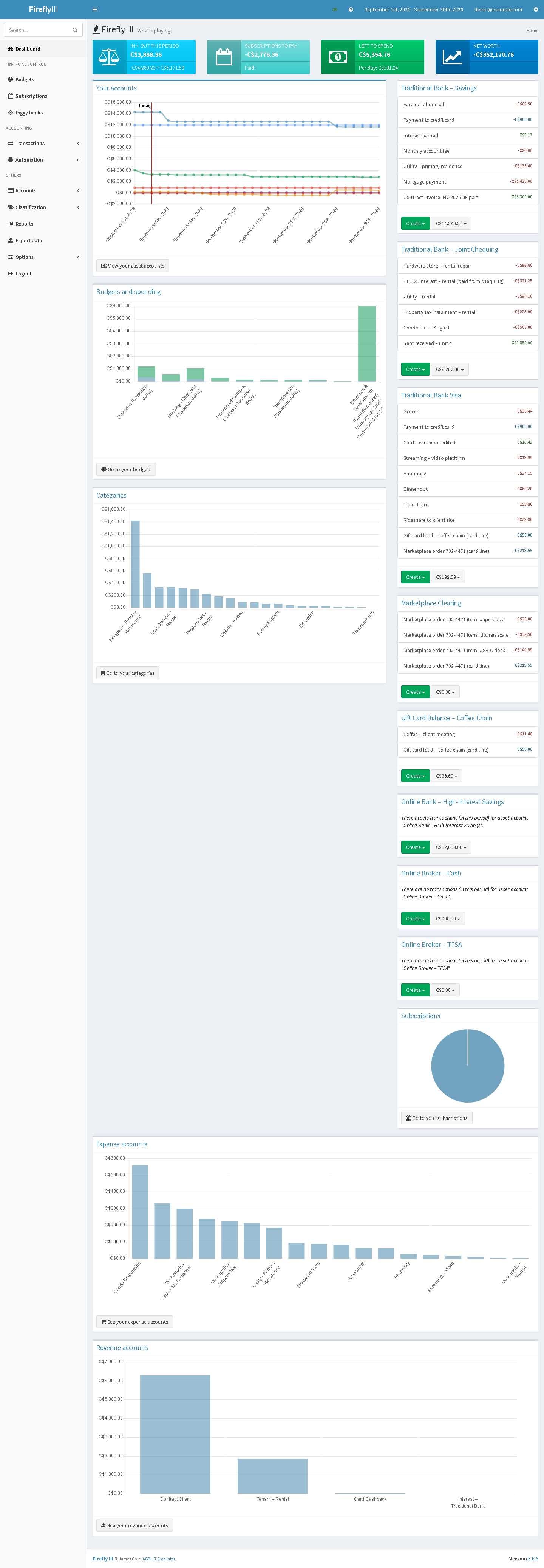
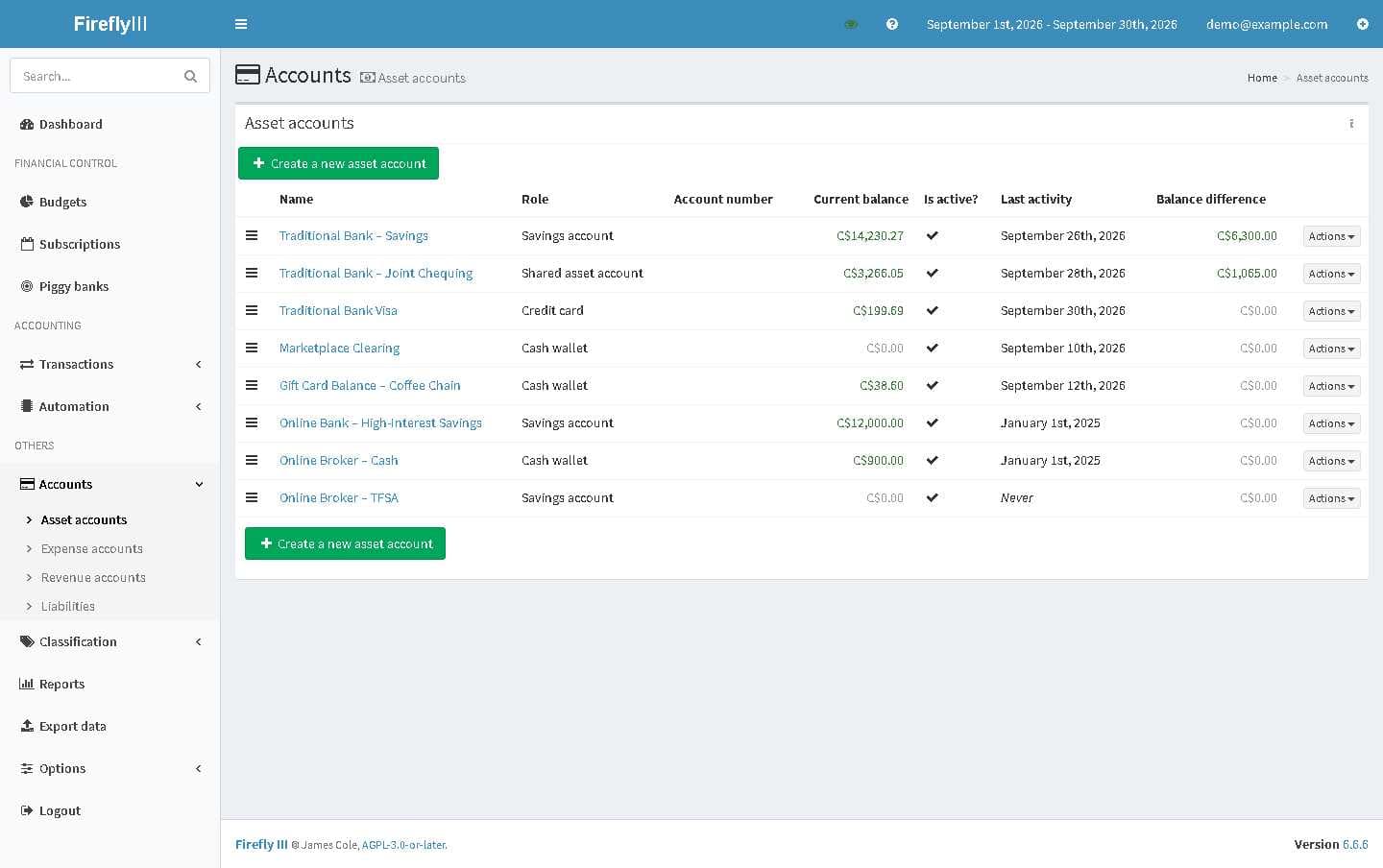
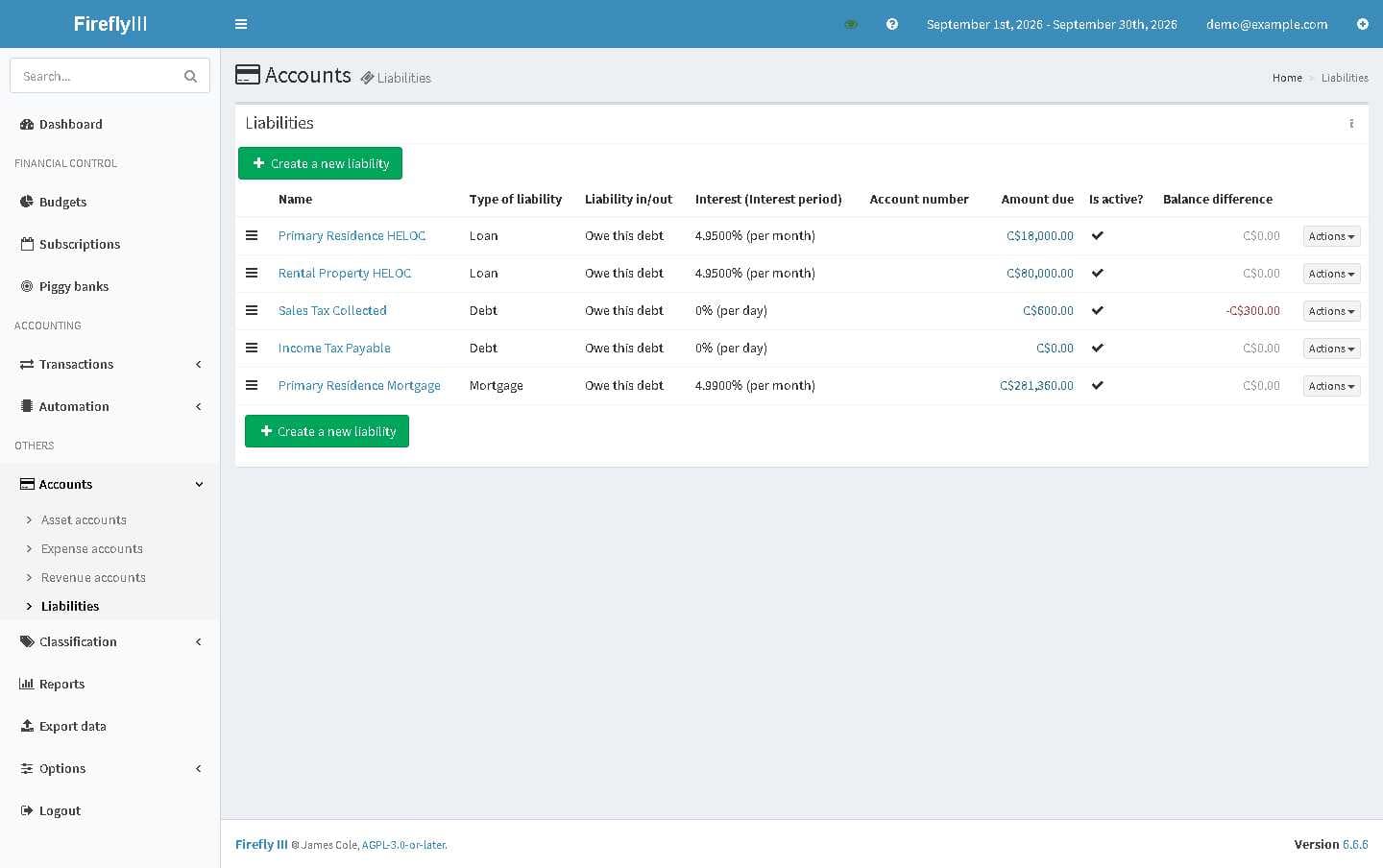
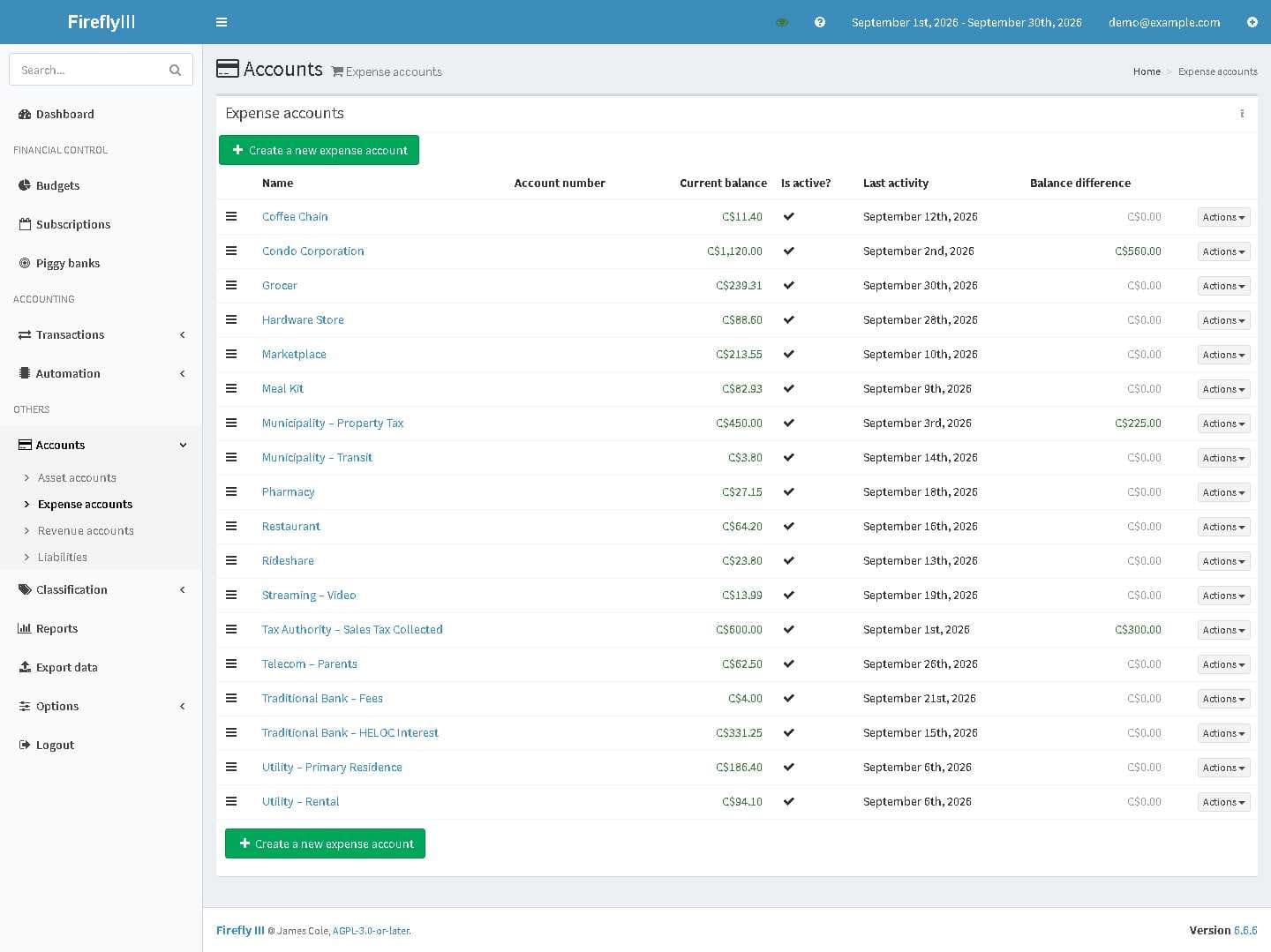
The screenshots come from a demo user seeded with invented data — every account,
payee and amount below is made-up. They are numbered in the order I would look
at them:
1–3: Dashboard, accounts and liabilities. Net worth across banks, cards, a
clearing account and broker cash mirrors, then the liability side — mortgage, two
lines of credit, sales tax collected, income tax payable. Two modelling choices do
most of the work here. A credit card is an asset account with a negative balance, so
paying it becomes a transfer between two accounts you own rather than an expense,
and it reconciles against the statement. Investment accounts exist only as cash
mirrors: the transfer in and the transfer out are recorded, the securities are not.
4: Budgets. An envelope per decision you can actually make about an amount.
Monthly resetting envelopes for the steady categories, annual rolling envelopes for
the lumpy ones such as travel, education and maintenance.
5: Subscriptions. A subscription in Firefly is an expectation, not a record of
spend — this payee charges between X and Y every period from this anchor date. Its
real value is making an absence visible: the charge that stopped, the one that
quietly doubled, the seasonal one that should have ended in October.
6: Tags. Two axes rather than one pile. A cost-centre axis (personal, home
office, business travel) and a behaviour axis (fixed, variable, subscription), plus a
year tag and an import-cycle tag on every imported row. The first axis is what an
accountant filters on. The second is what makes budgets and subscriptions meaningful.
The import-cycle tag is how I later tell a statement-derived row from one a workflow
posted, which matters more than it sounds.
On getting data in: the importer takes a CSV plus a mapping file. It can talk to bank
aggregation APIs, but for my accounts I export CSV from online and
import that. Two conventions saved me a lot of grief.
Every row carries a unique note with its source file and row number, because
duplicate detection will otherwise happily drop the second of two legitimate same-day,
same-amount charges. And transfers are counter-intuitive to map, so import one row and
look at it before you run a batch.
Other limits worth knowing before you invest a weekend: it is double-entry, so there
is a real learning curve if you have only used a budgeting app.
The feature I value most is that the household ledger is mine and stays consistent
when a bank changes its export format, its categories or its app. The categories and
tags are the ones I chose, not a vendor's, and eighteen months of history is still
queryable in one place.
Self-hosting is worth it to me for I control the data and can point AI at the bookkeeping to get answers to questions that the data can answer.
One thing I would ask you not to skip if you try Firefly III.
**Never hand an assistant a raw statement.**
A bank PDF carries your legal name, account and card numbers, address and
sometimes more, and a model needs none of it to categorize a transaction — it needs
dates, amounts and merchant names. Black boxes drawn on a PDF are not redaction; the
text is still in the file. I sanitize on my own machine first, with a names file,
because a pattern can catch an account number but only you can tell a script that a
particular name is you. The sanitize kit that does it is in both of my repos.
The setup notes, compose files, the account taxonomy, the budget and subscription
design, and the AI procedure are documented here:
https://github.com/ANPC86/firefly-nas-setup
It runs on anything that does Docker Compose.read more
This is the companion to my Ghostfolio post. I was asked about how I do budgeting and how I track and use AI for personal finance.
Ghostfolio tracks what you own; Firefly III tracks where and how the cash flows:
Firefly III — https://www.firefly-iii.org.
It is open-source, double-entry personal
finance software that you run yourself.
There is a live demo at
https://demo.firefly-iii.org (demo@firefly-iii.org / demo, both pre-filled) if you
want to check it out before installing anything.
There is no hosted service to buy, which is either the point or the dealbreaker depending on your patience for Docker.
The screenshots come from a demo user seeded with invented data — every account,
payee and amount below is made-up. They are numbered in the order I would look
at them:
1–3: Dashboard, accounts and liabilities. Net worth across banks, cards, a
clearing account and broker cash mirrors, then the liability side — mortgage, two
lines of credit, sales tax collected, income tax payable. Two modelling choices do
most of the work here. A credit card is an asset account with a negative balance, so
paying it becomes a transfer between two accounts you own rather than an expense,
and it reconciles against the statement. Investment accounts exist only as cash
mirrors: the transfer in and the transfer out are recorded, the securities are not.
4: Budgets. An envelope per decision you can actually make about an amount.
Monthly resetting envelopes for the steady categories, annual rolling envelopes for
the lumpy ones such as travel, education and maintenance.
5: Subscriptions. A subscription in Firefly is an expectation, not a record of
spend — this payee charges between X and Y every period from this anchor date. Its
real value is making an absence visible: the charge that stopped, the one that
quietly doubled, the seasonal one that should have ended in October.
6: Tags. Two axes rather than one pile. A cost-centre axis (personal, home
office, business travel) and a behaviour axis (fixed, variable, subscription), plus a
year tag and an import-cycle tag on every imported row. The first axis is what an
accountant filters on. The second is what makes budgets and subscriptions meaningful.
The import-cycle tag is how I later tell a statement-derived row from one a workflow
posted, which matters more than it sounds.
On getting data in: the importer takes a CSV plus a mapping file. It can talk to bank
aggregation APIs, but for my accounts I export CSV from online and
import that. Two conventions saved me a lot of grief.
Every row carries a unique note with its source file and row number, because
duplicate detection will otherwise happily drop the second of two legitimate same-day,
same-amount charges. And transfers are counter-intuitive to map, so import one row and
look at it before you run a batch.
Other limits worth knowing before you invest a weekend: it is double-entry, so there
is a real learning curve if you have only used a budgeting app.
The feature I value most is that the household ledger is mine and stays consistent
when a bank changes its export format, its categories or its app. The categories and
tags are the ones I chose, not a vendor's, and eighteen months of history is still
queryable in one place.
Self-hosting is worth it to me for I control the data and can point AI at the bookkeeping to get answers to questions that the data can answer.
One thing I would ask you not to skip if you try Firefly III.
**Never hand an assistant a raw statement.**
A bank PDF carries your legal name, account and card numbers, address and
sometimes more, and a model needs none of it to categorize a transaction — it needs
dates, amounts and merchant names. Black boxes drawn on a PDF are not redaction; the
text is still in the file. I sanitize on my own machine first, with a names file,
because a pattern can catch an account number but only you can tell a script that a
particular name is you. The sanitize kit that does it is in both of my repos.
The setup notes, compose files, the account taxonomy, the budget and subscription
design, and the AI procedure are documented here:
https://github.com/ANPC86/firefly-nas-setup
It runs on anything that does Docker Compose.read more
110 views
I’m a Millionaire. It’s Not What I Expected


I’m a Millionaire. It Doesn’t Feel Like I Thought It Would.
Here’s something that feels strange to say.
By the traditional definition of net worth what we own minus what we owe our household would technically be considered millionaires.
I’m not saying that as a flex. In fact, that’s kind of the point.
When I was younger, a millionaire meant big houses, fancy cars and expensive vacations.
Basically, Lifestyles of the Rich and Famous.
If you just heard Robin Leach’s voice, congratulations …..you’re probably my target audience.
But being a millionaire at 53 looks surprisingly… normal.
We have investments and equity in our home. We also have a mortgage, and I still get up and go to work.
What got me thinking about this was my friend @williamwang23 Will’s recent post about becoming a millionaire in his early 30s.
That’s an incredible accomplishment.
But what really stands out to me is that Will became curious about money early. He learned, saved, invested and, most importantly, gave his money time.
I didn’t start DIY investing until I was 50.
We saved and built home equity, but I didn’t become curious enough about investing and money until much later.
And I have to give @moementumfinance Moe credit for the word curious.
He talked about it during our panel at BlossomCon, and it really stuck with me.
Over the last three years, I’ve asked more questions, learned more and become much more financially literate.
I’ve also made mistakes.
I’ve posted things that weren’t quite right, and people here have corrected me. I’m good with that.
Being financially literate doesn’t mean knowing everything. It means being curious enough to ask questions and open enough to learn from the answers.
I wish I’d figured that out at 30 instead of 50.
Because Will and I might technically carry the same “millionaire” label today, but he’s given his money decades more time to compound.
That’s why the number itself is so relative.
Our goal is still to build a $1 million+ investment portfolio by retirement. On paper, our net worth could eventually be well into the millions.
But we’re not planning a Lifestyles of the Rich and Famous retirement.
We want to travel, enjoy our time, help our kids when we can and have enough that money gives us choices.
And maybe that’s the funny part.
Technically, I’m already a millionaire.
But we’re still working toward becoming what younger me thought a millionaire was.
Not the mansion or the yacht.
The freedom. The security. The choices.
Maybe that’s what being wealthy really means.
What does being a millionaire mean to you? read more
Here’s something that feels strange to say.
By the traditional definition of net worth what we own minus what we owe our household would technically be considered millionaires.
I’m not saying that as a flex. In fact, that’s kind of the point.
When I was younger, a millionaire meant big houses, fancy cars and expensive vacations.
Basically, Lifestyles of the Rich and Famous.
If you just heard Robin Leach’s voice, congratulations …..you’re probably my target audience.
But being a millionaire at 53 looks surprisingly… normal.
We have investments and equity in our home. We also have a mortgage, and I still get up and go to work.
What got me thinking about this was my friend @williamwang23 Will’s recent post about becoming a millionaire in his early 30s.
That’s an incredible accomplishment.
But what really stands out to me is that Will became curious about money early. He learned, saved, invested and, most importantly, gave his money time.
I didn’t start DIY investing until I was 50.
We saved and built home equity, but I didn’t become curious enough about investing and money until much later.
And I have to give @moementumfinance Moe credit for the word curious.
He talked about it during our panel at BlossomCon, and it really stuck with me.
Over the last three years, I’ve asked more questions, learned more and become much more financially literate.
I’ve also made mistakes.
I’ve posted things that weren’t quite right, and people here have corrected me. I’m good with that.
Being financially literate doesn’t mean knowing everything. It means being curious enough to ask questions and open enough to learn from the answers.
I wish I’d figured that out at 30 instead of 50.
Because Will and I might technically carry the same “millionaire” label today, but he’s given his money decades more time to compound.
That’s why the number itself is so relative.
Our goal is still to build a $1 million+ investment portfolio by retirement. On paper, our net worth could eventually be well into the millions.
But we’re not planning a Lifestyles of the Rich and Famous retirement.
We want to travel, enjoy our time, help our kids when we can and have enough that money gives us choices.
And maybe that’s the funny part.
Technically, I’m already a millionaire.
But we’re still working toward becoming what younger me thought a millionaire was.
Not the mansion or the yacht.
The freedom. The security. The choices.
Maybe that’s what being wealthy really means.
What does being a millionaire mean to you? read more
6,374 views


Dad on FIRE 🔥

I sat down with Jordan from @coveredcalletfinvesting to talk about something I think a lot of income investors will find fascinating — trying to live off your portfolio in your 30s while raising 4 kids.
We talked about his FIRE journey, why he likes income investing, his experience with margin, his top 5 holdings, and some of the biggest financial lessons he's learned.
Jordan was also the first finfluencer I ever met in person, so this was a really meaningful conversation for me.
Curious to hear from the Blossom community:
Could you see yourself living off your investment income in your 30s?
https://www.youtube.com/watch?v=4h_nKofwOzYread more
We talked about his FIRE journey, why he likes income investing, his experience with margin, his top 5 holdings, and some of the biggest financial lessons he's learned.
Jordan was also the first finfluencer I ever met in person, so this was a really meaningful conversation for me.
Curious to hear from the Blossom community:
Could you see yourself living off your investment income in your 30s?
https://www.youtube.com/watch?v=4h_nKofwOzYread more
1,300 views
Time to load up on Sofi!

People are worried about the amount of revenue generated by it's lending business, but I am bullish because of the 35% YoY increase of new members and 42% YoY increase of new products
opened. I will definitely be buying heavy if the Fed raises interest rates in a couple weeks.
Why It’s Time to Load Up on SoFi Stock https://share.google/ECmJInjbuMwchELpk
opened. I will definitely be buying heavy if the Fed raises interest rates in a couple weeks.
Why It’s Time to Load Up on SoFi Stock https://share.google/ECmJInjbuMwchELpk
96 views
📈 Do You Know How to Read a Stock Chart?

With Candlesticks?…. Be honest now… 😂
When you pull up a stock or ETF and there are candles, volume, timeframes…
Are you thinking…. “Yep. That definitely looks like a chart. And it’s going up and to the right.” 😂
In my newest investing basics video, I break down how to make sense of stock charts, without turning you into a technical analysis wizard and muddying the waters with complicated TA (technical analysis) jargon.
And there’s one thing I REALLY want to help beginners understand about charts that could save you from making some questionable assumptions about what you're seeing…..Just the basics you actually need to know to get started.
If you know the basics, what do YOU use stock charts for? Do you ANALYZE them before investing…. or mostly just glance at the price direction and MA’s?
I’ve been working hard to make regular, beginner friendly videos …. if you watched the video, was it helpful and clear? And please let me know what you would like to see next!
https://youtu.be/w5fKjYfRDdEread more
When you pull up a stock or ETF and there are candles, volume, timeframes…
Are you thinking…. “Yep. That definitely looks like a chart. And it’s going up and to the right.” 😂
In my newest investing basics video, I break down how to make sense of stock charts, without turning you into a technical analysis wizard and muddying the waters with complicated TA (technical analysis) jargon.
And there’s one thing I REALLY want to help beginners understand about charts that could save you from making some questionable assumptions about what you're seeing…..Just the basics you actually need to know to get started.
If you know the basics, what do YOU use stock charts for? Do you ANALYZE them before investing…. or mostly just glance at the price direction and MA’s?
I’ve been working hard to make regular, beginner friendly videos …. if you watched the video, was it helpful and clear? And please let me know what you would like to see next!
https://youtu.be/w5fKjYfRDdEread more
978 views



US economy adds +162,000 jobs in August, CRUSHING expectations of +55,000.
And $SPY falls pre-market?!
Too much going on for the market to digest great news.
And $SPY falls pre-market?!
Too much going on for the market to digest great news.
752 views
Quality companies with the highest net profit marg

🇺🇸 Ran a screen across the U.S. market for highly profitable companies.
Criteria:
• Market cap > $10B
• EPS growth (3 yrs estimate) > 10%
• Gross margin > 75%
• Positive FCF
Ranked by net profit margin:
1. $APP — 64.6%
2. $V— 50.8%
3. $PLTR — 49.0%
4. $MA — 46.3%
5. $HOOD — 42.0%
6. $MSCI — 40.7%
7. $ICE — 38.3%
8. $LLY — 33.5%
9. $RDDT — 31.4%
10. $META — 29.8%
11. $ADBE — 28.7%
12. $FTNT — 28.2%
13. $BKNG — 25.5%
14. $CDNS — 23.6%
15. $CRM — 22.0%
16. $ADSK — 21.1%
17. $ABNB — 20.5%
18. $ARM — 20.3%
19. $WDAY — 12.3%
20. $SNPS — 11.4%
High margins + EPS growth + positive FCF is a powerful combination… but but but valuation is a different topic.
Which of these 20 looks most attractive at today’s price? 👀
(Similar post for Canadian companies coming next)read more
Criteria:
• Market cap > $10B
• EPS growth (3 yrs estimate) > 10%
• Gross margin > 75%
• Positive FCF
Ranked by net profit margin:
1. $APP — 64.6%
2. $V— 50.8%
3. $PLTR — 49.0%
4. $MA — 46.3%
5. $HOOD — 42.0%
6. $MSCI — 40.7%
7. $ICE — 38.3%
8. $LLY — 33.5%
9. $RDDT — 31.4%
10. $META — 29.8%
11. $ADBE — 28.7%
12. $FTNT — 28.2%
13. $BKNG — 25.5%
14. $CDNS — 23.6%
15. $CRM — 22.0%
16. $ADSK — 21.1%
17. $ABNB — 20.5%
18. $ARM — 20.3%
19. $WDAY — 12.3%
20. $SNPS — 11.4%
High margins + EPS growth + positive FCF is a powerful combination… but but but valuation is a different topic.
Which of these 20 looks most attractive at today’s price? 👀
(Similar post for Canadian companies coming next)read more
1,800 views
World's Largest ETFs & Who Should Buy Them

The World’s Top 5 ETFs & Who Should Buy Them
When building a core portfolio, investors globally cluster around these mega funds.
Here is the breakdown of the top 5 ETFs ranked by Assets Under Management (AUM), along with who each fund is best suited for:
1. Vanguard S&P 500 ETF ($VOO): ~$1.05 Trillion AUM
* Who Should Buy: Long-term buy-and-hold retail investors.
* Why: Its rock-bottom 0.03% expense ratio makes it ideal for building wealth over decades in core accounts (like an RRSP or TFSA).
2. iShares Core S&P 500 ETF ($IVV): ~$870 Billion AUM
* Who Should Buy: Institutional portfolios, fee-conscious investors, and BlackRock/iShares account holders.
* Why: Matches $VOO's 0.03% expense ratio with massive liquidity, making it a favorite for institutional allocators.
3. SPDR S&P 500 ETF Trust ($SPY): ~$808 Billion AUM
* Who Should Buy: Active day traders, swing traders, and options traders.
* Why: While its 0.09% fee is slightly higher, its unparalleled daily volume and tight options spreads make it the premier tool for active trading.
4. Vanguard Total Stock Market ETF ($VTI): ~$660 Billion AUM
* Who Should Buy: Investors who want complete US market coverage beyond just large caps.
* Why: Holds over 3,500 companies, giving you instant exposure to large-, mid-, and small-cap stocks in a single ticker.
5. Invesco QQQ Trust ($QQQ): ~$300 Billion AUM
* Who Should Buy: Tech bulls and growth-focused investors comfortable with higher volatility.
* Why: Tracks the Nasdaq-100, providing heavy concentration in mega-cap innovators like $NVDA, $AAPL, and $MSFT.
Account Strategy for 🇨🇦 DIY Investors:
* RRSP: Best place for US-listed funds ($VOO, $QQQ) to avoid 15% US withholding tax on dividends.
* TFSA / FHSA: Consider Canadian-listed versions (like $VFV or $XEQT) to avoid currency conversion fees while keeping gains tax-free.
Which of these forms the backbone of your portfolio, or are you stick-picking? read more
When building a core portfolio, investors globally cluster around these mega funds.
Here is the breakdown of the top 5 ETFs ranked by Assets Under Management (AUM), along with who each fund is best suited for:
1. Vanguard S&P 500 ETF ($VOO): ~$1.05 Trillion AUM
* Who Should Buy: Long-term buy-and-hold retail investors.
* Why: Its rock-bottom 0.03% expense ratio makes it ideal for building wealth over decades in core accounts (like an RRSP or TFSA).
2. iShares Core S&P 500 ETF ($IVV): ~$870 Billion AUM
* Who Should Buy: Institutional portfolios, fee-conscious investors, and BlackRock/iShares account holders.
* Why: Matches $VOO's 0.03% expense ratio with massive liquidity, making it a favorite for institutional allocators.
3. SPDR S&P 500 ETF Trust ($SPY): ~$808 Billion AUM
* Who Should Buy: Active day traders, swing traders, and options traders.
* Why: While its 0.09% fee is slightly higher, its unparalleled daily volume and tight options spreads make it the premier tool for active trading.
4. Vanguard Total Stock Market ETF ($VTI): ~$660 Billion AUM
* Who Should Buy: Investors who want complete US market coverage beyond just large caps.
* Why: Holds over 3,500 companies, giving you instant exposure to large-, mid-, and small-cap stocks in a single ticker.
5. Invesco QQQ Trust ($QQQ): ~$300 Billion AUM
* Who Should Buy: Tech bulls and growth-focused investors comfortable with higher volatility.
* Why: Tracks the Nasdaq-100, providing heavy concentration in mega-cap innovators like $NVDA, $AAPL, and $MSFT.
Account Strategy for 🇨🇦 DIY Investors:
* RRSP: Best place for US-listed funds ($VOO, $QQQ) to avoid 15% US withholding tax on dividends.
* TFSA / FHSA: Consider Canadian-listed versions (like $VFV or $XEQT) to avoid currency conversion fees while keeping gains tax-free.
Which of these forms the backbone of your portfolio, or are you stick-picking? read more
360 views
The Profit You Didn't Take

Imagine watching your stock go from $169 to $308… and then all the way back to $169. 😳
That’s exactly why taking some profits along the way matters.
Let’s look at $CRDO
The stock climbed to around $308 and now it’s trading around $169 almost 45% below its high.
When a stock has a massive run, it can be tempting to think, “I’ll sell when it goes even higher.”
But the market doesn’t always give us that perfect exit.
One strategy is to sell part of your position and lock in some gains, while keeping the rest invested.
If the stock keeps going up — you’re still participating. 🚀
If it drops — you have cash available and may get another chance to buy at a lower price.
A gain on your screen is not the same as money in your pocket.
Sometimes, the smartest move isn’t selling everything.
It’s simply taking some chips off the table. 💰
Do you take profits along the way, or do you prefer to hold through the volatility?read more
That’s exactly why taking some profits along the way matters.
Let’s look at $CRDO
The stock climbed to around $308 and now it’s trading around $169 almost 45% below its high.
When a stock has a massive run, it can be tempting to think, “I’ll sell when it goes even higher.”
But the market doesn’t always give us that perfect exit.
One strategy is to sell part of your position and lock in some gains, while keeping the rest invested.
If the stock keeps going up — you’re still participating. 🚀
If it drops — you have cash available and may get another chance to buy at a lower price.
A gain on your screen is not the same as money in your pocket.
Sometimes, the smartest move isn’t selling everything.
It’s simply taking some chips off the table. 💰
Do you take profits along the way, or do you prefer to hold through the volatility?read more
184 views
Preparing for the inevitable.

I am currently 47 years old. Unfortunately in that time frame I have lost a lot of family members. Some (most) were accidents, some to age, some to cancer, and one to suicide. That’s 11 deaths total. Only 1 person out of 11 had a will.
When you are grieving the last thing you want to do is close an estate up.
It’s even harder if nothing has been prepared in advance.
After the initial shock of the death settles (the phase where everyone is usually nice), greed comes through in a most alarming manner. I’ve watched people turn into monsters. Make sure you have a will!!!! or people will fight. 
I know most people hate thinking about their death or their spouses death but honestly it’s just a fact of life.
I’ve personally been the executor of 2 estates now.
This is my advice:
1. If your young get life insurance. If you’re retired it’s not worth it.
2. Make sure you have a will.
3. Make sure you have a personal directive.
4. Make sure you have a power of attorney set up.
5. If your married make your spouse the beneficiary of your TFSA and RRSP(has to be done through the account not the will), they will roll into the spouses account without taxation.
6. If you’re married, and you own a house, make sure both names are on the title, joint tenant, NOT tenant in common. This activates right of survivorship on property and doesn’t have to go through the estate.
7. If you’re married, both people should have their name on all the vehicles, joint, otherwise it’s a headache after death.
8. Buy a file folding system. I have a plastic one that has a clasp and handle.
9. Put EVERYTHING in this file folder that would be needed if you died tomorrow.
a) all land titles
B) information on house insurance so it can either be eventually canceled or name changed over.
C) your will (or the location of your will),  power of attorney, and personal directive
D) the information for your car, car insurance, and registration on vehicles.
E) information on life insurance.
F) all current year papers needed for filing your taxes. Because the survivor will have to do it and will need that information.
G) where your household bills are. ALL OF THEM, electricity, gas, Netflix, magazine, subscriptions everything you can think of that is in their name. Because you are going to have to cancel them.
H) their credit card information where to contact to cancel the cards
I) birth certificate, SIN numbers, marriage, license, etc.
J) information on all your investments accounts, bank accounts, etc.
K) anything else you can think of for your situation
If you’re married, I’d have one box per person.
When you die, the funeral home will issue many death certificates. And your lawyer will give you copies of the will.
These will be needed to change over any accounts. Everything else goes through the estate which is taxed and the lawyers take their fees so I’d avoid this as much as possible especially if you’re married. This is why having property in both people‘s names is so important because it doesn’t have to go through probate.
I am widowed now and I have my black file folder and my two remaining children know if something happens to me, all they have to do is grab the folder. Everything they need to take care of my estate will be located in this folder.
At the beginning of every year, I open this file up and go through everything to make sure it’s up-to-date.
If you are young and do not own much or can’t afford a will, you can draft one up but it must be handwritten to be classified as a legal document. You cannot type it out!! If you’re not worth much, everything will most likely be sold to pay your bills and cover your funeral expenses. But you can state who your executor will be in your handwritten will.
 Disclaimer I’m not a lawyer or an accountant and this is not legal advice. Talk to a lawyer and talk to an accountant. Make sure everything is set up for you and your situation. These are situations that I personally ran into.
Good luck
Also I’ll add in. IF you have a lot of assets make an appointment with your accountant first. They will tell you how to properly set things up. Then take that information to your lawyer. read more
When you are grieving the last thing you want to do is close an estate up.
It’s even harder if nothing has been prepared in advance.
After the initial shock of the death settles (the phase where everyone is usually nice), greed comes through in a most alarming manner. I’ve watched people turn into monsters. Make sure you have a will!!!! or people will fight. 
I know most people hate thinking about their death or their spouses death but honestly it’s just a fact of life.
I’ve personally been the executor of 2 estates now.
This is my advice:
1. If your young get life insurance. If you’re retired it’s not worth it.
2. Make sure you have a will.
3. Make sure you have a personal directive.
4. Make sure you have a power of attorney set up.
5. If your married make your spouse the beneficiary of your TFSA and RRSP(has to be done through the account not the will), they will roll into the spouses account without taxation.
6. If you’re married, and you own a house, make sure both names are on the title, joint tenant, NOT tenant in common. This activates right of survivorship on property and doesn’t have to go through the estate.
7. If you’re married, both people should have their name on all the vehicles, joint, otherwise it’s a headache after death.
8. Buy a file folding system. I have a plastic one that has a clasp and handle.
9. Put EVERYTHING in this file folder that would be needed if you died tomorrow.
a) all land titles
B) information on house insurance so it can either be eventually canceled or name changed over.
C) your will (or the location of your will),  power of attorney, and personal directive
D) the information for your car, car insurance, and registration on vehicles.
E) information on life insurance.
F) all current year papers needed for filing your taxes. Because the survivor will have to do it and will need that information.
G) where your household bills are. ALL OF THEM, electricity, gas, Netflix, magazine, subscriptions everything you can think of that is in their name. Because you are going to have to cancel them.
H) their credit card information where to contact to cancel the cards
I) birth certificate, SIN numbers, marriage, license, etc.
J) information on all your investments accounts, bank accounts, etc.
K) anything else you can think of for your situation
If you’re married, I’d have one box per person.
When you die, the funeral home will issue many death certificates. And your lawyer will give you copies of the will.
These will be needed to change over any accounts. Everything else goes through the estate which is taxed and the lawyers take their fees so I’d avoid this as much as possible especially if you’re married. This is why having property in both people‘s names is so important because it doesn’t have to go through probate.
I am widowed now and I have my black file folder and my two remaining children know if something happens to me, all they have to do is grab the folder. Everything they need to take care of my estate will be located in this folder.
At the beginning of every year, I open this file up and go through everything to make sure it’s up-to-date.
If you are young and do not own much or can’t afford a will, you can draft one up but it must be handwritten to be classified as a legal document. You cannot type it out!! If you’re not worth much, everything will most likely be sold to pay your bills and cover your funeral expenses. But you can state who your executor will be in your handwritten will.
 Disclaimer I’m not a lawyer or an accountant and this is not legal advice. Talk to a lawyer and talk to an accountant. Make sure everything is set up for you and your situation. These are situations that I personally ran into.
Good luck
Also I’ll add in. IF you have a lot of assets make an appointment with your accountant first. They will tell you how to properly set things up. Then take that information to your lawyer. read more
292K views
S&P 500

$SOFI missed out on the S&P 500 again.
Added:
$BE Bloom Energy
$P Everpure
$ILMN Illumina
Removed:
$TAP Molson Coors
$TTD Trade Desk
$BLDR Builders FirstSource
I know a lot of SoFi investors were hoping this would finally be the quarter.
Still, nothing about the thesis changes for me. The business keeps growing, profitability keeps improving, and I still think S&P 500 inclusion is a matter of when, not if.
We wait. read more
Added:
$BE Bloom Energy
$P Everpure
$ILMN Illumina
Removed:
$TAP Molson Coors
$TTD Trade Desk
$BLDR Builders FirstSource
I know a lot of SoFi investors were hoping this would finally be the quarter.
Still, nothing about the thesis changes for me. The business keeps growing, profitability keeps improving, and I still think S&P 500 inclusion is a matter of when, not if.
We wait. read more
772 views
$UBER went from generating negative free cash flow a few years ago to roughly $10.1B in TTM free cash flow today.
That matters because Uber is no longer just a high-growth platform. It is becoming a serious cash-generating business while rides, delivery, ads and newer opportunities continue to scale.
A big part of my thesis is that free cash flow can keep compounding faster than revenue as operating leverage improves. If Uber keeps turning more of its scale into cash, I think the market will eventually have to value the business much differently.
$UBER remains one of my highest-conviction long-term holdings.
That matters because Uber is no longer just a high-growth platform. It is becoming a serious cash-generating business while rides, delivery, ads and newer opportunities continue to scale.
A big part of my thesis is that free cash flow can keep compounding faster than revenue as operating leverage improves. If Uber keeps turning more of its scale into cash, I think the market will eventually have to value the business much differently.
$UBER remains one of my highest-conviction long-term holdings.
132 views
Lululemon 🍋 Q2 Thesis Review


Ugly... the only fair thing to say about the recent performance of Lululemon.
I started buying Lululemon shares in June 2025, with the bulk of my position being built from November 2025 to June 2026 with my largest purchases being around $118 (interestingly also where lulu was buying back shares).
The story hasn't much changed, since then more just played out as the market had anticipated. Revenue continues to decline, we are seeing slight margin compression, and the managment team continues to cut guidance.
My reviewed perception of Lululemon is a split tale of two stories.
Story #1 📔
A company with a product offering that isn't resonating with customers, and weakening public sentiment due to detrimental advertising efforts. North American markets are not resonating with the products, and I don't anticipate the "Big Ass Bag" will likely improve that.
Managment on the Q2 earnings call insists that the issues are with marketing, and that they aren't reaching the audience that they need to.
Story #2 📘
Lululemon is not a failing business, backed by a fortified balance sheet and robust financials. Despite revenue declines, the company still produces significant cashflows and is a money machine.
At a $11.3billion market cap (around $10billion if you don't include the $1.4billion in cash on the balance sheet), the company still generates around $1.2billion in free cashflow (let's round and consider that a 10% cash yiled), and continues to operate with zero debt. ROIC remains durable at a +30%, and the book value is growing at 20% per year.
The story the market is leaning on is the recent revenue declines. I don't want to ignore this because I agree it's alarming and obviously not what we want to see the business doing. The interim leadership duo has done nothing but flounder, and if they were to remain at the helm I wouldn't see any hope of a narrative change.
However, there is a silver lining. Heidi O'Neal will be joining the team this week. She has a massive battle ahead of her, but may be the change that the company desperately needs.
Despite the current managment believing that marketing is the resounding weakness within the business, it's been obvious to everyone else that product newness, creativity, and uniqueness have been the culprit. This was the main point of contention with founder Chip Wilson who fought to get new creative minded board members their seats.
Heidi O'Neal's history at Nike was responsible for product creativity, consumer strategy, and brand which are all things that Lulu needs to focus on to turn around. She has a successful background in driving new products efficiently to market and engaging with customers effectively.
One quote I often go back to is "We want to buy a business an idiot could run, because one day an idiot will run it" from Charlie Munger. Lululemon has been horrendously mismanaged, and I firmly believe that they are on the brink of their turning point.
Managment (despite me saying has been incompetent) has suggested that they expect the business to be nearing its trough.
So, has my opinions or thesis changed at all on the business? No, not really.
I don't have any expectations of relief until the back half of 2027, and if shares continue to trade down then so be it.
I have no requirement or desire to try to compete or perform on a quarterly basis, but rather over the long term. I still see substantial fundamental value within this company.
In the short term, it may continue to decline, and I'm sure I'll continue to be ridiculed, but that honestly doesn't bother me at all.
I believe an inflection is coming, and patience will be rewarded. As active money movers flee the company, the patient sit calmly and build their positions. read more
I started buying Lululemon shares in June 2025, with the bulk of my position being built from November 2025 to June 2026 with my largest purchases being around $118 (interestingly also where lulu was buying back shares).
The story hasn't much changed, since then more just played out as the market had anticipated. Revenue continues to decline, we are seeing slight margin compression, and the managment team continues to cut guidance.
My reviewed perception of Lululemon is a split tale of two stories.
Story #1 📔
A company with a product offering that isn't resonating with customers, and weakening public sentiment due to detrimental advertising efforts. North American markets are not resonating with the products, and I don't anticipate the "Big Ass Bag" will likely improve that.
Managment on the Q2 earnings call insists that the issues are with marketing, and that they aren't reaching the audience that they need to.
Story #2 📘
Lululemon is not a failing business, backed by a fortified balance sheet and robust financials. Despite revenue declines, the company still produces significant cashflows and is a money machine.
At a $11.3billion market cap (around $10billion if you don't include the $1.4billion in cash on the balance sheet), the company still generates around $1.2billion in free cashflow (let's round and consider that a 10% cash yiled), and continues to operate with zero debt. ROIC remains durable at a +30%, and the book value is growing at 20% per year.
The story the market is leaning on is the recent revenue declines. I don't want to ignore this because I agree it's alarming and obviously not what we want to see the business doing. The interim leadership duo has done nothing but flounder, and if they were to remain at the helm I wouldn't see any hope of a narrative change.
However, there is a silver lining. Heidi O'Neal will be joining the team this week. She has a massive battle ahead of her, but may be the change that the company desperately needs.
Despite the current managment believing that marketing is the resounding weakness within the business, it's been obvious to everyone else that product newness, creativity, and uniqueness have been the culprit. This was the main point of contention with founder Chip Wilson who fought to get new creative minded board members their seats.
Heidi O'Neal's history at Nike was responsible for product creativity, consumer strategy, and brand which are all things that Lulu needs to focus on to turn around. She has a successful background in driving new products efficiently to market and engaging with customers effectively.
One quote I often go back to is "We want to buy a business an idiot could run, because one day an idiot will run it" from Charlie Munger. Lululemon has been horrendously mismanaged, and I firmly believe that they are on the brink of their turning point.
Managment (despite me saying has been incompetent) has suggested that they expect the business to be nearing its trough.
So, has my opinions or thesis changed at all on the business? No, not really.
I don't have any expectations of relief until the back half of 2027, and if shares continue to trade down then so be it.
I have no requirement or desire to try to compete or perform on a quarterly basis, but rather over the long term. I still see substantial fundamental value within this company.
In the short term, it may continue to decline, and I'm sure I'll continue to be ridiculed, but that honestly doesn't bother me at all.
I believe an inflection is coming, and patience will be rewarded. As active money movers flee the company, the patient sit calmly and build their positions. read more
1,298 views
Outperformed 98% of the Portfolios on this App! 🏆

..... and counting.........using one single KTS #2 Tool. 😂🤣
And I told you exactly how to do it about two years ago.
Seriously. Go check for yourself. Open your favorite accounts on this app right now and look at their all-TIME returns. I’ll wait.
Nobody’s close.
Most portfolios on this app? 😂🤣
In March 2024, I shared a simple ETF approach that could be used to READ, LISTEN to, and TIME the markets to achieve double-digit annualized returns. (KTS #2 – Follow the Sector.)
On April 29, 2024, I bought one share of $XME and one share of $XES as part of the “This Is the Way” series to demonstrate the application of KTS #2.
Here's yesterday's RE-POST of the original March 2024 post sharing the KTS #2 tool:
https://www.blossomsocial.com/posts/KTS-2-Follow-the-Sector-RE-POST__POST-1788528588432-2Vw4Cx2V_qoQV3QbaHcPIAvML
And here's the link to the "This is the Way" Series post:
https://www.blossomsocial.com/posts/This-is-the-Way-Series-1-KTS-2__POST-1714389509714-79HySrJi_qoQV3QbaHcPIAvML
Since April 1, 2025, these two subsectors have returned:
$XME: +110% 🏆
$XES: +75% 🏆
While $SPY returned only half of XES and one-third of XME for a measly +38%. 🤢🤮
You could have simply followed my second KTS post and outperformed…….everyone. 🤑🤑🤑
Think about all the TIME you’ve spent building your portfolio since that date? 🤔
Think about how you are juggling the daily ups and downs of economic data, concerned about whether you should be in …. or out of the SpaceX IPO. Is the semiconductor rally over? Is Crypto a buy again? Is the Fed going to raise or cut rates? The country’s debt is unsustainable!?!?!? Silver & Gold are back???? What’s Michael Burry thinking? What’s BlackRock buying? Are software stocks back for good? What’s going on in the Middle East? China and North Korea!?!?!? Russia-Ukraine??? Whatever happened to the ESG movement? Is TRUMP just saying shit to keep markets propped up until the midterms? And is the SpaceX IPO – at the highest level of understanding – just Elon Musk selling a new crypto coin to the Teachers’ Unions??? 🤣😂
You think this helps you. But does it? Does half of what you read really matter?
Maybe it’s interesting. Maybe you’d rather be catching every financial news development because it’s your passion. But is it necessary for portfolio outperformance? 🤔
The answer is no. No, it’s not.
That should be music to your ears! 😀😃😄😁🙂😊
There are even popular members of this community who preach spending 50–100 hours researching a single company before investing 😂🤪🫨😳🤣😆.
And their profile shows an all-TIME return of……………-1.65%! WTF!?!??
In the greatest bull market of their life 😂. Oh geez.
Keep it up basement boy - maybe you’ll get there one day? 😂🤣
Meanwhile……. successful investors step back to see the big picture.
They read the plan and the strategy we laid out. They see it playing out in real-TIME and are reaping the rewards of their intelligence – and got their weekends back. 😎
Answer this honestly. It’s April 29, 2024, and you get to run it again.
Door 1: Buy XME and XES, close the app, and go live your life for two years.
Door 2: Your “sophisticated” portfolio, your watchlist, your 100 hours of research, your swing trading. Blah, blah, blah, blah, blah!!! 😂
Which door do you walk through? 🤔 I’ll give you 5 minutes to digest that……even though it should only take you 5 seconds. 😂
Or maybe you’re buying XEQT, VFV and other passive funds?
Do you even know how just ONE measly percent of outperformance impacts your retirement age? 🤔😅
If not, read this:
https://www.blossomsocial.com/posts/Why-Outperforming-the-SandP-500-Index-Matters__POST-1712844746313-WeQtSmOp_qoQV3QbaHcPIAvML
Look at the chart attached and tell me which sector you would have wanted to own over the last 18 months. I’ll tell you what: my first pick wouldn’t be the line at the bottom (S&P 500), but that’s just me.
Wanna know the best part?
$XME and $XES have chopped sideways for most of this year (2026) building potential energy….and STILL beat virtually everyone on this app. Now wait until that coiled energy converts to kinetic energy! 🚀👩🚀😅😂🤑🤑🤑
And the party isn’t over.
I told you when I bought it..…and you had a 2-year window to enjoy my content for free and learn an alternative approach designed to outperform any type of market.
The ones who could recognize the true value and listen are now members because they understand that they can outperform for the rest of their lives by stepping back and reading the market instead of the news within the context of the real estate/banking crisis cycle.
They’re also the only ones who’ll know when $XES and $XME aren’t favored sectors anymore.
Always remember that I want you all to win!
But I can’t do it for you. You have to recognize for yourself that conventionalist propaganda will never allow you to outperform… and take the steps to change that.
Learn about membership here: https://www.beskarcapitalkts.com/
Natural selection is alive and well.
I always give you my best. 🏆
This is the Way! 🏄🌊
read more
And I told you exactly how to do it about two years ago.
Seriously. Go check for yourself. Open your favorite accounts on this app right now and look at their all-TIME returns. I’ll wait.
Nobody’s close.
Most portfolios on this app? 😂🤣
In March 2024, I shared a simple ETF approach that could be used to READ, LISTEN to, and TIME the markets to achieve double-digit annualized returns. (KTS #2 – Follow the Sector.)
On April 29, 2024, I bought one share of $XME and one share of $XES as part of the “This Is the Way” series to demonstrate the application of KTS #2.
Here's yesterday's RE-POST of the original March 2024 post sharing the KTS #2 tool:
https://www.blossomsocial.com/posts/KTS-2-Follow-the-Sector-RE-POST__POST-1788528588432-2Vw4Cx2V_qoQV3QbaHcPIAvML
And here's the link to the "This is the Way" Series post:
https://www.blossomsocial.com/posts/This-is-the-Way-Series-1-KTS-2__POST-1714389509714-79HySrJi_qoQV3QbaHcPIAvML
Since April 1, 2025, these two subsectors have returned:
$XME: +110% 🏆
$XES: +75% 🏆
While $SPY returned only half of XES and one-third of XME for a measly +38%. 🤢🤮
You could have simply followed my second KTS post and outperformed…….everyone. 🤑🤑🤑
Think about all the TIME you’ve spent building your portfolio since that date? 🤔
Think about how you are juggling the daily ups and downs of economic data, concerned about whether you should be in …. or out of the SpaceX IPO. Is the semiconductor rally over? Is Crypto a buy again? Is the Fed going to raise or cut rates? The country’s debt is unsustainable!?!?!? Silver & Gold are back???? What’s Michael Burry thinking? What’s BlackRock buying? Are software stocks back for good? What’s going on in the Middle East? China and North Korea!?!?!? Russia-Ukraine??? Whatever happened to the ESG movement? Is TRUMP just saying shit to keep markets propped up until the midterms? And is the SpaceX IPO – at the highest level of understanding – just Elon Musk selling a new crypto coin to the Teachers’ Unions??? 🤣😂
You think this helps you. But does it? Does half of what you read really matter?
Maybe it’s interesting. Maybe you’d rather be catching every financial news development because it’s your passion. But is it necessary for portfolio outperformance? 🤔
The answer is no. No, it’s not.
That should be music to your ears! 😀😃😄😁🙂😊
There are even popular members of this community who preach spending 50–100 hours researching a single company before investing 😂🤪🫨😳🤣😆.
And their profile shows an all-TIME return of……………-1.65%! WTF!?!??
In the greatest bull market of their life 😂. Oh geez.
Keep it up basement boy - maybe you’ll get there one day? 😂🤣
Meanwhile……. successful investors step back to see the big picture.
They read the plan and the strategy we laid out. They see it playing out in real-TIME and are reaping the rewards of their intelligence – and got their weekends back. 😎
Answer this honestly. It’s April 29, 2024, and you get to run it again.
Door 1: Buy XME and XES, close the app, and go live your life for two years.
Door 2: Your “sophisticated” portfolio, your watchlist, your 100 hours of research, your swing trading. Blah, blah, blah, blah, blah!!! 😂
Which door do you walk through? 🤔 I’ll give you 5 minutes to digest that……even though it should only take you 5 seconds. 😂
Or maybe you’re buying XEQT, VFV and other passive funds?
Do you even know how just ONE measly percent of outperformance impacts your retirement age? 🤔😅
If not, read this:
https://www.blossomsocial.com/posts/Why-Outperforming-the-SandP-500-Index-Matters__POST-1712844746313-WeQtSmOp_qoQV3QbaHcPIAvML
Look at the chart attached and tell me which sector you would have wanted to own over the last 18 months. I’ll tell you what: my first pick wouldn’t be the line at the bottom (S&P 500), but that’s just me.
Wanna know the best part?
$XME and $XES have chopped sideways for most of this year (2026) building potential energy….and STILL beat virtually everyone on this app. Now wait until that coiled energy converts to kinetic energy! 🚀👩🚀😅😂🤑🤑🤑
And the party isn’t over.
I told you when I bought it..…and you had a 2-year window to enjoy my content for free and learn an alternative approach designed to outperform any type of market.
The ones who could recognize the true value and listen are now members because they understand that they can outperform for the rest of their lives by stepping back and reading the market instead of the news within the context of the real estate/banking crisis cycle.
They’re also the only ones who’ll know when $XES and $XME aren’t favored sectors anymore.
Always remember that I want you all to win!
But I can’t do it for you. You have to recognize for yourself that conventionalist propaganda will never allow you to outperform… and take the steps to change that.
Learn about membership here: https://www.beskarcapitalkts.com/
Natural selection is alive and well.
I always give you my best. 🏆
This is the Way! 🏄🌊
read more
4,324 views
THE ETF HEAVYWEIGHTS 💰

Some of the biggest ETF names on Wall Street:
• Vanguard — $VOO
• State Street — $SPY
• Schwab — $SCHD
• J.P. Morgan — $JEPI
• Capital Group — $CGDV
$VOO has become the largest ETF in the world, recently becoming the first ETF to cross $1 trillion in assets.
That’s a massive shift toward low-cost passive investing.
Which ETF do you hold the most? read more
• Vanguard — $VOO
• State Street — $SPY
• Schwab — $SCHD
• J.P. Morgan — $JEPI
• Capital Group — $CGDV
$VOO has become the largest ETF in the world, recently becoming the first ETF to cross $1 trillion in assets.
That’s a massive shift toward low-cost passive investing.
Which ETF do you hold the most? read more
956 views
3 Common Covered Call ETF Misconceptions

These are the three biggest misconceptions I see on here when it comes to covered-call ETFs.
I call them misconceptions because the fund companies themselves do not make these claims and, in many cases, their own material directly contradicts them.
Fund companies are actually pretty clear on this. They consistently remind investors that yield is not the same as return, and that total return is the number you need to look at when evaluating how an investment is actually performing.
So with that said, here are my top three.
1. A higher yield means you can spend more
I put this at number one because I see a lot of people looking at the yield of a fund and making investment decisions based largely on that number. A higher distribution yield means more cash is being paid out per dollar invested, but it does not mean the investment is earning a higher return.
A fund yielding 12% can still produce a lower total return than a fund yielding 4%. That is the distinction people need to understand: cash flow and investment return are not the same thing.
A lot of people seem to assume that a higher yield automatically means they can spend more than a traditional 4% withdrawal rate. That conclusion is not supported by math or the fund companies themselves which consistently point investors back to total return, because that is what ultimately determines how much a portfolio can support over time.
2. If you sell shares, you will eventually deplete your account
This one gets repeated all the time, usually because people focus on the number of shares being sold instead of what is happening to the total value of the portfolio. Selling shares is not automatically the same thing as consuming your capital. What determines that is the relationship between your withdrawals and the total return of the investment, not the yield. If your investment earns a 10% total return and you withdraw 6%, you can still end the year with more money than you started with.
You may own fewer shares, but the shares you still own can be worth more. That is really no different from owning a covered-call fund that pays a large distribution and then reinvesting part of that distribution to maintain or grow your capital.
Fund companies themselves make this point. Recently, Olivia Li, Portfolio Manager at BMO ETFs who manages covered-call funds, stated: “You can create essentially the same cash flow by investing in the underlying index and periodically selling a small portion of your holdings.”
Jay Pestrichelli, Chief Trading Officer at Tidal, has made the same broader point: yield does not equal return, and investors need to look at total return when evaluating these products.
If the investment earns more than you spend, your capital can grow. If you consistently spend more than the investment earns, you are consuming capital. It does not really matter whether that money arrived as a distribution or because you sold a few shares.
3. Covered calls let you retire with less
This last one is probably the easiest to separate from what the fund companies actually say, because you will not see them promoting this idea. It is entirely a retail-investor claim. There are some people that argue that covered-call funds allow someone to retire with less money saved simply because the fund pays a larger distribution. But a 15% distribution does not suddenly give a smaller portfolio the same spending power as a much larger one. Someone with a $500,000 portfolio earning a 15% distribution is not automatically in the same position as someone with a $1 million portfolio simply because the cash yield is higher.
The distribution rate tells you how much cash is being paid out. It does not, by itself, tell you how much the portfolio can sustainably support over time. There are no fund companies that are out there pushing this narrative or supporting it and when they are asked they bring the conversation back to total return.
Those are the 3 big misconceptions that I see people spreading. In the end total return tells you what the portfolio earned. If you don’t want to spend down your portfolio you have to spend less than the total return.
Covered calls change how the cash flow is delivered. They do not change the mathematics of total return.
There are plenty of reasons people choose to be income investors, and many of them are perfectly valid. For anyone looking seriously at income investing, I highly recommend reading The Income Factory and spending some time reading or listening to interviews with the people who actually manage these funds.
One of the things you will quickly notice is that many of the more outlandish claims made about income investing are not coming from the fund managers themselves. Now I imagine there will be people who disagree with this, and for those people I would say: go directly to the fund company and ask them.
Does a higher distribution rate, by itself, allow you to sustainably spend more?
Is selling shares inherently worse, from an economic standpoint, than receiving the same amount of cash through a distribution?
Can a covered-call fund with a higher distribution allow you to retire with a smaller portfolio?
And share the answers they give below !read more
I call them misconceptions because the fund companies themselves do not make these claims and, in many cases, their own material directly contradicts them.
Fund companies are actually pretty clear on this. They consistently remind investors that yield is not the same as return, and that total return is the number you need to look at when evaluating how an investment is actually performing.
So with that said, here are my top three.
1. A higher yield means you can spend more
I put this at number one because I see a lot of people looking at the yield of a fund and making investment decisions based largely on that number. A higher distribution yield means more cash is being paid out per dollar invested, but it does not mean the investment is earning a higher return.
A fund yielding 12% can still produce a lower total return than a fund yielding 4%. That is the distinction people need to understand: cash flow and investment return are not the same thing.
A lot of people seem to assume that a higher yield automatically means they can spend more than a traditional 4% withdrawal rate. That conclusion is not supported by math or the fund companies themselves which consistently point investors back to total return, because that is what ultimately determines how much a portfolio can support over time.
2. If you sell shares, you will eventually deplete your account
This one gets repeated all the time, usually because people focus on the number of shares being sold instead of what is happening to the total value of the portfolio. Selling shares is not automatically the same thing as consuming your capital. What determines that is the relationship between your withdrawals and the total return of the investment, not the yield. If your investment earns a 10% total return and you withdraw 6%, you can still end the year with more money than you started with.
You may own fewer shares, but the shares you still own can be worth more. That is really no different from owning a covered-call fund that pays a large distribution and then reinvesting part of that distribution to maintain or grow your capital.
Fund companies themselves make this point. Recently, Olivia Li, Portfolio Manager at BMO ETFs who manages covered-call funds, stated: “You can create essentially the same cash flow by investing in the underlying index and periodically selling a small portion of your holdings.”
Jay Pestrichelli, Chief Trading Officer at Tidal, has made the same broader point: yield does not equal return, and investors need to look at total return when evaluating these products.
If the investment earns more than you spend, your capital can grow. If you consistently spend more than the investment earns, you are consuming capital. It does not really matter whether that money arrived as a distribution or because you sold a few shares.
3. Covered calls let you retire with less
This last one is probably the easiest to separate from what the fund companies actually say, because you will not see them promoting this idea. It is entirely a retail-investor claim. There are some people that argue that covered-call funds allow someone to retire with less money saved simply because the fund pays a larger distribution. But a 15% distribution does not suddenly give a smaller portfolio the same spending power as a much larger one. Someone with a $500,000 portfolio earning a 15% distribution is not automatically in the same position as someone with a $1 million portfolio simply because the cash yield is higher.
The distribution rate tells you how much cash is being paid out. It does not, by itself, tell you how much the portfolio can sustainably support over time. There are no fund companies that are out there pushing this narrative or supporting it and when they are asked they bring the conversation back to total return.
Those are the 3 big misconceptions that I see people spreading. In the end total return tells you what the portfolio earned. If you don’t want to spend down your portfolio you have to spend less than the total return.
Covered calls change how the cash flow is delivered. They do not change the mathematics of total return.
There are plenty of reasons people choose to be income investors, and many of them are perfectly valid. For anyone looking seriously at income investing, I highly recommend reading The Income Factory and spending some time reading or listening to interviews with the people who actually manage these funds.
One of the things you will quickly notice is that many of the more outlandish claims made about income investing are not coming from the fund managers themselves. Now I imagine there will be people who disagree with this, and for those people I would say: go directly to the fund company and ask them.
Does a higher distribution rate, by itself, allow you to sustainably spend more?
Is selling shares inherently worse, from an economic standpoint, than receiving the same amount of cash through a distribution?
Can a covered-call fund with a higher distribution allow you to retire with a smaller portfolio?
And share the answers they give below !read more
5,156 views
Good morning from the dining table

Rise & Grind, what a week to close out summer. Hot jobs flipped the mood: nonfarm payrolls came in at 162K vs the 53K expected, and suddenly Fed hike odds ripped to ~58%. On the week: Dow -0.3%, S&P 500 +0.1%, Nasdaq +0.4%, but Friday stung, with the Dow shedding 271.86 pts (-0.51%) to 53,414.25, the S&P -0.38% to 7,718.60, and the Nasdaq -0.29% to 26,506.99. $TSLA cratered -6% on a lukewarm Cybercab reveal, yet the S&P still sits ~1% under records, just ~78 points from a fresh all-time high. Up north, the TSX slipped to 36,513.80 (-0.33%) as Canada surprised with 41.7K jobs LOST vs +15K expected. Monday's Labor Day (markets closed), but the short week is loaded: $ORCL ($1.74 EPS / $19.13B rev) and $ADBE drop Thursday, $KR ($1.06 EPS / $34.61B) Friday, and August CPI lands Friday, with the Cleveland nowcast pointing at 3.38% headline. So what will move the tape more into the Sept 15-16 FOMC: a hot CPI print or $ORCL's cloud guide?
668 views


Here is the ultimate beginner portfolio

I see many beginners posting that they’re new to investing and don’t know where to start. 🤔 As someone who was in a similar situation just a few months ago and learned, here are the 4 ETF types (& ETFs) that are popular among long term investors 😃 :
1) S&P 500:
US: $VOO / $SPY / $SPLG
Canadian: $VFV / $ZSP / $TPU
2) GROWTH / TECH:
US: $QQQ / $VUG / $VGT / $SCHG
Canadian: $QQC / $HXQ / $TEC / $ZUQ
3) DIVIDENDS:
US: $SCHD / $VYM / $DGRO
Canadian: $VDY / $XEI
4) ALL IN ONE / BASKET / Global Exposure:
US: $VT / $AVGE
Canadian: $ZEQT / $XEQT / $TGRO / $VEQT / $ZGQ
I noticed many people following this type of a basic / uncomplicated portfolio and are doing really well for themselves 🔥
For % allocation, you can divide evenly among the ETF categories or allocate a higher % based on your preferences. Just DCA regularly and you should be good. 😎
Some people even just put it all into an all in one etf like $XEQT. This is also a good approach - it is much simpler and it works. Ultimately, it comes to whatever you prefer 🙂
Oh and yea, there are overlaps, but I don’t think there is anything wrong in that though - it would just count as doubling down on good things. 💯
I’m sharing with you all what helped me, but don’t forget to do your own research too! 🙏🏼
read more
1) S&P 500:
US: $VOO / $SPY / $SPLG
Canadian: $VFV / $ZSP / $TPU
2) GROWTH / TECH:
US: $QQQ / $VUG / $VGT / $SCHG
Canadian: $QQC / $HXQ / $TEC / $ZUQ
3) DIVIDENDS:
US: $SCHD / $VYM / $DGRO
Canadian: $VDY / $XEI
4) ALL IN ONE / BASKET / Global Exposure:
US: $VT / $AVGE
Canadian: $ZEQT / $XEQT / $TGRO / $VEQT / $ZGQ
I noticed many people following this type of a basic / uncomplicated portfolio and are doing really well for themselves 🔥
For % allocation, you can divide evenly among the ETF categories or allocate a higher % based on your preferences. Just DCA regularly and you should be good. 😎
Some people even just put it all into an all in one etf like $XEQT. This is also a good approach - it is much simpler and it works. Ultimately, it comes to whatever you prefer 🙂
Oh and yea, there are overlaps, but I don’t think there is anything wrong in that though - it would just count as doubling down on good things. 💯
I’m sharing with you all what helped me, but don’t forget to do your own research too! 🙏🏼
read more
543K views

THIS WEEK - 100% WIN RATE
$TSLA 365 Calls - +100%+
$QQQ 720 Calls - +35%+
$NVDA 220 Calls - +31%+
$AAPL 322.5 Calls - +300%+
$AAPL 320 Calls - (closed trade at 2.75)
$META 597.5 Calls - +330%+
$SPX 7665 Calls - +15%
$QQQ 714 Calls - +160%+
$NVDA 232.5 Calls - +153%+
$SNDK 1730 Calls - +362%+
Green week. Strong execution. Real opportunities. Stop watching from the sidelines. Join the community, learn with us, execute with us, and let’s chase consistency together! read more
$TSLA 365 Calls - +100%+
$QQQ 720 Calls - +35%+
$NVDA 220 Calls - +31%+
$AAPL 322.5 Calls - +300%+
$AAPL 320 Calls - (closed trade at 2.75)
$META 597.5 Calls - +330%+
$SPX 7665 Calls - +15%
$QQQ 714 Calls - +160%+
$NVDA 232.5 Calls - +153%+
$SNDK 1730 Calls - +362%+
Green week. Strong execution. Real opportunities. Stop watching from the sidelines. Join the community, learn with us, execute with us, and let’s chase consistency together! read more
138 views

If I was given $100,000 RIGHT NOW snd couldn’t sell until 2031 this is how i would invest it👇
$AMZN $20,000
$MELI $15,000
$META $15,000
$APP $15,000
$NBIS $10,000
$ZETA $10,000
$SOFI $10,000
$CELH $5,000
I believe these companies will all greatly outperform the market.
How would you invest the 100k? read more
$AMZN $20,000
$MELI $15,000
$META $15,000
$APP $15,000
$NBIS $10,000
$ZETA $10,000
$SOFI $10,000
$CELH $5,000
I believe these companies will all greatly outperform the market.
How would you invest the 100k? read more
1,576 views
Power is the next hot sector 🔥
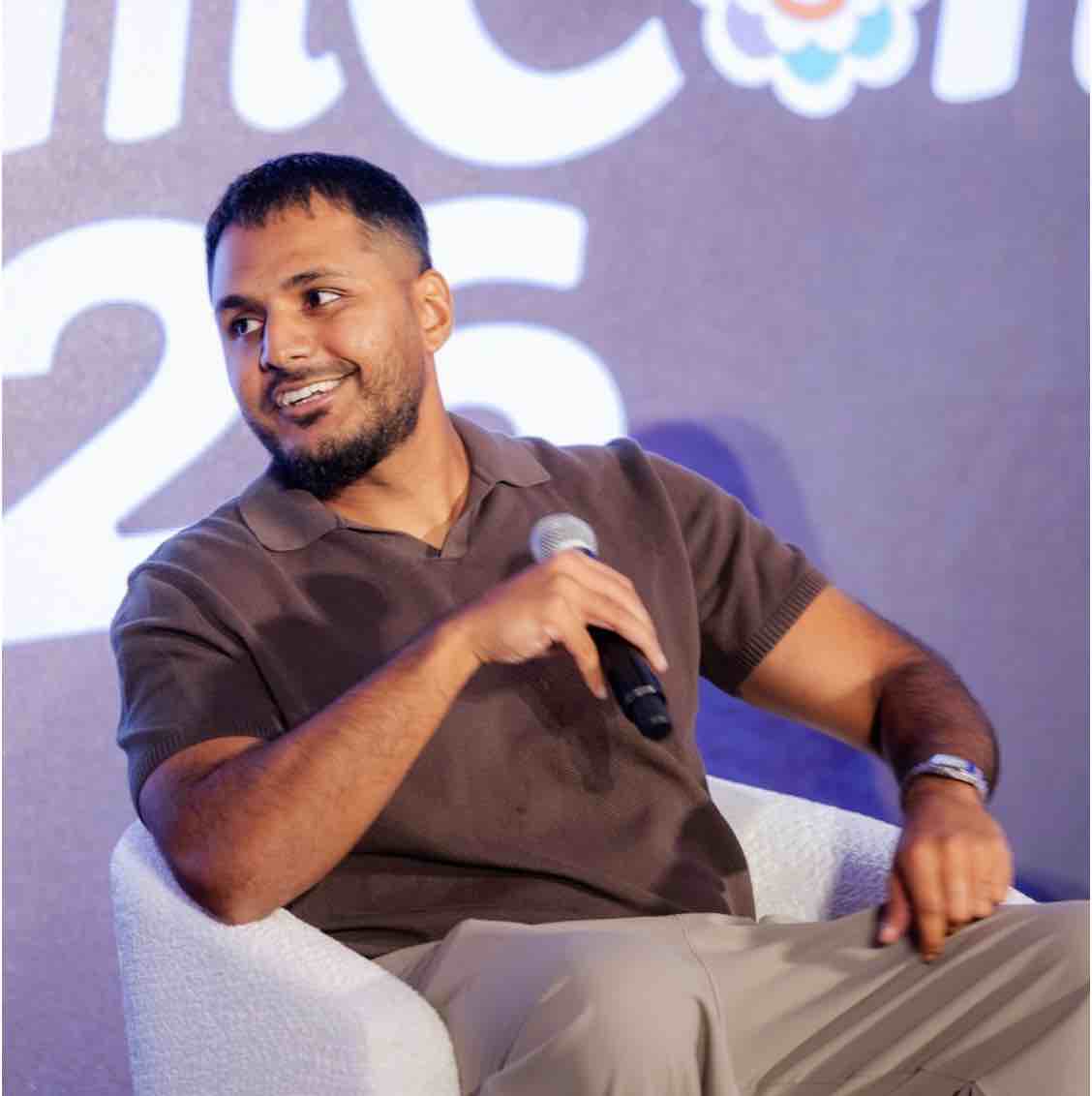

The next AI bottleneck is POWER ⚡️ — and these stocks have recently pulled back.
If you were at blossomcon I’m sure you heard me emphasize how important power , electricity and grid upgrades will be in order for ai and physical ai to move forward. This is one of the reasons why I continue to increase exposure to electrical infrastructure
Power is the next AI bottleneck because chips now arrive faster than electricity, transformers, and grid connections.
Jensen Huang calls electricity “the bottleneck,” not GPUs. Energy sits at the base of AI infrastructure: factories turn electrons into tokens, so revenue is tokens per watt. He expects small nuclear reactors beside data centers and says computing may need ~1,000× more energy as agents run continuously.
Elon Musk says the limiter moved from chips to transformers to generation. The U.S. will soon make more chips than it can power; he cites ~15 GW of 2027 compute sitting idle. China scales solar faster. His fix: on-site turbines now, solar satellites later.
Gavin Baker frames two constraints—watts and wafers. Power shortages slow overbuild and make tokens-per-watt decisive. Watts ease around 2027–28; zoning remains a choke.
Chips take months. Gigawatts take years.
$VST — Generates massive amounts of electricity from nuclear and natural gas. Has 20-year nuclear power deals with AWS and Meta, giving it direct exposure to Big Tech’s growing power needs.
$CEG — America’s largest nuclear operator. Supplies huge amounts of reliable 24/7 electricity, with long-term power deals tied to Microsoft and Meta’s growing data-center needs.
$GEV — Builds the gas turbines and grid equipment needed to create and move electricity. AI data centers need huge amounts of new power generation, making turbines increasingly important.
$VRT — Builds the power and cooling infrastructure inside data centers. Think liquid cooling, power management, UPS systems and increasingly microgrid infrastructure.
$BE— Provides onsite fuel-cell power, allowing data centers to generate electricity closer to where it’s needed instead of waiting years for new grid connections.
$CCO— One of the world’s largest uranium producers. Uranium is the fuel that keeps nuclear reactors running, giving Cameco exposure to rising nuclear power demand.
$ETN — Makes the electrical equipment that gets power into and around the data center — breakers, switchgear, transformers and power-distribution systems.
read more
If you were at blossomcon I’m sure you heard me emphasize how important power , electricity and grid upgrades will be in order for ai and physical ai to move forward. This is one of the reasons why I continue to increase exposure to electrical infrastructure
Power is the next AI bottleneck because chips now arrive faster than electricity, transformers, and grid connections.
Jensen Huang calls electricity “the bottleneck,” not GPUs. Energy sits at the base of AI infrastructure: factories turn electrons into tokens, so revenue is tokens per watt. He expects small nuclear reactors beside data centers and says computing may need ~1,000× more energy as agents run continuously.
Elon Musk says the limiter moved from chips to transformers to generation. The U.S. will soon make more chips than it can power; he cites ~15 GW of 2027 compute sitting idle. China scales solar faster. His fix: on-site turbines now, solar satellites later.
Gavin Baker frames two constraints—watts and wafers. Power shortages slow overbuild and make tokens-per-watt decisive. Watts ease around 2027–28; zoning remains a choke.
Chips take months. Gigawatts take years.
$VST — Generates massive amounts of electricity from nuclear and natural gas. Has 20-year nuclear power deals with AWS and Meta, giving it direct exposure to Big Tech’s growing power needs.
$CEG — America’s largest nuclear operator. Supplies huge amounts of reliable 24/7 electricity, with long-term power deals tied to Microsoft and Meta’s growing data-center needs.
$GEV — Builds the gas turbines and grid equipment needed to create and move electricity. AI data centers need huge amounts of new power generation, making turbines increasingly important.
$VRT — Builds the power and cooling infrastructure inside data centers. Think liquid cooling, power management, UPS systems and increasingly microgrid infrastructure.
$BE— Provides onsite fuel-cell power, allowing data centers to generate electricity closer to where it’s needed instead of waiting years for new grid connections.
$CCO— One of the world’s largest uranium producers. Uranium is the fuel that keeps nuclear reactors running, giving Cameco exposure to rising nuclear power demand.
$ETN — Makes the electrical equipment that gets power into and around the data center — breakers, switchgear, transformers and power-distribution systems.
read more
6,784 views
LULU Why!

0.01% of my portfolio implode! Noooooo!
How will I sleep at night!
This is a testament to the fact that really anything can happen. A balance sheet doesn't tell you where a company is going.
Then the company tells you where it is going, you get a day like this and have to decide if they are just yanking your chain or not.....
In conclusion, telling the future is tough as nails. things like $LULU happeb all the time, and the only way around it is broad diversity.
Holding single stocks isnt just volitile, it is more often then not a losing bet. The saddest part is that you wont even know why till after the fact.
Lulu Lemon doesnt have to recover from here. if it does that will be nice. If it doesn't, that will simply be average.read more
How will I sleep at night!
This is a testament to the fact that really anything can happen. A balance sheet doesn't tell you where a company is going.
Then the company tells you where it is going, you get a day like this and have to decide if they are just yanking your chain or not.....
In conclusion, telling the future is tough as nails. things like $LULU happeb all the time, and the only way around it is broad diversity.
Holding single stocks isnt just volitile, it is more often then not a losing bet. The saddest part is that you wont even know why till after the fact.
Lulu Lemon doesnt have to recover from here. if it does that will be nice. If it doesn't, that will simply be average.read more
2,680 views