Do you know how to “read” a portfolio?
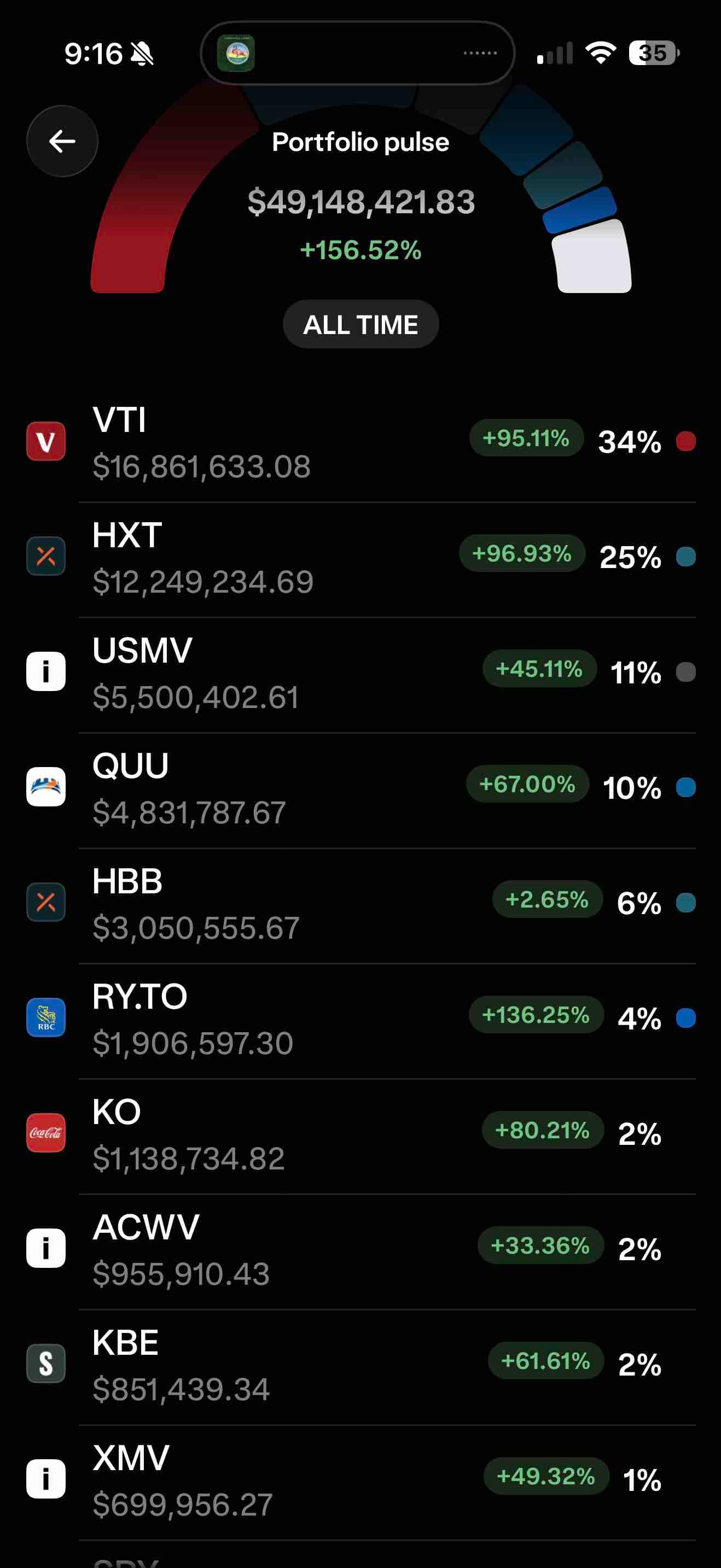
Wealthsimple has a feature called “Portfolio Pulse”whereby you can be that proverbial “fly on the wall” and look into the private portfolios published anonymously. I found this to be a very interesting exercise.
I reviewed the top 100 portfolios but examined in detail the top 10.
#1 is $49,148,421.83
#2 thru 10 range between $15,147,052.02 to $8,767,708.57
As more investors elect to publish their portfolios the more we will get to see, but after looking at the top 100, there is a repeatable common portfolio structure to all of them and I developed a quick method to examining them into categories.
This method you can actually use to examine Blossom portfolios. This is regardless of account type like 401K, RRSP etc. and more about being able to understand the portfolio as a “whole” and how it is “constructed”.
So let’s start.
Core → Satellites → Concentration (Risk Character).
1) Core = the “engine”
Ask: What’s the #1 holding (or top 2–3 combined)?
This tells you what the portfolio is really about and the investor.
Common cores:
- Broad index core (US/global equity ETFs)
- Factor core (quality / low-vol / dividend-tilt style ETFs)
- Theme core (tech/semis/innovation basket)
- Single-name core (one stock dominates)
If you can identify the core in less than 10 seconds, you’re already ahead in portfolio diagnosis.
---
2) Satellites = what it’s “tuning”
Satellites are the positions that sit next to the core and change the risk/return personality.
Typical satellite buckets:
- Growth / Theme tilts (tech, semis, AI, platforms)
- Income / defensive tilts (dividend ETFs, more defensive-style exposures)
- Real assets / REIT sleeve
- Currency/cash proxy (large USD or CAD allocation acting like “liquidity bias”)
- Additional factor overlays (value, momentum, small-cap, etc.)
Key intuition:
Satellites usually explain the “why,” while the core explains the “what.”
---
3) Concentration = the “how risky is this?” reality check
Don’t overthink it—just eyeball concentration:
- Diversified: no single position dominates; many meaningful holdings
- Moderately concentrated: top holdings matter, but it’s not “one bet”
- Highly concentrated: one name (or one theme) is doing most of the work
This matters because two portfolios can both be “growth,” but one is *one big bet* and the other is *a diversified growth tilt.*
---
The 6 portfolio types this creates (simple labels)
Once you’ve identified Core + Satellites + Concentration, you can usually label the portfolio quickly:
1) Index + Tilt
- Broad equity core + a few purposeful overlays.
2) ETF Ladder / Multi-Core
- Multiple big ETFs spanning regions/styles (often US + Canada + international + value/RE).
3) Theme Basket
- A theme is the core and dominates the holding list.
4) Single-Name Conviction
- One stock is the core; the rest are supporting actors.
5) Income / Defensive Overlay
- Dividend/income/defensive exposures are prominent, even if equity-heavy.
6) Core All-Equity (near-passive)
- Mostly one or two broad all-equity ETFs, with minimal satellites.
---
A quick 30-second “portfolio read” checklist
When you open holdings:
1. Circle the core: What’s #1 (and #2/#3 if close)?
2. Label satellites: Are the other big lines income/defensive, theme, real assets, or currency?
3. Check concentration: Is it diversified, moderate, or dominated by one bet?
If you do this consistently, you will start to be able to see the patterns, the portfolios will stop looking like a bunch of tickers, and you start to see them by their architecture, structure, core, shell, diversification, allocation, and risk and then you will see by the daily and annual returns how these portfolios performed against the macroeconomic and market conditions and WHY.
Only then can you call yourself an investor, when you can examine a portfolio and determine its structure, risk and the alignment of its return against the current economic and market backdrop.