🚀 My 25% 'Income' Yield | Never Sell A Share ...
Cool sounds bite. Maybe even great story telling. However, your own money called and it wants some credit 😂
Covered call ETFs and some “income funds” love marketing giant distributions like they discovered a money printing machine that the government can't confiscate.
Finfluencers post screenshots of monthly payouts like they cracked the cheat code to passive income.
There’s a part they never show; the reason they don't show it may vary, however, one thing remains true. It's misinformation/malinformation at its core.
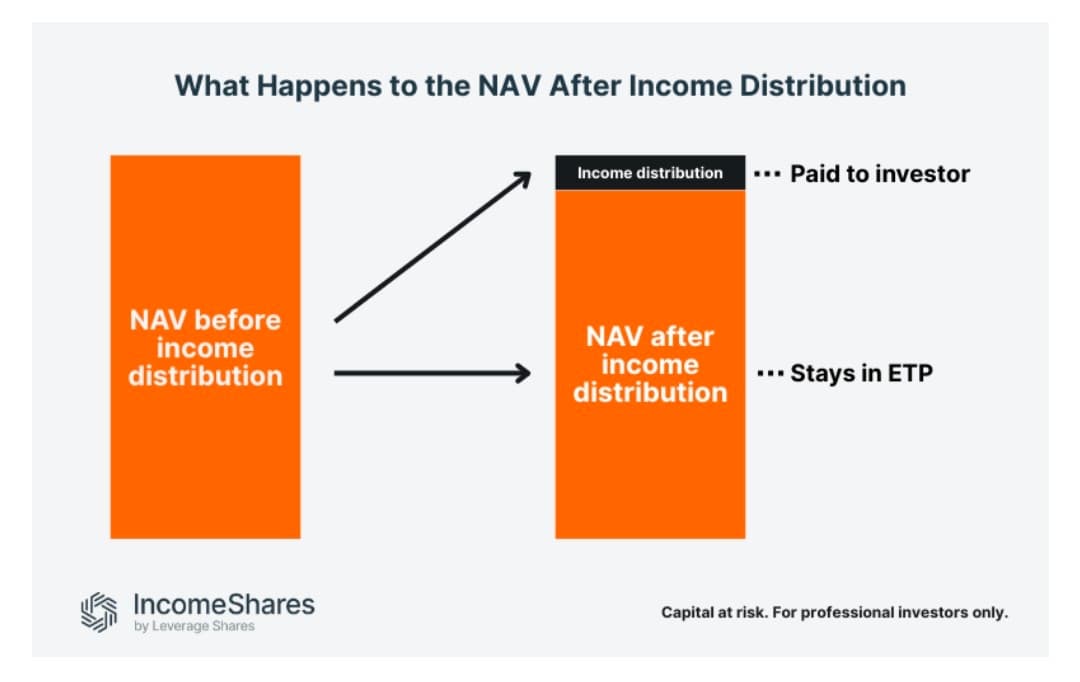
When a covered call ETF pays a distribution, or any ETF/ETP for that matter, the NAV drops by the EXACT same amount. Income shares has a beautiful infographic that shows this (attached to the post).
The “income” didn’t magically appear out of nowhere. It was already inside the fund. And it's been there the entire time, every day of every year.
Think of it like this...
You have a pizza worth $20.
You cut out 2 slices and hand them to yourself.
Congratulations! You now have...
2 slices in your hand ...
and a pizza with 2 less pieces.
You did not create extra pizza slices🍕
That’s how covered call distributions work.
Let's look at an example:
Imagine you own $100,000 of covered call ETFs yielding 25% annually like $hhis or other high yield products.
The finfluencer says something along the lines of...
“Check out my $25,000 a year in passive income!” Or "My 500 paychecks this year!"
Sounds amazing until you ask a few pertinent questions and reality arrives to the video or post.
This is one of the lies of covered call ETF investing.... A distribution isn't a creation of income or wealth. It has told you absolutely nothing about the fund, except that it has a distribution policy. That's it. Nothing more.
Where did the distribution come from?
Was it foreign income, dividend income, capital gains?
Was it from option premiums?
Was it a return of capital?
Is the underlying holdings of the ETFs performing well?
Has the liability of derivatives created more NAV or has it eaten away at the NAV?
I'll give you two scenarios... Tell me if they are different.
Scenario A ... Covered Call ETF with a low yield of 12% on a $100,000 portfolio. $uscl or $hyld are good examples.
ETF pays you $1,000/month.
After a year the ETFs returned 6% .... your account is now around $94,000.
Scenario B ... Holding the exact underlying of the covered call ETF's....
You simply sell about 1% of shares monthly to get your $1000/month. The underlying only returns 6% on the year and you end around... $94,000.
One is labeled “income.” High yield. Never sell.
The other is labeled “selling shares.” Bad. You'll run out of money because of not having any shares/units.
Accounting wise? They are nearly identical.
That's the math. That's the truth any professional will show you.
Many high-yield covered call products are just... TRYING to convert volatility into cash flow ... But it doesn't always work that way. Many funds take negative risk adjusted returns or worse yet, lose money on the covered call trades.
What they do very effectively (and deceive many DIY investors) is repackage your total return as “income" via distributions.
It's the same $20 pizza... Same number of slices.
That’s not free yield... Free extra two pieces.
That’s financial cosmetics, financial lipstick on a product.
So be weary of a favourite finfluencer trick
Show monthly cash distributions ... That's all that matters to get you hooked.
...Never show total returns compared to the underlying. Total returns after years of investing.
Never mention inflation adjusted NAV erosion from distributing more than a funds total return..
Never explain opportunity cost for selling ATM or nearly ATM calls or receiving distributions that need to be reinvested.
Never show total amount invested and where they would be without the 25% distribution.
Never share the volatility of a high-risk products.
Never show the industry breakdown of a portfolio.
Never show how a company they own with a covered call wrapper is doing fundamentally.
If a fund pays 25%, but underperforms the benchmark by 2%, will only return 8% over decades... you didn’t win. You lost about 50% of your total return in the name of a distribution.
You just got your returns handed to you in a psychologically satisfying format. I personally don't like mind tricks, especially not doing the trick to myself.
Most covered call ETF investors don’t need high yield distributions at all... They are reinvesting it away... Creating a period where they go to cash for 7 days or so, then reinvest... why go cash to reinvest at higher prices 70% of the time?
What they need is... The same as every other investor in the accumulation and decumulation phase.
• Total returns that achieve their financial goals
• A sustainable drawdown plan if in retirement
• Portfolio construction based on their risk profile, not 'yield'.
If there's anything to take away from this post , it's this...
A withdrawal is not magically better because a finfluencer labeled it as income. A distribution is just a withdrawal from a fund.
That's it.