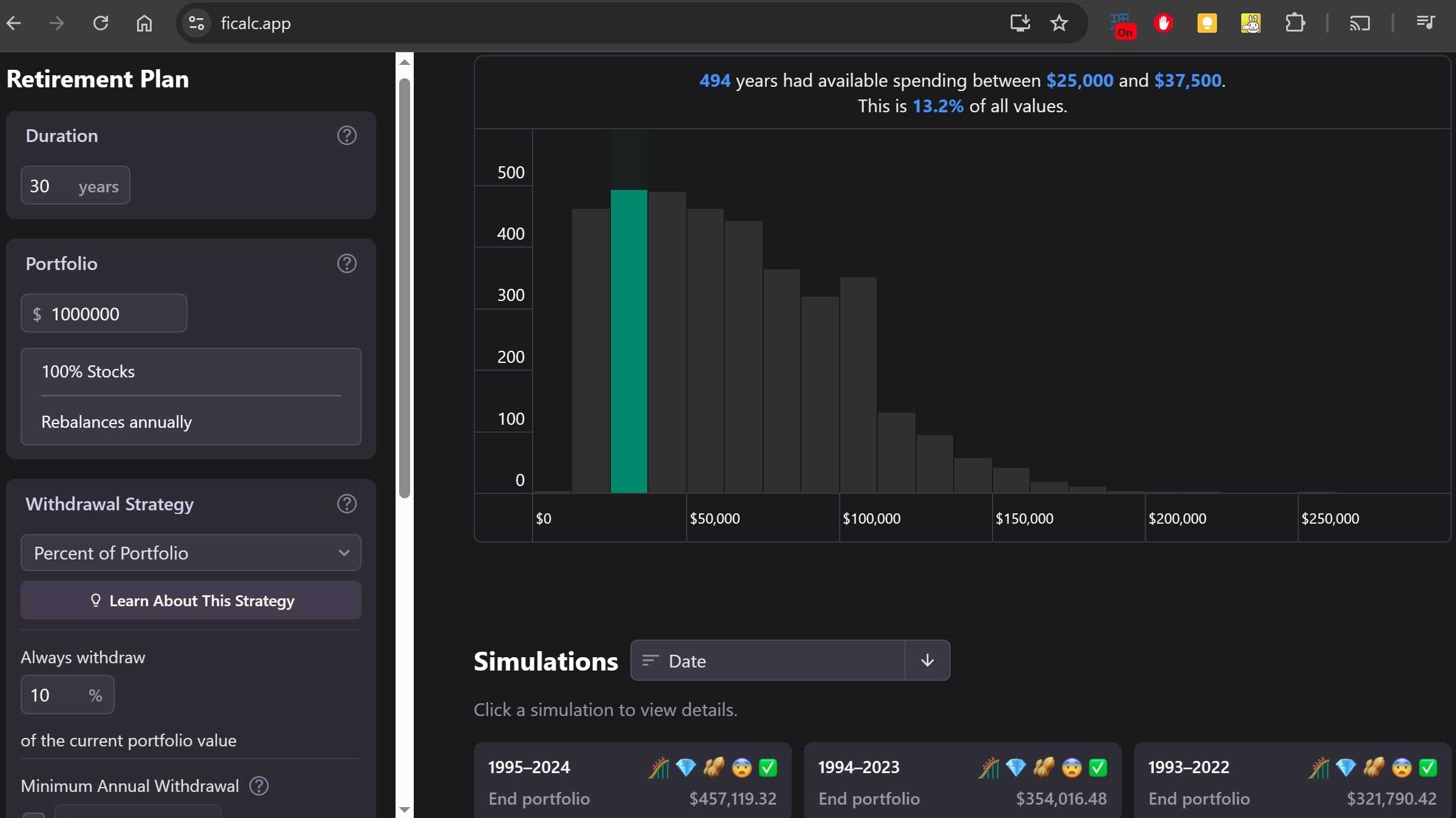
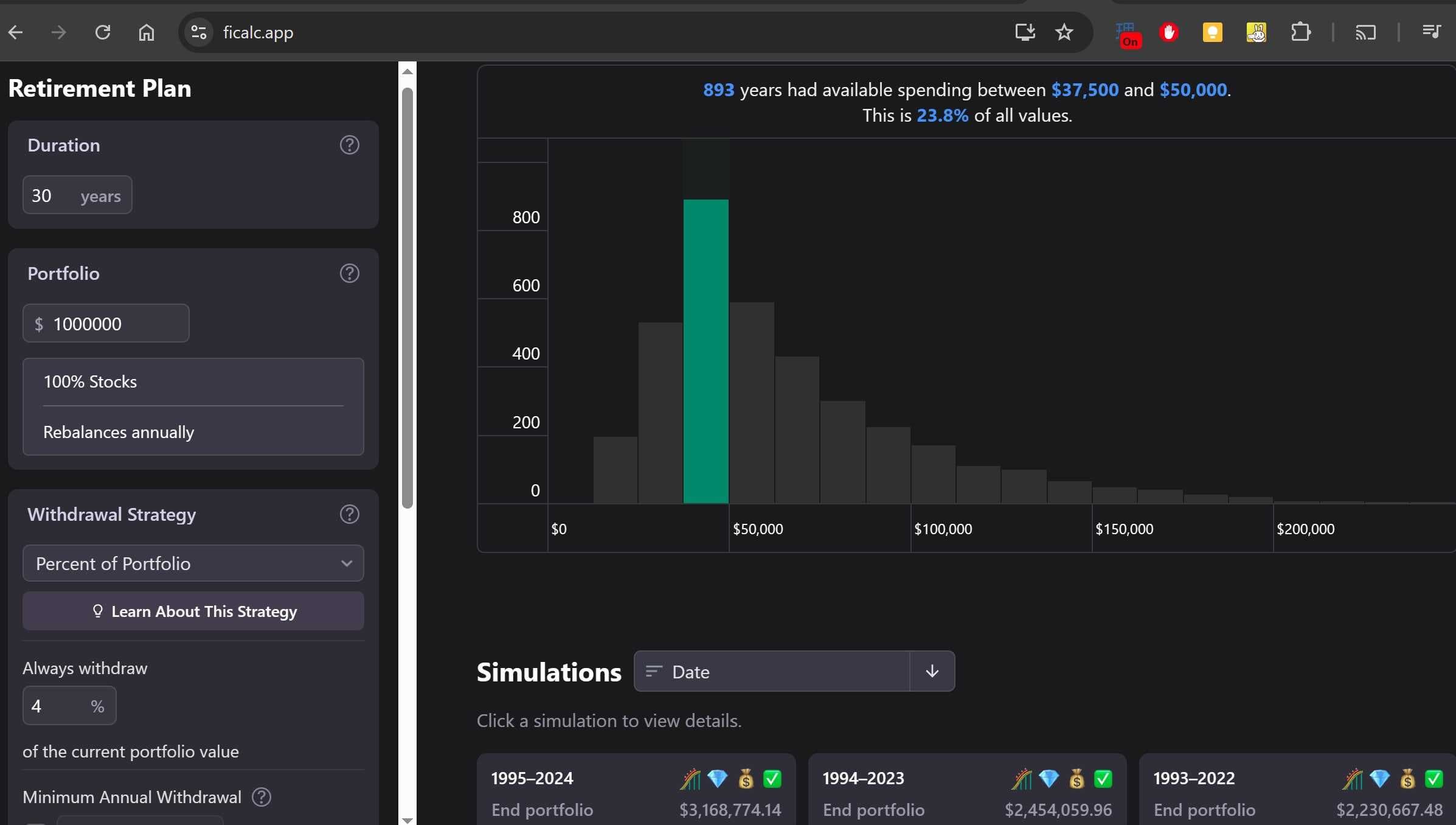
Many investors use 10% as the long-term performance benchmark of $SPY . In theory, one can sell 10% of a $1M SPY portfolio and generate $100K/year indefinitely. In reality, annual performance changes from one year to the next. When your share count is reduced, the ability to ride the bull market is reduced. Even if the share count is held constant, a 11.1% rally is needed to recover from a 10% downturn. The ability to generate cash flow is also reduced with fewer shares. If you run a 10% withdrawal simulation with historical data on https://ficalc.app/, you will find minimum wage level withdrawals for the majority of calendar years. Ironically, a 4% withdrawal simulation yields a better statistical outcome. Either way, selling shares only to generate cash flow is not the winning formula. edit 1: CRA sends its thank you if you run 4% in your RRIF. See end portfolio balances at bottom.
8,964 views
83 Comments
Levi Ewald@smallbird.financial · 9mo
This entire post is fundamentally flawed because it's built on a massive strawman to draw a dangerously incorrect conclusion. You’re right that a 10% withdrawal rate fails, but no credible financial planner or researcher "theorizes" this is safe. You're simply re-describing sequence of returns risk, the very problem that retirement research, like the 4% rule you "ironically" noted works better, was designed to solve from the start. The most damaging part of your post is the conclusion that "selling shares... is not the winning formula." This implies the method of withdrawal is the problem, when in reality the rate (10%) is the problem. This basic misunderstanding leads investors down a much worse path in a search for "income." It makes no difference to your total wealth whether you get cash by selling a share or by receiving a dividend. When a company pays a $1 dividend, its stock price drops by $1, leaving your net worth identical. A 10% dividend yield is just as unsustainable as a 10% share-selling withdrawal. It's not "free" money; it's just a different way of taking capital from your own portfolio, often with worse tax consequences and less diversification. This flawed "income" preference is the exact sales pitch for high-yield traps like Covered Call (CC) ETFs. The irony is that you worry about not being able to "ride the bull market," yet these products guarantee you can't. They generate "yield" by selling call options, which sells away all the upside potential. They capture 100% of the market's downside but are permanently capped during the recovery rallies. This makes them far worse. They accelerate the very failure you're trying to avoid by systematically destroying the one thing a portfolio needs to survive: the ability to recover from downturns. The winning formula isn't avoiding selling shares; it's combining a total return approach with a sustainable withdrawal rate.
Mr Financial@mr.financial · 9moEdited
Why do you think a 10% withdrawal rate is reasonable is beyond me. You really need to read about safe withdrawal rates and sequence of return risk. Morning star, s&p, MSCI all have free information on it. Try withdrawing 10% of an equivalent cc S&P500 fund... Say xyld vs spy. The result is you run out of money even FASTER.
The Investing Sorcerer @theinvestingsorcerer · 9mo
Covered call investors propaganda.
Perry's PIIverse@piiverse · 9mo
Yes... at the end of the day... when you are retired and your portfolio IS YOUR ONLY INCOME SOURCE... and if you hold pretty much all growth portfolio... like you said... assume one that follows the S&P... and yes its avg annual nav growth is 10%... Even if it goes up 10% / year... excluding the small portion you get from dividends to contributeto the $100k each year, the rest has to come from selling shares and melting down the portfolio wealth. Each year. (We are excluding the strategy of generating income from your portfolio by selling options... as that would be a total hypocrisy since then you might as well buy cc etfs!) So this is exactly what my last video showed when I added the "NET HOLDING ROI".... sure.. the remaing shares you have will go up another 10% ... but then the cycle repeats and you lose more shares... the logic that the S&P keeps going up 10% so i will never run out of nav to pay the $100k a year to live on... IS TOTALLY WRONG. All it means when you are down to your portfolio having 1 share left... its per share ROI might be like 1500% ... but its only 1 share. You have eroded / melted down all the wealth in your portfolio. So... if you want to follow a growth portfolio.... you better have millions to fund your retirement using brute force income capitalization.
See the full comment section 👀Sign up for the full Blossom experience!