The $25 Rule - This One Surprised Me
The $25 Rule: What a Guaranteed $1 of Pension Income Is Really Worth
Imagine two retirees.
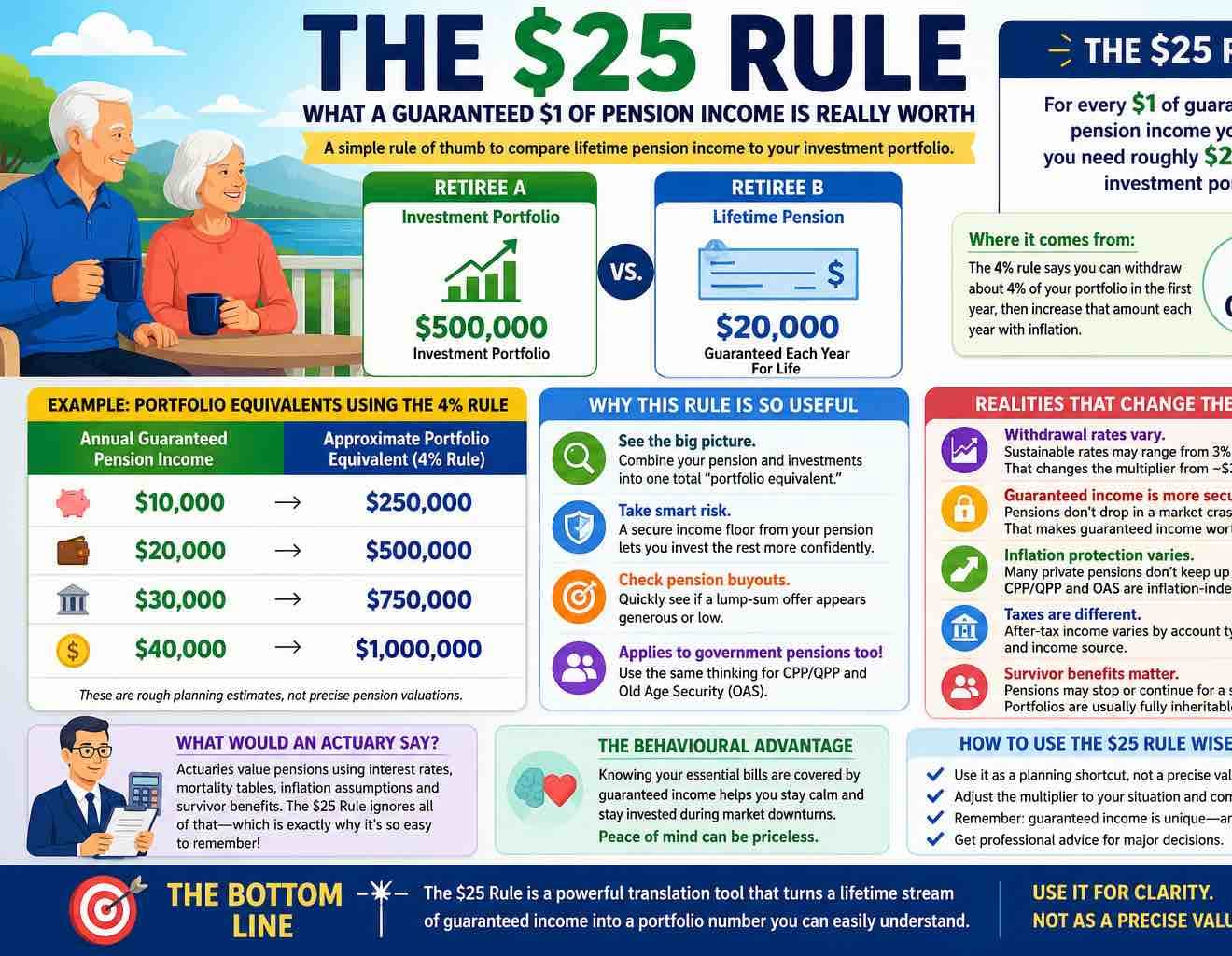
One has a $500,000 investment portfolio.
The other receives a guaranteed lifetime pension of $20,000 per year.
At first glance, they seem difficult to compare. One owns a pool of investments, while the other receives a monthly cheque for life.
Yet a surprisingly simple rule of thumb suggests they may provide roughly the same level of retirement income.
It’s known as the $25 Rule.
If you’ve spent any time around retirement planning forums, you’ve probably seen it:
For every $1 of guaranteed annual pension income you receive, you need roughly $25 less in your investment portfolio.
It sounds almost too neat to be true. And in some ways, it is. But the logic behind it is sound enough to make it a genuinely useful planning tool—as long as you understand where it comes from and where its limitations begin.
⸻
Where the Number Comes From
The $25 figure isn’t arbitrary. It’s the mathematical inverse of the well-known 4% rule, a retirement withdrawal guideline popularized by financial planner Bill Bengen in the 1990s.
The rule suggests that a retiree could historically withdraw about 4% of their portfolio during the first year of retirement, then increase that dollar amount each year with inflation, while having a high probability of their savings lasting for a 30-year retirement.
The math is simple:
If 4% of a portfolio produces $1 of annual income, then producing $1 requires approximately $25 of investments.
$1 ÷ 0.04 = $25
Using that shortcut, a pension paying $20,000 per year is roughly equivalent to having a $500,000 investment portfolio generating sustainable retirement income.
This isn’t an actuarial valuation of the pension—it’s simply a convenient way to compare two very different sources of retirement income.
⸻
Why This Shortcut Is So Useful
For quick retirement planning, the $25 Rule solves a real problem.
Pensions pay guaranteed income for life.
Investment portfolios are pools of assets that must be managed and gradually spent.
The rule translates both into a common language.
It can help you:
* See your complete retirement picture. Instead of viewing your pension and investments as unrelated, you can estimate a combined “portfolio equivalent.”
* Decide how much investment risk to take. Someone whose essential living expenses are largely covered by guaranteed pension income can often afford to invest the remainder of their portfolio more aggressively because they already have a secure income floor.
* Evaluate pension buyout offers. While it shouldn’t replace professional advice, the rule provides a quick reality check on whether a lump-sum offer appears generous or surprisingly low.
⸻
A Quick Example
Using the 4% framework:
Annual Guaranteed Pension Approximate Portfolio Equivalent
$10,000 $250,000
$20,000 $500,000
$30,000 $750,000
$40,000 $1,000,000
Again, these are rough planning estimates, not precise pension valuations.
⸻
Where the Math Starts to Break Down
Despite its usefulness, treating every dollar of pension income as exactly equal to $25 of investments overlooks several important realities.
The 4% Rule Isn’t a Law of Nature
The 4% rule is based on historical market data—not a guarantee of future outcomes.
Many researchers today suggest sustainable withdrawal rates may range anywhere from 3% to 5%, depending on retirement length, investment fees, future returns and personal circumstances.
That changes the math considerably.
* At 3%, $1 of annual income requires about $33 of investments.
* At 3.5%, it requires about $29.
* At 5%, it requires only $20.
The “right” multiplier depends on your assumptions.
Guaranteed Income Is Different From Market Income
A pension continues paying whether markets are booming or crashing.
A portfolio doesn’t.
Retirees relying on investments face sequence-of-returns risk, where poor market performance early in retirement can permanently reduce how much income their portfolio can safely provide.
Because of this, many financial planners argue that a dollar of guaranteed lifetime income is actually worth more than an equivalent dollar of portfolio withdrawals.
Inflation Matters
The traditional 4% rule assumes withdrawals increase with inflation every year.
Many private pensions do not.
If your pension payments remain fixed for decades, inflation steadily reduces their purchasing power.
By contrast, government pensions like CPP/QPP and Old Age Security include inflation adjustments, making them more valuable than many private pensions over long retirements.
Taxes Matter
Pension income, RRSP/RRIF withdrawals, TFSA withdrawals and taxable investment income are often taxed differently.
Two retirees receiving the same pre-tax income may end up with different amounts left to spend.
Survivor Benefits Matter
Some pensions stop when you die.
Others continue partially—or fully—to a surviving spouse.
Investment portfolios, meanwhile, generally become part of your estate.
Those differences can significantly affect the true economic value of a pension.
⸻
The Behavioural Advantage
One benefit that’s difficult to measure is peace of mind.
Retirees whose essential expenses are covered by guaranteed income often find it much easier to stay invested during bear markets.
Instead of worrying about selling investments after a large market decline, they can allow their portfolios time to recover.
That emotional stability can improve long-term investing outcomes just as much as mathematics.
⸻
How to Use the Rule Wisely
The $25 Rule works best as a conversation starter—not the final answer.
A few practical guidelines:
1. Use it as a planning shortcut. It’s excellent for estimating whether your retirement picture is generally on track.
2. Adjust the multiplier when appropriate. If you’re retiring very early or prefer a more conservative withdrawal rate, using a multiplier closer to 28–33 may be more appropriate.
3. Remember that guaranteed income is unique. A pension isn’t just another investment—it’s insurance against living longer than expected and against poor market returns.
4. Seek professional advice for major decisions. Pension buyouts and retirement timing deserve a detailed analysis using actuarial assumptions, taxes, inflation and your personal circumstances.
⸻
The Bottom Line
The idea that every $1 of guaranteed annual pension income replaces roughly $25 of investment savings is one of the most useful mental shortcuts in retirement planning.
It provides a simple way to compare lifetime income with investment portfolios and helps put pensions into terms most investors immediately understand.
Just remember that it’s a translation tool, not a valuation tool.
The true value of a pension depends on inflation protection, taxes, survivor benefits, longevity and market conditions.
Used appropriately, though, the $25 Rule remains one of the quickest and most practical ways to understand the real contribution guaranteed income makes to your retirement security.
Think Saskatchewan Pension Plan, available to all Canadians or partial annuitization of your RRSPs as a sleep-well-at-night fund, no market risk. Let CPP act as the bond which is indexed for inflation and your TFSA’s as inflationary protection. If you want to stay in your home, apply for the provincial deferral of property tax programs, where the province pays your property taxes.
** I am heavily invested in Saskatchewan Pension Plan, interesting fact, I now get a pension tax credit for buying it at 55. Second interesting fact, I won’t touch it until 71, as it converts to an annuity the whole amount is converted, there is no RRIF mandatory tax, I just pay income taxes on annual basis on what it pays me.