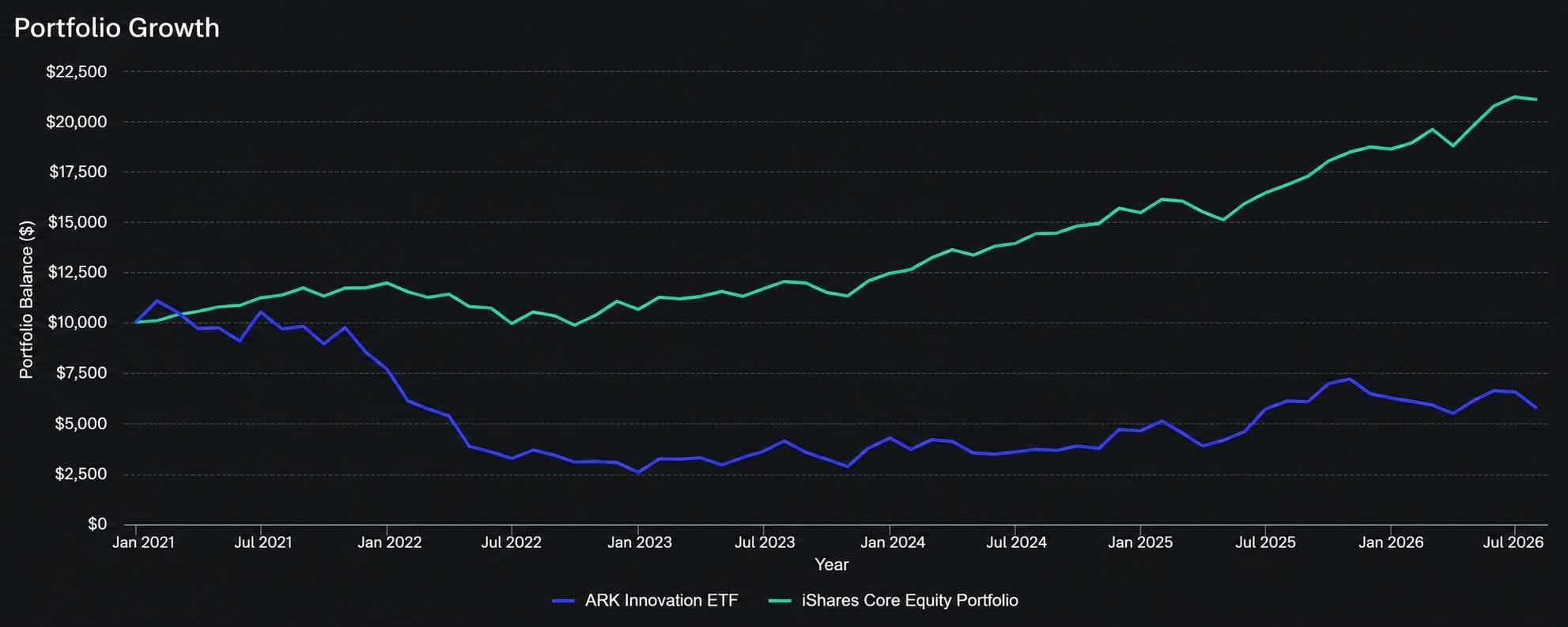
Yesterday’s Winner Doesn’t Start Ahead
One way to make comparisons with outperformers fairer is to start tracking them from the moment they actually get your attention.
If you have thousands of investors, fund managers and strategies all doing different things, some are inevitably going to produce incredible historical returns. Some may be genuinely skilled. Some may have benefited from a particular market environment. Some may simply have gotten very lucky.
The problem is that we usually notice them because they already won.
Cathie Wood is a good personal example. ARKK returned roughly 35% in 2019 and 152% in 2020. That meteoric rise put her on basically everyone's radar, including mine, since I had just started investing around that time.
My sister actually bought ARKK after that run.
She eventually regretted that decision.
At the time, Cathie Wood was being treated by many people as a visionary. Today, she is a much more polarizing figure, and some of her extremely bullish predictions are openly mocked. That change in perception is part of what makes the example so interesting.
And that's why I think the fairer measurement starts there. Not because ARKK's earlier returns don't count, but because those returns were already known. They were part of what made people interested in Cathie Wood in the first place.
What happened after you identified the supposed outperformer?
Even then, there's an important caveat: you still need a huge amount of data before you can confidently say someone is a persistent market beater. A few more years of outperformance could still be luck, factor exposure, concentration, or simply a favourable market environment.
At the end of the day, past outperformance is impressive, but when it comes to your decision today, it's almost like starting a new game. The old points don't carry over.
You don't get to earn yesterday's returns. You're choosing between the opportunities in front of you based on which one you think offers the best expected outcome for the risks you're willing to take.
One thing I find really cool about being a content creator is that it gives you a timestamped record of what you actually believed at the time. We can talk about products, managers and strategies while they're at peak hype, then come back 5 or 10 years later and see how those opinions held up.
To me, that's a much more interesting test than looking backward, finding the winner, and then explaining why they were obviously the winner.