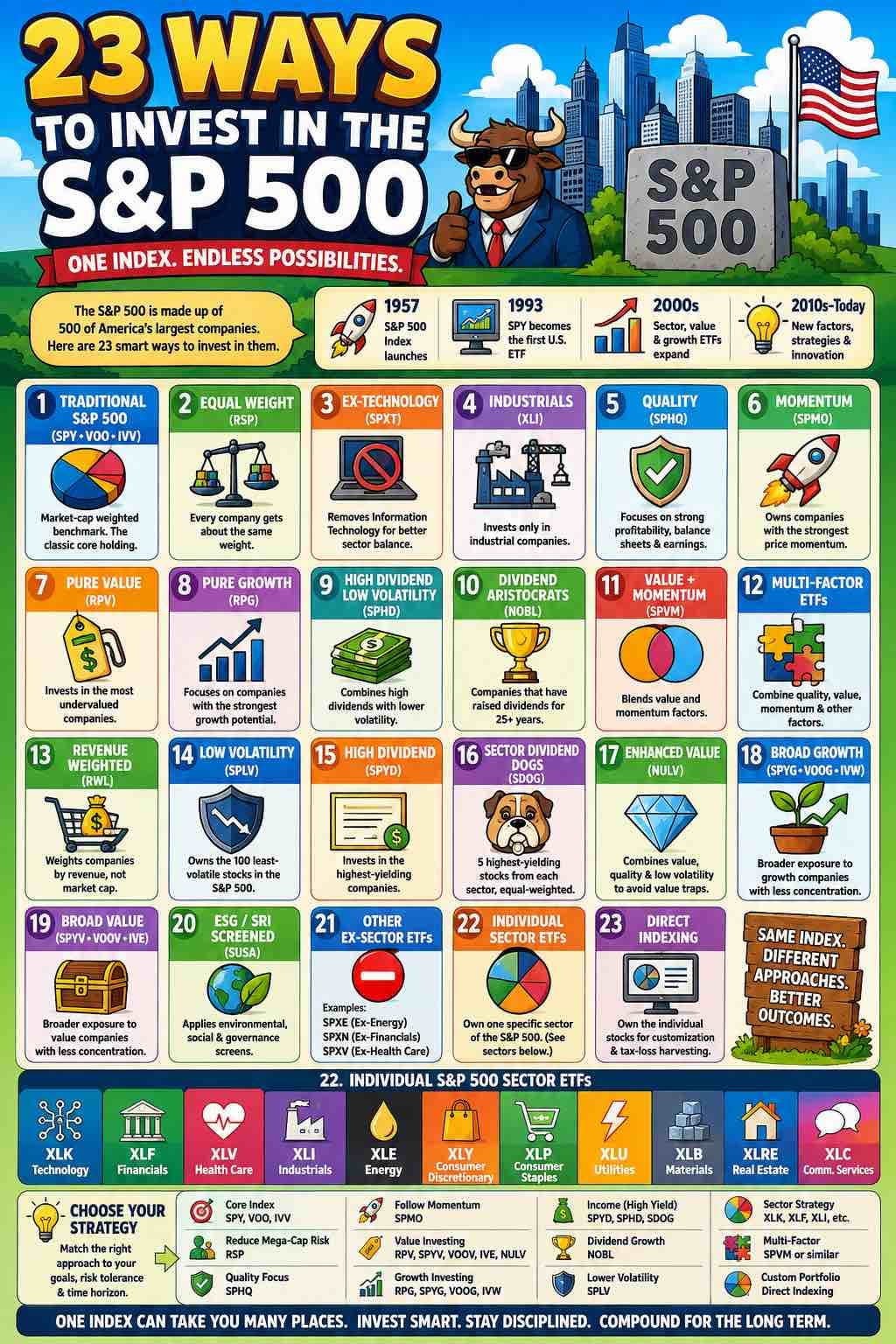
*There are often more that 500 companies. **This article does not purport to be a complete list and does not include leverage, coveralls or mutual fund versions. Beyond the S&P 500: 23 Major Ways to Invest in America’s Largest Companies When most investors think of the U.S. stock market, they think of the S&P 500—approximately 500 of America’s largest publicly traded companies. What many don’t realize is there are dozens of ways to invest in the same universe of companies. Different ETFs apply different weighting methods, factor screens and investment philosophies, creating portfolios that can behave very differently over time. A Brief History * 1957: The S&P 500 Index launches. * 1993: SPY becomes the first U.S.-listed ETF. * 2000s: Sector, value and growth ETFs become widely available. * 2010s: Quality, momentum and low-volatility investing become mainstream. * Today: Investors can choose from dozens of S&P 500 strategies tailored to different goals and risk tolerances. ⸻ 1. Traditional S&P 500 ($SPY • $VOO • $IVV) How it differs: The benchmark index. Companies are weighted by market capitalization, so the largest companies have the biggest impact on returns. Best for: Most long-term investors. ⸻ 2. Equal Weight ($RSP) How it differs: Every company starts with approximately the same weighting instead of allowing the largest companies to dominate. Best for: Investors wanting broader market participation and less mega-cap concentration. ⸻ 3. Ex-Information Technology ($SPXT) How it differs: Removes companies in the Information Technology sector while leaving the rest of the S&P 500 intact. Best for: Investors already heavy in technology. ⸻ 4. Industrials ($XLI) How it differs: Owns only the industrial companies in the S&P 500. Best for: Investors bullish on infrastructure, manufacturing, aerospace and defence. ⸻ 5. Quality ($SPHQ) How it differs: Screens for companies with stronger profitability, healthier balance sheets and higher-quality earnings. Best for: Long-term compounders seeking financially strong businesses. ⸻ 6. Momentum ($SPMO) How it differs: Owns companies with the strongest recent price momentum. Unlike growth ETFs, holdings change as market leadership changes. Best for: Growth-oriented investors comfortable following market trends. ⸻ 7. Pure Value ($RPV) How it differs: Concentrates on the cheapest companies in the S&P 500 using traditional valuation measures. Best for: Contrarian value investors. ⸻ 8. Pure Growth ($RPG) How it differs: Focuses on companies with the strongest growth characteristics, making it more concentrated than traditional growth ETFs. Best for: Aggressive growth investors. ⸻ 9. High Dividend Low Volatility ($SPHD) How it differs: Combines above-average dividend yields with lower historical volatility. Best for: Conservative income investors. ⸻ 10. Dividend Aristocrats ($NOBL) How it differs: Owns companies that have increased their dividends for at least 25 consecutive years. Best for: Dividend-growth investors. ⸻ 11. Value + Momentum ($SPVM) How it differs: Blends two proven investment factors by combining attractive valuations with positive price momentum. Best for: Investors seeking multiple factor exposure. ⸻ 12. Multi-Factor ETFs $QVML$QVMT How they differ: Combine several factors—typically quality, value, momentum and sometimes low volatility—into one portfolio. Best for: Investors wanting diversified factor exposure. ⸻ 13. Revenue Weighted ($RWL) How it differs: Weights companies by annual revenue instead of market capitalization. Best for: Fundamental investors. ⸻ 14. Low Volatility ($SPLV) How it differs: Owns the 100 least-volatile stocks in the S&P 500. Best for: Defensive investors and those seeking a smoother ride. ⸻ 15. High Dividend ($SPYD) How it differs: Selects the highest-yielding companies in the S&P 500. Best for: Investors focused on maximizing current income. ⸻ 16. Sector Dividend Dogs ($SDOG) How it differs: Owns the five highest-yielding stocks from each S&P 500 sector and equal-weights them, creating balanced sector exposure. Best for: Income investors who also want diversification across sectors. ⸻ 17. Enhanced Value ($NULV) How it differs: Combines value with quality and lower-volatility screens, attempting to avoid classic value traps. Best for: Long-term value investors seeking a smoother experience. ⸻ 18. Broad Growth ($SPYG • $VOOG • $IVW) How it differs: Tracks the growth half of the S&P 500. Unlike RPG, these ETFs are broader and more diversified. Best for: Core growth exposure. ⸻ 19. Broad Value ($SPYV • $VOOV • $IVE) How it differs: Tracks the value half of the S&P 500. Unlike RPV, these ETFs provide broader diversification. Best for: Core value exposure. ⸻ 20. $ESG / SRI ($SUSA) How it differs: Applies environmental, social and governance screens while maintaining broad large-cap exposure. Best for: Values-based investing. ⸻ 21. Ex-Sector ETFs How they differ: Remove a specific sector while leaving the remainder of the S&P 500 intact. Examples: $SPXT (Ex-Technology), $SPXE (Ex-Energy), $SPXN(Ex-Financials), $SPXV (Ex-Health Care). ⸻ 22. Sector ETFs ($XLK, $XLF, $XLV, $XLI, $XLE, $XLY, $XLP, $XLU, $XLB, $XLRE, $XLC) How they differ: Each ETF owns only one S&P 500 sector. Best for: Investors making tactical sector allocations. ⸻ 23. Direct Indexing How it differs: Instead of buying an ETF, investors own the individual stocks, allowing customization and tax-loss harvesting. Best for: Larger taxable portfolios. ⸻ Which Strategy Fits You? Goal Consider Traditional index SPY, VOO, IVV Equal weighting RSP Quality SPHQ Momentum SPMO Value RPV, SPYV, VOOV, IVE, NULV Growth RPG, SPYG, VOOG, IVW Dividend income SPYD, SPHD, SDOG Dividend growth NOBL Lower volatility SPLV Ex-technology SPXT Sector investing XLK, XLI, XLF and other Sector SPDR ETFs Multi-factor SPVM or similar ETFs Revenue weighting RWL ESG investing SUSA Custom portfolio Direct Indexing Final Thoughts Warren Buffett has often recommended that most investors simply own a low-cost S&P 500 index fund. Today’s ETF landscape doesn’t replace that advice—it expands on it. Whether you prioritize quality, momentum, value, dividends, lower volatility, ESG principles or sector specialization, there is likely an S&P 500 strategy that aligns with your goals. The biggest takeaway is simple: many of these ETFs begin with the same universe of companies. The difference is how they select and weight those companies—and that can lead to very different investing experiences and long-term results. Final thought. I own SPMO, NOBL interests me except for the MER fee; and, I think SDOG 🐕 sounds cool 😎 as hell.
2,506 views
1 Comments
Susan @sm0007 · 7h
This is great info! Thank you for putting it together 👍🌸
Join the conversation with 500,000+ other investors 💸
Create an account to get access to everything Blossom has to offer!
📊 Personalized algorithm based on your investing style, experience level and interests
📈 Powerful portfolio and dividend tracking tools
👀 See what top creators and others in the community are investing in