Boston Scientific is back up and running after its cyberattack but investors still don’t know the full financial cost. The stock has been hit, uncertainty remains high, and now the real question is whether the market is pricing in too much damage or not enough. 👀 We broke down the recovery, valuation, competitive risks, and what investors should be watching next. 👉 Open the full TPC breakdown and see what could determine BSX’s next move. https://smartmoneymadesimple.substack.com/p/boston-scientific-after-the-cyberattack?r=5t0c4h
A few days ago I was on the back nine with a close friend of mine. He's getting married soon, life is moving fast, and somewhere between holes he brought up investing. He told me he'd finally hit a milestone — his HYSA had crossed a full year of expenses. Acting as an emergency fund. Now he wanted to know what to actually do with the money he was saving on top of that. He'd been sitting on it in a normal savings account, watching interest rates do the minimal work, but he knew deep down that wasn't a long-term strategy. He wanted his money to actually grow. So I told him to stop thinking about picking stocks and start thinking about building a foundation first. Here's roughly what I laid out for him: ~60% into $VOO. This is the core. The S&P 500, low cost, and over long enough time horizons it's done the heavy lifting for most investors. You're not trying to be clever here but you're buying a piece of the entire U.S. large cap market and letting compounding do its thing. 15–25% into $SCHD. This is where the snowball starts to form. $SCHD is a dividend ETF that holds high-quality U.S. companies with strong cash flows and a history of growing their dividends. The play here isn't just the yield it's the snowball. Even buying one share a week, those dividends start reinvesting, which buys more shares, which pays more dividends. It's slow at first and then it isn't. My friend genuinely didn't realize how powerful that compounding loop becomes over a 10–15 year window, especially because he's only 24 years old! The rest into $VT or $IWM. This is where you get either global diversification (VT covers the entire world market, not just the U.S.) or small cap exposure through IWM. We talked about VT specifically as a hedge — with rate hikes still in play and AI volatility creating some uncertainty in U.S. growth names, having exposure to international markets gives you a buffer if domestic equities go sideways for a period. His biggest concern was missing out. He'd heard stories about people loading up on single stocks and making life-changing returns and didn't want to be the guy who just "bought index funds." I had to break that fear down a little. The truth is most people who go all-in on individual stocks without a foundation underneath them end up giving back the gains or holding through drawdowns they weren't prepared for emotionally. The foundation isn't what limits your upside — it's what keeps you in the game long enough for the upside to arrive. Once his core is built and he understands how his portfolio moves, there's nothing stopping him from putting a smaller portion into individual names he believes in. But you build the floor before you start going for the ceiling. Everyones situations are different and that's why I would like to hear from some of you on what your "foundation" in your portfolio is. How are you allocating your capital? The breakdown if you want to steal the framework: ✅ Emergency fund first — at least 6–12 months of expenses in your HYSA before investing a dollar 📈 VOO (~60%) — broad market core, set it and forget it 💰 SCHD (15–25%) — dividend compounder, reinvest everything, let the snowball build 🌍 VT or IWM (remainder) — global hedge or small cap exposure depending on your outlookread more
Does Future Potential Growth Justify Outrageous Price to Sales of 70? $SPCX There are three enormous growth drivers at SpaceX. 1) Starlink costs are far lower that traditional telecom and should come to dominate the industry 2) Datacenters in space supposedly will be 1/5 the cost of earth and could great enormous growth. 3) SpaceX Launch business supposedly is on the cusp of lowering the cost per kilo to space by a factor of 10 with starship All of the above coming true could mean 10-20x more revenue for SpaceX in my opinion. What if the price to sales of SpaceX as it matures is more around 20.... That would leave enormous upside for investors. Still, investing in SpaceX violates my personal principles. 1) Don't invest in P/S above 50 ever! 2) Don't buy unprofitable companies So I am still pondering what to do, because I do like the SpaceX company. Overpriced or worth investing? I don't know. https://youtu.be/R3qAEqKibZA?si=4F_3lTX8JgIJKmRHread more
The group of 5 last night at Rockaberry's! Trying to push the message that you're never too young to start building wealth! 💰 Most of the attendees so far have actually not been from Blossom. See the link in my bio to join the group and possibly attend the next meetup! Looking forward to meeting you.😀
I hold Xeqt in our kids resp our rrsp and in tsfa . It’s easier to use and maintain however I’ve been debating changing the rrsp to a different etf. What do you hold for ETFs ?
I get asked ALOT how I’ve been able to grow my investments over the years, and the funny thing is there really wasn’t one secret. No crazy 10x investment. No perfect strategy. A lot of it was just consistently doing a few things right (and making plenty of mistakes along the way 😭). If I had to start from $0 again, here’s exactly what I’d focus on: 1. Focus on making money first 💰 This is probably the biggest one. When your portfolio is $5,000, obsessing over whether you’ll make 8% or 10% isn’t going to make nearly as much of a difference as finding a way to invest another $5,000. Work more hours. Learn a valuable skill. Start something on the side. Ask for the raise. Early on, I’d spend WAY more energy increasing my income than trying to become the world’s greatest stock picker. 2. Invest before you spend Every time I got paid, I tried to think of investing as an expense rather than something I’d do with whatever was left over. Paycheque comes in → money gets invested → then I figure out the rest. You can even automate it so you never have to think about it. 3. Don’t make investing more complicated than it needs to be I definitely learned this one the hard way. 5. Increase your contributions whenever you can Your first contribution might be $50. Then $100. Then $500. The number isn’t really the point. Every time my income increased, I tried to increase the amount I was putting away too. At the beginning, those contributions are doing most of the heavy lifting. Eventually, compounding starts helping you out. 6. Stop trying to get rich overnight Some of my worst investing decisions came from wanting things to happen faster. FOMO, chasing returns, buying something because everyone was talking about it… The irony is that trying to shortcut the process can end up setting you back. I’d rather build wealth slowly than constantly restart because I blew myself up trying to get there quickly. 7. Surround yourself with people who talk about money This is something I appreciate even more now that I work at Blossom. Talk to people about investing. Share ideas. Ask questions. Have people challenge your thinking. You shouldn’t blindly follow anyone else’s investments, but being around people who care about building wealth can completely change how you think about your own money. 8. Track the milestones $1K → $5K → $10K → $25K → $50K → $100K. Don’t spend the entire journey staring at $100K and feeling behind. Your first $10K is a big deal. So is your first $25K. Celebrate the progress and keep going. The biggest thing I’d tell anyone working toward their first $100K is that there probably isn’t going to be one moment that gets you there. It’s thousands of small decisions compounded over years. Earn more. Keep your expenses under control. Invest consistently. Avoid the massive mistakes. Give yourself time. Then one day you look at the number and realize all those boring decisions actually added up. I’m still early in my own journey and have a LOT left to learn, but these are the things that have helped me the most so far. I hope this helps 🙏 (P.S. sorry for the ticker spam 😭 just wanted to get this in front of more people!)read more
For the period shown through Sep. 16, 2026, Harvest NVHE leads the group with a +14.91% total return, followed by Ninepoint NVHI (+12.78%), Purpose YNVD (+8.90%), and NVIDIA (NVDA) itself at +8.09%. The key takeaway is that both covered-call ETFs outperformed the underlying stock over the period, with NVHI ahead of NVDA by 4.69 percentage points and NVHE ahead by 6.82 points. NVHI also outperformed YNVD by 3.88 points, suggesting that differences in overwrite level, strike selection, leverage and portfolio implementation can materially affect total-return outcomes even when all strategies reference the same underlying stock.
With everything happening with Trump, I prefer to invest in VEQT rather than XEQT to have a bigger exposure into the Canadian market. If Canada actually join the European Union like they talk about last week I think Canada will trade a lot less with the United States, along with the rest of the world.. Just my personal thoughts! 😌 💡
Hi guys! Need some advice from experts. I got 15k on hand and I’m thinking to put it in an etf, but don’t know which one. The goal is to use the money for mortgage downpayment, I’d say I’m planning to withdraw it in 6 months or 1 year max. Any recommendations? Thanks in advance!
Hi all, I am still pretty new to all of this. Have been accumulating a TFSA via Wealthsimple. We've now made the decision to move our (my wife and I) spousal RRSP from 4 Mackenzie mutual funds to Wealthsimple where we hope to invest in, ideally, one or two ETFs. Here's our parameters: * Funds will remain in the spousal RRSP for at least 7 years but more likely 10 years. (Yes, we're that close to retirement :-)) * Current value of spousal RRSP is just over $200k * For next 7 years will contribute approx $8k / year - likely lump sum in the first months of the calendar year. * Are not interested in doing any trading - just buy and hold. * Been thinking of one of the EQT funds like XEQT. Questions: * Some research suggests that as you approach retirement you should increase holdings in bonds. Perhaps even go for an ETF like VGRO that has an approx 20% bonds. Do you agree/disagree? We'll be able to avoid drawing down the RRSP during a down turn. * Is the one ETF approach reasonable given that out basic goal is growth without undue risk? * Any other suggestions or thoughts. Thanks in advance for any help. Much appreciated.read more
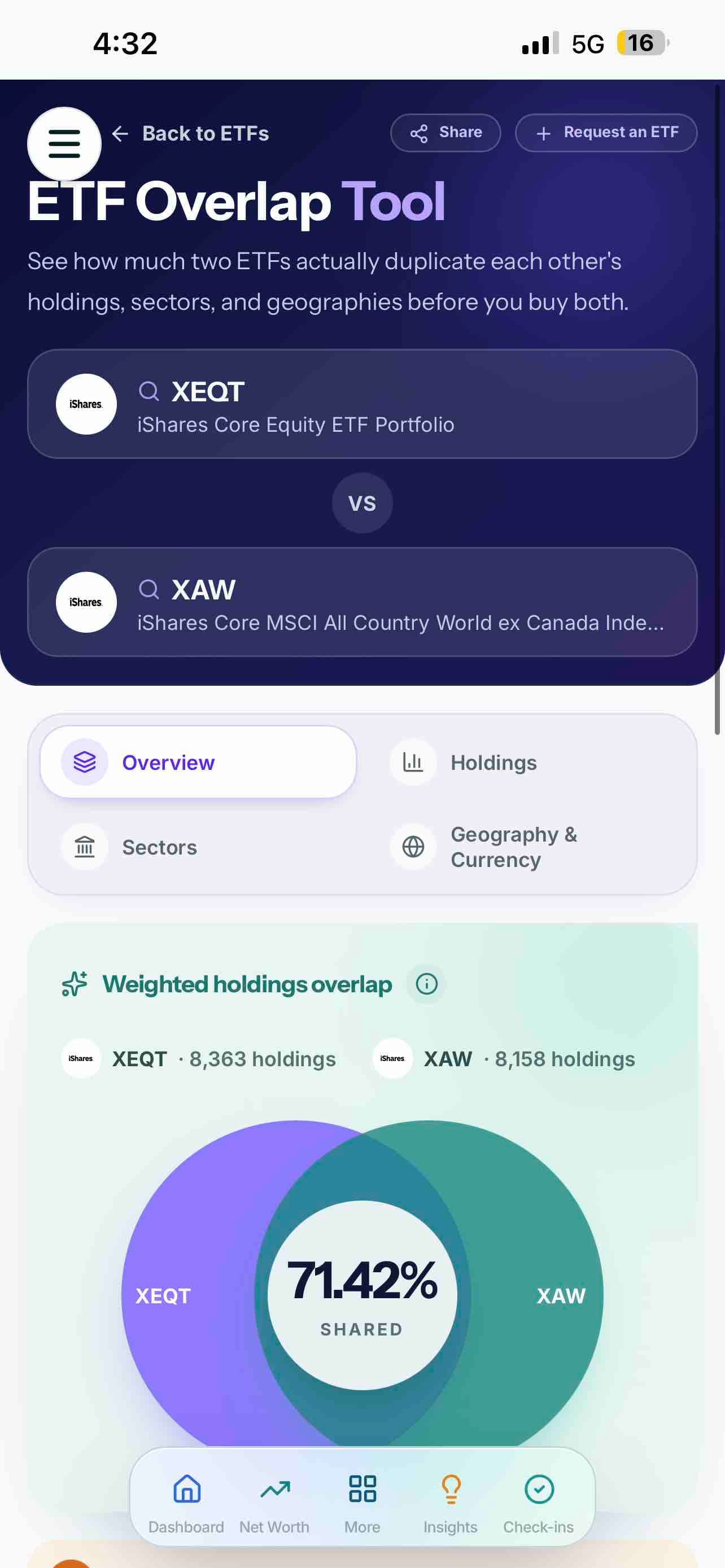
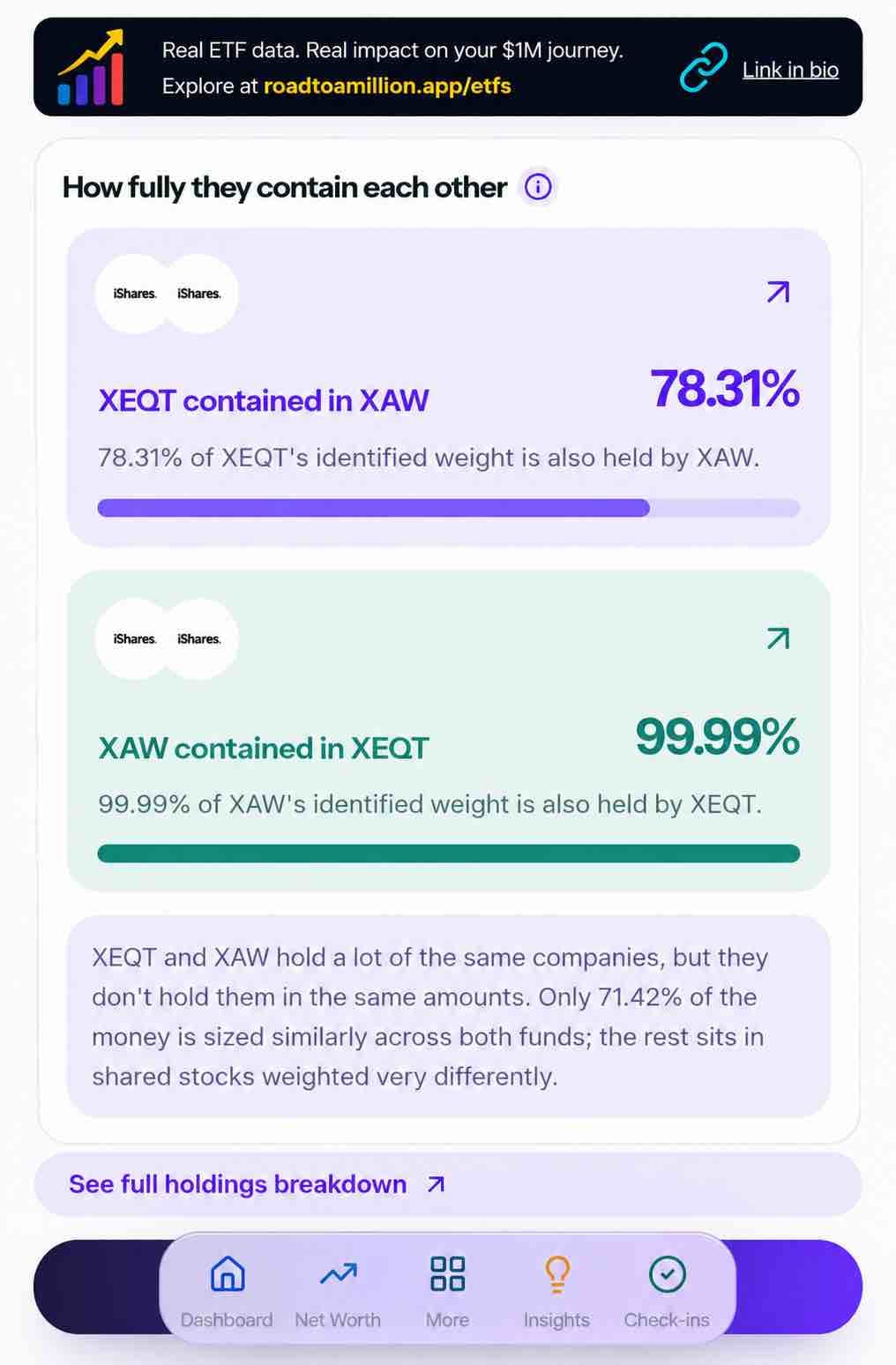
This one was requested by @ibetpa. I compared $XEQT and $XAW, and the overlap is pretty significant: * 71.42% weighted holdings overlap * 78.31% of XEQT’s identified weight is also held by XAW * 99.99% of XAW’s identified weight is also held by XEQT XAW is essentially fully represented inside XEQT, but the two funds don’t weight those shared holdings the same way. So if you already own XEQT, adding XAW is less about getting access to completely new companies and more about changing how much weight you give to the ex-Canada portion of the portfolio. Which ETF pair should I run next? read more