$CRWV is raising another $3B through convertible debt, with an additional $500M potentially coming in, while also opening an ATM program for up to 35M shares. I understand why CoreWeave needs capital. AI infrastructure isn't cheap to build. But as an investor, I’m watching the other side of the equation too: debt, dilution, and whether all this spending eventually turns into stronger cash flow. The AI demand is real. Now I want to see the economics behind it.
I heard something on the Rational Reminder podcast that really stuck with me: trust plays a much bigger role in investing than we probably realize. We always hear that one of the keys to investing is staying invested. But how do you stay invested when you don’t actually trust what you own? When I started investing, I bought things like Enbridge, Telus, REITs and eventually covered call ETFs. A lot of those decisions were influenced by what I was seeing on social media. I don’t necessarily think that’s a bad thing because social media helped get me investing in the first place. The problem was that I didn’t really understand WHY I owned those investments. I hadn’t developed the knowledge or conviction to trust them when things weren’t going well. And I think that’s when trust really matters. Every investment or strategy will eventually give you a reason to question it. Markets fall, strategies underperform and there’s always someone telling you there’s something better. The same idea applies to financial advice. If someone is helping manage your life savings, understanding how they’re compensated, what they’re doing and trusting the advice you’re receiving matters too. Maybe that’s part of the reason some people eventually move toward DIY investing. I’ve changed my portfolio a lot over the last three years, but perhaps the biggest change isn’t what I own. It’s understanding WHY I own it. I don’t expect my investments to always outperform. But today I understand what I’m invested in and why. And that makes it a lot easier to stay invested when things aren’t going well. Maybe the question isn’t just, “What should I invest in?” It’s, “Do I understand what I own well enough to trust it?”read more
I'ts an honest question. I used to think, Im an investor when my investment total return is higher then my yearly wage. I still dont consider myself an Investor. Im also still pretty far from that goal. That will not stop me from twiddling my mustache as I look at my 7 shares of $BLK ..... I also own in large part Just indexes ($XEQT and $VEQT) I dont nessisarally think that makes me an investor as much as it just makes me a market participant. So today as I sit in a 1.5 foot tall crawl space doing sheet metal beside my new homie Fred the spider..... I have a hard time saying "Im an investor". At what point would you be proud to call yourself an "investor" to your friends?read more
Wall Street is already reacting to $OSCR Investor Day. Several analysts updated their price targets this morning: - Barclays raised its target from $39 to $49, Overweight - Baird raised its target from $27 to $33, Neutral - Bank of America raised its target from $28 to $30, Underperform - Piper Sandler reiterated $48, Overweight Barclays now has one of the highest targets on the Street, while Baird said Oscar’s 2029 targets look achievable after updating its model following Investor Day.read more
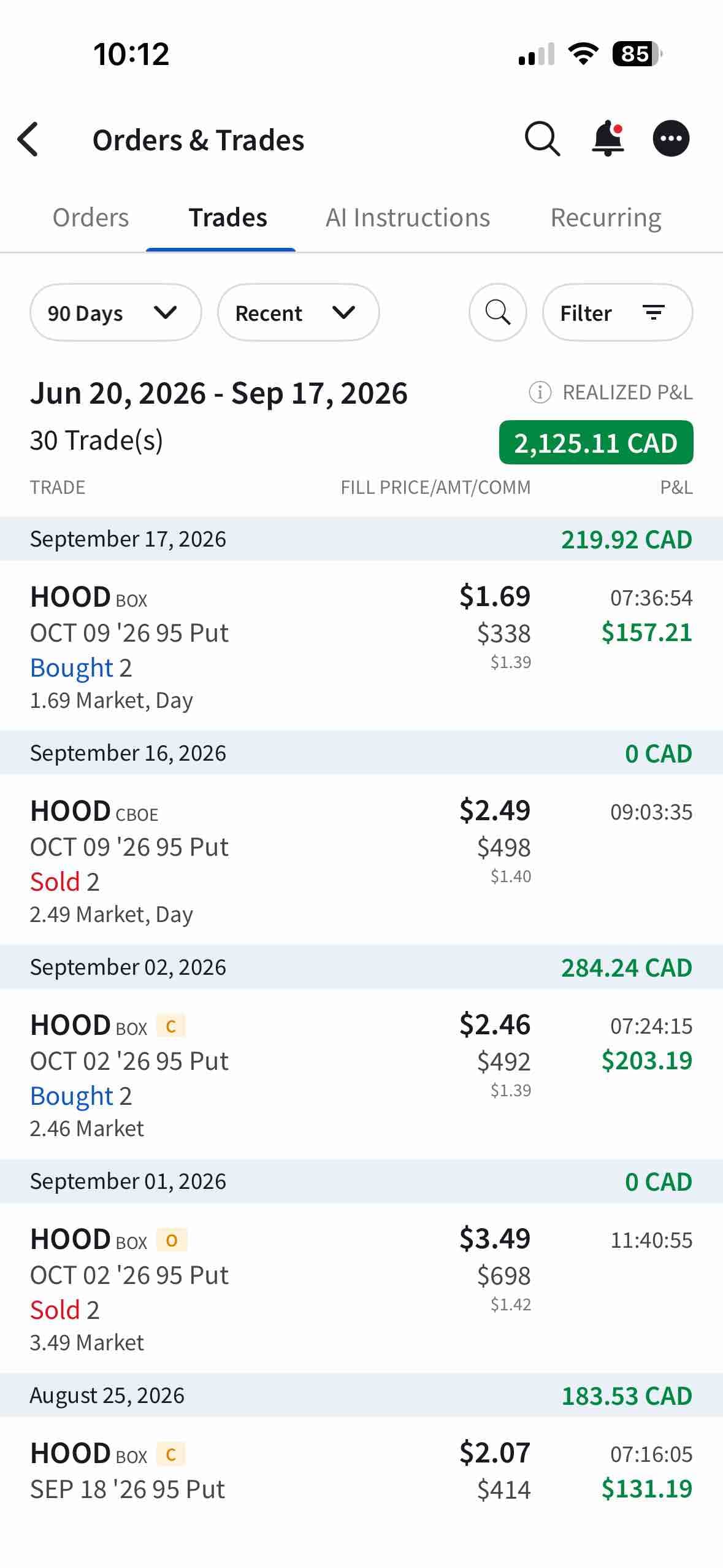
I have been making around $3000/month consistently with options now I keep learning, and want to get that number up 📈 I don’t force myself to trade, I only trade when the setup seems right, and most of all, I’m not greedy. $PLTR$HOOD$IREN$NVDA
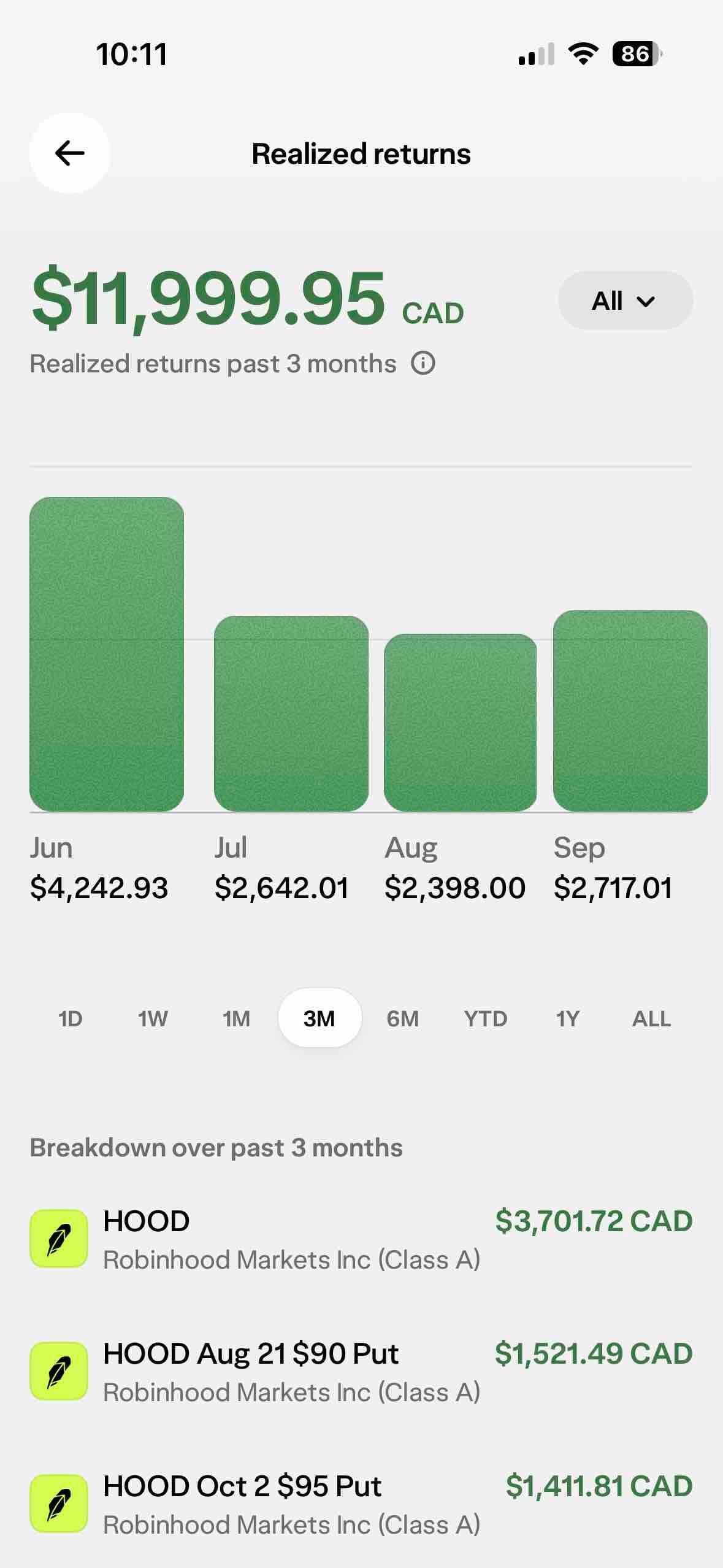
$14k in realized return in the last 3 months. Consistency is key 🔑 Most influencers would get paid to shill stocks, but never really show their actually returns. Wondering why? Keep learning and grinding everyday 💪🏼 I know I will soon make those numbers on a monthly basis 🙌🏼 $PLTR$HOOD$NVDA$DELL$TSLAread more
Building real wealth doesn't look like the flex videos. It's discipline, risk management, and staying calm when the market throws a tantrum. 10 principles to keep your portfolio green and your sanity intact: 1. Consistency beats timing. Dollar-cost averaging quietly outperforms trying to snipe tops and bottoms. Buy on schedule, not on vibes. 2. Run a barbell. Pair high-beta growth with rock-solid index anchors — upside without catastrophic drawdown risk. 3. Defense protects the compounding. A high income is offense. Killing lifestyle creep and holding a cash buffer is the defense that actually lets compounding work. 4. Boring is the superpower. The assets that let you sleep through a 20% swing are usually the ones quietly carrying your net worth over decades. 5. Watch high-yield traps. A double-digit distribution feels great until NAV decay kicks in — you're just getting your own principal handed back to you. 6. Rebalance on math, not emotion. Trimming winners to top up discounted quality removes the panic from volatile months. 7. Fees are a silent leak. FX markups, MERs, transaction costs — they compound against you just as hard as returns compound for you. Plug them. 8. Total return over hype. Narrative chasing is exhausting. Stick with revenue drivers and fundamentals that actually hold up. 9. Decide your dip plan in advance. Buy the dip, hold dry powder, or stay on autopilot — pick before the pullback, not during it. 10. Time in market > looking rich today. Real wealth is quiet. It's financial independence tomorrow, not a leased car today. 💬 Which number hit closest to home? Drop your number below 👇read more
Right now I’m taking a stance that my former broker thinks is foolhardy and could cost me everything. I’m aggressively buying big tech , mutual funds and EFTs that are volatile. I’m of the opinion that more is better but I’m only riding with the stocks, mutual funds and ETFs that I own. I’m not looking outside my lane. This approach is risky but the potential is too high for me to sit on the sidelines. Concerning the “buy the dip” ploy - I only use this to increase the shares that I own. Not financial advice
The Fed raising rates changes my portfolio decisions, but it does not automatically change my long-term investing plan. I’m separating my money into three different jobs. https://www.instagram.com/stockswithpawan/reel/DdZoWTAA5Ry/ Long-term money This keeps going into diversified ETFs. I do not want my retirement or long-term compounding strategy to depend on correctly predicting the next Fed move. Opportunity cash I want some liquidity available because higher rates can create sharper corrections in growth stocks. Cash gives me flexibility if better prices appear. Individual stocks This is where I’m becoming more selective. A 20-30% drawdown can look attractive, but price alone does not tell me whether something is cheap. I still want: • durable revenue • healthy balance sheet • real end-market demand • reasonable valuation • an entry level where downside is manageable That framework helps me avoid two extremes: panic-selling everything because rates went up, or buying every dip simply because stocks are red. For me, the answer sits in the middle: keep investing, keep liquidity, and demand more from individual stocks. Not financial advice - just sharing what I’m watching, researching & investing in. Always do your own research before investing.read more
Inflation. Interest rates. Oil. Bond yields. 📈📉 Each one pulls on a different part of the market—but stocks react to the combination: growth, earnings, valuations, and investor sentiment. Understanding the macro backdrop won’t predict every move, but it can help explain why the market is moving. Save this for the next CPI, Fed, or Treasury-yield headline.
Hit my goal today! 🥳🥳 250k portfolio. I know it will still go down and up but the feeling is surreal. Next stop 300k 🥳 Grill my portfolio if you guys want, open for what ever opinions you have. PLTR will stay, it used to be 80% of my portfolio, i sold a bunch on the way up and put it on real estate. I will just hold this and let it dilute as i keep adding on others. HHIS/HDIV/ XEI is my income producing so far, xei is the only one on drip. Hhis and hdiv income goes to xeqt. I wont add on xei anymore i will just let it drip, next contribution im thinking xdiv as it is on a taxable account. 🥳🥳 thanks guys! read more
$SNAP — Expectations are extremely low, but monetization is improving, costs are coming down, and Specs adds a major layer of optionality. There is plenty of risk, but I think the upside could be much larger if even a few pieces come together. $SOFI — The company is already profitable, still growing quickly, and expanding far beyond lending. If members, products and earnings keep compounding, I think the business can become much larger than the market currently expects. $NOW — A great business that has become much more interesting after the valuation reset. Growth remains strong, AI is becoming more important, and cash generation keeps climbing. I mostly need ServiceNow to keep executing. $UBER — Rides and delivery are already massive, advertising and Uber One add more monetization, and AV gives Uber additional long-term optionality without the thesis depending on it. The cash flow story here keeps getting stronger. $AMZN — Probably the highest-quality setup of the five. AWS, advertising and retail each give Amazon separate ways to grow earnings, while the company continues generating enormous cash flow. Different levels of risk, but in each case I think the potential upside outweighs what is currently being priced in. read more
I just went through the $BN 2026 Investor Day presentation. There was a lot in it, but these were the biggest takeaways for me: - Brookfield sees Plan Value reaching $140/share by 2031, up from $67 today. - Distributable earnings before realizations are expected to grow from $5.3B in 2026 to $11.6B by 2031. That is a 17% CAGR. - Wealth Solutions might be the biggest story here. Insurance assets have gone from basically nothing in 2020 to around $200B today. Brookfield is targeting nearly $400B by 2031 and close to $5B in annual distributable earnings. Management estimates Wealth Solutions alone could be worth $29–$37 per $BN share by 2031. - Carried interest is becoming a much bigger earnings driver. Carry-eligible capital is expected to grow from around $273B today to $600B by 2031. Brookfield also expects roughly $25B of net carried interest realizations over the next decade. - The cash generation here could get massive. Brookfield expects roughly $54B of free cash flow over the next five years. After dividends and reinvestment into the business, management estimates around $26B of excess cash could still be available for new investments, strategic deals or shareholder returns. - AI and power infrastructure are becoming a much bigger part of the thesis. Brookfield highlighted a $4T+ AI compute infrastructure opportunity and a $6T global energy grid opportunity. They are already deploying billions across nuclear, AI data centers and power infrastructure. - Real estate also looks a lot healthier than the headlines make it seem. Brookfield’s Super Core portfolio is around 95% occupied. Its office portfolio is roughly 94% leased. Management is targeting around 4% annual same-store NOI growth through 2031. - The new Brookfield structure could be a huge advantage over time. Combining permanent capital with insurance float gives Brookfield roughly $345B of flexible capital today. Management believes that could eventually grow to more than $1T as the platform scales. And one underrated slide: Brookfield invested $325M in SpaceX. That stake is now worth roughly $1.5B. 4.7x multiple. 55% IRR. More than $1B of value created. My biggest takeaway: $BN is becoming a much bigger and more powerful business than I think most people realize. Asset management keeps scaling, Wealth Solutions is becoming a monster, carried interest is starting to matter more, and real estate is improving. On top of that, Brookfield could have tens of billions of dollars to deploy into AI, energy and other massive opportunities over the next decade. These are long-term management targets, not guarantees, but this presentation definitely strengthened my conviction in $BN .read more
$AMZN just signed a major long-term supply agreement with Generac for backup generators across its data centers. Initial deliveries are expected to total $2.4B in 2027 and 2028, while the broader agreement could support as much as $8B in purchases over time. Amazon also received warrants to buy up to 1.69M Generac shares at roughly $200.93 per share. The bigger takeaway: The AI buildout is about a lot more than GPUs. $AMZN is locking down the power and infrastructure AWS will need to keep scaling for years.read more
With investing, when you find a disconnect between stock price going one way and business performance going another, that screams OPPORTUNITY 3 Stocks whose stock price has not kept up with strong business performance $SOFI $VST $NOW
$SOFI just released its 2026 Investor Confidence Survey, and a few numbers stood out to me: - 73% of investors said they felt optimistic, excited or satisfied about their investments over the past year - 41% actively bought during market volatility - 55% said inflation is the biggest threat to their portfolios What I find interesting is how much this lines up with what we’ve seen all year. Investors are still worried about inflation and volatility, but they are not necessarily running away from the market. A lot of them are actually using weakness to buy. And I think studies like this are another underrated part of what $SOFI is building: not just financial products, but a broader investing and financial ecosystem around its members.read more
+1.18% S&P 500 ($SPY) +1.76% Nasdaq ($QQQ) Good Evening everyone, I apologize for missing todays morning briefing I had a big exam today so I had to prepare for that.. Lets continue with todays post market brief. Markets exhaled on Thursday. After Wednesday's 631-point Dow plunge the worst single day reaction to a Fed rate hike since 1997 — investors woke up, decided the sky wasn't falling, and bought the dip. The Nasdaq led the recovery with gains of roughly 1.6%, the S&P 500 added around 1.1%, and the Dow climbed back ~0.65%. One bad day of selling turned into a textbook post-FOMC bounce. The backdrop: the Federal Reserve raised the federal funds rate by 25 basis points Wednesday to 3.75%–4.00% in a unanimous 12-0 vote — the first hike in over three years. Chair Kevin Warsh's tone was blunt: "The plain fact is that inflation is too high and has been for too long." The dot plot pointed to year-end rates of 4.1%–4.4%, signaling at least one more hike before the end of 2026, with tightening likely extending into 2027. By Thursday, traders had digested it and concluded the move was largely expected — meaning Wednesday's selloff was more about the hawkish rhetoric than the actual numbers. The session's biggest individual story had nothing to do with the Fed. Generac Holdings ($GNRC) exploded 21%–30% on a landmark Amazon deal — a reported $2.4 billion initial contract to supply backup generators for Amazon data centers, part of a broader ~$8 billion framework. As AI infrastructure spending accelerates, demand for reliable power backup is becoming a structural growth story, and Generac just landed the contract that proves it. Semiconductors had a strong session as well. $INTC surged ~9.8% amid reports of talks with SK Hynix around advanced memory chip manufacturing in the U.S., while $AMD gained 7.3% and $MU added 5.1%. The AI trade caught a bid. $MRNA also jumped ~9.4% on positive Phase 3 data for its mRNA cancer vaccine co-developed with Merck, with analysts already floating M&A as a next chapter. Not everything recovered. $NKE hit 12-year lows near $36 as China exposure and tariff headwinds continue to grind the brand down. $FLNC cratered as much as 22% after slashing full-year guidance — a brutal reminder that the clean energy buildout isn't a straight line. $CRWV fell 4.7% on a $3 billion convertible note offering, the kind of dilution that gets punished fast in the current rate environment. Oil pulled back from recent highs. WTI crude slid ~1.7% to around $100.70 after Saudi Arabia signaled it would offer additional exports through Oman following temporary pipeline disruptions. Prices remain above $100 — the Iran conflict aftermath keeps a risk premium in the market — but the relief valve is cracking open. Defense stocks continued to face pressure from ceasefire dynamics, with the end of Operation Epic Fury removing some of the emergency procurement premium that had driven the sector higher. The next major catalyst to watch: a Xi-Trump summit scheduled for September 24. Taiwan arms sales and trade tariffs are on the agenda, and the outcome could move tech supply chains, defense names, and emerging markets simultaneously. After a week dominated by the Fed, geopolitics is already lining up to take the baton.read more
YAY it's Thursday that means its "Stock Spotlight" day!! be sure to checkout my spotlight on Newmont Corporation, lets dive in! $GNRC Just Landed a $2.4B Amazon Deal — And It Changes Everything A $2.4 billion Amazon data center deal has rewritten Generac's story overnight — from struggling consumer appliance maker to core AI infrastructure supplier with a hyperscaler-sized growth runway. What They Do & Why It Matters Generac Holdings has spent most of its 67-year history making backup generators for homes and small businesses. That was a fine business until today. On September 17, 2026, Amazon announced a $2.4 billion initial contract with Generac to supply backup power systems for its data centers, part of a broader ~$8 billion framework agreement. In a single announcement, Generac stopped being a consumer appliance company and became a core AI infrastructure supplier. The stock opened up 32% and closed up 18.7% on nearly 9x its average daily volume. The market is still figuring out what this means, which is exactly why it's worth paying attention. Financials Snapshot $207.78 Price (+18.7%) $12.3B Market Cap 40.4x P/E Ratio 9x Avg Volume Today $2.4B Amazon Contract $134.80–$296.44 52-Week Range Bull Case The $2.4 billion $AMZN deal is roughly 1–2x Generac's entire annual revenue — and it's described as an initial contract within a broader $8 billion framework. That means follow-on orders are already baked into the relationship. More importantly, if Amazon is calling Generac, Microsoft, Google, and Meta are next. AI data centers require industrial-grade backup power that can sustain a full facility blackout without interruption — it's not a discretionary purchase, it's a non-negotiable infrastructure requirement. Generac has the products, the manufacturing capacity, and now the credibility of the world's largest e-commerce company to win that business. The P/E looks high at 40x, but if this deal re-rates Generac as an AI infrastructure play, the comparables shift from consumer appliance peers to industrial tech companies — and the multiple follows. Bear Case The stock opened at $230 and closed at $207 — a 10% intraday fade from the highs. That kind of action often signals that the first wave of buyers got the news right but the valuation is still being debated. At 40x earnings, Generac needs to execute on a business model it has never operated at this scale. Large data center contracts also come with complex delivery timelines, customization requirements, and potential penalties for delays — this is not the same as selling a home generator through Home Depot. Execution risk is real, and if the Amazon relationship hits any snags, the stock re-rates down fast from an AI premium multiple. What to Watch Analyst upgrades and price target revisions will start rolling in over the next 48–72 hours — watch for those to act as secondary catalysts or resets. Listen for any commentary from other hyperscalers ($MSFT, $GOOGL, $META) about data center power infrastructure contracts. Generac's next earnings call will be the first opportunity for management to frame the scale and timeline of this Amazon relationship. Any signal of additional contract awards would reprice the stock meaningfully higher from here. Bottom Line Generac didn't pivot to AI — AI came to Generac. When you need to power a building full of GPUs 24/7 with zero tolerance for downtime, you call the company that has been engineering backup power systems since 1959. The Amazon deal doesn't just add revenue — it changes the category Generac competes in. The intraday fade from $230 to $208 is noise; the story being written here is about whether Generac becomes the backup power backbone of the AI data center buildout. If the answer is yes, today's close looks cheap in six months.read more
Gold at $4,400 and $NEM Is Still Cheap — Here's Why It Just Popped Newmont is the world's largest gold miner delivering maximum leverage to gold at all-time highs above $4,400/oz — and at just 15x earnings, it's still trading like a value stock despite a 63% one-year run. What They Do & Why It Matters Newmont Corporation is the world's largest gold mining company, operating mines across the U.S., Canada, Australia, Ghana, Peru, Suriname, and beyond. Founded in 1921, Newmont sits at the center of every gold bull market — when gold moves, Newmont moves more. That's exactly what's playing out right now. With gold at $4,404/oz — a new all-time high — Newmont's operating margins are expanding at a pace that makes the company's 15x P/E look like a value stock. The market is still catching up to what $4,400 gold actually means for the bottom line. Financials Snapshot $124.37 Price (+2.1%) $131.0B Market Cap 15.4x P/E Ratio $4,404 Gold Spot Price 0.84% Dividend Yield $76.05–$135.29 52-Week Range Bull Case Every $100 increase in the gold price adds roughly $800M–$1B to Newmont's annual operating cash flow. At $4,400/oz — more than triple their all-in sustaining cost of ~$1,300/oz — Newmont is printing money. The company is up approximately 63% over the past year and still trades at only 15x earnings, a valuation more typical of a slow-growth utility than the world's premier gold mining franchise. Gold mining stocks as a sector trade at a 20-year discount relative to the gold price itself, meaning the mean-reversion trade is alive. The Fed hiking cycle keeps inflation anxiety elevated, which is structurally bullish for gold as a reserve asset. Newmont pays dividends quarterly and continues to expand its production base through acquisitions. Bear Case Gold's $4,400 price already embeds significant geopolitical and inflation risk premium. If the Xi-Trump summit on September 24 goes well and global risk appetite improves, gold could give back some of its run as investors rotate into risk assets. Newmont's operations span politically complex jurisdictions Ghana, Suriname, Papua New Guinea, where permitting delays, labor disputes, or government royalty changes can hit production targets. The stock is also up 63%+ over the past year, so any gold price softening would get amplified on the downside. What to Watch The Xi-Trump summit (September 24) is the nearest-term catalyst, a positive outcome could pressure gold as a safe haven, while a breakdown in talks would likely send gold higher. Also watch the next FOMC meeting (October 27–28): additional rate hikes would reinforce the inflation hedge narrative for gold. Newmont's Q3 2026 earnings will be the first full quarter capturing $4,000+ gold across all its operations — those numbers should be significant. Bottom Line When gold is at all-time highs and the world's largest gold miner is trading at 15x earnings, something in the math doesn't add up — and that gap usually closes in favor of the stock. Newmont is the cleanest way to own the gold bull market without touching futures or ETFs: you get production leverage, a dividend, and a balance sheet that can grow through the cycle. In an environment where the Fed is hiking, geopolitics are unsettled, and inflation is "too high and has been for too long" in the Fed chair's own words, gold has more friends than enemies right now. read more
$BN shows about $265B in consolidated debt. At first glance, that looks pretty scary. But only about 6% of Brookfield’s consolidated debt is issued by, or has recourse to, Brookfield Corporation itself. Most of the debt sits at the asset, project, subsidiary, or managed-entity level. Brookfield’s corporate borrowings excluding commercial paper were about $14.3B at Q2, with a weighted-average term of 15 years and a weighted-average interest rate of 4.8%. This is why the headline debt number alone can give you the wrong picture of $BN. read more