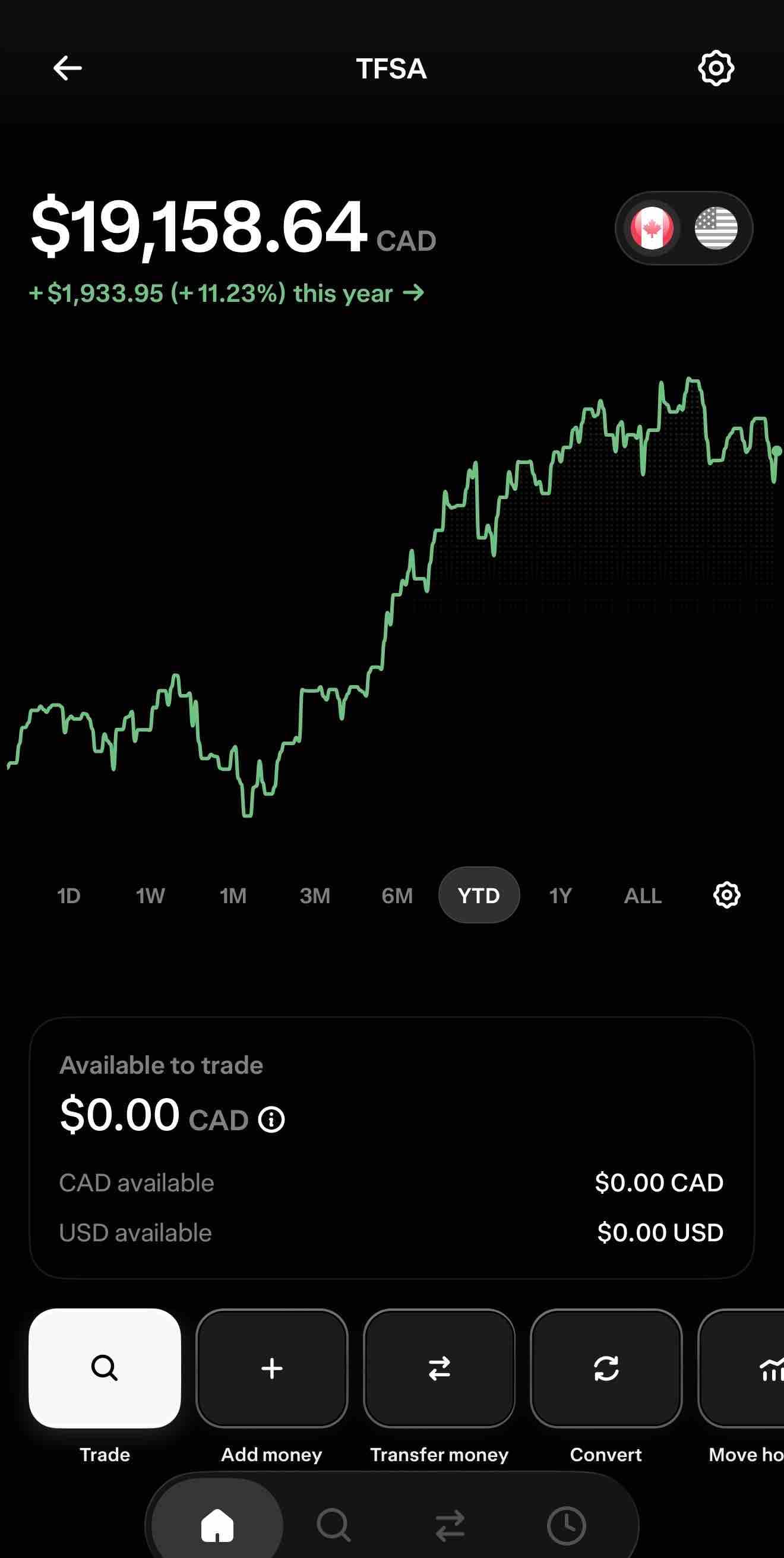
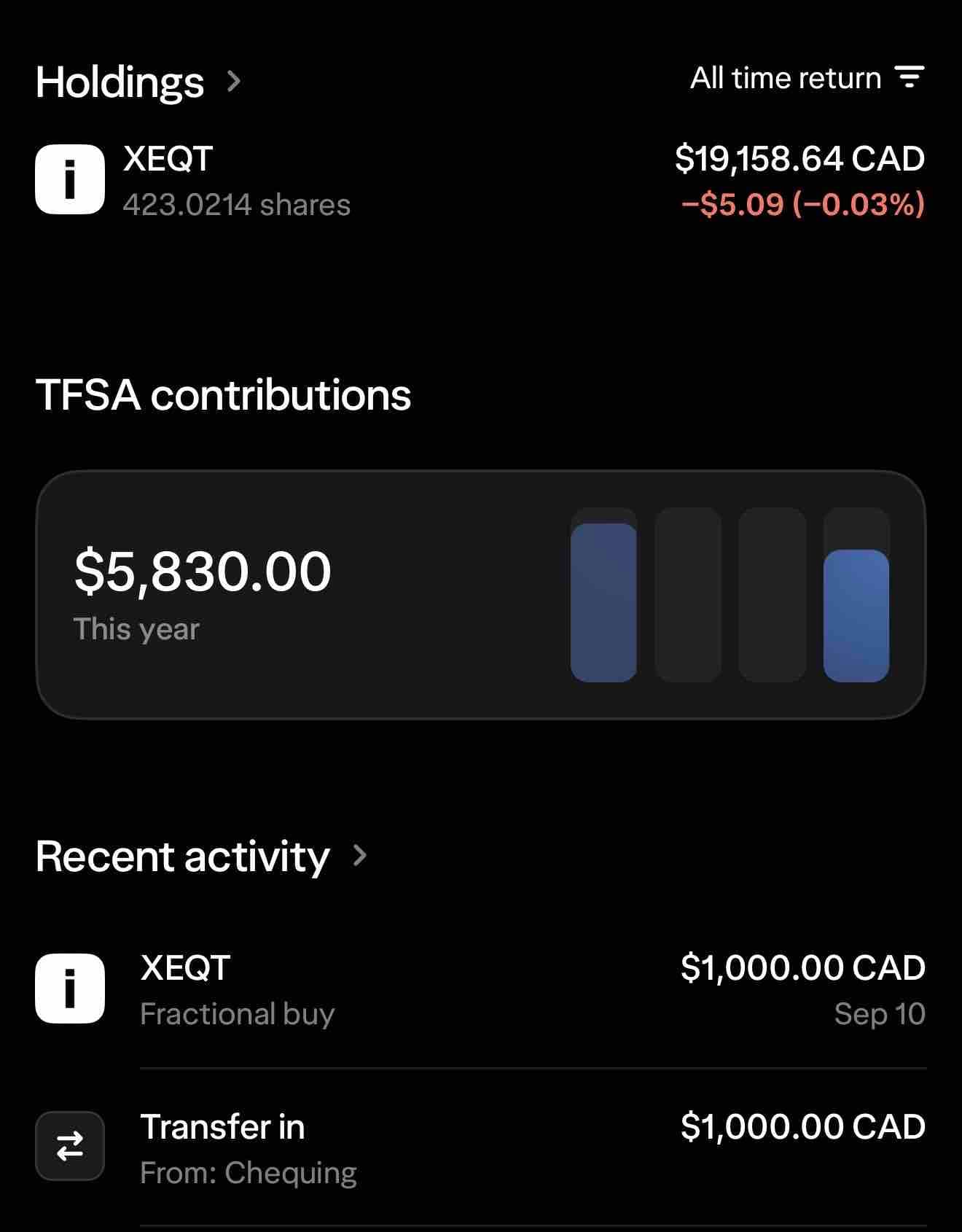
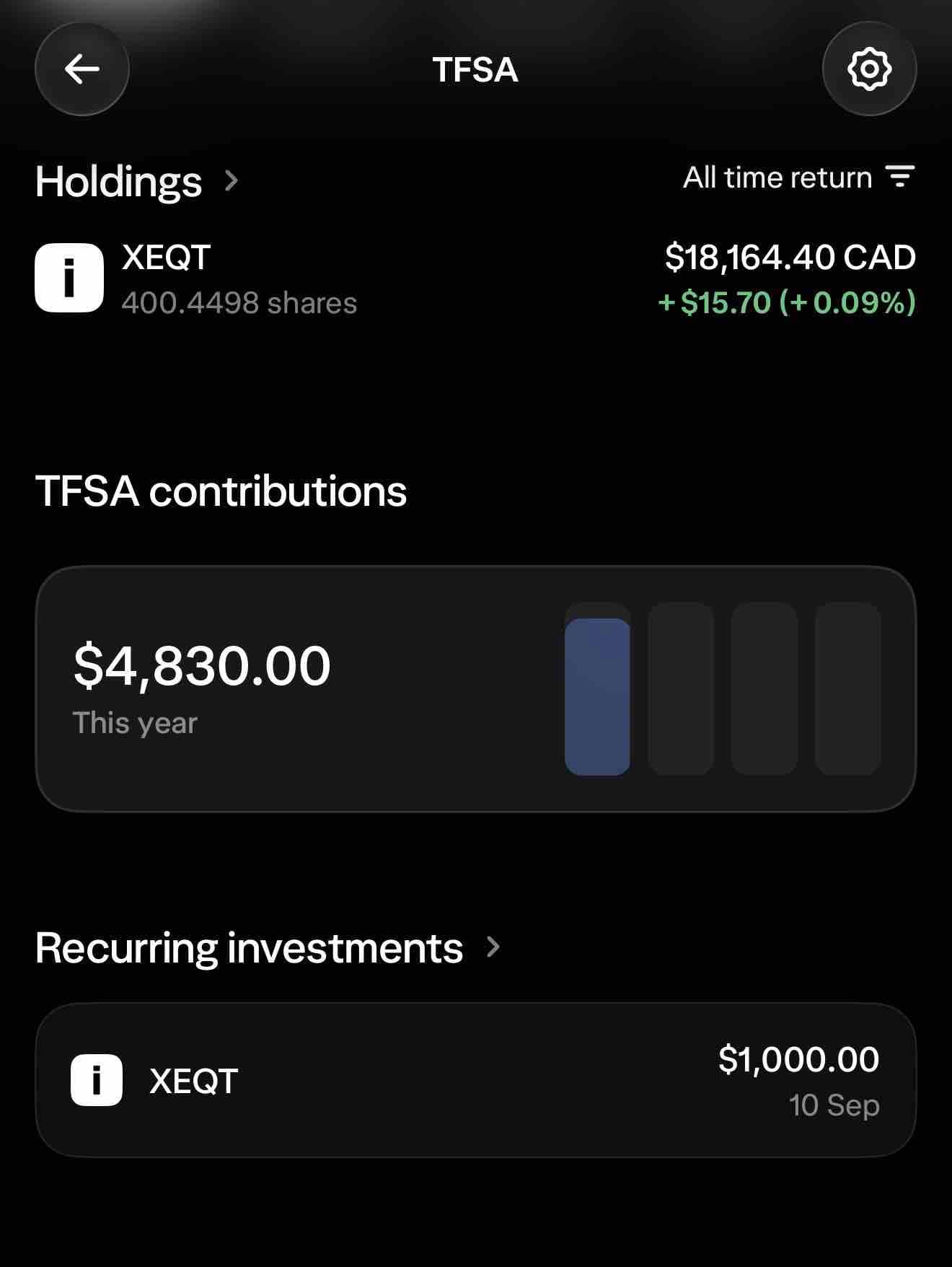
Another $1,000 into $XEQT. TFSA is now just over $19K. My goal is to invest $1,000 every payday: $26K/year, and document the progress along the way. Currently keeping it simple with 100% $XEQT. Less worrying about finding the “perfect” portfolio and more focusing on consistently putting money to work. See you in two weeks 🫡
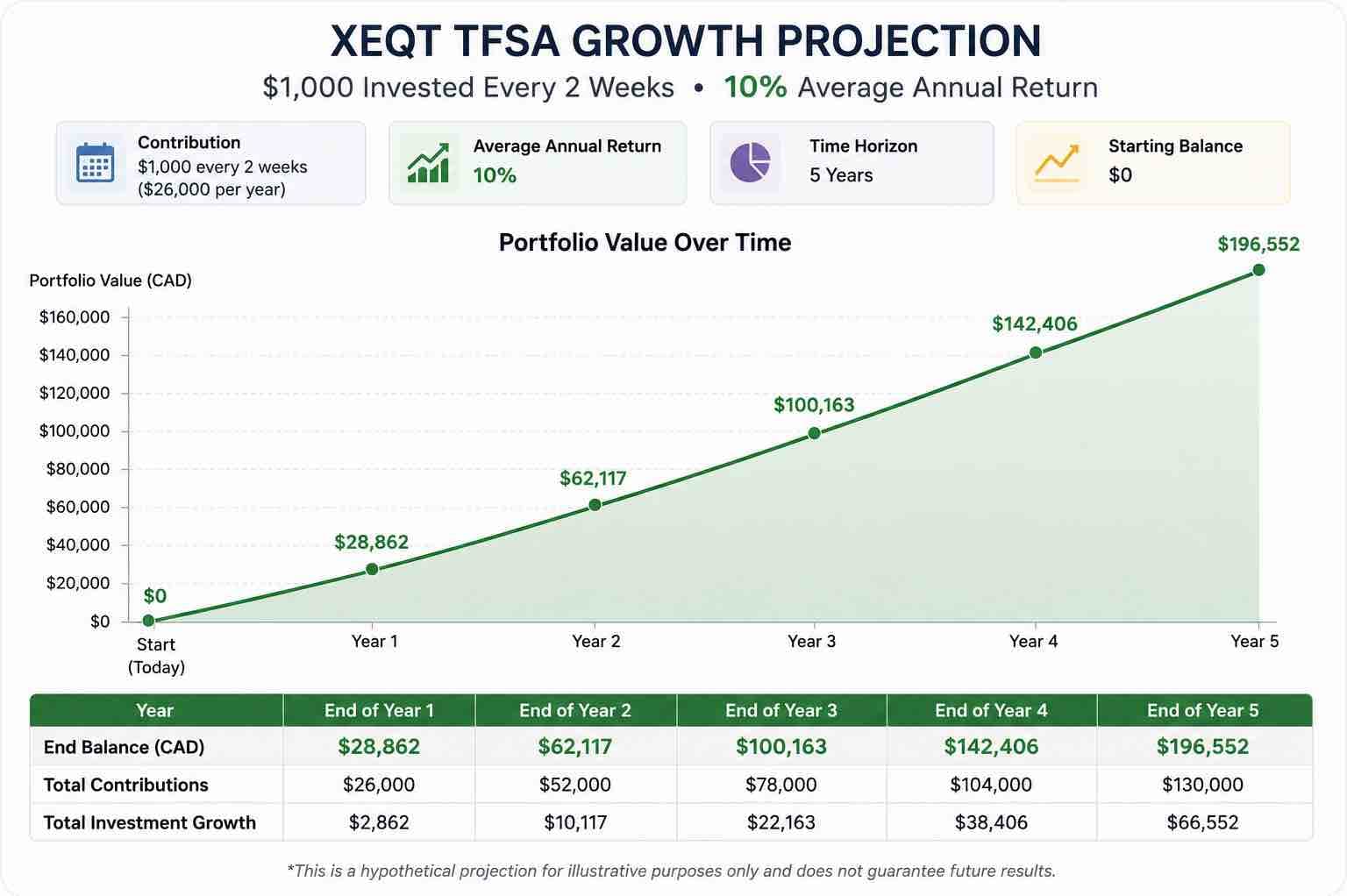
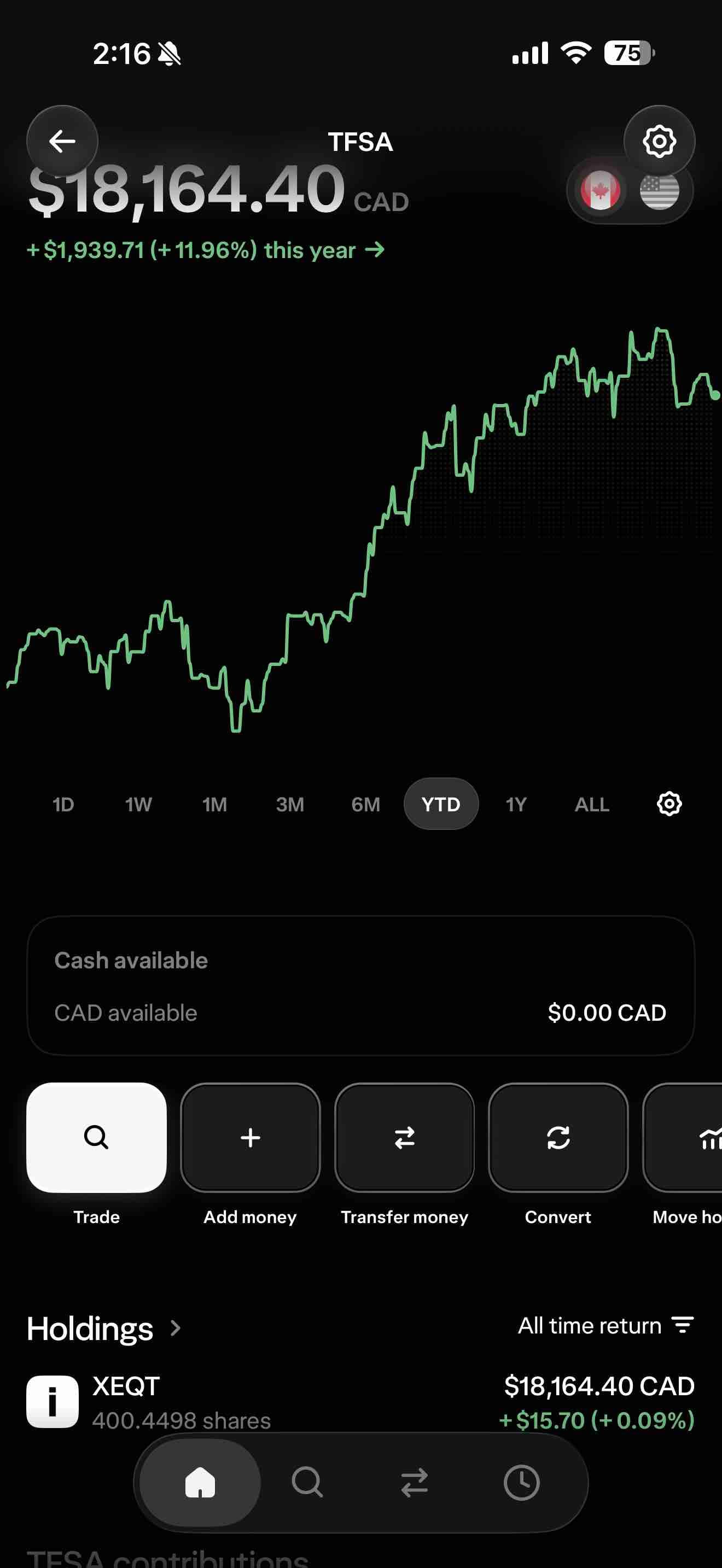
Decided to simplify my TFSA and go 100% $XEQT📈 Sold my remaining positions in my TFSA and consolidated everything into XEQT. Going forward, I’ve set up an automatic $1,000/biweekly investment and plan to just let it compound. That works out to $26,000 invested per year as long as I have the TFSA contribution room, and based on the graph after 5 years of 10% annualized returns that could be worth $196,532! Anyone else running 100% XEQT in their TFSA? Any suggestions or changes you would make?
Having not been born into wealth and understanding the feeling of having ambition without the means to realize any of it, I volunteer as a mentor and try to show my mentees how they can create better opportunities for themselves by making the right life choices and financial decisions. The destiny of anyone who's trying to go from $0 to a lot more lies in the quality of their awareness, decisions, and social circle. This is where my passion for life truly lies. Helping others, specifically young people. Building long-term wealth quite literally lies in one's ability to e-transfer money to their brokerage and buy all-in-one all equity broad market ETFs consistently! This is exactly why I created my personal finance Facebook group! It's welcome to everyone across the spectrum of knowledge of personal finance. I am holding a meetup this Wednesday in Montreal. Turnout has been good so far but I would like the group to grow more! See link below for details! 😀 https://fb.me/e/4NodeKD98 read more
I wanted to make time to post to Blossom this weekend. I’ve been working 60hrs/week since February and barely have 30mins to myself anymore! It’ll all be worth it, though. I’m trying to collect as much money as possible right now. If it were easy, everyone would do it. I wanted to post my timeline, particularly how I went from $0 to mortgage-free at 29. 14 years old: Started working my first job at a textile warehouse with my dad. I worked full-time during summer and holiday periods. From memory, I remember my mom telling me how I was making a couple thousand dollars a year and how that was pretty good for a young teen. 15-19 years old: I kept working at the warehouse. while on holiday from school. I also started working other part-time jobs across multiple industries. At this point, I remember graduating high school with around $30,000. I wasn’t investing yet, just working and saving. 20 years old: This was a defining moment of my life. The son of the owner of the textile warehouse I worked at gifted me Rich Dad Poor Dad by Robert Kiyosaki. I write about this book a lot, it’s changed a lot of peoples lives. This book needs to be disseminated and implemented into the school system curriculum. Robert Kiyosaki is a real estate investor so I wanted to copy his investing style and success. 20-22 years old: I finished trade school and got my first adult job working in IT. I was lucky that the job offered overtime, I gobbled up as much of that as I could. I kept on working and saving, and had $60,000 at the time. I bought my first rental property with a $30,000 down payment. 22-24 years old: I saved my first $100,000 by working and saving aggressively so I decided to buy a 2nd rental property with a $62,000 down payment. 24-27 years old: I continued to work and save and moved into my 2nd rental in between these years (which is my current primary residence.) The mortgage on my first rental property was up for renewal. The market value of that property had almost doubled from when I had bought it so I decided to sell. I bought my 1st rental for $153,000 and sold it for $278,000. 29 years old: The mortgage on my primary residence was up for renewal so I used the proceeds of sale to pay off the $150,000 balance on the mortgage. Looking back, the prices of real estate seem unrealistic. The rental properties I bought were condos. The market was a lot different pre-pandemic versus today. I live in a 1 bedroom condo. It’s all I need. My north star has always been ownership of my time over material possessions. 30 years old: I’m working 60hrs/week, and have less than $300/month fixed expenses (excluding food.) I’ve invested $131,904.66 ($15,000 borrowed) since February 2026. I calculate my net worth every 6 months, last I checked in June it was $532,629.06. I guess I can be considered a “success”, but trust me I’m still figuring things out. Although I have freedom via low expenses and high income, I'm still very much stuck in the rat race trying to define what freedom looks like for me. I'm still young, and feel as though I should still be working, sacrificing and investing for my future more than anything else right now. What can you learn from this? What I did right: I was consistent at maximizing my earnings and lowering my expenses. I saved a lot and invested modestly (in my opinion and knowing what I know now.) What I did wrong: I sat on a lot of cash throughout my 20s. That could’ve been invested instead of sitting idle. I was also “in and out” of sector concentrated ETFs and single stocks. That’s a waste of time. Just index and chill. I like to read about other peoples timelines, and the progression of their net worth at certain points in their journey. This was mine! I’m holding an in-person personal finance meetup this Wednesday September 16th in Montreal. Join my Facebook group (link in bio) for details!😀read more
My strategy to try to minimize losses and maximize growth over the long term: 📈 When the market is near all-time highs: I focus more on income-focused ETFs like $QQQI and $SPYI, plus $SCHD. 📉 When the market drops heavily: That’s when I want to get aggressive and buy growth—S&P 500, Nasdaq, $FTEC, $SOXQ, and AI/technology-focused funds. The idea is simple: when growth is expensive, collect income and stay more defensive. When growth gets beaten down, use the opportunity to accumulate it at lower prices. Nothing is guaranteed, but I like this approach because it gives me a balance between income, stability, and long-term growth. What do you guys think of this strategy? read more
When I first started investing, I made it WAY more complicated than it needed to be. I thought I needed to find the next crazy stock, own a bunch of different ETFs, and constantly be changing something in my portfolio. Looking back, I probably would’ve been better off just keeping things simple 😭 So for anyone on Blossom who’s just getting started, here are a few of the main types of ETFs I wish I understood when I started: 1) S&P 500 🇺🇸 500 of the largest publicly traded companies in the US. A simple way to get exposure to companies like Apple, Microsoft, Amazon, Nvidia, and more. US: $VOO / $SPLG Canada: $VFV / $ZSP 2) Total US Market 🇺🇸 Want broader US exposure? Total-market ETFs include large, mid, and small-cap companies instead of only the S&P 500. US: $VTI Canada: $XUU / $VUN 3) Global / All-in-One 🌎 One of the simplest approaches for someone who doesn’t want to manage a bunch of different allocations themselves. Canada: $XEQT / $VEQT / $ZEQT One ETF can give you exposure to thousands of companies across Canada, the US, and international markets. 4) Dividends 💰 For investors interested in companies that regularly return cash to shareholders, dividend ETFs bundle a bunch of dividend-paying companies together. US: $SCHD / $VYM / $DGRO Canada: $VDY / $XEI Just remember: a high dividend yield doesn’t automatically mean a better investment. Total return still matters. 5) Growth / Tech 💻 If you want additional exposure to growth and technology companies, there are ETFs for that too. US: $QQQM / $VUG Canada: $QQC / $TEC Just remember: adding one of these on top of an S&P 500 or all-in-one ETF means you may be increasing your exposure to companies you already own. The biggest thing I wish I understood earlier: More ETFs ≠ more diversification. Owning $VFV + $QQC + $XEQT might look diversified because you own three ETFs, but there can be significant overlap between their underlying holdings. Sometimes the simplest portfolio is the one you’re actually able to stick with. Pick an approach you understand, invest consistently, keep learning, and give compounding time to do its thing. Not financial advice — just what I wish someone explained to me when I started. ☺️read more
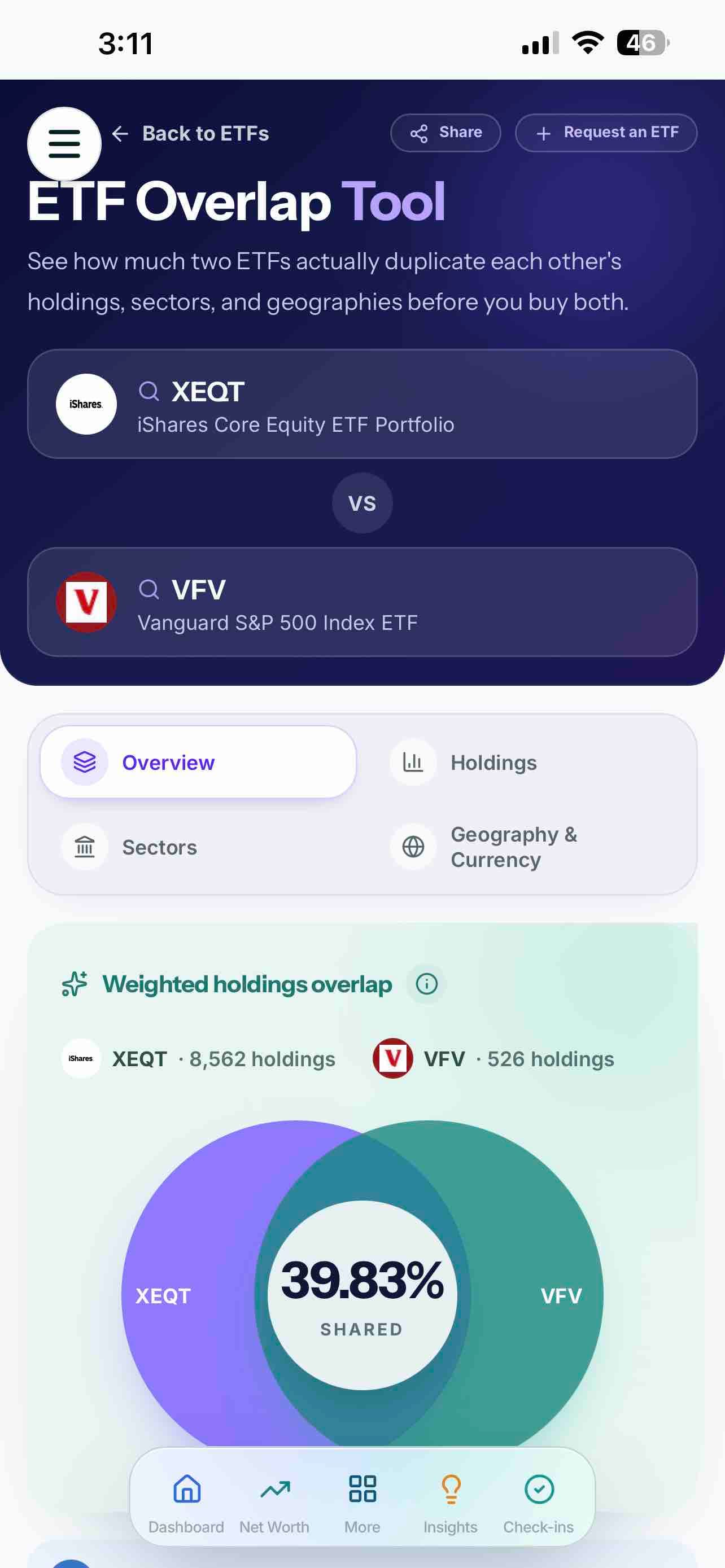
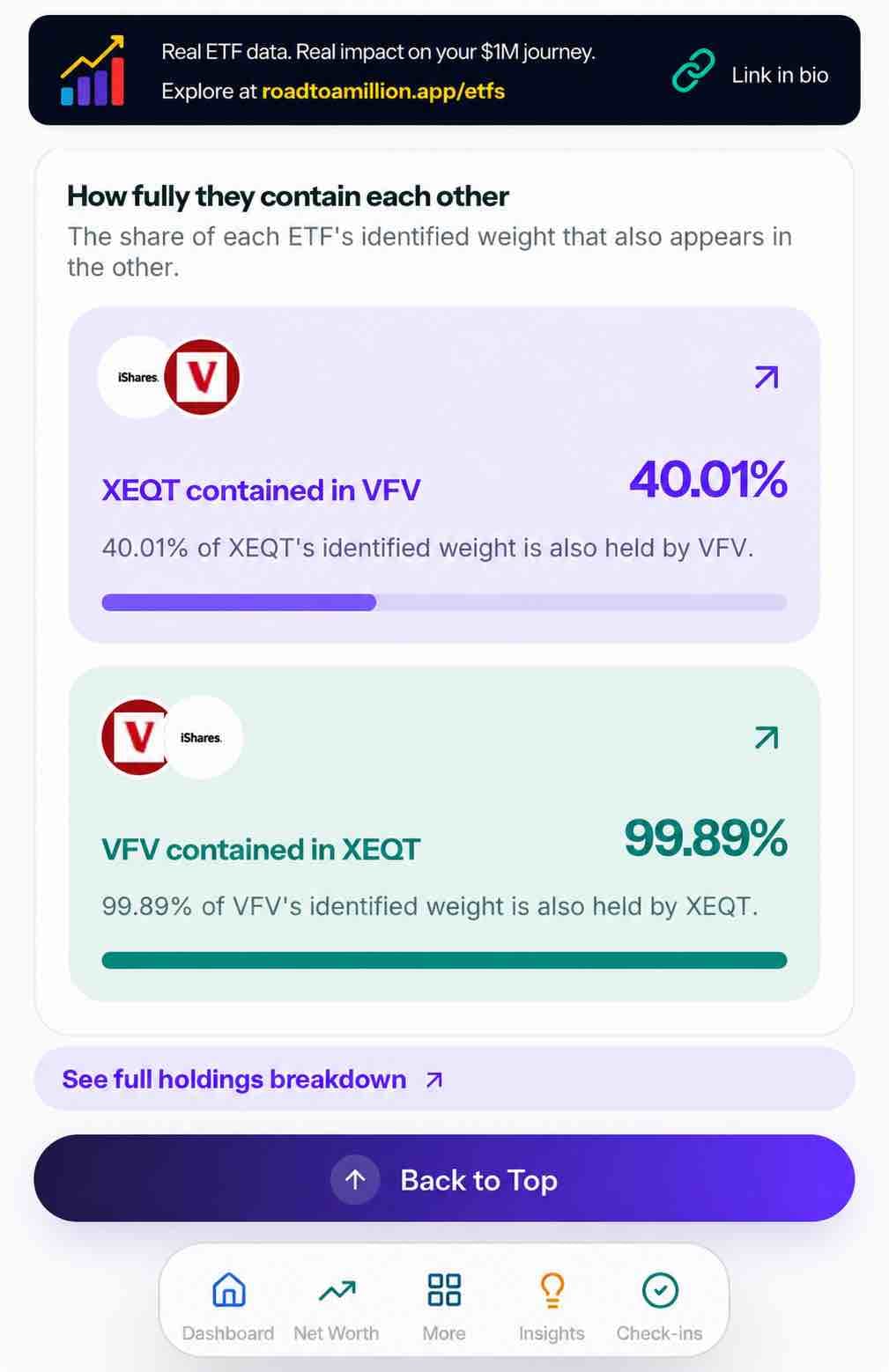
I compared $XEQT and $VFV to see how much of the two portfolios actually overlap. The weighted overlap comes out to 39.83%. But the more interesting number is this: • 99.89% of VFV’s identified weight is already contained in XEQT • 40.01% of XEQT’s identified weight is also held by VFV So while XEQT is much broader overall, VFV is almost entirely represented inside it. That’s a useful reminder that adding VFV or any ETF tracking the SP500 to XEQT may increase your U.S. large-cap exposure more than it increases diversification. 🔍 Where to find this ETF Overlap Tool → Overview Which ETF pair should I compare next? read more
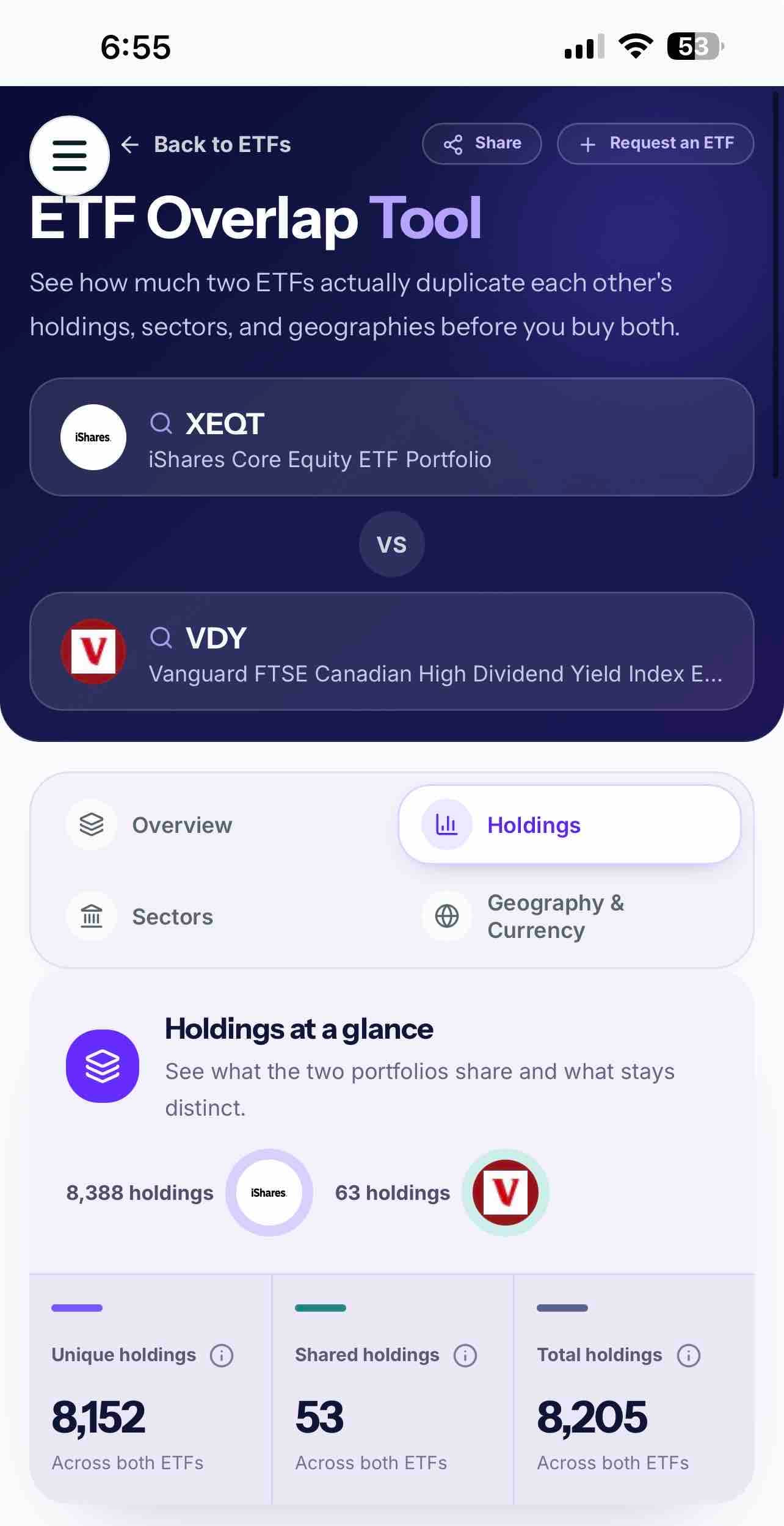
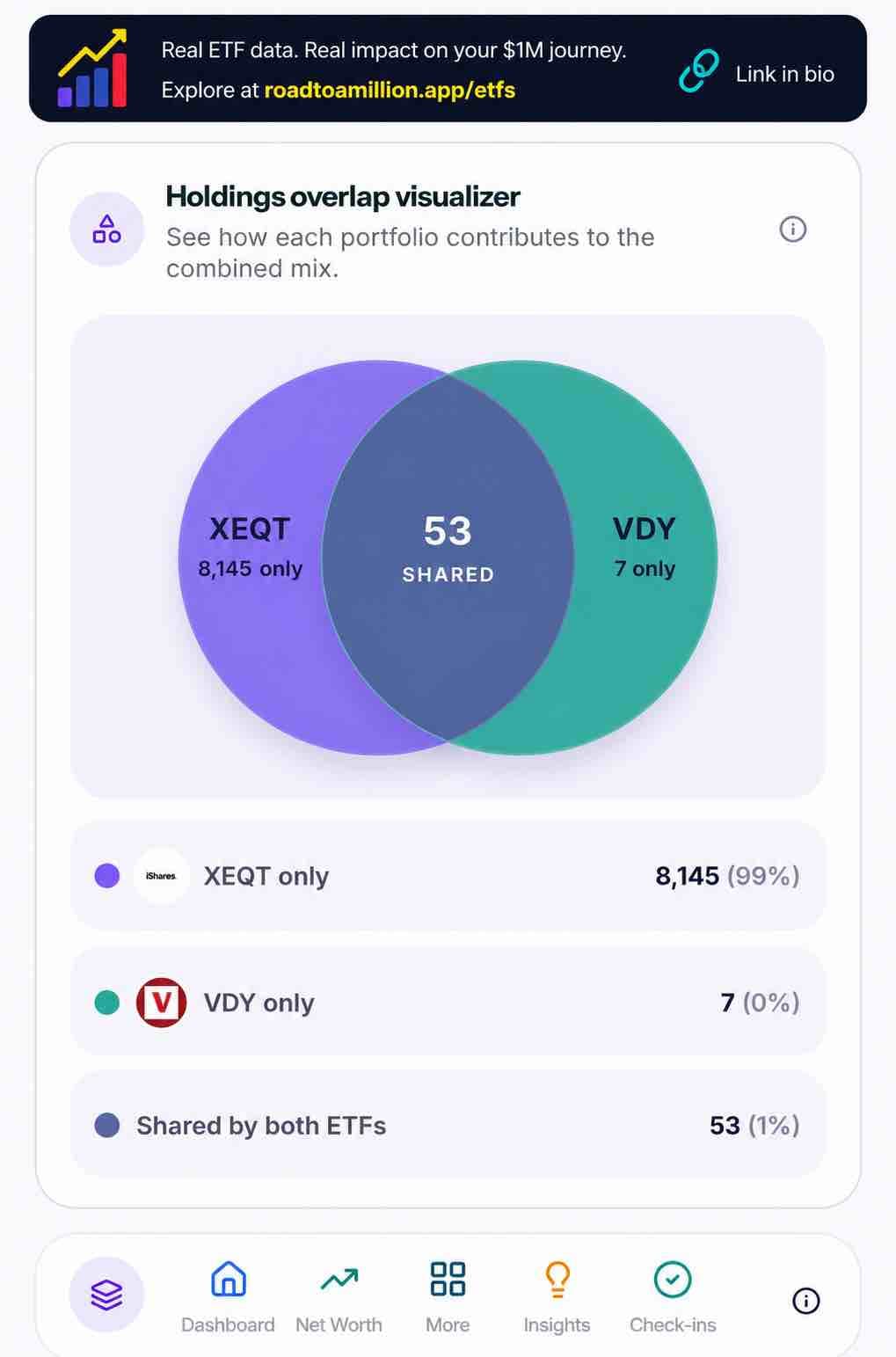
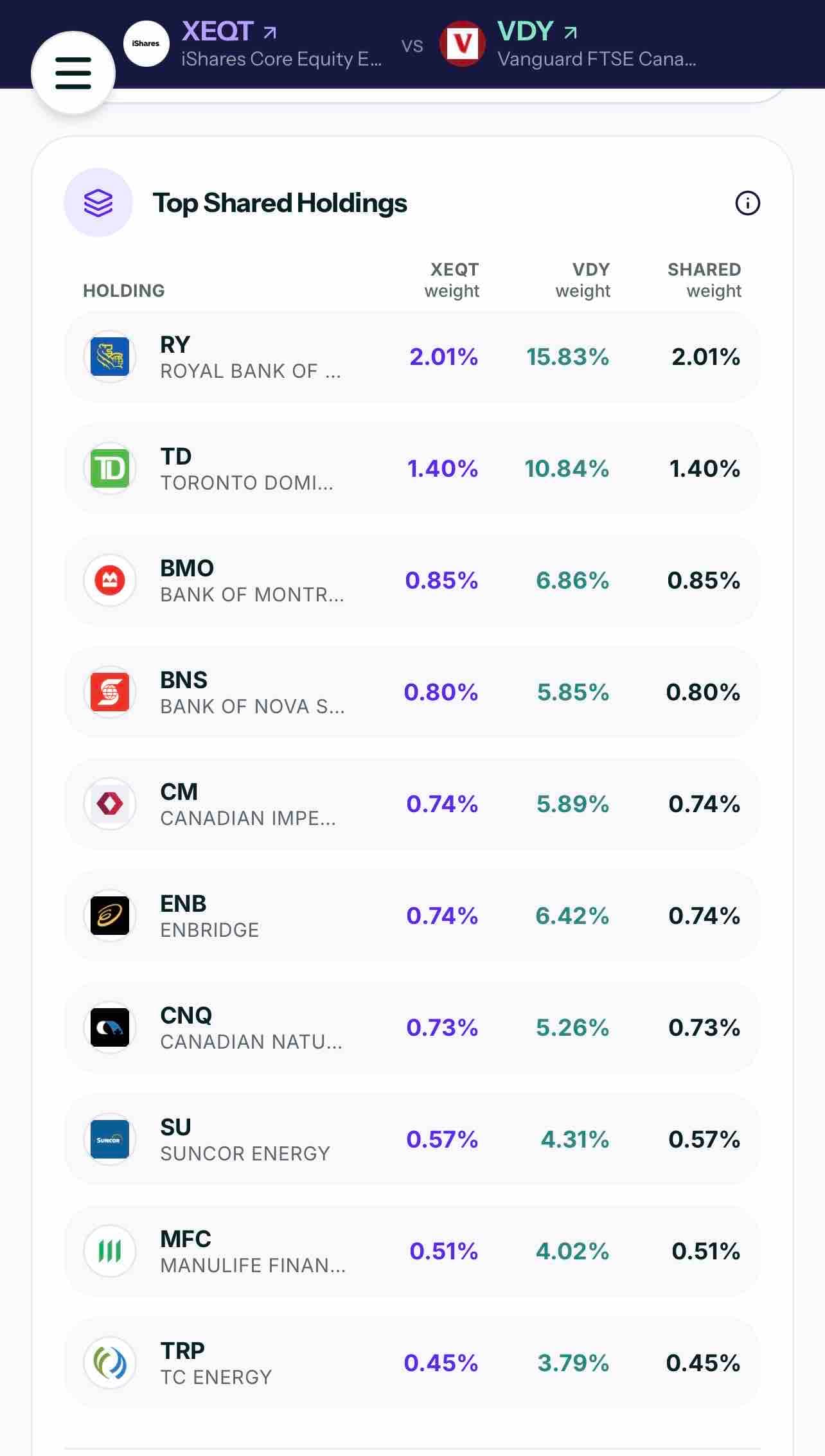
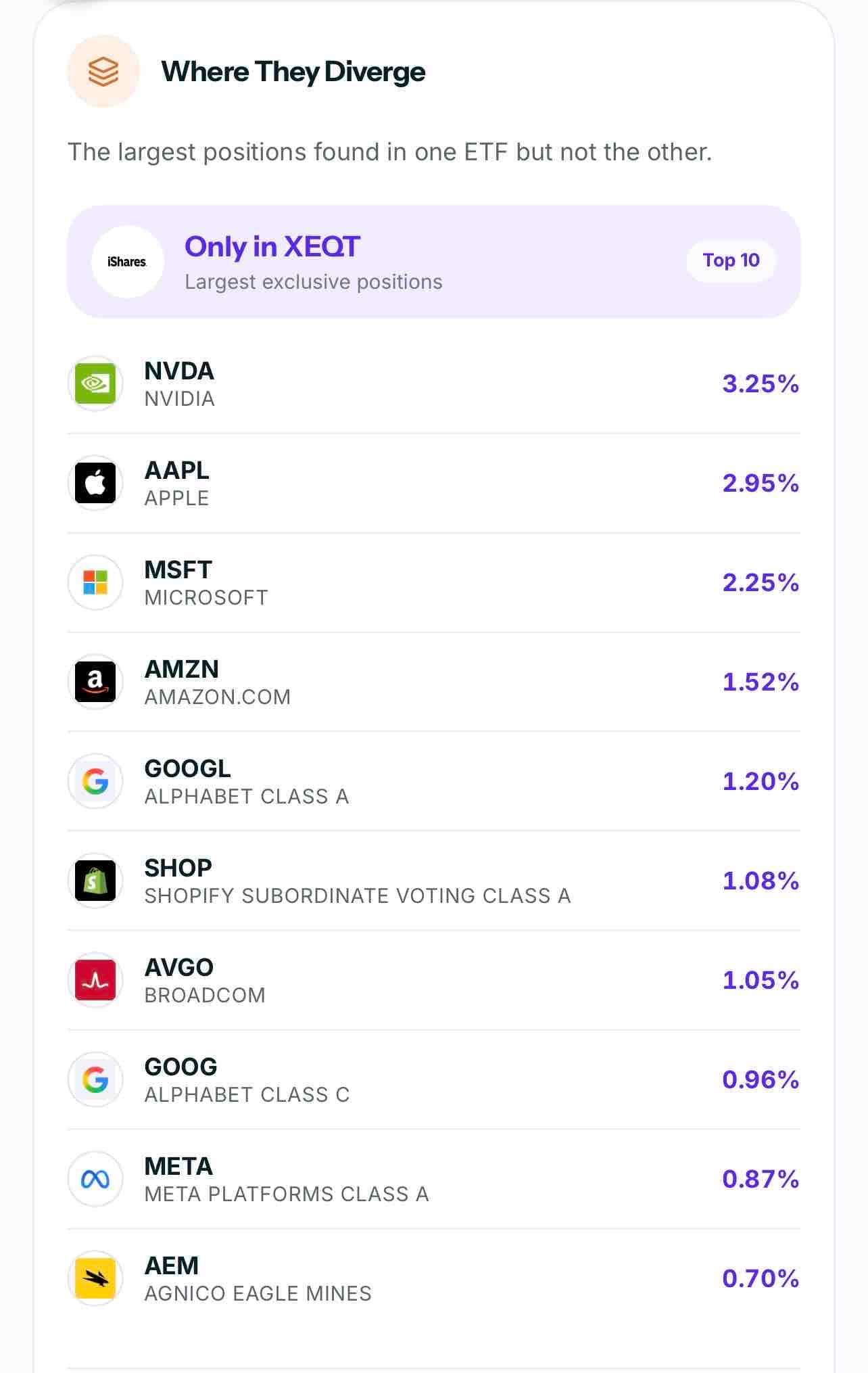
I took a deeper look at the holdings overlap between $XEQT and $VDY. Here’s the breakdown: • 53 holdings are shared • 8,145 holdings are unique to XEQT • 7 holdings are unique to VDY • 8,205 unique total holdings across both ETFs The shared names are mostly the large Canadian companies you’d expect: • Royal Bank • TD • BMO • Scotiabank • CIBC • Enbridge • Canadian Natural Resources • Suncor • Manulife • TC Energy Where they really diverge is outside that Canadian dividend core. XEQT adds names like NVIDIA, Apple, Microsoft, Amazon, Alphabet, Shopify, Broadcom, and Meta, while VDY’s exclusive positions are much more limited. So even though VDY is almost entirely represented inside XEQT, owning VDY alongside XEQT mainly changes the weighting toward Canadian dividend stocks rather than adding much new diversification. 🔍 Where to find this ETF Overlap Tool → Holdings Which ETF pair should I break down next? read more
One thing I’ve realized from being on here: you don’t need to have the biggest portfolio or know everything about investing to start building wealth. I’m just sharing my journey, the buys I make, the mistakes, and what I’m learning along the way. If you’re also trying to grow your portfolio over the next 5, 10, 20+ years, follow along. Would love to build this little investing community together. Have a great weekend everyone! $VTI$XEQT$VOO$NVDA
The market will test you. There will be red days. There will be stocks you wish you bought sooner. There will be times when doing nothing feels like the wrong move. But I think the biggest advantage most investors have is simply time. Keep investing. Keep learning. Keep adding when you can. You don’t need to get every trade right. You just need to keep playing the long game. 10 years from now, I’d rather look back and be glad I stayed invested than wish I had started. What’s one stock you plan on holding for the next 10+ years? $VTI$XEQT$VOO$VFVread more
If you had $100,000 to invest for the next 20 years, would you rather: A) Build a dividend portfolio and collect income along the way B) Focus on growth stocks and worry about income later I personally lean more toward growth while I’m younger, but I can definitely see the appeal of building a portfolio that eventually pays you every month. What’s your choice? A or B? And why? $VOO$SCHDread more
Let’s get a discussion going - if you were to build a 3 fund portfolio using of ETFs only Mine are $VTI $AOTG $XLE Drop yours in the comments? 👇read more
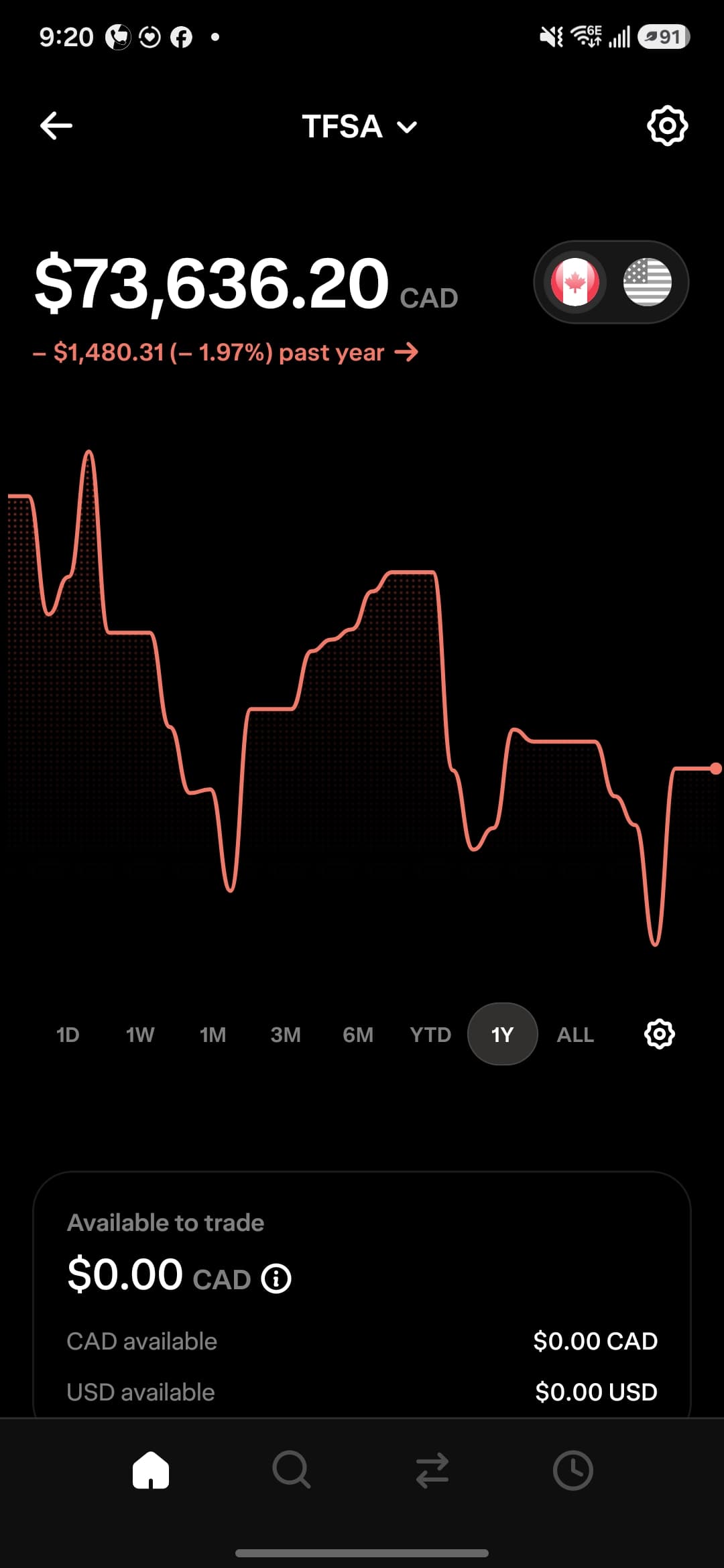
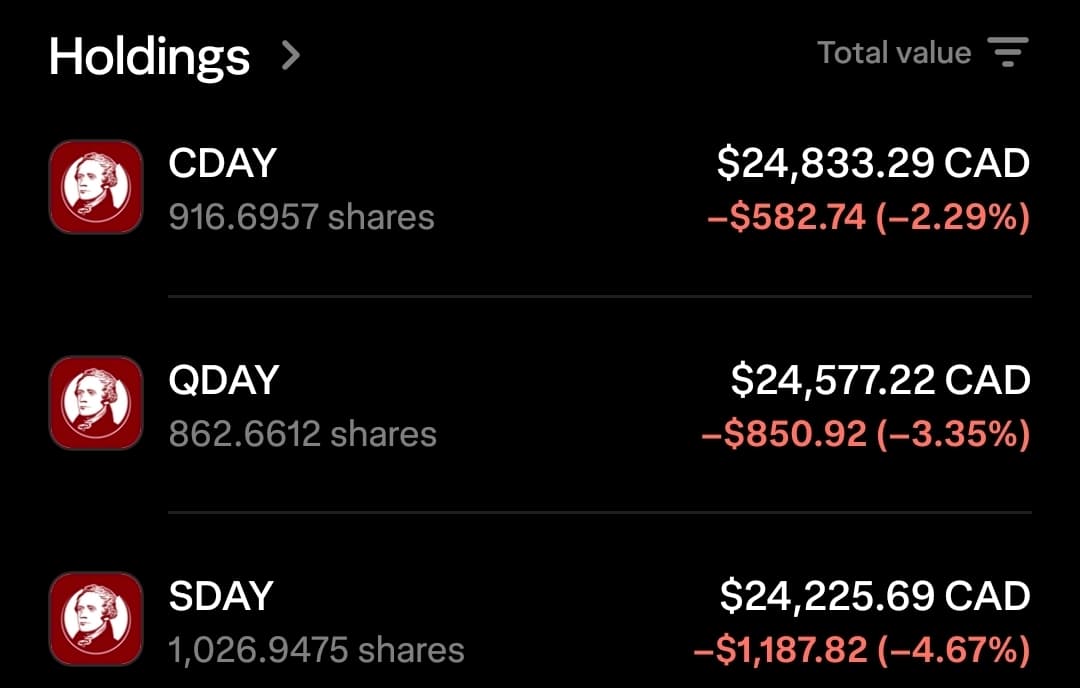
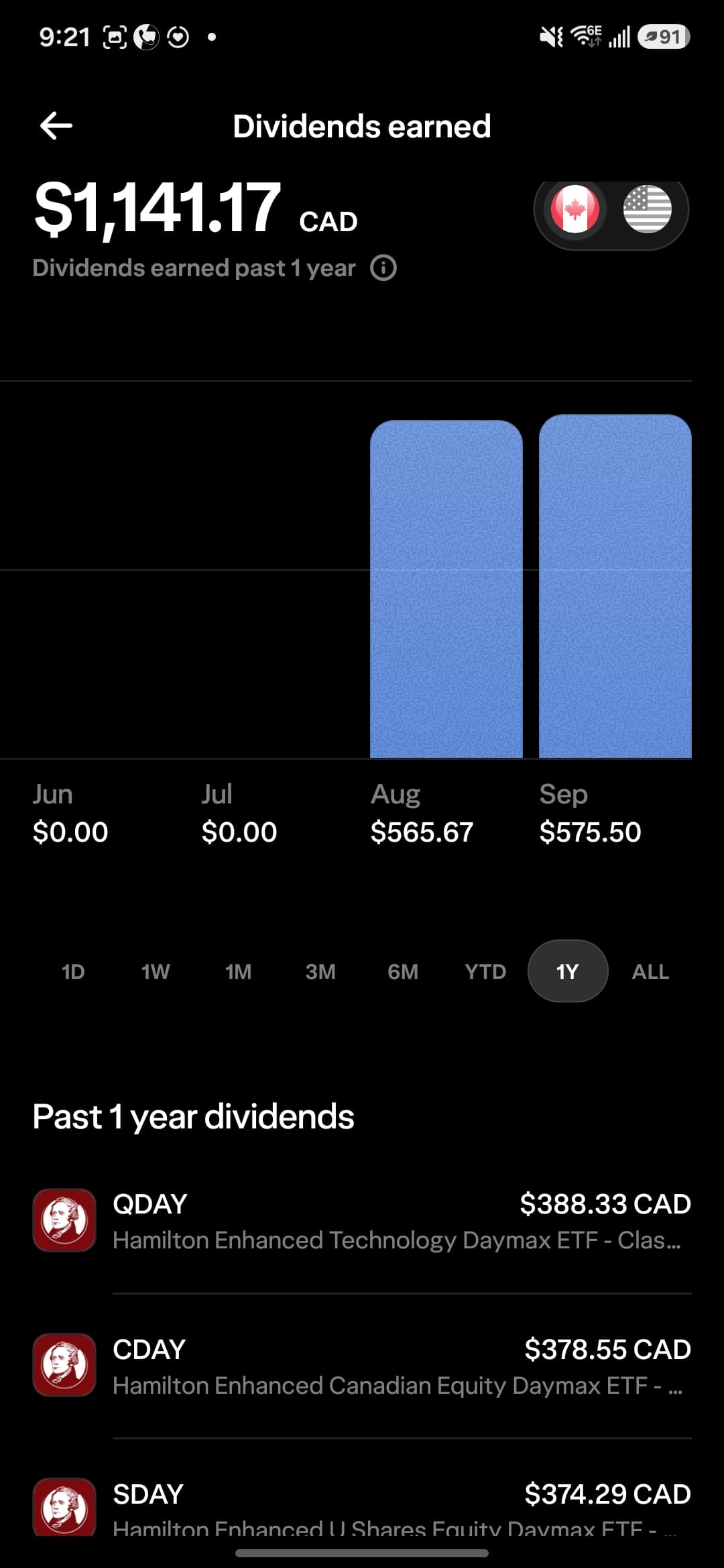
$75K TFSA. 30 Days. $1,141 in Distributions. On August 11, I opened a brand-new TFSA and deployed $75k across three Hamilton ETFs: 📈 QDAY 🍁 CDAY 🇺🇸 SDAY The goal? Build a tax-free income stream and let the distributions compound through DRIP And after my first 30 days, here's what happened: 💰 Aug. 21 payout: $565.67 💰 Sept. 8 payout: $575.50 Month 1 distributions: $1,141.17 CAD Here's what the Sept. 8 DRIP added: 📈 $QDAY → +6.944 shares 🍁 $CDAY → +7.0077 shares 🇺🇸 $SDAY → +7.9877 shares Total: +21.93 shares Now, before anyone says “free money”… 😅 The portfolio's market value is currently down 1.97% (-$1,480.31) from my starting point. And that's exactly why I'm watching total return, not just the distribution yield. Big distributions look great on paper, but what ultimately matters is the combination of: 💰 Distributions 📈 DRIP/share growth 📉 NAV & price performance ➡️ Total return This is a long-term experiment for me, not a claim that these funds are risk-free or guaranteed to outperform. I'm especially curious to see how the numbers look after 6 months and 12 months For anyone else holding Hamilton's 0DTE funds: are you happy with the total return so far? read more
Canada is making a major pitch to global capital. https://www.cbc.ca/news/business/carney-investment-summit-explainer-9.7341009 At the Canada Investment Summit, the federal government is positioning the country not only around traditional strengths such as energy, infrastructure and critical minerals, but also around AI, data centres, quantum and advanced technology.
Well, I really dont. Following my recent post about reaching my 2026 investing goal, I was asked how I stock pick, since my portfolio has a few individual stocks mixed in with my core ETFs. A lot of those positions are simply part of my investing journey. I started with $500 in Wealthsimple and didn’t contribute another dollar for a year because I was scared of losing money. Eventually, I started learning and doing my own research. I watched videos, used Morningstar, and literally sat down with a pen and paper to learn how to analyze a stock. I started with Tesla and ATD, along with ETFs like ZCN and VRE. I was so nervous about losing money that I’d only buy three or four shares at a time. Then I discovered XEQT and VDY. I realized I could keep things simpler and diversified, and they became the core of my portfolio. I still hold a few individual stocks and more concentrated ETFs. I also got lucky with Rocket Lab, which I bought around $8. But my biggest lesson has been patience. You can research and choose your investments, but you still have to give them time to work. My progress didn’t happen overnight. If you’re on your own investing journey, feel free to connect. I’m always happy to talk investing and goals. 🙂 read more
$QQCL gets a lot of hype in the covered call ETF investing space. And I get it! The NDX (the Nasdaq 100 Index like $QQQ or $QQC ) is the best performing , WELL KNOW index in the US for tech. What I did in my most recent deep dive is compared the Nasdaq 100 against two covered call versions of the same index by cboe. The 5 year returns were TELLING .... and I mean TELLING! NDX .... +89% BXNH 50% covered .... +75% BXNT 100% covered .......... +53% That's the exact same Nasdaq 100 universe of stocks with VERY different outcomes because of selling ATM (at-the-money) monthly call options. These are not ETF's, so there was no cost drag either... I think that is the part that gets overlooked when investors see a 14.4% distribution yield.... Some think ....."Well… that looks delicious like tiramisu and I get an extra shot brandy on the side!” The Cboe indices show exactly what happens as you increase the amount of the portfolio covered by calls and sell them ATM (at-the-money) each and every month. The long term results are what the mechanics of call options should result in. So what are you really trading away to get that income? This question gets asked a lot... but never really answered concretely and definitively. And how does QQCL's 1.25x leverage AND the covered call strategy change the outcome? I dug into all of it in my latest deep dive... I broke the performance over the last 15 years using $QQCC (the non leveraged version), distributions and why they have been able to increase, the option strategy, the real costs of the ETF, leverage and what happens when the Nasdaq 100 decides to have one of its many crashes. After watching ... would you take the income … or the upside? https://youtu.be/sILOigoTS00read more
I want to know, seriously? Is it the dividend (distribution)? The performance? The low fees? Or did you eventually see enough people on the internet say something like, “$SCHD is the best dividend ETF ever". And ,you figured, 400,000 Redditors and YouTubers couldn't possibly ALL be wrong? 😅 Either way, there's something about SCHD that I believe many investors don't fully appreciate. Recently, 22 stocks disappeared from the ETF.... big names like Cisco and AbbVie... bye bye 👋 And they weren't replaced with the same old names So us investors need to ask ourselves....If I'm buying SCHD for the long term... do I actually know what I'm buying for the long term? The reason is that SCHD is NOT a static portfolio of dividend growth stocks. And depending on WHY YOU OWN IT, some of what I found might matter more than you think. For example, here's something interesting about its performance. SCHD looked remarkably strong when the market was getting hammered.... Then the market environment changed... And so did the SCHD story. Why... why, WHY? You need that answered And then there's the dividend (distribution).... I've seen SCHD described as the perfect retirement ETF because you can supposedly live off the income and never sell a share... Sounds like the perfect solution to a difficult problem. However... is that actually the best way to think about retirement income? And if you're Canadian, there's another question you should probably ask before buying it... Which account is the best for a high yield ETF like SCHD? In my latest deep dive, I put SCHD under the microscope... No “SCHD is amazing, buy it now” nonsense that you see on tikytoktok from me as you know 😂 I just go into the methodology, the numbers, the risks, the tradeoffs and my honest verdict/opinion at the end... ALWAYS remember, even a beautiful, high quality shoe can still be a TERRIBLE FIT 👠 So why are YOU invested in SCHD or why are you thinking about it? https://youtu.be/B2kxkIyHjPkread more
$MSTE up by 10% 💥. I was saving some money to finally buy some MSTE to reduce my average. Was hoping for under 2 dollar. but its increasing almost everyday. This might sound dumb, but have you all had this experience? Is it wise to wait or just cash in? I can never answer this myself.
Building the 50 year TFSA For me, the TFSA is the most coveted account. The contribution room is SACRED. I was obsessed with maxing it out as fast as possible to let compounding do its magic. Optimizing it has been my most recent priority. My goal with the TFSA is to be a buy and hold for 30+ years. Something I hopefully won’t touch until later in retirement. Make one ~$7000 contribution + buys per year, probably all into $VEQT . Then not look at the account again until the next year. With optimal long term total returns. The kind of thing a lot of people find a solution within a simple all in one fund like $XEQT. I love low cost passive indexing and am a true believer. But for me, it’s not quite enough. I personally believe: -In a Tech tilted future -In Bitcoin -25-30% home bias is kind of BS E.g. Do I believe in 30 years the Nasdaq 100 will outperform an all-in-one fund? Yes. Will it be a choppy ride? Also Yes. 8 months ago I said goodbye to individual stocks in my TFSA: https://www.blossomsocial.com/posts/Its-finally-done-TFSA-is-percent-ETFs__POST-1767812921730-ww8KVMzA_nAUaQLqSRtwRiLHr Today I took another big step forward with this in my TFSA refactor. I said goodbye to 4 holdings: $XIC $VFV $XEF $XEC And hello to: $VEQT I also trimmed over 1/3rd of $SOXX. Lastly I trimmed some $QQQM for some $VOO. This may seem like small moves, but it took a lot of thinking for me to pull the triggers. As usual, I’ve spent way too many hours thinking about my portfolio construction. I liked the lower fees and having the granular control over a decomposed all-in-one equity ETF. Where I subbed US all market cap for SP500 (VFV), and had modified allocations to Canada (XIC), and International (XEF, XEC). Ironically, I chose $VEQT as my all in one fund because it is heavier on the Canadian side (~30%). Overall the TFSA breaks down as: 69% Equities ($VEQT, $QQQM, $VOO, $SOXX) 28% Bitcoin ($IBIT , $FBTC) 3% Gold ($ZGLD) There is only really one more move left to make: completely get rid of $SOXX. I love the thematic tilt, but it simply does not pass the 30 year buy and hold test. I am still working on the plan to reallocate this semiconductor exposure partially into my other accounts. Cheers 🍻read more
Hey everyone happy Sunday. Just about to start my shift and have the classic ice coffee to help☕ What would recommend hold in a FHSA, about to open one here soon which is exciting, my time horizon is 10-12 years. Thinking either $VFV or $XEQT. Any ideas? Cheers.
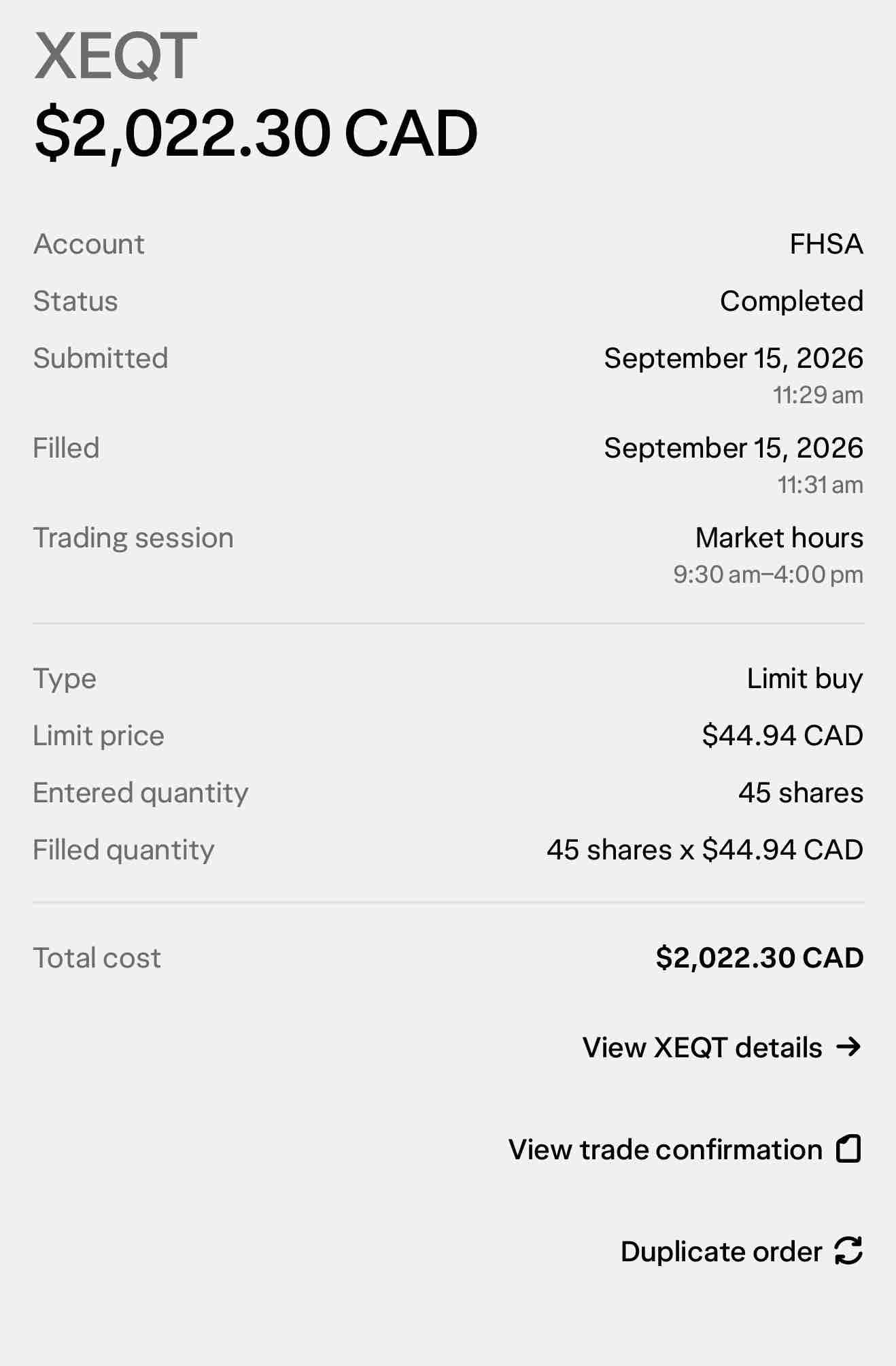
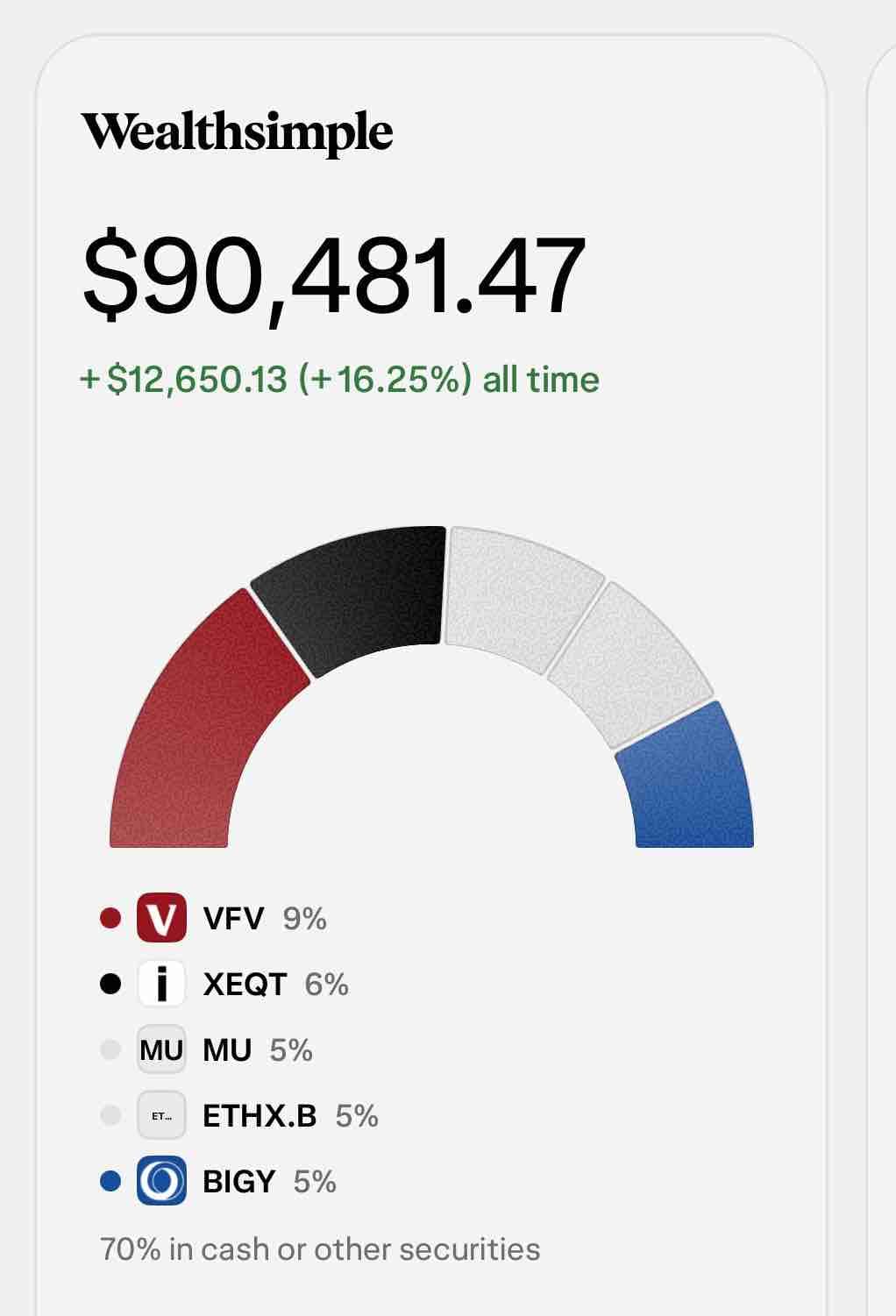
Today I reached 90k in investments 🥹 I still can’t believe it. Maxed out my TFSA contribution room for the year. Bought some $XEQT in FHSA today🔥 Excited to see how it goes. I want to reach 100k so that I can peacefully gift my wife a car 🚗 we have lived our lives without a car in Canada so far 😭 $VFV$MU$AMZN$VDYread more