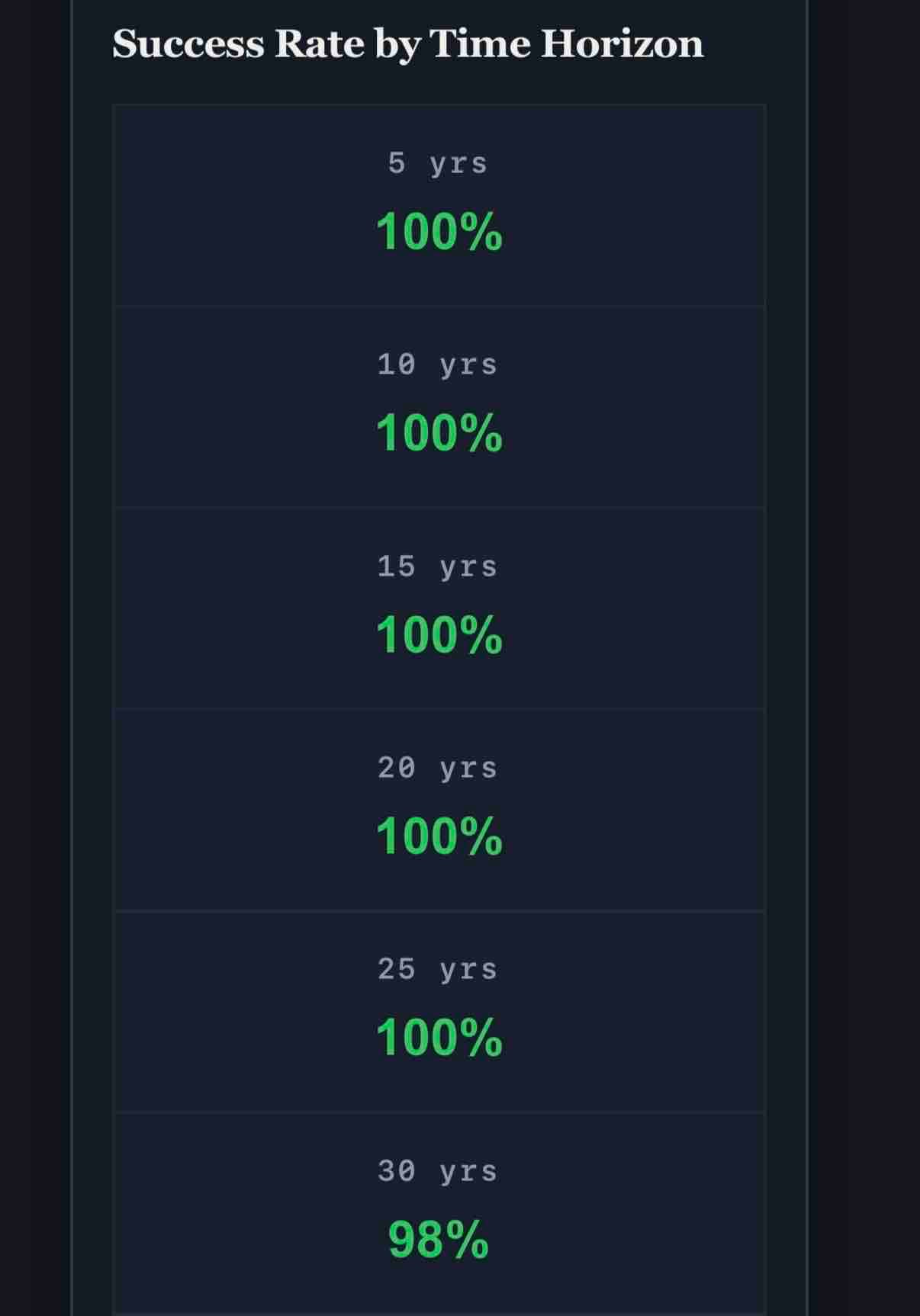
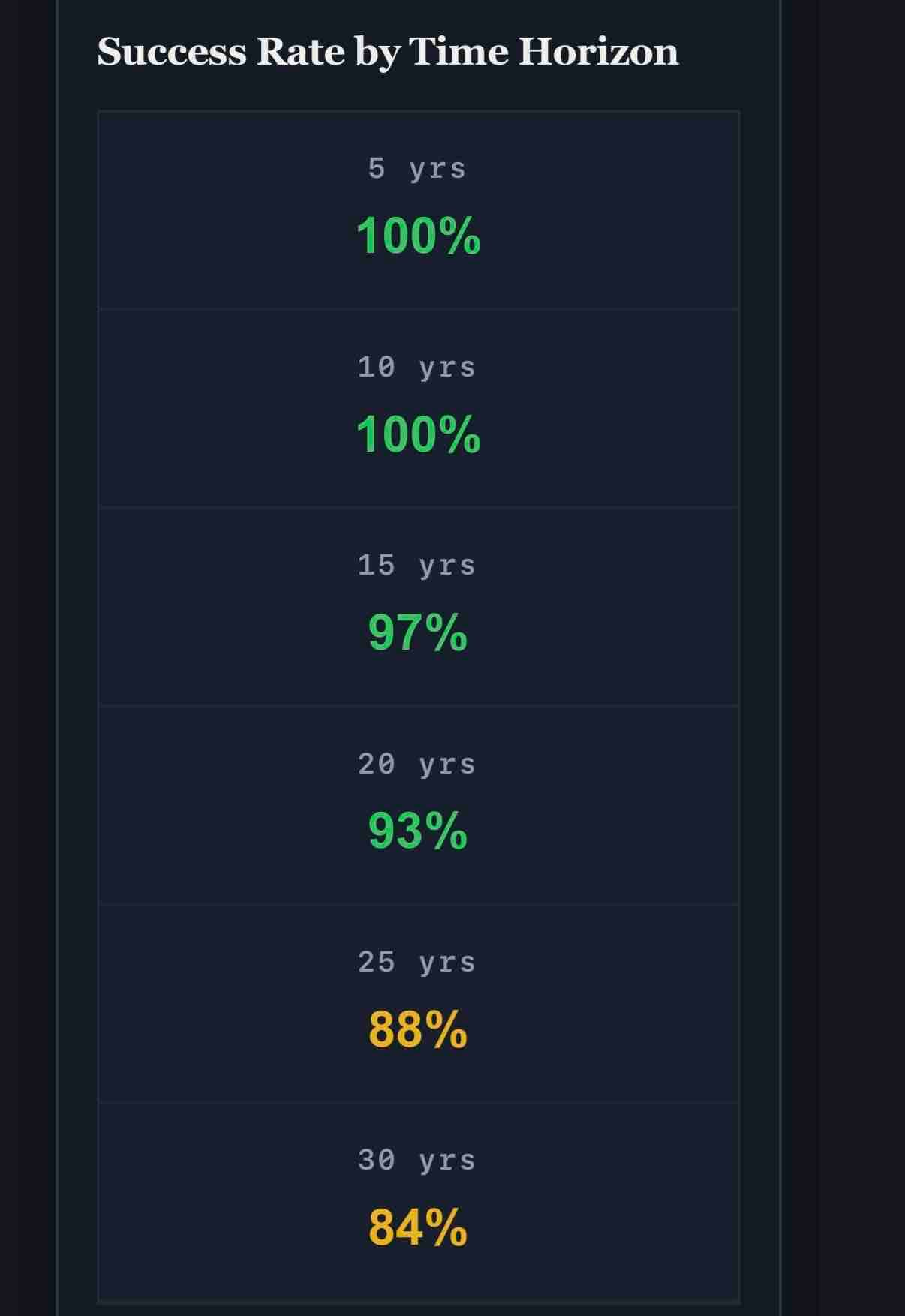
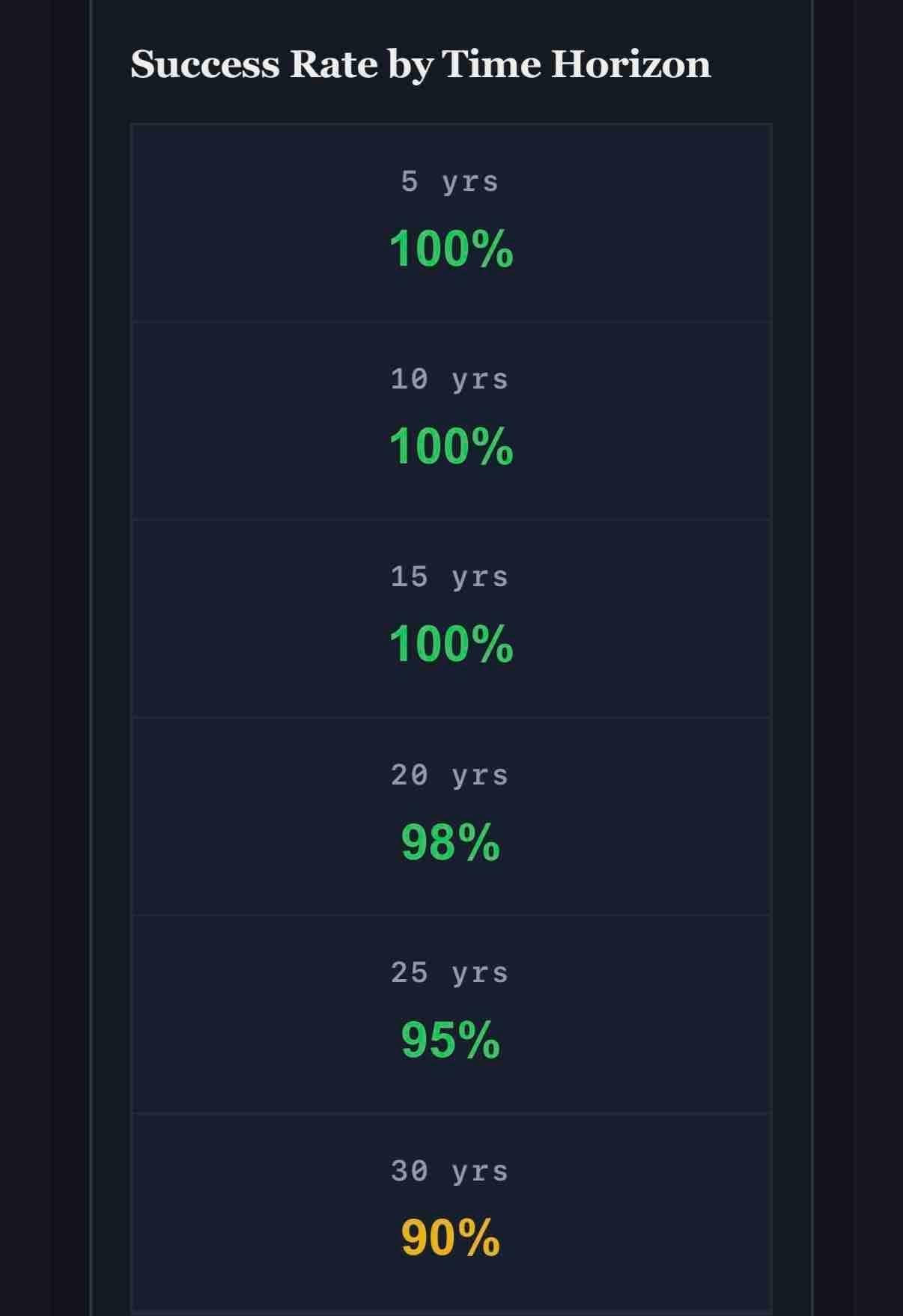
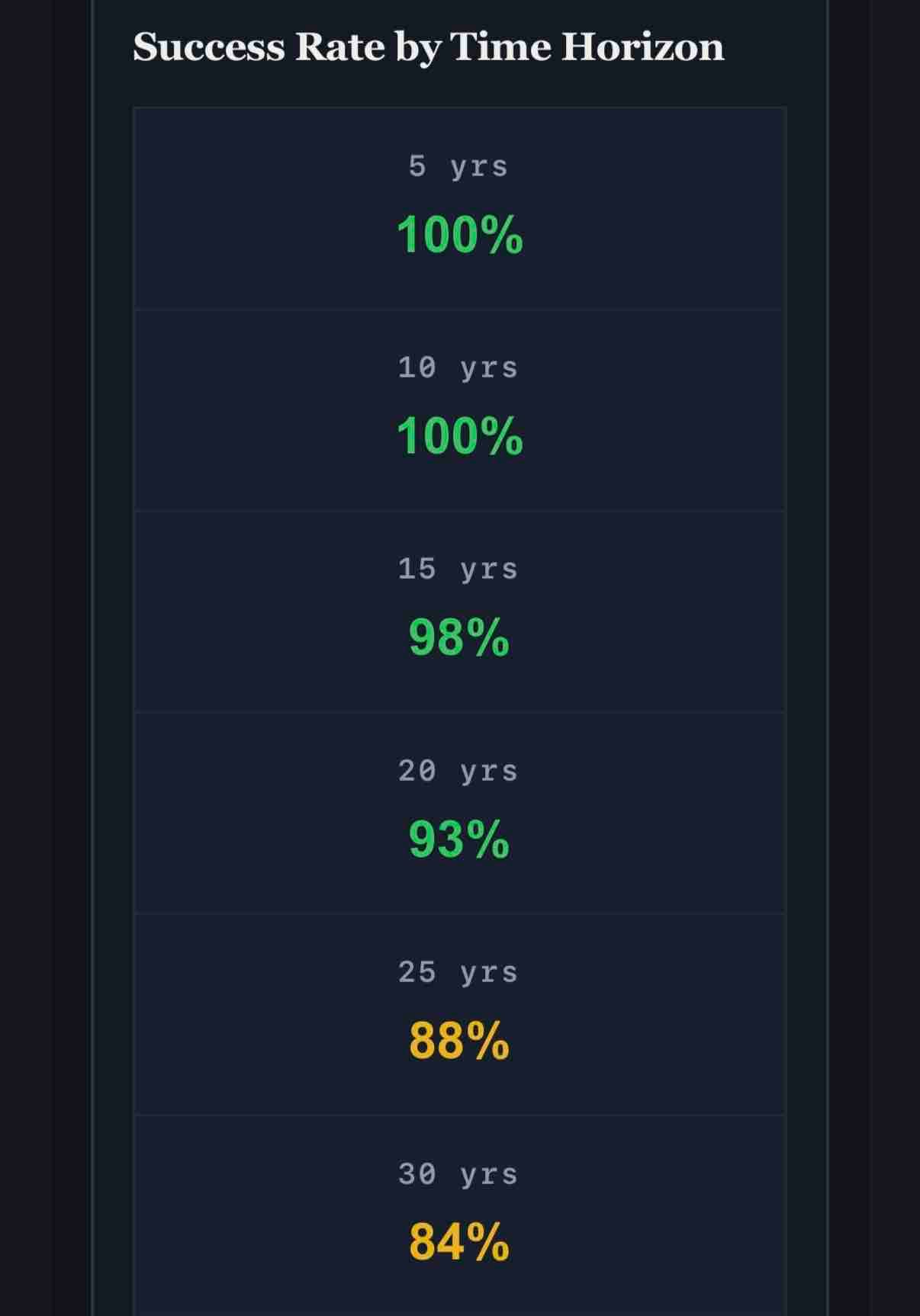
I’ve been running a very boring and conservative Balanced portfolio with a variety of ETFs (Index, Factor & a bit of CC) for the last few years. 😴 Since markets have been strong the past few years it’s given me more than enough to cover our expenses. 🙌 But with the popularity of CC/High Yield ETFs and so many finfluencer videos to learn from I thought I’d check a few out and see if it makes sense to jump on the ‘yield train’ and take advantage of these big monthly pay days! Before pulling the trigger though I thought I’d run the theory through a few scenarios using @karyungtom Reitrement Spending Calcultor. https://karyungtom.com/retirement-spending-calculator/ We can’t know future return paths but we can run various assumptions based on past market performance and other tools like a Monte Carlo simulators. So let’s see what happens… CURRENT PORTFOLIO/APPROACH Plugging in my hypothetical $2M and setting my spending strategy to ‘Fixed Inflation Adjusted’ with the Withdrawal Rate = 4% starts me off with $80k for spending. Not bad! Let’s say my time horizon is 30yrs and Inflation = 2.5%. Using the ‘Historic Backtesting’ option (which pulls full history of SP500 data) I can see my portfolio was a near 100% SUCCESS RATE through all time periods (5-30yrs). ✅✅ But… Unfortunately I’m not comfortable running a 100% equity portfolio. Since im running a 60/40 portfolio I need to see what that looks like. THE BALANCED MODEL ⚖️😴 The only way to see the 60/40 Model using the tool is to change my simulation model to the Monte Carlo option. From there - I can keep the 100% equity option, change to a Global, 60/40, Conservative or even a Custom option by entering my own Return/Volatility assumptions. Before moving to my current 60/40 model I hit ‘Run Simulation’ on the SP500 (all equity) just to check result and this showed a probability of 90-100% for the shorter timeframes but 88%-84% for the 25/30yr periods. Still - odds would be in my favour that our money would last! ✅ Moving to my Balanced (60/40) option I expected a lower success rate due to being more conservative but surprisingly the 25/30yr success rate jumped to 95-90%. A bit surprising - but Great!! That said - I WANT A CASHFLOW MACHINE! 🏧 From one video I’ve seen the Finfluencer suggested ‘bonds are useless’ and from all the CC ETF portfolios I see on Blossom I assume that 100% equity is much better for the CC ETF approach. Another Finfluencer suggest I need to ‘create a yield at least 3x bigger than my spending needs’. This would let me receive big monthly paydays to cover my expenses and the excess could simply be reinvested! I would ‘never have to sell a share’. Sounds great! Luckily - @karyungtom calculator lets me model all of this out and link to Return/Volatility assumptions based on the preferred asset allocation. THE CASHFLOW MODEL 💰💰 Following the guidance of the Finfluencers I switched the model back to 100% Equity/SP500. This showed Expected Return = 10.5% and Volatility = 19.7% (both seem reasonable and inline). I guess I’ll just have to except more volatility if I want to benefit from the high yields. 🤔 I referred back to the ‘Rules/Guidance’ I saw online for CC ETFs and saw I should have a mix of 15%+ and 30%+ yielding products. Based on that I set my models Distribution Yield = 25%. YES!!! On the Model’s $2M value a 25% distribution would mean a $500k per year PAYDAY! Now we’re talking! 🤑🤑 Let’s run it! …… WTF! The SUCCESS RATE stayed the SAME. 🤷♂️🤷♂️ The 25yr = 88% and 30yr = 84%. So the portfolio generated way more cashflow but since I only need 4% to cover my spending I now have to reinvest the excess to make sure I get the same result. Hmm. I guess Distribution Yields don’t influence actual longevity. 💡 The calculator actual shows this in the ‘Portfolio Path Table’. It even shows the share count. Under this approach I guess I at least don’t have to ‘sell my shares’ right away since I’m receiving such big distribution. I guess those are a few benefits. 🙃 But wait - CC ETFs have much higher fees than the Tradtional Index/Factor ETFs I was using for my Balanced Model. 🤔 My model has a total cost of 0.5%. When I calculated the MER/TER of a CC ETF Model it was closer to 1.7%. I wonder if I should lower my Return to reflect the higher cost? I wonder if that makes a difference over 30 years? After all - 0.5% on $2M is $10k per year in fees and 1.7% is $34k in fees. Whatever 🤷♂️ - so I’m paying a bit higher in fees. There’s probably another calculator for that. Let’s ignore fees and get back to my options for boosting my MONTHLY CASHFLOW… So far I have the same expected success rate I’m just receiving cash instead of having to sell my shares but I’m paying a bit higher fees and have to make sure I reinvest all the excess cash that’s coming in. That hardly seems like much of a benefit and since I’ve seen these CC/High Yield investors pay for vacations, kitchen renos and new hot tubs with distributions I can probably afford to take a bit more out for spending right? HIGH SPEND MODEL 🏧🏦 With $500k per year or over $40k per month coming in and a $2M portfolio I can probably just reinvest 50% and take 50% or $250k for extra spending. An extra $250k of spending buys a lot of living!! Let’s go!!! So since my Yield = 25% I can set my Withdrawal Spend Rate = 12.5%. After all - I got some ‘juicers’ now! I’m not sure what those are - but I’ll buy them anyway if it means I get an extra $250k! Let’s run it ….. AGAIN - WTF??? My first 5-10yrs looks fine - but by year 15 (when I’m only 65) it shows I’d have a 70%+ chance of hitting $0!! Year 25 = 88% and Year 30 = 90% chance of running out of money. 🤬 So success is NOT ‘impossible’ it just seems to be a lot ‘less probable’. Especially since result shows the exact OPPOSITE of my Balanced Model and 4% withdrawal that had a 90% SUCCESS RATE. So if I change - I get big paydays each month and don’t have to sell units but I have to take on more risk, pay higher fees, reinvest all the excess cashflow and accept that there’s only a 10% chance that my portfolio may still have some money by the time I’m 80?? But this is getting to be a lot to swallow. 😬 Maybe I missed something. Maybe this is better for SMALLER ACCOUNTS. I can change the portfolio value from $2M to $500k and maybe we can use it for our smaller accounts? Let’s run that… FML!! That’s also just a 10% chance of our money lasting 30yrs and a 90% chance that it runs out. ⚠️⚠️ Honestly - What’s going on? Ohhhh! You know what - this tool and calculator is probably wrong and just more ‘FUD’ because @karyungtom is one of those ‘growth’ investors. 😂 Then again - I guess the Finfluencers that I watched - despite their videos, spreadsheets and followers/sponsorships - may also just be learning too and also trying to figure this stuff out. 🤔 Either way - I get that these tools and calculators are all based on historic data (since future returns are unkown) - and they rely on a variety of assumptions and inputs - but just to be on the safe side and in case this analysis/approach is NOT totally wrong - I better take some more time to think and learn about portfolio construction, distributions and withdrawal strategies before I make a change to my actual portfolio. 💡 So for now - as tempting as $40k / mth looks - I’m going to stick to my boring Balanced Model with 4% withdrawals because this data shows it has a higher probability of creating more sustainable longterm wealth. ✅✅✅ MY TAKEAWAY ‼️ Despite everything I’ve seen online about the high yield strategies I’ve actually thought distributions were always just a ‘feature’ of a portfolio - not an actual strategy on their own or a reflection of quality or indicator of future returns. This exercise more or less would support that view. 🤷♂️ I can see the use case for some CC ETFs in certain situations but it’s important to consider all aspects. Currently I’m happy with the small % that I own (more as a way to capture volatility vs for the yield) so maybe I don’t need to ‘go all in’ on them and take more risk or pay the high fees across my entire portfolio? 🤔 Since we can’t control markets or returns - withdrawing too much too fast seems like one of the surest way to damage a portfolio’s longevity and we’re probably better to control what we can - asset allocation, strategy selection, fees and withdrawals/spending. ✅ Still happy to have gone through the exercise. Hope this helps and you consider doing the same. 🤓 Perspective ≠ Prediction Stay open to learning and do what’s best for you! 😉👍 ————- PS. Whether you agree with my take away and analysis or not - it’s worth exploring @karyungtom tool and entering your own models/assumptions. It’s a good one! 🤓 .
1,472 views
14 Comments
M @pantomimepotato · 3h
Don’t you know that having a higher yield magically increases safe withdrawal rates??? See, the problem is you’re using outdated data. We can throw all those decades of theory and research in the trash. It’s just a bunch of hogwash to keep the retail investors poor. You need to get on with the modern times, man. Source: It was revealed to me in a dream.
Scott S@scottsinvesting · 2h
Thank goodness!!! I totally thought this post was going in another direction at first and my head was shaking back and forth, saying no, no, no ETF Go...
Levi Ewald@smallbird.financial · 1h
Love this post, very well written. Hope newer investors read this before getting sucked into the CC Algorithm with Perry and Adriano…
Ronan @ronan · 1h
Great (sarcastic) post and breakdown Long ago I gave up the debate, if you won’t agree with math there’s no hope for your portfolio Like I’m sure you’ve discussed, withdrawal rates is based on EVERY source of what you withdrawal. No matter where it comes from, it’s part of your withdrawal, yield is no different What makes it worse is the SWR assumes a broad index or a mix of stocks/bonds, most of these products are based on single stocks or a small basket of hype picks that is even MORE risk of failure Those fund managers are having the time of their life
See the full comment section 👀Sign up for the full Blossom experience!