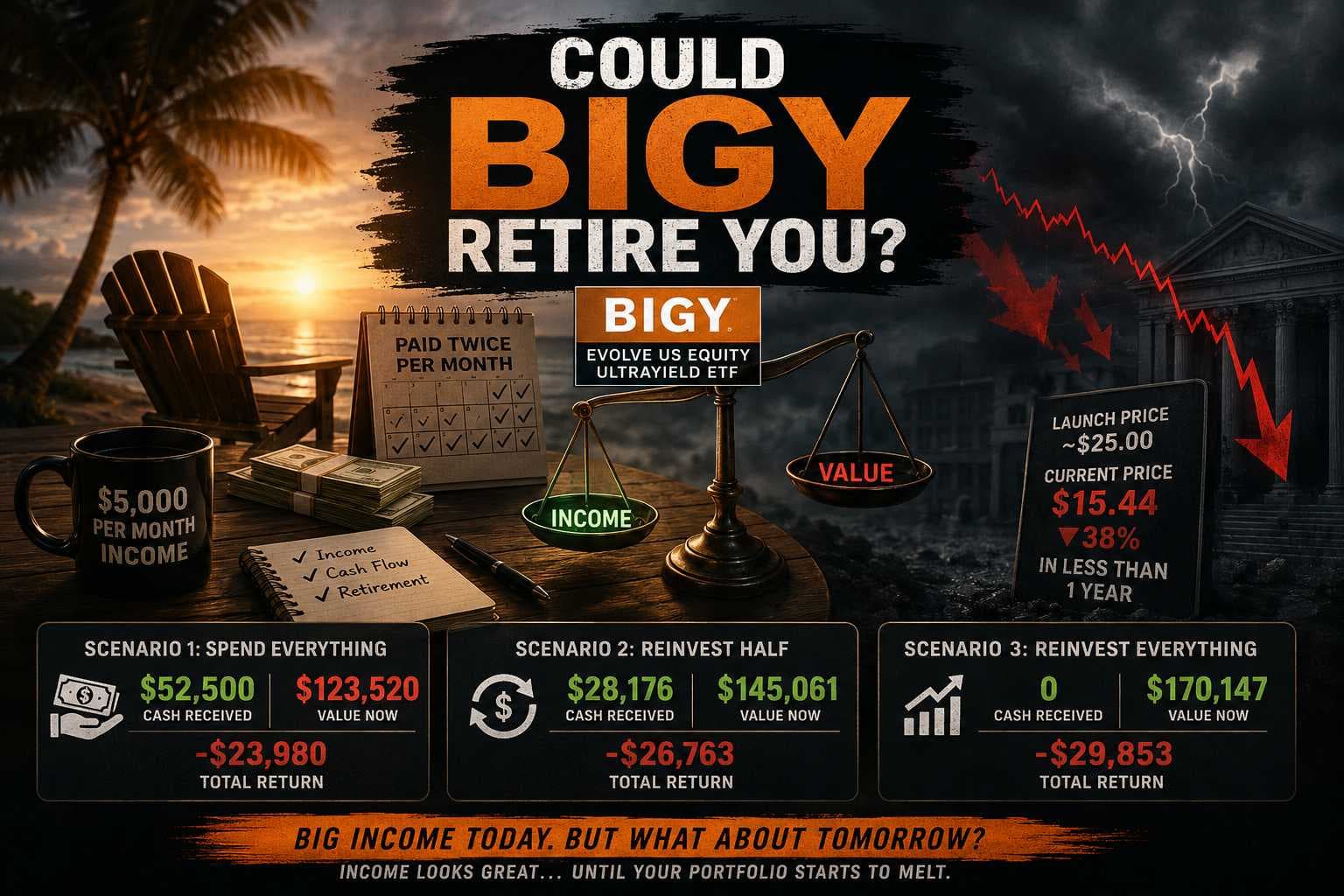
Could BIGY Retire You?
BIGY, BIGY, BIGY can you retire me ? Those big distributions hypnotize me...
I used to watch a YouTube channel where the creator would take an income fund and ask a simple question: Could this investment have supported someone through retirement?
The experiment usually followed a hypothetical investor who bought the fund at launch and handled the distributions in one of three ways:
Scenario 1: Spend everything.
Scenario 2: Spend half and reinvest half.
Scenario 3: Reinvest everything.
It is not necessarily useful for predicting the future because we already know how the historical period ended. Real investors never have that luxury. Still, it shows how three people can buy the exact same investment on the exact same day and end up with very different results based entirely on what they do with the income. And really it was just for entertainment and makes for an interesting thought experiment.
So, why not try it with Evolve US Equity UltraYield ETF ticker BIGY
BIGY was designed to generate a very large amount of income, with distributions paid twice per month. The headline yield immediately catches an income investor’s attention, but a large distribution does not automatically mean the investor is getting richer. Sometimes income represents real growth. Other times, it is simply money moving from one pocket to another and with that said lets look at BIGY.
Imagine an investor bought 8,000 shares of BIGY at launch for approximately $25 per share, requiring an initial investment of roughly $200,000. With a distribution of $0.3125 per share twice monthly, the position would generate approximately $5,000 per month. Between September 29, 2025, and July 31, 2026, BIGY made 21 distributions.
Scenario One: Spend Everything
The investor spent every distribution like a paycheque. They would have collected: $52,500 in cash They would still own the original 8,000 shares, worth approximately $123,520 at BIGY’s July 31 price of $15.44.
Their monthly income would remain approximately $5,000 because their share count never changed and the fund has not made any changes to the distributions paid out.
The share value fell from roughly $200,000 to $123,520, a decline of about $76,480, or 38%.
After including the distributions, the investor’s total return would be approximately: $176,020. That leaves them down around $23,980, or roughly 12%.
There is an important distinction here. If the distributions were spent, the investor would not currently have $176,020 sitting in an account. They would have a portfolio worth $123,520 and would have already consumed $52,500 of income.
Scenario Two: Reinvest Half
The second investor spent half of each distribution and reinvested the other half.
By July 31, they would have:
Received approximately $28,176 in cash
Increased their position to approximately 9,395 shares
Built a portfolio worth approximately $145,061
Increased monthly income to approximately $5,872
Including the cash they received, their total return value would be approximately: $173,237 That leaves them down about $26,763, or roughly 13%.
This investor ended with more shares and more monthly income than the investor who spent everything, but their total return was slightly worse. Why? Because the reinvested distributions purchased additional shares while BIGY continued falling in share price. They owned more shares, but those new shares were worth less.
Scenario Three: Reinvest Everything
The final investor spent nothing and reinvested every distribution. Their original 8,000 shares would have grown to approximately: 11,020 shares
Those shares would be worth approximately: $170,147 That leaves the portfolio down about $29,853, or roughly 15%.
However, this investor built the strongest income stream. Their monthly distributions would have increased from approximately $5,000 to $6,887. That is almost $1,900 more income per month in less than one year. At first glance, you might expect the investor who reinvested everything to have the highest total value.
That is normally the promise of compounding. More shares produce more income. More income buys more shares. Those shares produce even more income. But compounding does not automatically create wealth. It simply multiplies whatever is happening underneath it. When an investment rises, reinvestment can accelerate the gains. When it falls, reinvestment can mean repeatedly buying more of something that continues to lose value.
The Final Results
Spend everything:
$176,020 total return value
Down approximately $23,980
Reinvest half:
$173,237 total return value
Down approximately $26,763
Reinvest everything:
$170,147 portfolio value
Down approximately $29,853
For this period, the investor who spent every distribution finished with the best total return because they removed cash before the share price declined further. The investor who reinvested everything finished with the lowest total value, but they now own approximately 3,020 more shares and generate the largest monthly distribution.
That could matter if BIGY eventually recovers. The investor who reinvested everything would benefit the most from rising prices because they own the most shares. The investor who spent everything protected themselves better during the decline, but would participate less in a future recovery.
That is the strange trade-off with reinvestment. During a falling market, spending the income can look like the smartest decision. During a rising market, reinvesting can look brilliant.
So, could BIGY retire you?
After nearly one year, BIGY has not cut its distribution. The original 8,000 shares continue to generate approximately $5,000 per month. But the original investment has also fallen by more than $76,000 in market value while paying approximately $52,500 in distributions. The income softened the loss, but it did not eliminate it.
So could BIGY ALONE safely retire someone on $5,000 per month with no reinvestment? I would say no. I think you would need some level of reinvestment or it could be a part of a larger strategy. The first year suggests the distribution is currently too high relative to the fund’s total return to be considered a durable, capital-preserving retirement income stream. The fund may maintain the nominal payment for another year or longer, but maintaining a distribution and sustaining a retirement are not the same thing.
At the July 31 price of $15.44, the annualized distribution is:$0.31250 × 24 payments = $7.50 per share annually. That is an indicated distribution rate of:$7.50 ÷ $15.44 = 48.6% A portfolio of large U.S. stocks, covered calls and moderate leverage cannot reliably generate a 49% economic return every year through a full market cycle.