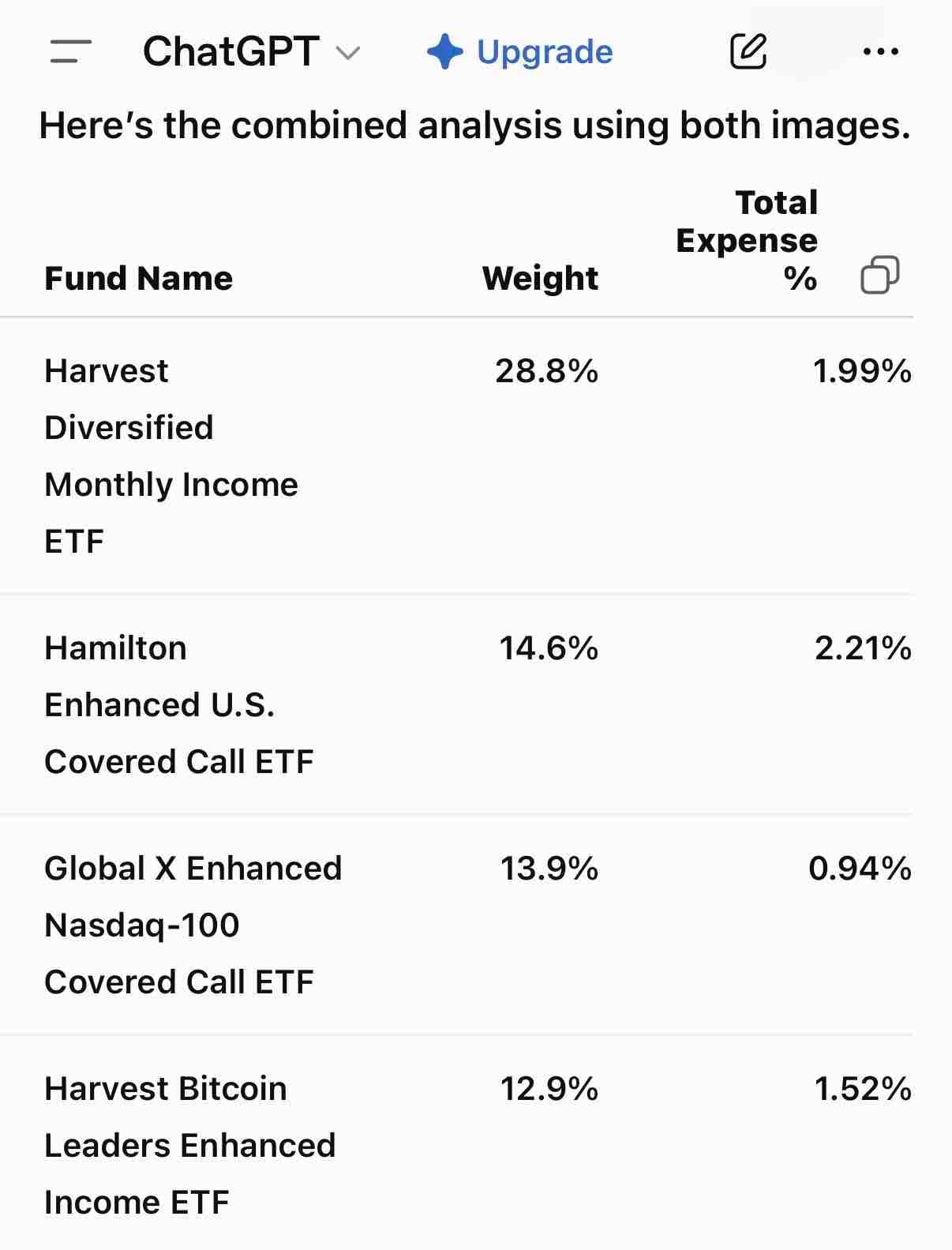
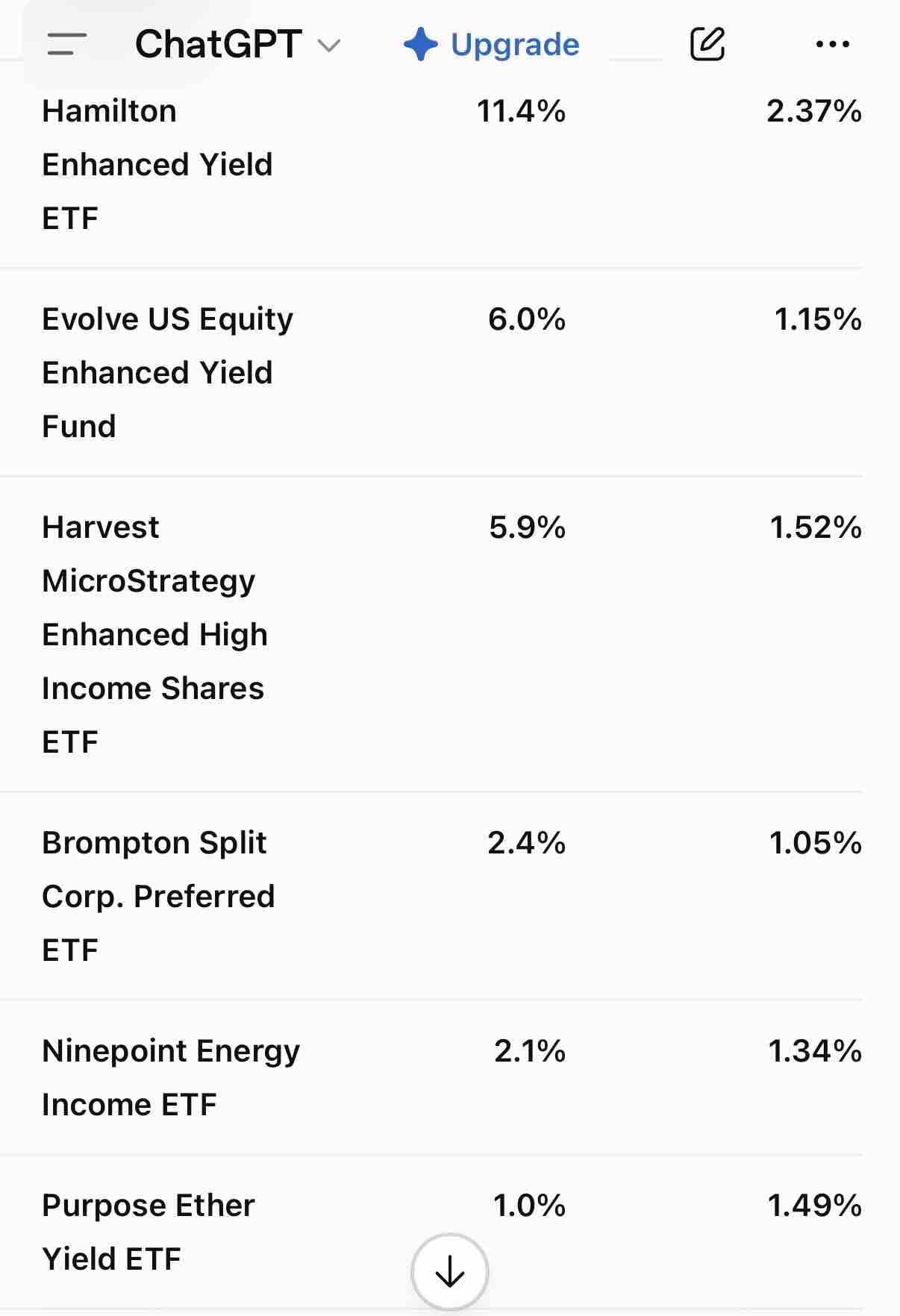
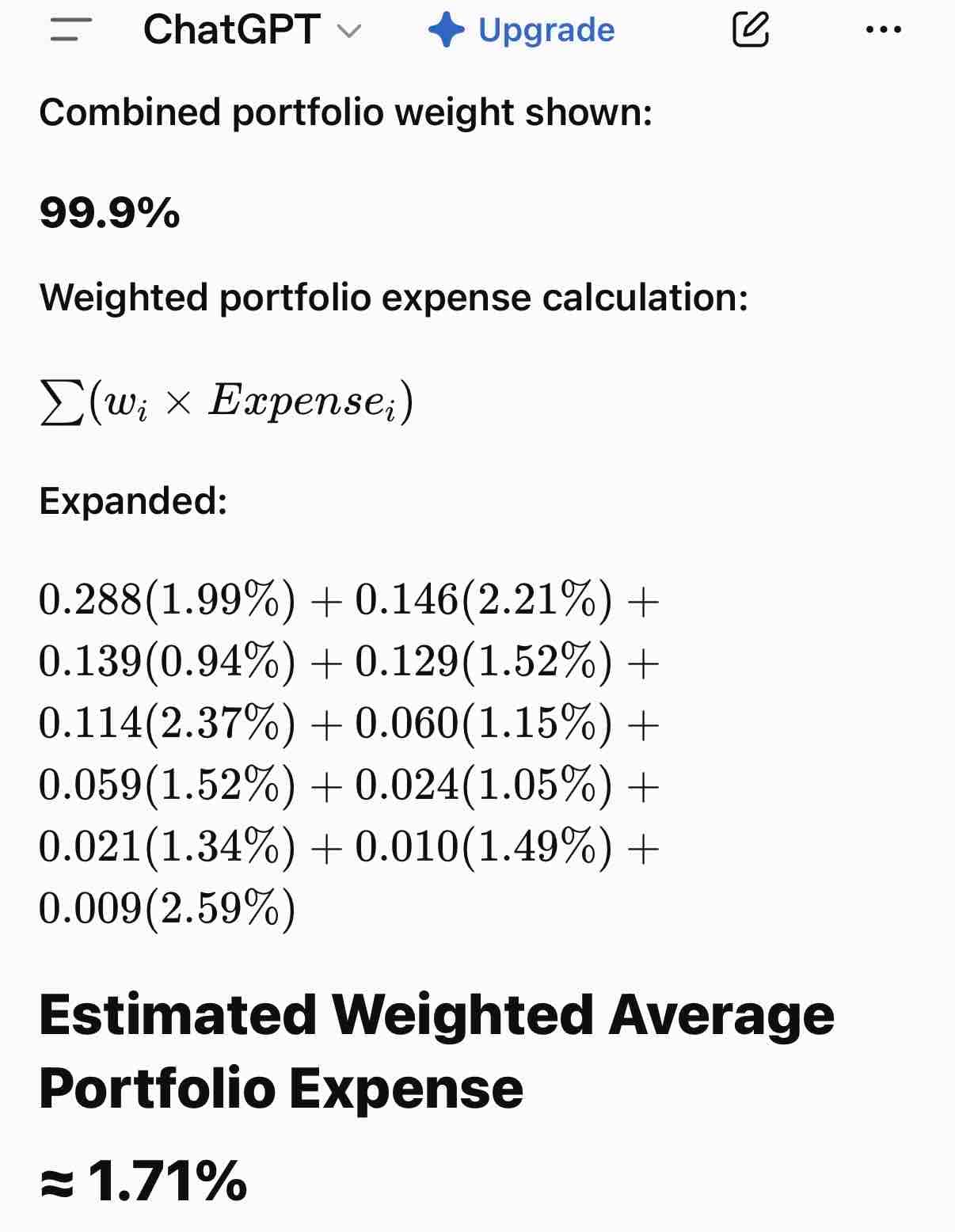
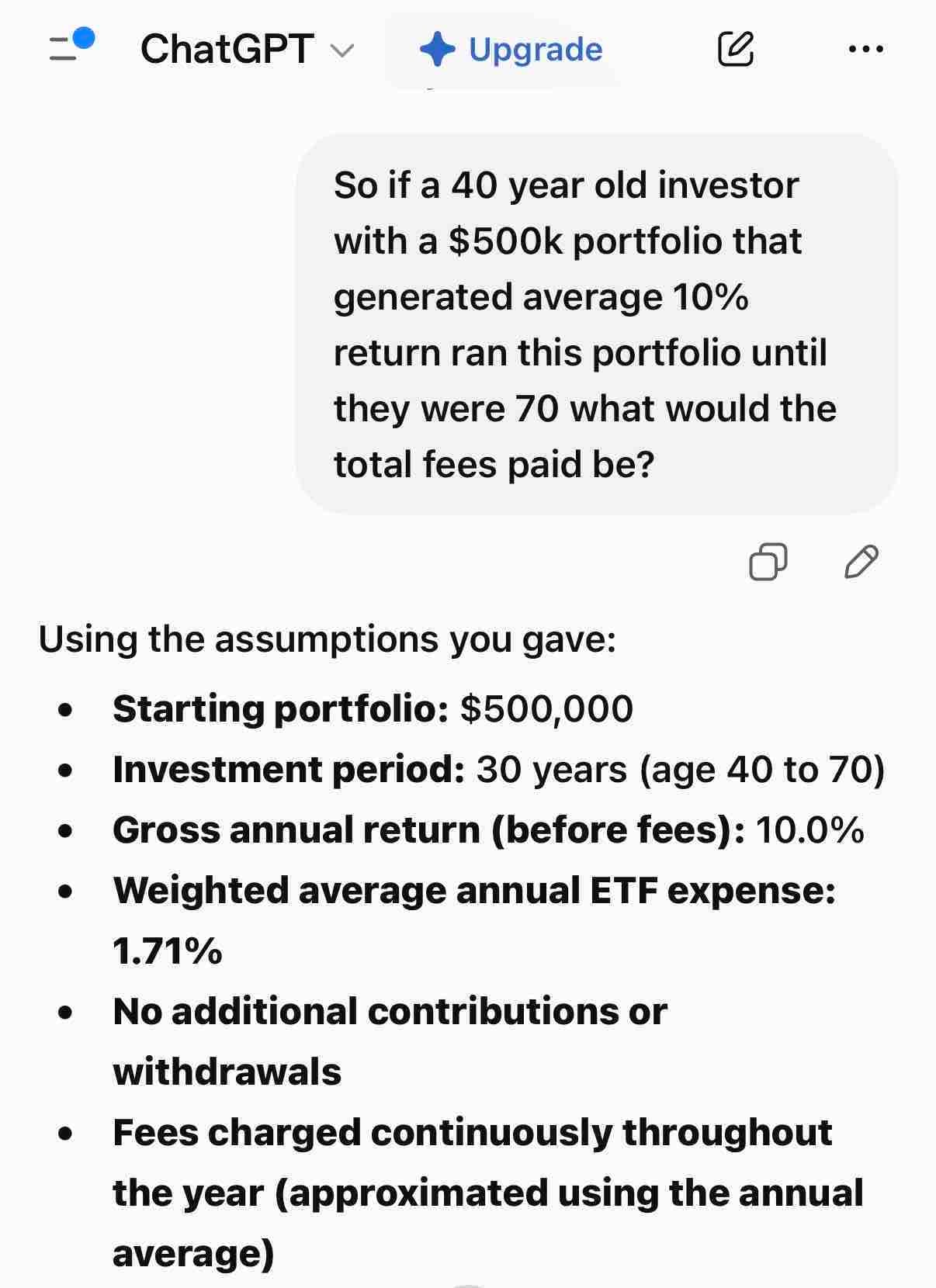
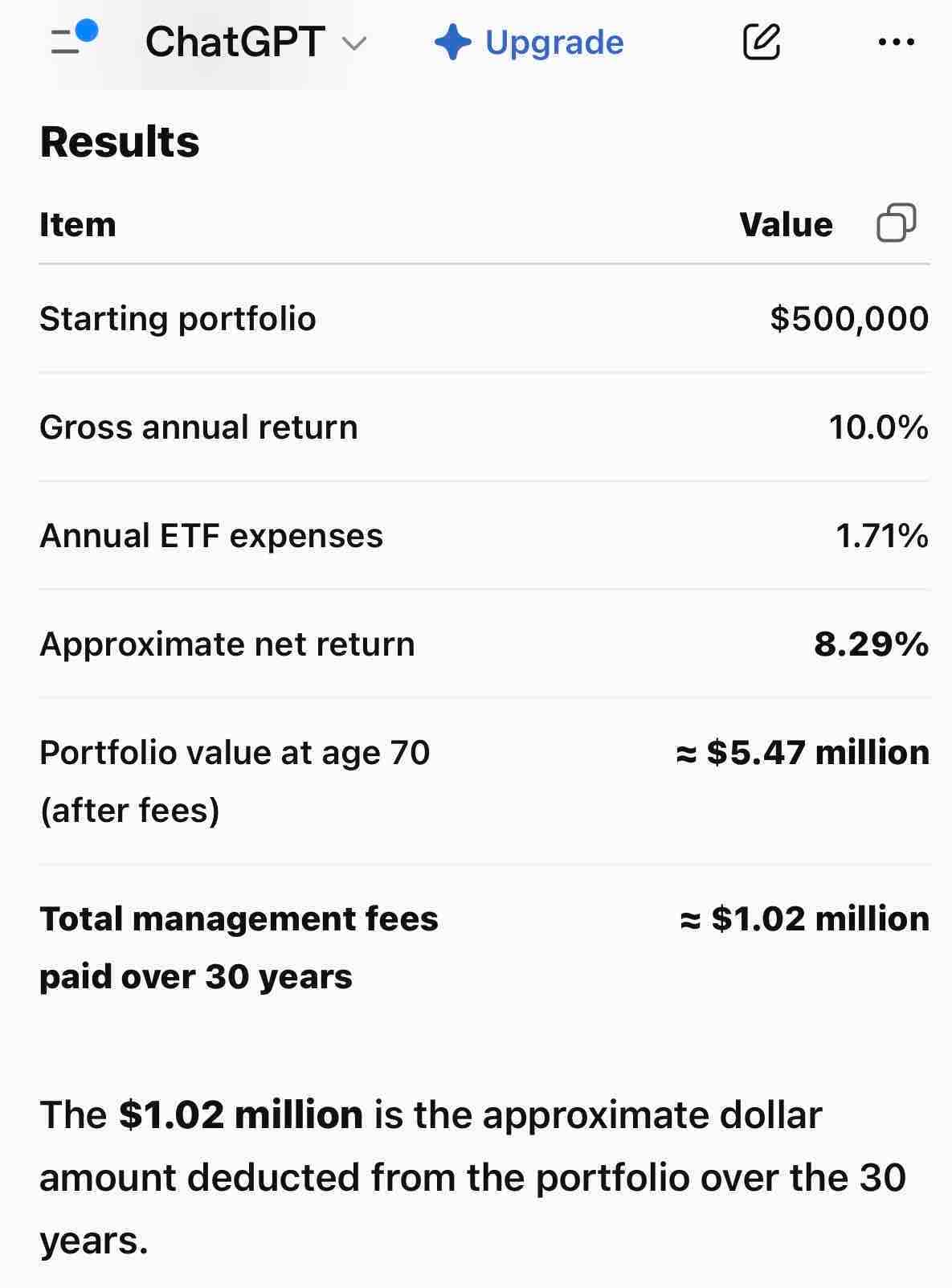
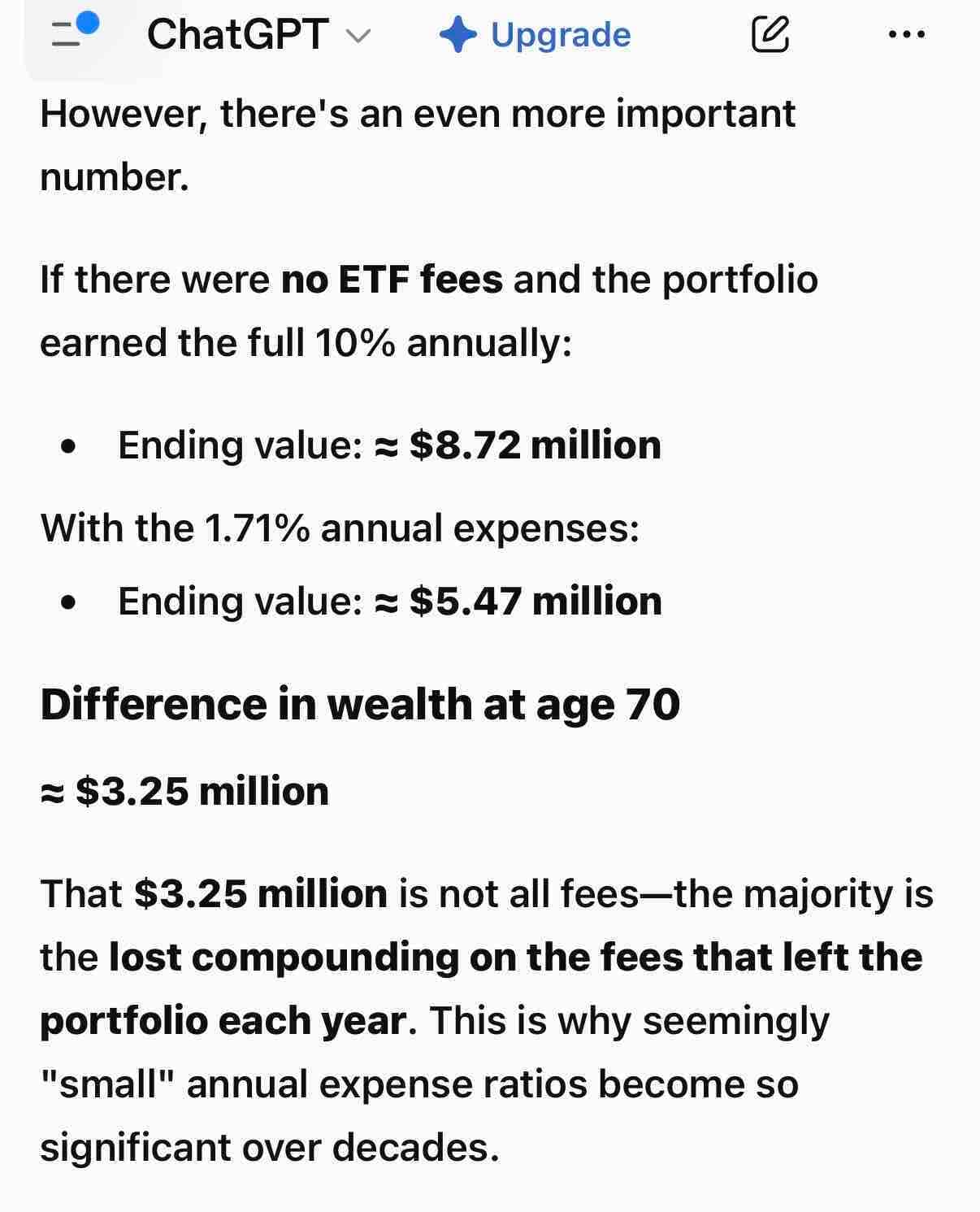
@edsam asked me to tee this post up after I had commented on another post suggesting the person should consider calculating the TOTAL COST (MER+TER) on their portfolio. My suggestion was based on the fact that I continue to see people building full portfolios constructed exclusively with high fee products based on what they see on SocialMedia (typically in favour of big distributions). Having spent 10yrs of my career working with a lower cost traditional ETF company (IShares), battling the high cost mutual funds of the day and advocating that Advisor/Investors consider costs along with their strategy selection - I obviously have my biases. 🤓 But if I’m honest it’s a bit disheartening to see so many newer investors revert back and dismiss the benefits low fees bring over time in favour of higher cost less proven strategies. 😔 When Ed chimed in on my comment saying he ‘doesn’t mind paying for the right outcome’ I felt I was going back in time. 🦕 My take on the ‘outcome’ is that the MARKET (not the MANAGER) provides the majority of the ‘outcome’. That has been supported by research that suggested ‘asset allocation drives 90% of investors returns’. Unless that research has been debunked (🤷♂️) surely investors could find similar asset allocations with more reasonable product fees while maintaining the same risk/reward profile (I don’t actually believe fees should be the sole driver of an investments decision - just part of the decision). ✅ To show the impact of fees I asked AI to analyze a sample portfolio constructed mostly of high fee ETFs (yes - they were Covered Call ETFs). While I don’t think the analysis included the Trading Expense Ratios (TERs) it provided an ‘ESTIMATED TOTAL COST = 1.70%’ ⚠️ From there I asked for the impact in real dollars assuming a $500k portfolio with a 10% average return over a 30yr time frame (40-70yrs old). The TOTAL DIRECT FEE ($) = ~$1.02M. ⚠️⚠️ But it also added the impact from ‘lost compounding’… TOTAL FEE IMPACT ($) = ~$3.25M ⚠️⚠️ Based on the inputs and scenario I provided (note: no withdrawals were considered) the portfolio still grew to $5M. 👏 But a hypothetical 0% fee portfolio (not realistic) would have grown to over $8M. 🥳 Obviously we can’t avoid all fees but I thought I laid out a pretty compelling case highlighting the impact of high fees. Of course in my usual (somewhat) brash/dry style I did also suggest the ‘high fee managers (+$1M) appreciate their loyalty’ but it might be worth asking the kids which they would prefer: $5M vs $8M. 😂 Too my surprise - despite the $3M gap - the OP subsequently commented that she too would still be ‘more than happy to pay (the manager) to do the work for me’. @edsam you offered the debate. So over to you. Help me understand what I’m missing? 🙏🙏 ————- For everyone else - feel free to weigh in as well on any of the below questions… • Do you trust Managers to outperform and close the fee gap? (**Please search SPIVA Report before answering this one 😉) • Do you know the approx TOTAL COST (MER+TER) of your portfolio? • What’s your split between low cost allocations vs higher cost allocations? • Would you take the ~$8M? • Or would you take the $5M+’Hope’ of more / ‘Less Work’ option? ————- I’ve link a few popular funds for visability (sorry) but this debate isn’t about any specific funds. It’s about fees and strategies. As always keep it classy. 😉👍 🤖AI output in the images.
12K views
88 Comments
ETF Go
@etf.go · 2moEdited
PS. For those reading and interested - here is the snapshot of the portfolio I asked AI to evaluate from a few perspective. Yield = 14.2% MER = 1.7% Time will tell what the return profile will look like. With such a high fee let’s hope it’s over 10% CAGR. 🤷♂️👍
Ed
@edsam · 2moEdited
Thanks for posting the cost calculation—this debate deserves higher visibility. Blossom members will appreciate seeing how two highish-net-worth individuals reached opposite conclusions based on different life designs. There is no free lunch. Converting assets to spendable cash always incurs a cost (e.g., 4–5% for real estate agents). An ETF’s “total return” is only a theoretical maximum; for financial freedom, paper gains must become actual cash flow. In my “go-go years,” my goal is to maximize that monetization so my family can cross off bucket-list items with our 12-year-old son. I also plan to “die with zero” on my RRIF and LIF while leaving our TFSAs and non-registered accounts intact for the next generation. Specialization is standard in a modern economy. I pay for high-stakes expertise (like a $500/hr family lawyer) because paying for a desired outcome works—I certainly couldn't raise my own chickens! The real question is: How do we make the most of the next 10 years? Low-Cost ETFs + AUM Planner? Firms like PWL (Ben Felix) charge ~1.25% AUM on top of fund fees, yet most stick to a standard 4% withdrawal from a conservative 60/40 mix. Entrusting a full portfolio to a single, risk-averse vendor introduces both concentration of vendor risk and potential underperformance. The SWR Reality: Bengen’s 4% rule exists because selling assets too aggressively during downturns depletes share counts to zero. After 30 years of building a nest egg, I want to preserve the core capital for my son. Is a 1.7% fee high? Yes, but I'm fine paying it for highly efficient monetization. My income portfolio converts an IRR of 17.44% into a 16.23% yield (a 93% conversion efficiency) across buckets 1 and 2, using diverse options strategies from 5 different ETF providers. It’s structured simply enough that my family could manage it if I were hit by a truck. It generates a 7% regular withdrawal, an extra 3% monthly for DRIP/splurging, and keeps 30% in pure growth (bucket 3). https://www.blossomsocial.com/posts/Income-portfolio-reveal__POST-1779435638715-jImNDaTK_S0mSh5PeO29pitte In your pinned post, you mentioned withdrawing $68K (3.5%) while your portfolio grew by $180K. If you don’t spend that nest egg in your go-go years, what is your ultimate plan for it? (Bonus material: How the Wealthy Get Paid? https://youtu.be/8rWfbuqhvFE?si=iNgY33Q0tO3-xkxx)
Le Corb@lecorb · 2mo
@edsam@etf.go there’s really only the risk of sequence of returns which really boils down to running out of money BEFORE you die. To ensure that a portfolio does not FAIL, logic dictates that during bull runs, the portfolio grows SUFFICIENTLY and during bear runs it MINIMIZES losses. That and the RATE of withdrawl vs RATE of return is sustainable over the period of retirement without FAILURE (calculus). We rely on statistics and historical measures because we are PREDICTING the future as best POSSIBLE on the most PROBABLE outcomes. This is RISK in a nutshell and I personally see the PII community using IRR a terminology I don’t understand in terms of investing, as a self-deception to mask having to look at the reality of Time Weighted Returns and project the reality of portfolio sustainability.
John D@iamjohn_d · 2mo
Those who say that they're "more than happy to pay the manager to do the work for me" on a high yield, high fee product likely haven't done the math (it's middle/high-school level) to figure out that being charged 1.5-2% annually in fees, which compounds exponentially, will cost them millions in the long-run. Why do you think people moved out of mutual funds? I guess ignorance is bliss for some people. Any who, I hate debating/arguing with these people because it almost feels like you're playing chess with a pigeon. Checkmate it all you want with all the facts & data that challenges their beliefs, the pigeon will still flap its wings, knock over all the pieces, shit on the board, and fly away thinking it won. So pick your battles.
See the full comment section 👀Sign up for the full Blossom experience!