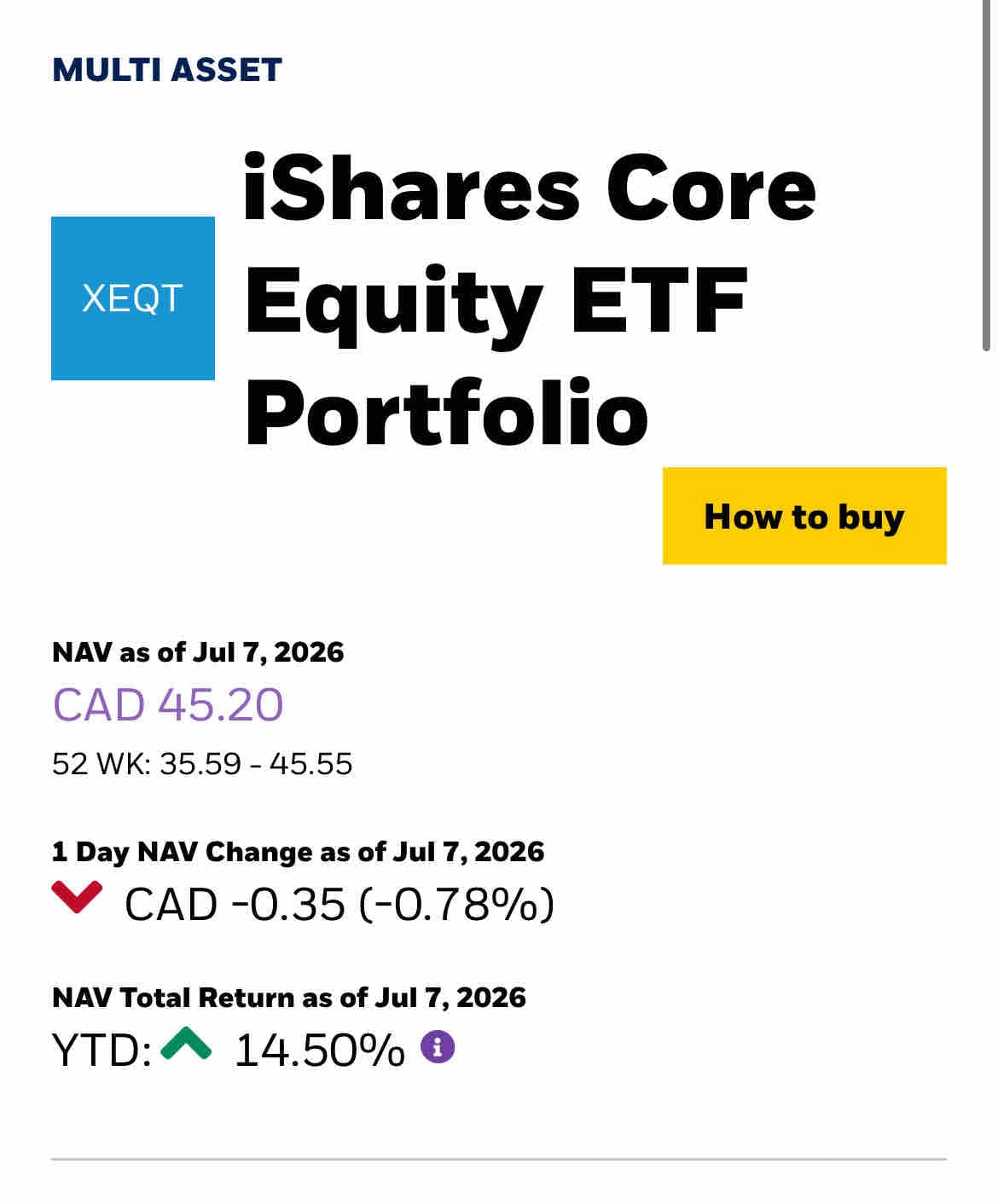
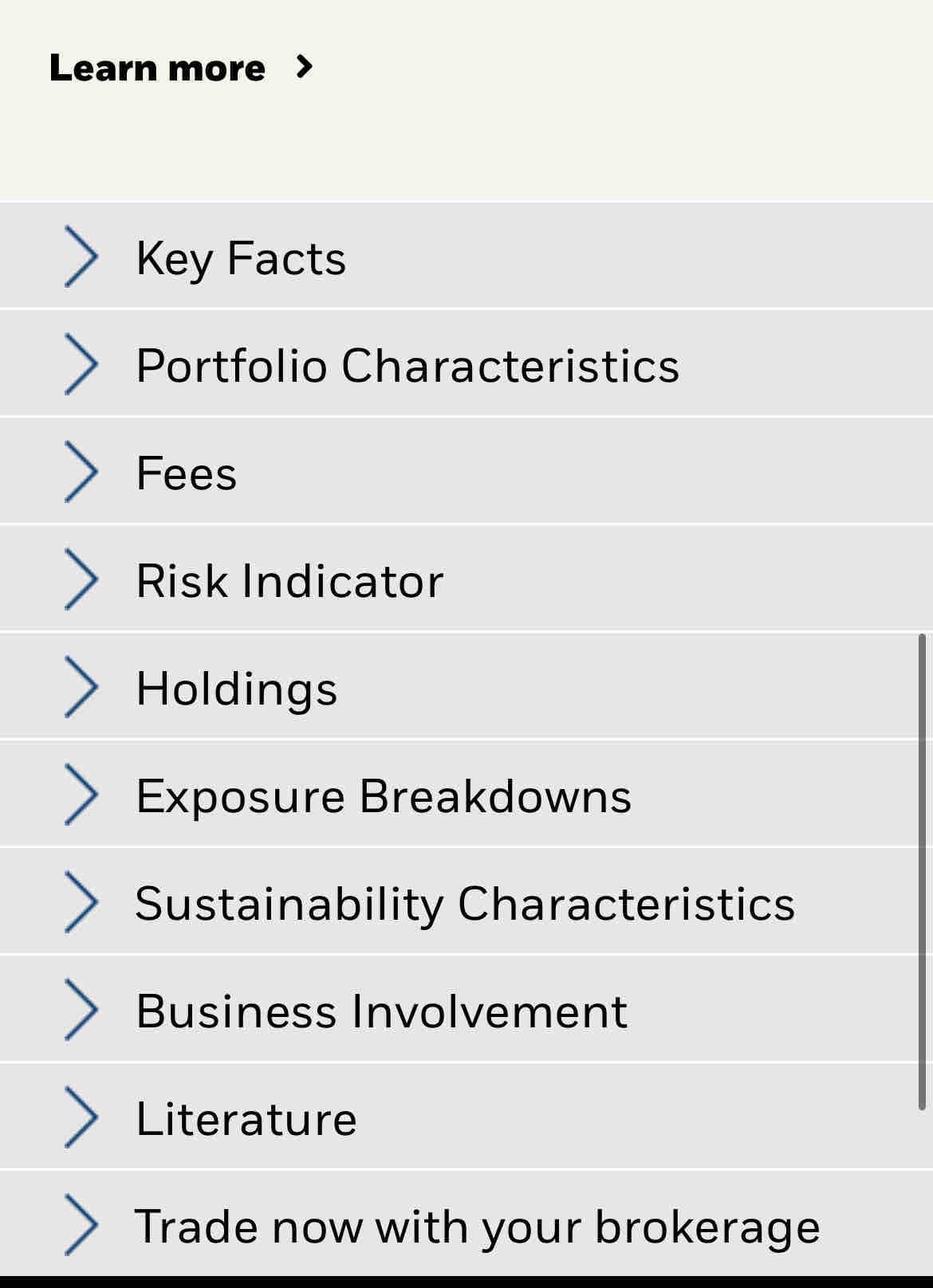
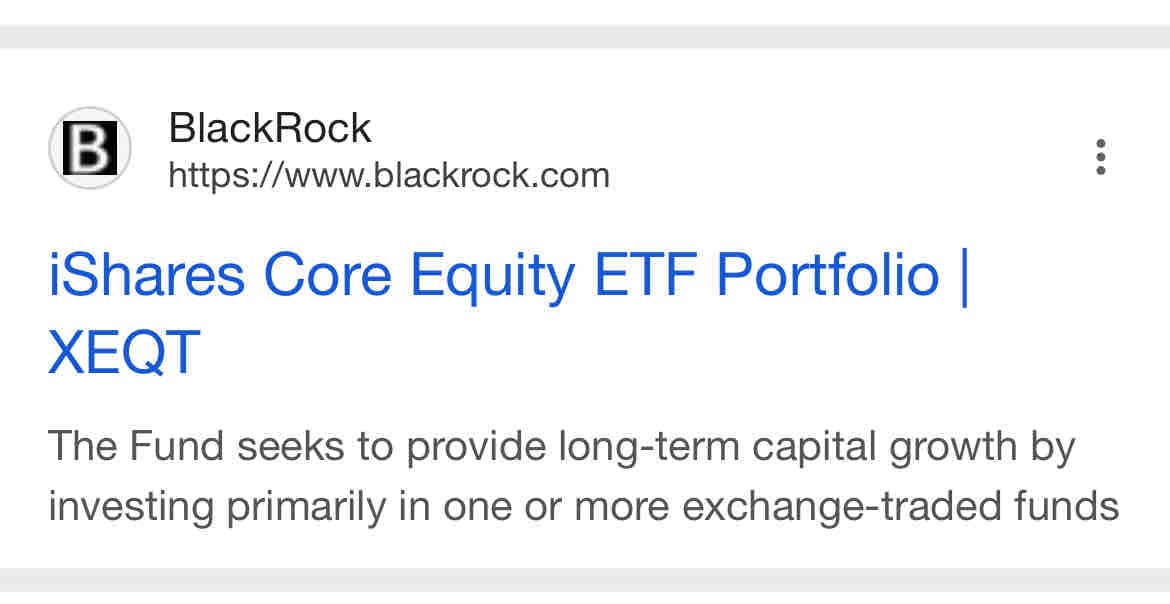
Anytime you purchase an ETF, there's a lot of information under the hood that you might not realize exists. If you haven't before, today you'll learn how to research any ETF or Fund. Using $XEQT as our example, we're going to go through everything inside of the ETF and how you learn more about the fund. The first thing you should do is go to google and type in the ticker symbol followed by ETF. In this case you can search "XEQT ETF". The top search result should be the BlackRock page talking about iShares Core Equity ETF XEQT. This will be our fund page. On the site there will be a lot of information involving the XEQT fund. For XEQT there will be different headings including Overview, Performance, Key Facts, Fees, Holdings, Exposure, etc. Each of these sections breaks down a different aspect of the fund and everything tied to it. The overview is usually simple, it explains the point of the fund and why it exists as an investment. XEQT is described as a low cost option to help investors get exposure to broad stock markets while not having to rebalance themselves. The performance is also straight forward, it displays the return of the fund in different ways. It shows the total return since its inception, annualized returns, total returns, and its distributions. This gives you insight on how the fund has performed overtime. Remember, past returns aren't guaranteed into the future so it's more important to understand the kind of fund and how it will perform going forward relative to the market. The next section is the key facts and some important information. For XEQT it will show you what exchange the fund trades on, how many it holds in assets (the people investing in the fund), the number of holdings and underlying holdings, when the fund was created, it's share price, etc. After that the fund shows its portfolio characteristics. This talks about DRIP plans, distribution yields, distribution frequency, and its eligibility. This will help determine where your return will come from and what kinds of accounts to buy the fund in. Then comes the fees, arguably the most important section. All it shows is the fee being charged to own this fund yearly. On this page it shows you the Management Fee and the Management Expense Ratio. The management fee is what the management team take home yearly regardless of how well the fund performs. The MER is the total fee you pay as an investor to own the fund. If XEQT returns 10% in 1 year, the management team take off 0.17% for themselves, and 0.2% overall from the investors. This means your return net of fees would actually be 9.8%. That extra 0.3% would be a mix of trading fees or taxes paid. Another thing to watch out for is the TER, this is another fee you’re being charged but likely isn’t obviously under the “fees” section. For XEQT, the TER is within the ETF Facts document and is displayed as 0.01%. For more actively managed funds, this will be much higher and something to lookout for. The risk indicator is a subjective section, BlackRock considers XEQT a medium risk fund however that risk will be subjective to any individual investor. One investor may consider stocks high risk, another might think a broad market is low risk. It comes down to your risk tolerance and capacity as an investor. The holdings section is where you learn what the fund actually owns. XEQT owns a total of over 8000 stocks, but only actually holds 5 different funds, each of which hold their own stocks. XEQT contains $XIC$XEF$XTOT$ITOT and $XEC. Since the fund is simply an index (meaning it tracks a certain set of standards) your performance will be directly tied to the performance of these 5 funds net of fees. If your ETF holds only a few stocks, it would be wise to actually do your full research into those holdings as well, since XEQT is a broad market fund you don’t need to research all 8000 stocks. Exposure is also key to understand what kind of investments you're actually owning in the fund. The asset class (which in this case is 100% stocks), and the geography. XEQT is known as an all in one fund because of its global diversification. The current exposure is 45% in the US, 23% in Canada, and the rest is spread between many international companies. There are multiple other sections on this fund, however these ones will differ from site to site and aren't always the same kind of information across investments. The one section to keep in mind on this site however is "Literature", this includes very in-depth documents that give you much more insight into the fund itself. Some pages to keep in mind that are on many other kinds of funds are the ETF Fact Sheet, Distribution Sheets, Financial Statements, etc. These come in handy when you want a larger breakdown from the fund company on what you're owning. Once you've gone through all the sections and read any documents, you're now knowledgeable on this specific fund. This same research should be applied to every ETF you own. The site itself will look different depending on the provider, and some of the labels and amount of information will vary, but these are the key ideas to remember to research: - Overview - Key Facts about the ETF - Performance - Characteristics - Fees - Risk - Holdings - Exposure These are the kinds of things to research in your funds. Remember, just because something is an ETF, doesn't mean it's safe. Many of you might own ETFs that only have 1 or 2 underlying stocks that make it incredibly high risk. Some providers also like to hide their facts as much as possible, if your ETF page hides the documents in small text, somewhere at the bottom of the page, or through multiple links, that's not a good look. This is also only a “simple” ETF, other funds may add layers of complexity through active management, covered calls, factors, etc. All of this will require a deeper understanding of how the fund actually works. If you have any questions feel free to comment, and as always do your research and happy investing!
10K views
24 Comments
Jacob B@jacobb · 26d
If you don’t win an award, Ronan, I will internally combust.
Kalpit Katpara@kalpitkatpara · 26d
Great information for anyone starting with ETF investing 🙂🙏
ETF Go@etf.go · 25dEdited
Another beauty post. One new investors should pay attention to. 👏 My rec is ALWAYS VISIT THE ETF PAGE DIRECTLY. ✅ That said - I would actually argue that EXPOSURE is ‘most important’ section to understand as this determines what you’re actually investing in, how and where it may fit into your broader portfolio and make you think how it can compliment or be complemented by your other holdings. 🤔 Also - please add ‘TER’ to your Fee writeup. As you know it’s a real cost that also gets taken from return but isn’t captured by the MER. 😉👍
Anna @annad1967 · 25d
Thank you so much, as I'm still learning 😊
Shawn @sstone · 25d
Great work Ronan.. Thank you..🙏
You must have an account to viewCreate an account for the full Blossom experience!
Join the conversation with 500,000+ other investors 💸
Create an account to get access to everything Blossom has to offer!
📊 Personalized algorithm based on your investing style, experience level and interests
📈 Powerful portfolio and dividend tracking tools
👀 See what top creators and others in the community are investing in