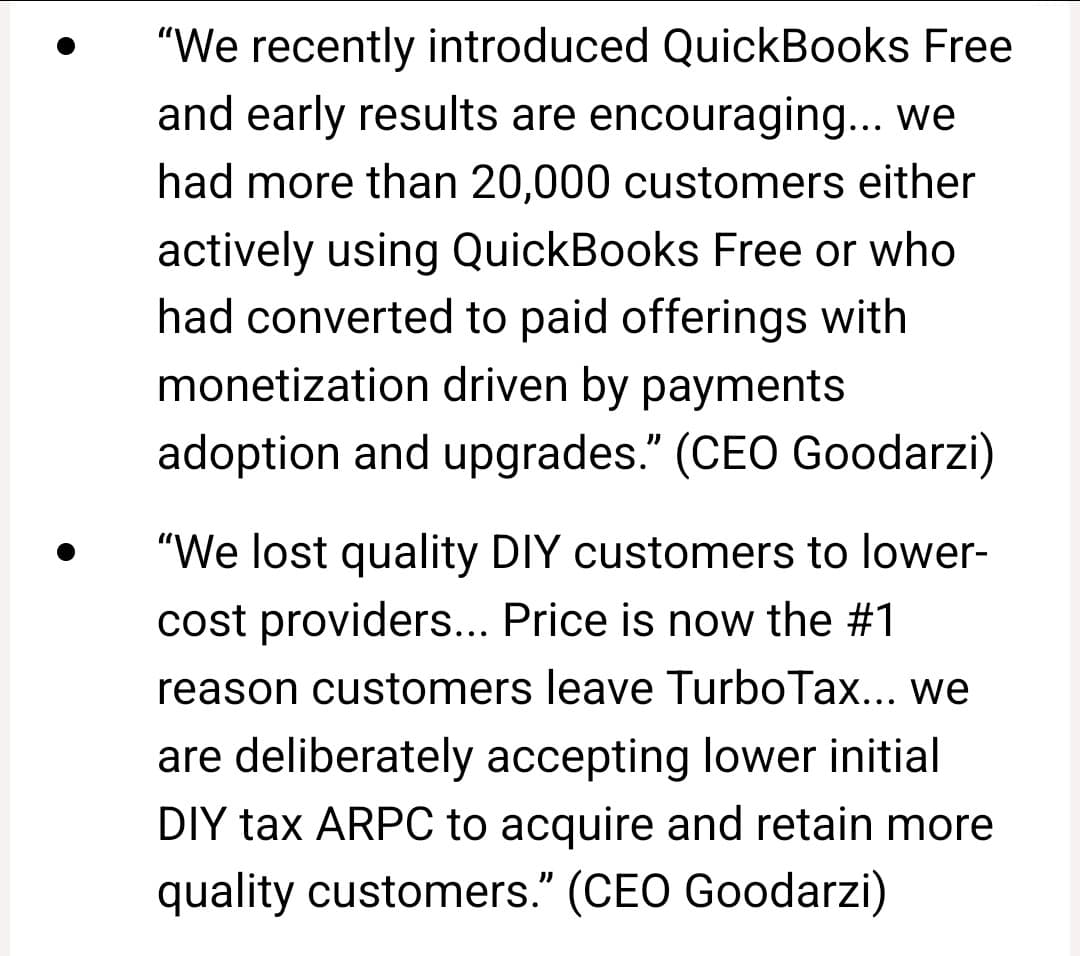
Many must have posted about $INTU earnings till now. What I am going to focus on are the reasons behind the soft guidance: The main reason as CEO himself acknowledged was losing DIY customers to lower priced customers. What are they going to do about it? - introduced quickbooks free and are seeing accelerated adoption - accepting lower initial DIY tax ARPC and resetting expectations. What does the 2nd item mean? Here's claude's response: "DIY tax ARPC" = **Average Revenue Per Customer** for TurboTax's DIY (do-it-yourself) tax filing product. In context: - **DIY tax** — refers to Intuit's self-service TurboTax product line, where customers file their own taxes (as opposed to TurboTax Live, where a professional helps). - **ARPC** — Average Revenue Per Customer, a standard SaaS/consumer metric showing how much revenue the company earns per customer, on average. So when Goodarzi says Intuit is "deliberately accepting lower initial DIY tax ARPC," he means: they're intentionally letting the average revenue earned from each self-service tax customer dip (likely through discounts, free tiers, or lower-priced entry offers) as a strategic tradeoff — the goal being to win back and retain price-sensitive customers who'd been switching to cheaper competitors, with the expectation that these customers become more profitable over time (through upsells, retention, or eventually moving to paid tiers). I'll be honest, days of high growth are gone. I have a low cost basis and honestly, I do not believe Intuit is going to be the compounder anymore. I will look for a 10% profit on my cost basis before selling my holdings. No shame in admitting, I was wrong on this one. 😒✌️
292 views
2 Comments
Mitchell McKenna@mitchmckenna · 2h
Didn’t they say Quickbooks still growing 20%?
See the full comment section 👀Sign up for the full Blossom experience!