Option Losses Can Become Return of Capital pt 2
Part one explained how option premiums can become return of capital in a rising market. But how does it work when the market is falling?
The simple covered-call theory is that you buy shares, sell a call option and keep the premium if the stock remains below the strike price. Once the option expires, you sell another call and repeat the process. That sounds straightforward when the share price remains reasonably close to the original purchase price.
The problem becomes more complicated when the stock falls significantly. At that point, the fund must decide how aggressively it wants to continue selling calls. It could sell calls with strike prices above its purchase cost, but those options may generate very little premium because they are now far above the current market price.
It could stop selling calls temporarily, but that means giving up the option income the strategy is designed to generate.
Or it could sell a call closer to the current share price, even though the strike is below the fund’s original purchase price, and hope the stock does not recover above it.
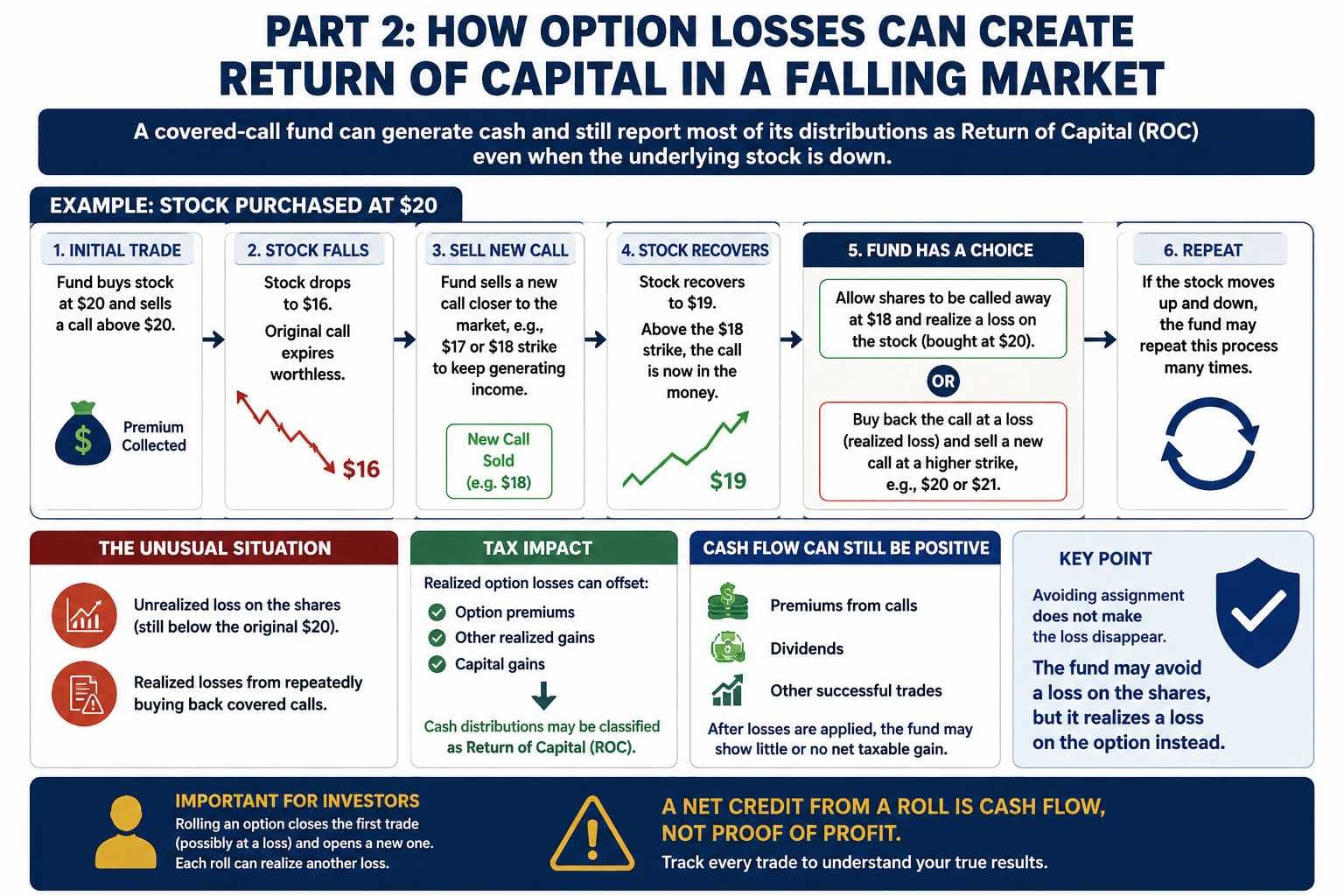
Suppose a fund buys a stock at $20 and sells a covered call above that price. The stock then falls to $16. The original call expires worthless, allowing the fund to keep the premium. To continue generating meaningful income, the fund sells another call closer to the current share price, perhaps with a strike of $17 or $18.
Over the next month, the stock recovers to $19. The shares are still below the fund’s original $20 purchase price, so the fund has not fully recovered its loss. However, the new call is now in the money because the stock has risen above the $17 or $18 strike.
The fund now has another decision to make.
It can allow the shares to be called away below the original $20 purchase price, realizing a loss on the stock. Or it can buy back the call at a loss and sell another call with a higher strike, perhaps at $20 or $21, giving the stock more room to recover.
If the stock continues moving up and down, the fund may repeat this process several times. Each time the stock rises above the latest strike price, the fund may realize another loss when it closes the call. Yet the stock itself may still be trading below the fund’s original purchase price.
This can create an unusual situation where the fund may have an unrealized loss on the shares while also accumulating realized losses from repeatedly buying back covered calls.
Those realized option losses can offset option premiums and other realized capital gains for tax purposes. As a result, cash distributions that might otherwise have been reported as capital gains may instead be classified as return of capital.
The fund may still be generating cash from option premiums, dividends and successful trades elsewhere in the portfolio. However, after the realized option losses are applied, the fund may report very little net taxable income or capital gains.
This can help explain how a covered-call fund can distribute a large amount of ROC even during a year when its underlying stocks have not performed especially well. The fund is still paying cash to investors, but the tax character of that distribution may be shaped by the losses created when its calls are closed and rolled.
This is also where individual investors who sell covered calls on shares they own can misunderstand what happens when they roll an option.
Because the broker processes the roll as one combined transaction, it can feel as though the investor simply extended the original trade and collected another payment.
But a roll is actually two separate transactions.
The investor first buys back the original option, closing that trade. A new option is then sold, opening an entirely separate trade.
Suppose an investor receives $100 for selling the original call. Later, the stock rises and the investor pays $250 to close it.
The original option trade has now ended with a realized loss of $150:
$100 received minus $250 paid to close the option.
At the same time, the investor sells a new call and receives $300.
Because the investor paid $250 to close the old call and received $300 from the new one, the broker may display the roll as a $50 net credit.
That $50 is real cash entering the account. However, it does not mean the original trade was profitable. The original option closed with a $150 realized loss. The new option brought in $300 of premium, but it remains open and does not yet have a final profit or loss.
From the investor’s perspective, the cash flow can feel positive:
$100 was received when the original call was sold.
Another $50 of net cash was received when the option was rolled.
The account has therefore received $150 in cumulative cash.
But the tax and profit records tell a different story.
The first option has already produced a $150 realized loss. The second option is still open, and some or all of its $300 premium may eventually be required to buy it back. If that new option is later rolled, the investor may receive another net credit while realizing another loss on the option being closed.
This process can repeat several times. Cash may continue entering the account even as realized option losses accumulate. The credits are real cash flow, but they are not automatically profit. To determine the actual result, the investor must separate each completed option trade from the new option that replaces it. Rolling an option does not erase the previous loss. It closes one trade possibly at a loss and opens another.
This is similar to what can happen inside a covered-call fund. Investors see cash distributions arriving in their accounts, but behind those distributions the fund may also be realizing losses as it closes and rolls its call options. An investor can be paid cash and realize a loss at the same time.