Paul Volcker: American Hero or Villian?
Paul Volcker
The Man Who Had the Courage to Be Unpopular. He put America & Indeed Canada through a wold incredible pain. Most hated him. He chose recession over depression, it was mean and cruel and hard, he was hated….but…
Does Warsh have the same kahones?
“Sometimes leadership means choosing long-term prosperity over short-term popularity.”
⸻
At a Glance
Who: Paul A. Volcker (1927–2019)
Best Known For: Chairman of the U.S. Federal Reserve (1979–1987)
Defining Achievement: Breaking the back of double-digit inflation, paving the way for decades of economic growth.
Legacy: Widely regarded as one of the greatest central bankers in modern history.
⸻
A Giant in Every Sense
Standing an imposing 6 feet 7 inches tall, often with a cigar in hand, Paul Volcker was impossible to miss. Yet it wasn’t his height that made him one of the most influential figures in financial history—it was his willingness to make decisions almost no one else was willing to make.
History remembers very few central bankers.
Investors remember Warren Buffett.
Index investors remember John Bogle.
Technology enthusiasts remember Steve Jobs.
But when economists discuss courage, discipline, and independent leadership, one name consistently rises above the rest:
Paul Volcker.
His decisions changed the course of the American economy and affected every homeowner, investor, worker, and business owner in the United States.
⸻
America Was Losing Control
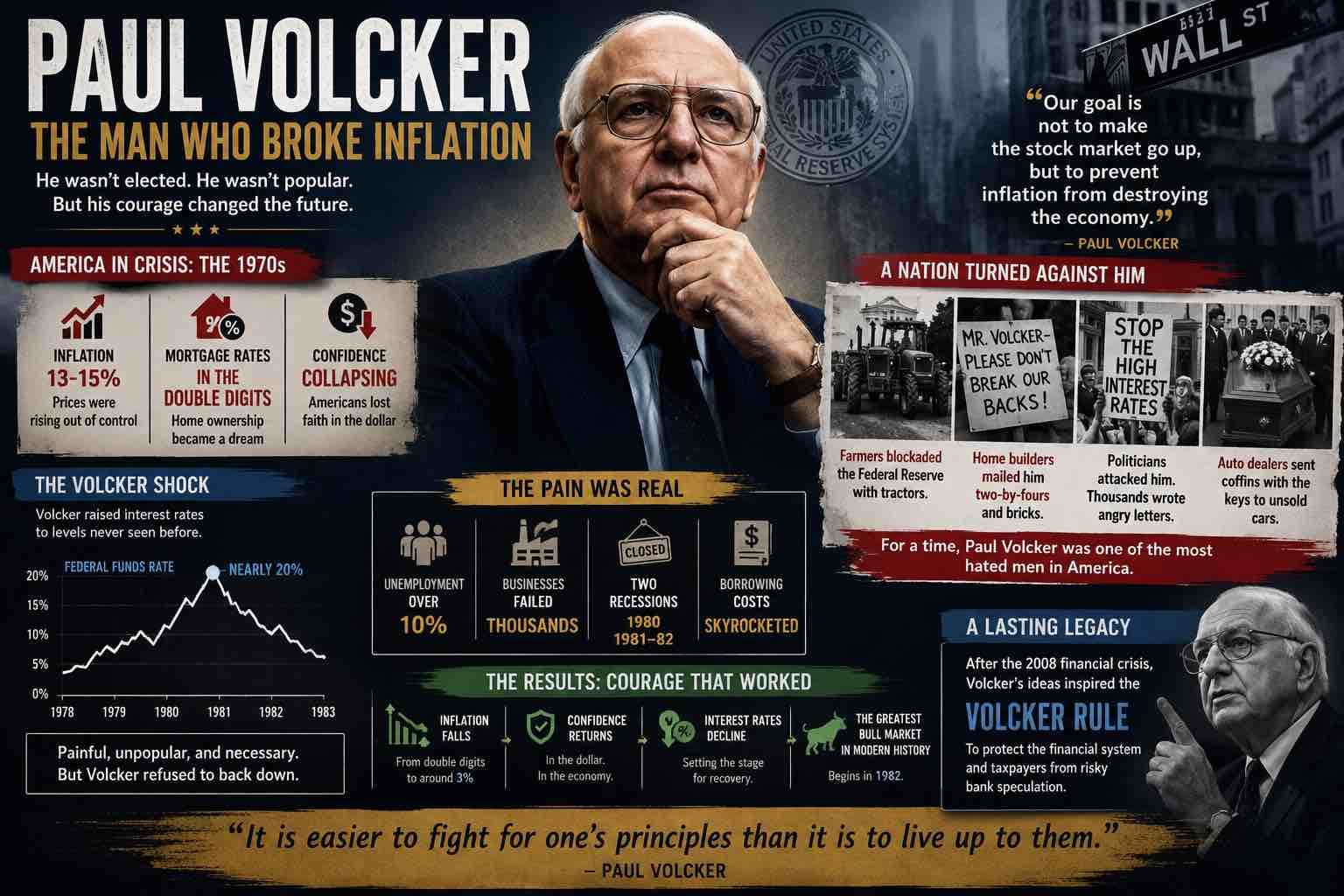
When Volcker became Chairman of the Federal Reserve in August 1979, America faced an economic crisis unlike anything seen since the Great Depression.
Inflation had exceeded 13%.
Gasoline prices soared.
Mortgage rates climbed relentlessly.
Food prices rose every month.
Families watched their purchasing power disappear.
Businesses raised prices because they expected costs to continue rising.
Workers demanded larger wages simply to keep pace.
Inflation had become a vicious cycle.
Volcker believed that unless someone acted decisively, inflation would permanently damage the American economy.
⸻
“Inflation is the cruelest tax because it quietly steals purchasing power from everyone.”
⸻
The Volcker Shock
Most politicians wanted lower interest rates.
Volcker did exactly the opposite.
He instructed the Federal Reserve to raise interest rates aggressively.
Eventually, the federal funds rate approached 20%.
Mortgage rates exceeded 18%.
Borrowing became painfully expensive.
Almost overnight, the economy slowed.
Factories reduced production.
Businesses postponed expansion.
Construction projects stopped.
Auto sales collapsed.
Farmers struggled to repay loans.
Unemployment eventually climbed above 10%.
America entered back-to-back recessions.
Many believed Volcker had gone too far.
⸻
Timeline
1979
* Paul Volcker becomes Chairman of the Federal Reserve.
1980
* Interest rates surge.
* First recession begins.
1981–1982
* Rates approach 20%.
* Unemployment rises above 10%.
* Inflation begins falling rapidly.
1982
* The economy bottoms.
* A historic bull market begins.
1987
* Volcker leaves the Federal Reserve after helping restore price stability.
⸻
A Nation Turns Against Him
As the recession deepened, public frustration became outright anger.
That anger focused on one man.
Paul Volcker.
The protests became some of the largest ever directed at a Federal Reserve Chair.
Farmers drove hundreds of tractors into Washington, D.C., surrounding the Federal Reserve building.
Home builders mailed him two-by-fours and bricks, symbols of an industry that had nearly ground to a halt.
Auto dealers mailed coffins containing the keys to unsold vehicles.
Thousands of Americans wrote emotional letters describing businesses that had failed, farms they feared losing, and homes they could no longer afford.
Politicians from both parties publicly condemned him.
Editorials criticized him.
Congress pressured him.
Many Americans blamed him personally for the recession.
For a time, Paul Volcker became one of the most unpopular men in America.
⸻
“The easiest decision would have been to lower interest rates. Volcker believed the right decision was to stay the course.”
⸻
Standing Firm
Most leaders would have backed down.
Volcker refused.
He believed inflation was a far greater danger than a temporary recession.
Allowing inflation to continue would slowly destroy savings, wages, investment, and confidence in the U.S. dollar.
He accepted years of criticism because he believed temporary pain was the price of long-term prosperity.
History would eventually vindicate him.
⸻
The Results
Slowly but steadily, inflation collapsed.
Confidence returned.
Interest rates declined.
Businesses began investing again.
Consumers regained confidence.
The economy recovered.
What followed was one of the greatest economic expansions and stock market bull markets in American history.
Many of today’s corporate giants—including Microsoft, Apple, Home Depot, and Walmart—expanded rapidly during the stable economic environment that followed.
No single person created that prosperity.
But few individuals did more to make it possible than Paul Volcker.
⸻
The Volcker Rule
Following the 2008 Global Financial Crisis, Volcker once again influenced financial policy.
He argued banks should focus on serving customers—not making speculative bets with federally insured deposits.
His ideas became the Volcker Rule, a key part of post-crisis banking reform designed to reduce excessive risk-taking and strengthen the financial system.
⸻
Could Volcker Do It Again Today?
More than forty years later, economists still debate one question.
Would Volcker’s policies work today?
The answer is yes—but at an even greater cost.
The economic principles have not changed.
Higher interest rates still reduce borrowing.
Reduced borrowing slows spending.
Lower spending cools inflation.
What has changed is the amount of debt.
Today’s governments, households, and corporations owe dramatically more money than they did in 1980.
Interest rates approaching 20% today would likely produce:
* A severe recession.
* Significant declines in housing prices.
* Increased corporate bankruptcies.
* Much higher government borrowing costs.
* Sharp stock market declines before recovery.
That is why modern central banks generally try to act earlier, raising interest rates before inflation becomes deeply entrenched.
Yet Volcker’s lesson remains timeless.
Delaying difficult decisions usually makes the eventual solution even more painful.
⸻
Lessons Every Investor Can Learn
Leadership Requires Courage
The right decision is not always the popular one.
Short-Term Pain Creates Long-Term Opportunity
The greatest bull markets are often born from periods of maximum pessimism.
Inflation Is an Invisible Tax
Inflation quietly destroys purchasing power every day.
Owning productive businesses has historically been one of the best ways to protect wealth.
Discipline Beats Emotion
Volcker ignored enormous pressure because he focused on long-term outcomes rather than short-term approval.
Successful investors must often do exactly the same.
⸻
Why Paul Volcker Still Matters
Paul Volcker never sought celebrity.
He never measured success by opinion polls.
He measured success by whether he fulfilled his duty.
When confronted with one of the greatest economic challenges of the twentieth century, he chose conviction over comfort, principle over popularity, and long-term prosperity over short-term approval.
History rewarded that courage.
Today he is remembered not simply as the man who defeated inflation, but as one of the greatest central bankers in history.
His story is ultimately about more than economics.
It is about character.
It is about discipline.
It is about having the courage to endure temporary hardship in pursuit of a better future.
For investors, that lesson is as valuable today as it was in 1980.
⸻
Final Thought
“Markets recover. Economies heal. Inflation can be defeated. But only when leaders—and investors—have the courage to think beyond today’s discomfort and focus on tomorrow’s prosperity.”