Studies Show Retirees Are More Afraid Of Dying
Than Outliving Their Money - This is one of my fears as well. 😬
——————-
One Often Overlooked Option Is An Annuity:
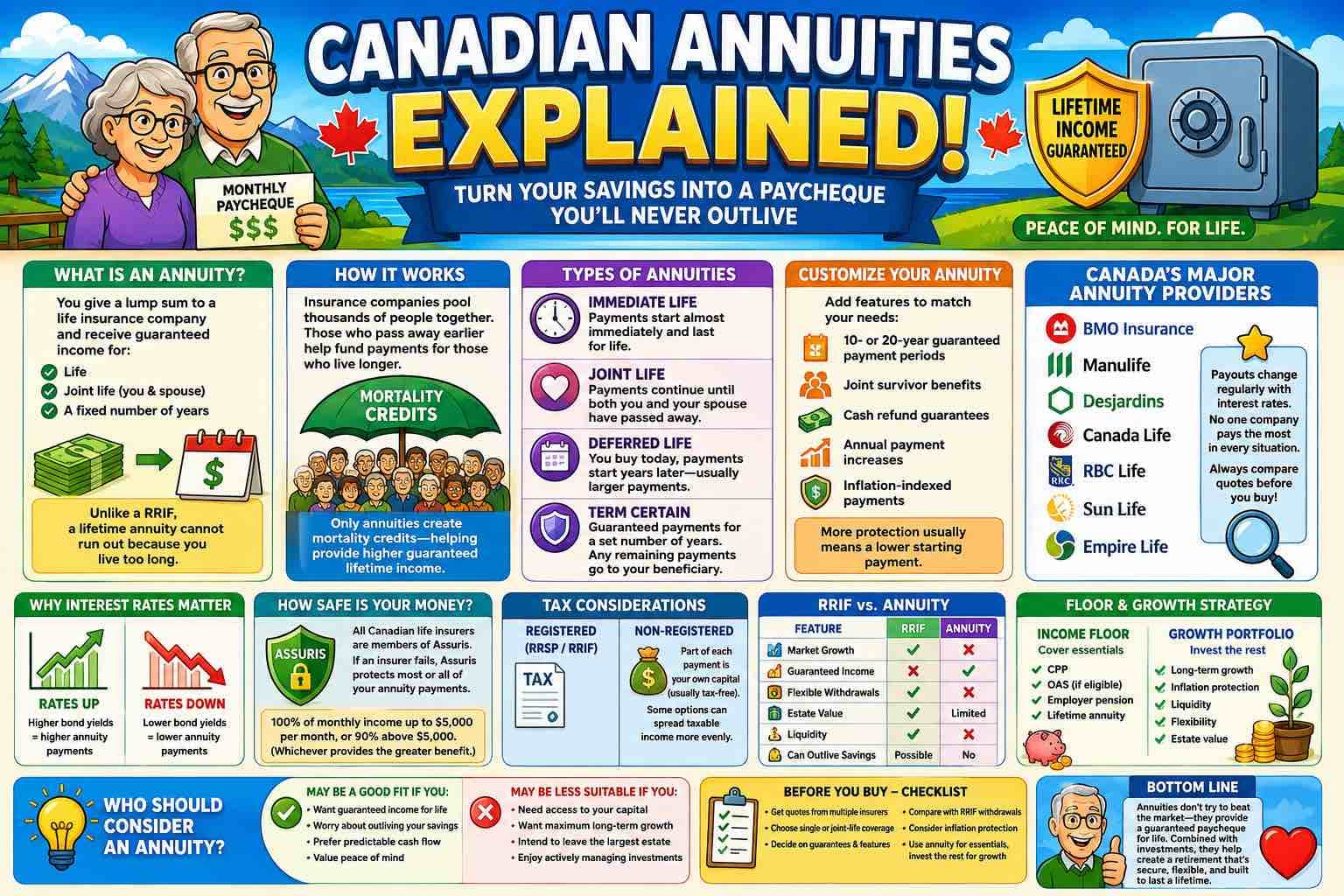
Canadian Annuities Explained: The Complete Guide to Lifetime Income, Canada’s Leading Providers & Whether They’re Worth It
Most Canadians spend decades building RRSPs, TFSAs, pensions, and investment portfolios.
But eventually, every investor faces the same question:
“How do I turn my savings into a paycheque I’ll never outlive?”
That’s where annuities come in.
They don’t get the same attention as ETFs or dividend stocks, yet annuities quietly power one of the world’s most reliable retirement inventions—the defined benefit pension.
If you’ve ever admired someone receiving a guaranteed pension cheque every month for life, you’ve admired an annuity. Today, Canadians can purchase that same type of guaranteed lifetime income from a life insurance company.
⸻
What Is an Annuity?
An annuity is a contract with a Canadian life insurance company.
You exchange a lump sum for guaranteed income that can be be paid:
* For life
* For the lives of you and your spouse
* For a fixed number of years
Unlike a RRIF, a lifetime annuity cannot run out because you live too long.
For that reason, many retirement specialists call annuities “personal pensions.”
⸻
Why Can Insurance Companies Guarantee Lifetime Income?
The answer is something most investors have never heard of:
Mortality Credits
Imagine 1,000 retirees each contribute $100,000.
Some unfortunately pass away earlier than expected.
Others live well into their 90s—or even past 100.
Insurance companies pool this longevity risk across thousands of policyholders. Money that is no longer needed for those who die earlier helps fund payments to those who live much longer.
No ETF.
No stock portfolio.
No GIC.
No bond ladder.
Only a lifetime annuity creates mortality credits, which is why annuities can often provide higher guaranteed lifetime income than conservative investments alone.
⸻
The Main Types of Annuities
Immediate Life Annuity
Income begins almost immediately and continues for life.
Ideal for retirees who want dependable monthly income.
Joint Life Annuity
Income continues until both spouses have passed away.
A popular choice for married couples who want to protect the surviving spouse.
Deferred Life Annuity
Purchased today.
Payments begin years later.
Because payments start later, monthly income is generally larger.
Term Certain Annuity
Provides guaranteed payments for a fixed number of years.
If you die before the term ends, remaining payments continue to your beneficiary or estate.
⸻
Customizing Your Annuity
Most insurers allow buyers to customize an annuity with features such as:
* 10- or 20-year guaranteed payment periods
* Joint survivor benefits
* Cash refund guarantees
* Annual payment increases
* Inflation-indexed payments
Each additional guarantee provides more protection but generally reduces the starting monthly income.
⸻
Canada’s Leading Annuity Providers
Canadian annuities are issued by life insurance companies, not ETF or mutual fund companies.
Some of Canada’s largest providers include:
* BMO Insurance
* Manulife
* Desjardins
* Canada Life
* RBC Life
* Sun Life
* Empire Life
All are federally regulated insurers and members of Assuris, Canada’s policyholder protection organization. (Canada)
Who Pays the Most?
There is no permanent winner.
Annuity payouts change continually as long-term interest rates and bond yields change.
One month BMO Insurance may offer the highest payout.
A month later it could be Manulife, Desjardins or another insurer.
The best company depends on:
* Your age
* Your sex
* Province of residence
* Single or joint annuity
* Guarantee period
* Inflation protection
* Current interest rates
That’s why experienced advisors almost always obtain quotes from several insurers before recommending one.
⸻
What Could $100,000 Buy?
There is no single answer.
Unlike GIC rates, annuity payouts change frequently with financial markets.
Your quote depends on:
* Age
* Sex
* Interest rates
* Type of annuity
* Optional guarantees
* Whether registered or non-registered money is used
As a broad historical reference, healthy retirees in their early 70s purchasing a registered lifetime annuity have often received payouts in roughly the 5%–8% annual range, but actual quotes vary and should always be obtained at the time of purchase.
⸻
Why Interest Rates Matter
Interest rates have an enormous impact on annuity pricing.
Insurance companies invest much of the money they receive in high-quality long-term bonds.
When bond yields rise, insurers can generally offer larger monthly payments.
When bond yields fall, new annuity payments usually decline.
This is why Canadians purchasing annuities today may receive considerably higher guaranteed income than buyers who locked in contracts during the ultra-low interest-rate environment of the late 2010s and early 2020s.
⸻
How Safe Are Canadian Annuities?
Many retirees ask:
“What happens if my insurance company fails?”
Every licensed Canadian life insurance company that sells annuities belongs to Assuris.
If a member insurer becomes insolvent, Assuris protects annuity owners by covering 100% of monthly income up to $5,000 per month, or 90% of the promised monthly income if it exceeds $5,000—whichever provides the greater benefit. (Canada)
This protection provides an additional layer of security beyond Canada’s already strict insurance regulation.
⸻
Taxation
The tax treatment depends on where the money comes from.
Registered Funds (RRSPs & RRIFs)
Payments are generally fully taxable because the contributions were tax-deferred.
Non-Registered Funds
Part of each payment is often treated as a return of your own capital, while the remainder is taxable income. Certain prescribed annuities can spread the taxable portion more evenly over time, making them attractive for some retirees. (Canada)
⸻
RRIF vs. Lifetime Annuity
Feature RRIF Lifetime Annuity
Market Growth ✅ ❌
Guaranteed Income ❌ ✅
Flexible Withdrawals ✅ ❌
Estate Value ✅ Limited
Liquidity ✅ ❌
Can Outlive Savings Possible No
Neither is universally better.
Each solves a different retirement challenge.
⸻
Understanding Sequence-of-Returns Risk
One of retirement’s biggest risks isn’t simply poor investment returns.
It’s when those returns occur.
Two retirees can earn exactly the same average return over retirement.
If one experiences major market declines immediately after retiring while withdrawing income, their portfolio can shrink much faster—even if markets later recover.
This is known as sequence-of-returns risk.
A lifetime annuity removes this risk entirely because payments continue regardless of market performance.
⸻
The Biggest Weakness: Inflation
Traditional annuities provide stable income.
Inflation gradually reduces purchasing power over time.
Many insurers offer annual payment increases or inflation-linked contracts, but these features reduce the starting monthly payment.
For this reason, many retirees combine annuities with diversified investment portfolios that continue growing over time.
⸻
The “Floor and Growth” Strategy
Many retirement specialists recommend combining guaranteed income with long-term investing.
Income Floor
Cover essential living expenses using:
* CPP
* OAS (if eligible)
* Employer pension
* Lifetime annuity
Growth Portfolio
Leave the remainder invested in diversified ETFs through a RRIF to provide:
* Long-term growth
* Inflation protection
* Liquidity
* Flexibility
* Estate value
This approach combines certainty with opportunity.
⸻
Before You Buy
Before purchasing an annuity:
✓ Compare quotes from several insurers.
✓ Decide whether single-life or joint-life coverage is appropriate.
✓ Consider whether inflation protection is worth the lower starting payment.
✓ Decide whether a guaranteed payment period is important for your estate.
✓ Compare annuity income with your planned RRIF withdrawals.
✓ Consider using an annuity to cover essential expenses while keeping the remainder of your portfolio invested.
⸻
Who Should Consider an Annuity?
An annuity may be an excellent choice if you:
* Want guaranteed income for life.
* Worry about outliving your savings.
* Prefer predictable cash flow.
* Value peace of mind.
It may be less appropriate if you:
* Need ongoing access to your capital.
* Want maximum long-term growth.
* Intend to leave the largest possible estate.
* Enjoy actively managing investments.
⸻
Final Thoughts
Annuities aren’t designed to outperform the stock market.
They’re designed to solve a different problem.
They convert retirement savings into a guaranteed paycheque that continues for as long as you live.
For many Canadians, the strongest retirement plan isn’t built entirely around investing or entirely around guarantees.
It’s built by combining both.
A lifetime annuity can provide confidence that essential expenses will always be covered, while a diversified ETF portfolio continues pursuing growth, helping offset inflation, and building wealth for future generations.
⸻
Quick-Reference Ratings
Category Rating
Lifetime Income Security ⭐⭐⭐⭐⭐
Protection Against Outliving Savings ⭐⭐⭐⭐⭐
Market Crash Protection ⭐⭐⭐⭐⭐
Simplicity ⭐⭐⭐⭐⭐
Financial Strength of Canadian Insurers ⭐⭐⭐⭐⭐
Inflation Protection ⭐⭐☆☆☆
Liquidity ⭐☆☆☆☆
Estate Preservation ⭐⭐☆☆☆
Growth Potential ⭐⭐☆☆☆
Peace of Mind ⭐⭐⭐⭐⭐
Bottom Line
Annuities are not a replacement for investing—they are a powerful complement. Used alongside CPP, OAS, workplace pensions, RRIFs, and diversified ETFs, they can help create retirement income that is secure, predictable, and built to last a lifetime.
Of course if you have an RRSP you can transfer all or part of it into the Saskatchewan Pension Plan for annuitizing with options.