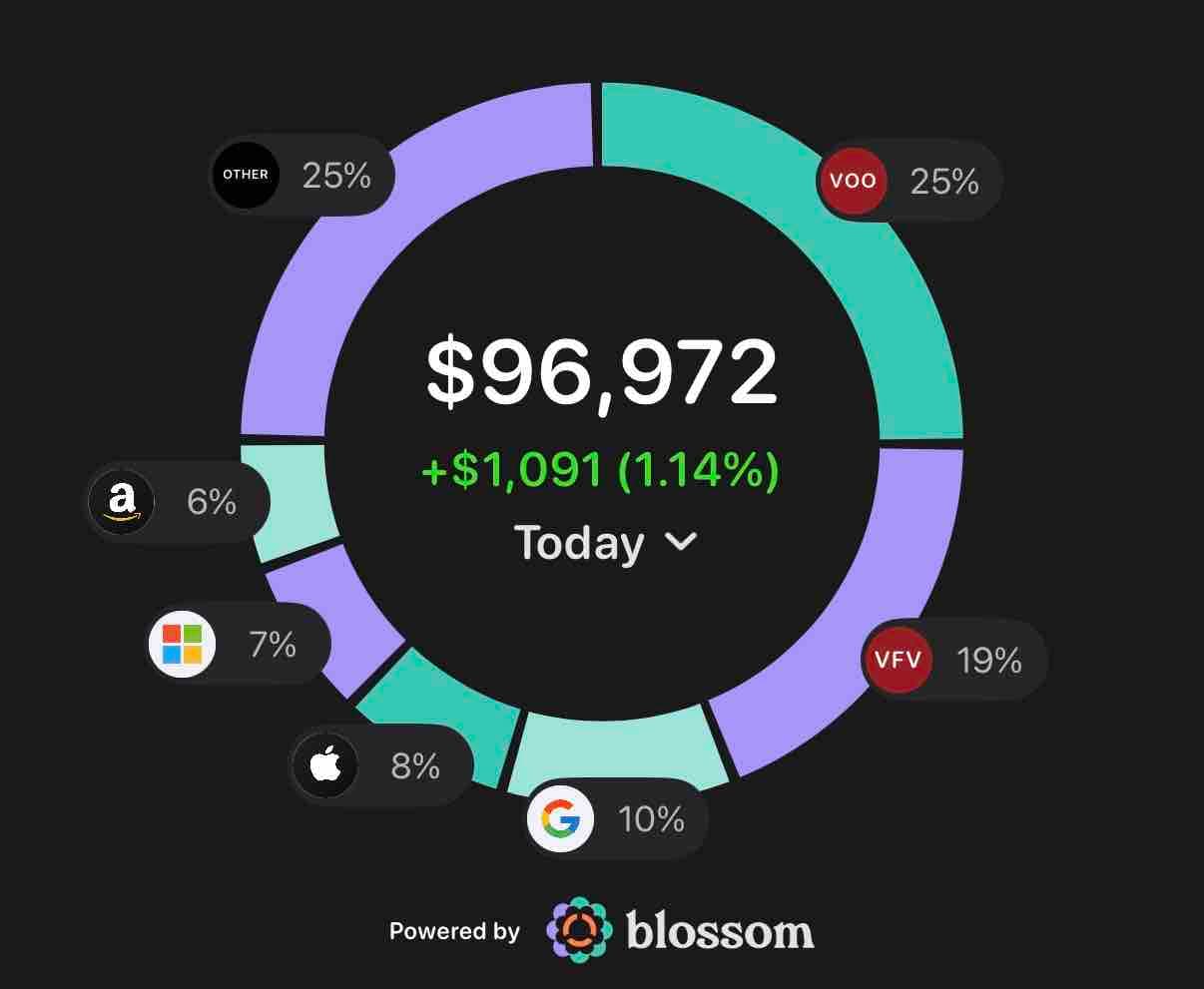
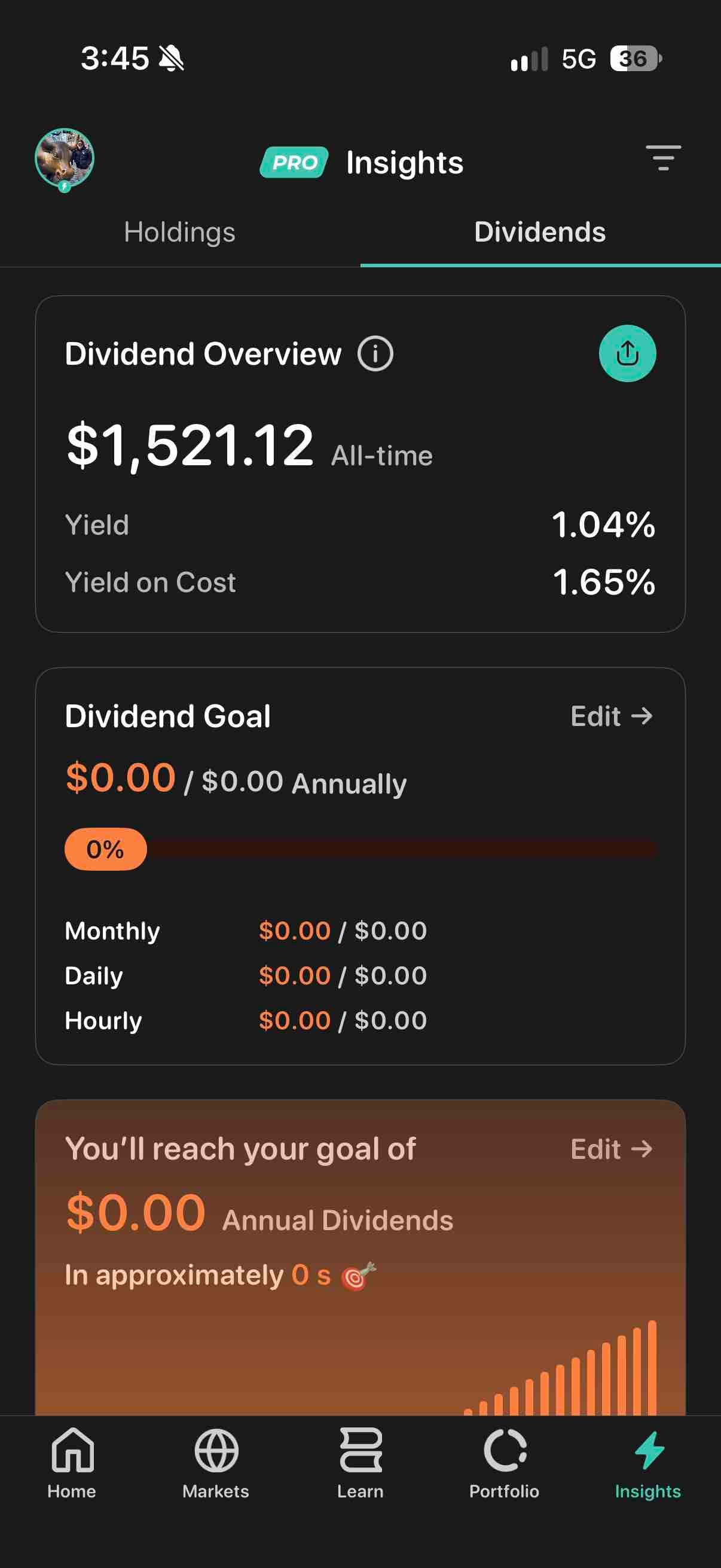
Currently at $96,972 Who else is big on dividend stocks? I’ve always been more of a growth stock guy myself, but lately I’ve been seriously looking into adding some higher dividend yields to the mix, getting that steady recurring cash flow sounds pretty nice. What would you guys recommend for dividend stocks?
(Personal Opinion) - I think something everyone needs to keep in mind before commenting on posts is that: a) not everyone is a financial advisor b) they aren’t about financial advice these are documented personal journeys c) these aren’t requirements for how you need to invest If someone is brave enough to share their stories or insights there isn’t a need to shit all over their post. What a way to make someone clam up and not enjoy a community or give up on investing. It’s a personal story or insight, at the very least be open minded enough to digest it thoroughly and properly but most of all simply be respectful. read more
MACD (Pronounced Mac-Dee) is the short abbreviation for the moving average convergence/divergence technical indicator. The MACD is a trading indicator used in technical analysis to filter and trade price action momentum on a chart. It was created by the late Gerald Appel in the late 1970s as a tool for technical analysts. It was created to visually show changes in price strength, direction, momentum, and duration of price trends and swings on a chart. The MACD is a simple visual momentum indicator. The MACD uses two moving averages as trend-following indicators and creates a momentum oscillator by subtracting the shorter-term average from the longer-term average. This formula creates the MACD as a dual indicator for both trend identification and momentum magnitude. The MACD lines fluctuate above and below the zero line in the histogram as the moving averages converge, cross, and diverge. How to use MACD: Traders can wait for signal line crossovers, center line crosses, and divergences as potential trading signals. The MACD is not bounded by set parameters, so it’s not a good tool for identifying extended overbought or oversold price levels. It is a trend and momentum indicator and shows the current direction of a move. The MACD is calculated by subtracting the 26-period Exponential Moving Average from the 12-period EMA. The answer to the calculation is the MACD line. A nine-day EMA of the MACD is called the signal line. This is the faster signal line that moves with the MACD line and can act as a crossover trigger for buy and sell signals in the direction of the price move, helping capture trends or swings. Many traders may use it as a buy signal when the stock's MACD line crosses above its signal line, and then lock in profits when the signal line crosses back below the MACD line. The MACD indicator can be used in many ways, but it is commonly used to generate signals from crossovers and divergences. The bullish MACD crossover signal can indicate momentum and a possible swing higher in price that could evolve into a sustained trend. A bullish crossover can occur near a price bottom after a rally from the lows, or when the price breaks out of a price range. A bearish MACD signal-line cross can indicate an early loss of momentum when a trend turns into a range and fails to make new highs. A bearish MACD cross under can also signal the beginning of a downtrend and the end of an uptrend. The MACD works best when used with other technical indicators for confirmation. For example, if you use MACD crosses to get into a trade, you could use the Relative Strength Index (RSI) to exit and lock in gains as a chart becomes overbought with a 70 RSI zone or oversold with a 30 RSI zone. Also, if you have a key moving average crossover signal on a chart, a bullish MACD crossover can confirm the trade, adding confluence and increasing the trade's odds of success. The MACD can help with trading price action on a chart by showing the current directional bias along with key turning points. read more
Chasing 100-200% returns a year is why most traders fail. Settle for 20% annually and you'd be outperforming 95% of hedge funds. Most traders don't fail from bad strategy. They fail from unrealistic expectations.
What was your biggest weakness in trading that took you the most time and effort to overcome so that others can learn from your mistakes? I'll I'll be in the comment section👇
I have stepped away from my portfolio recently, with school in full swing again.. Final year and still working 50-hour weeks. It's been very hard to keep up with everything, so I haven't rushed into positions I don't understand. Haven't made a ton of moves besides scooping up some quality businesses when the market lets me. Names include $PPL$ENB$EQT and $ATD have been my latest buys, with my cash position sitting just under 20% (which is healthy given current market conditions) TFSA is maxed FHSA is maxed RRSP is maxed and now building up my non-registered... while also stacking some cash aside to pay for school in full. Just a quick update for everyone!! Hope everyone is enjoying their Thursday. read more
Added a little bit more today, coming back to work is so interesting, ALL the customers from Zanzibar are coming to us now and we are packed everyday (even day time). I truly hope I will have no days off in the next three months and three weeks that we have left. Hope everybody is having a great weekend and happy investing! 🫡
A little story time about how grateful I am that I focused on financial literacy and built a retirement plan. I took my daughter to the Dentist this afternoon. As I'm waiting for her to come out, a dad and his son are checking out and he asked for a Doctor's note. She starts writing the note out, and the dad says "I need that for my work". He was asking for a note for his employer to excuse him from taking his son to the dentist. Now, I don't belittle anyone that works hard to provide for their family, and he may have a great job that pays well. But the idea that he had to get proof of what he was doing, is not a life that I would be happy living. For those that are in that type of situation... Let me tell you that there are employers that trust their employees, and allow you to take time to take care of your family without needing proof. Employers can do this because we accept it, and we don't have to.
Why do you think some people you know don’t invest? Fear of losing money? Don’t know where to start? Think they need a lot of money? Don’t know that they can invest at all? Or simply don’t trust the market? No judgment, just curious. What do you think is holding them back?read more
Stop Inflation from Draining Your Wealth! 🛑💸 With Canadian inflation stuck at a stubborn 3%, the cash sitting in a standard savings account is mathematically shrinking every single day. But before the Bank of Canada cuts rates again, you can execute two specific moves to insulate your wealth and guarantee positive real returns! 💡 How does inflation trap your standard savings? When the Bank of Canada pauses rates, it creates a dual trap for your wealth. Standard savings accounts yield negative real returns after accounting for the 3% inflation rate. At the same time, prime-linked borrowing costs continue to heavily weigh down your finances. 📈 What are the best financial moves to beat inflation in Canada? To stop this silent wealth drain, execute these two optimization moves: Build a Tax-Sheltered GIC Ladder: Staggering a 1-to-4 year Guaranteed Investment Certificate (GIC) ladder inside a Tax-Free Savings Account (TFSA) locks in current yields (up to 3.85%). This eliminates the tax drag and guarantees a real return (+0.85%) safely above inflation. Eliminate High-Interest Consumer Debt: Aggressively redirect surplus cash to pay down high-interest, prime-linked debt. Eliminating this debt locks in an immediate, guaranteed return of up to 21%, instantly destroying the heaviest weight on your financial scale. By shielding your yields and attacking debt, you can completely insulate yourself from the inflation trap. So, is your cash currently working for you, or is it silently melting away? Let me know below! 👇 #CanadianInflation #BankOfCanada #TFSA #GICLadder #DebtPayoffread more
I just added $FTK to my Turnaround Challenge portfolio. It's not entirely a turn-around like the others... quite a bit more cyclical, but the reason I added it, is because they've actually changed their business model to be less reliant on these cyclical... um... cycles. 😅 So in that sense, I feel it fits the mold enough to be included. We see rising EPS, along with rising revenue, as the initial catalyst for being considered. Up 1% already, so I'm off to spend the rest of my money on hats! 🎩 😜 The full portfolio also includes: $BLZE$ZETA$IOT$SMRT
Antonio Cibella, examines how to turn a $1 million dollar of investments into a paycheck. The material is from the USA. It is well explained, easy to understand and applicable to retired individuals on both sides of the border. He uses: “ The stock market peak in 1966 marked the start of a brutal 16-year sideways or secular bear market that overlapped directly with the Great Inflation of the 1970s”(AI generated) to do his back testing. I remember the inflation of the 1970s but nothing of the bear market. Making $350 gross a month left little opportunity to invest in the stock market. Consider the 30 minute video as an investment in your knowledge. https://youtube.com/watch?v=IHm81JJyZX8&si=-7xhpEQTMkBMvKal
The word mortgage comes from old French for death pledge. Fitting, once you do the math on what one actually costs. Take a $600000 mortgage at today's five-year fixed rate of about 4 percent, paid over 25 years. You pay back the $600000, plus roughly $359000 in interest on top of it. And none of that interest gives you a cent of tax back, because in Canada interest is only deductible when you borrow to invest. Borrow to buy a house and it is not deductible. You can change the type of that debt without adding a single dollar to what you owe. It works with a readvanceable mortgage, which just means a mortgage with a line of credit attached that grows a little every time you pay the mortgage down. Each payment frees a bit of room on that line. You borrow the room, invest it in something expected to earn income, and that slice of debt becomes tax deductible. Same total balance. Different tax treatment. Over the years the whole thing slowly converts. Say you get the deductible portion up to $100000. At about 4.95 percent that is roughly $4950 of interest a year, and at an Ontario marginal rate near 44 percent you get about $2180 of it back at tax time. Every year. You do not owe more at the end than at the start. But the money you borrow is now invested, so the market can drop while you still owe the balance. It only works with stable income, a long horizon, and a stomach for swings. The tax rules are picky too. The borrowed money has to move straight into the investment through its own account, never mixed with personal cash, or you lose the deduction. ome to the free zoom tonight: https://masteryourmortgageinfo.comread more
100% Conviction. Changing my strategy to all in 3x leverage with weekly dollar cost average to smooth volatility over time. Holding for long term. Built to harvest volatility. Dips are my friend now.
Borrow money specifically to contribute to your RRSP, then use the tax refund to pay most of it back. Here's how it works: 1. Take a short-term loan and contribute it to your RRSP before the deadline 2. That contribution lowers your taxable income, generating a refund 3. Use the refund to pay down most of the loan right away 4. The rest keeps growing tax-deferred for retirement The math: contribute $14,400 at a ~40% marginal tax rate, get back roughly $5,760 as a refund. Pay that toward the loan, and your real out-of-pocket cost drops to about $8,640, while the full $14,400 keeps compounding. The rule that makes or breaks it: loan interest has to stay smaller than your refund, and you pay it off fast, ideally within 12 months. Best for: unused RRSP room, a decent marginal tax rate, and the discipline to pay it off quickly. Skip it if you're carrying high-interest debt already. Not financial advice, just how the math works.read more
Opening an FHSA with $0 can still be a great financial move. Your FHSA contribution room STARTS when you actually OPEN THE ACCOUNT. Once opened, your yearly participation room is $8,000 and $40,000 lifetime limit. So someone who opened an FHSA earlier but didn’t have much money to contribute could potentially have MORE ROOM AVAILABLE later than someone who waited to open one. If you’re eligible but not ready to buy a home yet, have you opened your FHSA?