Still de-risking, but not stepping away from equities…there's a difference between playing defense and leaving the game. Adding to gold and silver $CEF, leaning into low volatility ETFs $ACWV & $FLVI and building out TIPS and cash like positions $SCHP, $SGOV, & $HISU-U. Not a retreat, just a shift in posture: staying invested, but tilting the portfolio toward things that hold up when everything else doesn't.
I’ve been using Neo Financial’s Grow account for the 2.75% savings rate at $0 fee having more than $20k in the account. However, I got a notification this week that starting October 1, Neo is increasing the Grow membership to $14.99/month AND removing the ability to waive the fee by keeping $20K+ with them. I could downgrade to the Essentials at 2.00%, but that’s certainly less appealing. The break-even is roughly $24,000, and even above that, I’m not sure 2.75% is compelling enough to justify paying a monthly fee when there are other HISA options out there. Maybe I’ll throw the money into $CASH instead. I’ve liked Neo, but this definitely has me shopping around. 👀 Anyone else moving their cash somewhere else? Where are you getting the best HISA rate right now without having to direct deposit your pay or be on a promo special?read more
Your TFSA loss can PERMANENTLY EAT your Contribution Room. Wait… what? 😳 If you put $7,000 into your TFSA and your investment falls to $3,500, that $3,500 contribution is GONE. So if you’ve used-up your room, you can’t simply deposit another $3,500 to “top it back up.” And yes… OVERCONTRIBUTING can trigger a 1% TAX PER MONTH on the excess amount. Did you know a bad investment inside your TFSA could have this consequence? 👇read more
Property taxes have become one of the most overlooked increases in the cost of homeownership. Over the past decade, cumulative residential municipal property-tax increases have been roughly 69% in Vancouver, 53% in Toronto, 50% in Halifax, 45% in Calgary and 44% in Prince Edward County. Some of that reflects inflation and higher costs for wages, policing, fire services, transit, construction and infrastructure. But the question for homeowners is pretty simple: Do you feel like you’re getting better value from your municipality for the significant increase in property taxes you’re paying? Better roads? Better transit? Better services? Better infrastructure? @talukder9712@etf.goread more
Adversaries of Bitcoin love to say that it “has no utility” 🤦. Which drives me a lil nuts, because it is simply not true. A very useful utility: medium of exchange. Or better put: Bitcoin is a permissionless global value-transfer and settlement network. More simply: Sending and receiving money 💸 1) Across borders 2) Or within Canada, e-transfers suck! Note that this applies more broadly to Crypto as a whole, but I only focus on Bitcoin. 1) Across Borders 🇳🇱 🇬🇧 🇯🇵 Have you ever tried to send money to someone in the US? Or anywhere in the world? It’s a royal PITA. E-transfers do not work, these are Canada only. There are some decent ways to send money to/from the US, but they all require a middle man. A bank, or some third party service like PayPal or wise. *Wise is a new thing I learned about just today, and seems like the cheapest US solution for a lot of cases. All of these solutions have FEEs, which are often opaque. Especially the FX fees. All require TRUSTing a middle man. A bank wire takes multiple days. Oh it's a Saturday? Sorry you’ll have to wait until Monday. In terms of privacy, you usually need a ridiculous amount of recipient information: full legal name, address, account number, bank/branch address, routing number, etc. See the image below for a breakdown of fees and speeds. Whereas BITCOIN, you can send money anywhere in the world directly. No TRUSTing a middle man to do this for you is required. You can literally VERIFY the transaction yourself. The fees are extremely small, and are not percentage based. It's basically the same fee to send $10 as it is to send $1,000,000. A Bitcoin transaction appears on the network almost immediately. Once mined, it gets its first confirmation usually within 10 minutes (1 block). Every subsequent block makes reversal exponentially more difficult, and you can independently verify all of it. The transaction is then SETTLED. No reversal. 24/7, 365 days a year. Bitcoin Lightning, a layer 2 solution, further reduces the fees and speeds. Near-instant payments for tiny fees. There are a couple tradeoffs here, but it is awesome for small transactions like paying for a coffee. 2) Within Canada - e-transfers Suck! Somehow in Canada, “e-transfers” have become the main way to send and receive money. It’s like a clever front end hack sitting on top of the Canadian banking system. When you send money, it doesn’t actually travel through email. It uses the interac network between the sender and receiver’s financial institution. It is NOT real time settlement. Making them susceptible to scams in many different ways. If you sell something on marketplace, and someone sends you $500 via etransfer. Is that $500 safely in your account forever? No. It could be reverted and you cannot do anything about it. That person cannot simply hit “undo”, but that person could still quite easily be scamming you. It could be from a compromised bank account, or the legitimate account owner can report it as unauthorized / fraud. Which could lead to reversal. The most common scam for this today is when someone “accidentally” sends you some money and then asks you to send it back. After you send it back, the amount they you sent originally gets reverted. Disappearing from your account. Not to mention that e-transfer request e-mail and texts are a great medium for phishing attacks. There are also limits to transaction size, and it is anchored on sensitive personal information like email address and phone number. Sending and receiving money to anyone in the world is clearly one Utility of Bitcoin. There is no sitting around for a week wondering when your wire transfer will go through. Or worse, what if the wire transfer doesn't go through for some reason? What if the bank decides to hold your money to investigate? What if they flat out reject it? What if they completely freeze your account? What if…. <insert basically infinite what if’s here> With Bitcoin, you can send money to anyone in the world using a simple address string. You can independently verify the transaction from point A to point B. All you literally need is the internet to broadcast it. Using a wallet that you have complete control over. Cheers 🍻read more
My net portfolio value decreased 2.5%, or about $24,000 in August, primarily due to price corrections in major holdings such as Alphabet $GOOGL and Brookfield Corporation $BN. In the absence of any news that could materially disrupt the operations of these businesses, I consider these price fluctuations to be sentiment-driven and of little concern to long-term shareholders. Two of the five largest holdings in my portfolio, Brookfield and Constellation Software $CSU , reported earnings in August. Both companies continue to demonstrate strong progress in terms of per-share earnings growth. Brookfield’s distributable earnings (DE) before realization increased by 15% in the most recent quarter, compared with just 7% growth in the previous quarter. Its Asset Management segment reported 20% growth in fee-related earnings supported by record fundraising activity. The Wealth Solutions segment added $50 billion of new insurance assets through acquisitions and new annuity sales, expanding its asset base by 35% to $191 billion. While the majority of the segment’s 22% DE growth was driven by acquisitions, the significantly larger asset base should provide a foundation for further earnings growth as Brookfield continues to optimize its insurance portfolio. Constellation Software also delivered another strong quarter, with revenue increasing 17% and free cash flow growing 18.2% after excluding the IRGA liability. Capital deployed toward acquisitions during the first half of 2026 reached $1.59 billion, more than double the amount deployed during the same period last year. This suggests that the private vertical market software M&A pipeline remains robust and that Constellation continues to have ample opportunities to reinvest capital at attractive returns. It is also worth mentioning the extraordinary recovery of the Salesforce stock (CRM). While the company only slightly exceeded analyst expectations, its share price surged about 25% within a few days. This is clearly a sentiment-driven repricing unrelated to the fundamental improvements, as AI disruption concerns surrounding the stock appear to have eased significantly. This again demonstrated the high return potential of investing in undervalued stocks in a sentiment-driven market. 📊 Here is a detailed breakdown of my portfolio: TFSA: $201,601 ->$197,691 RRSP: $194,231 -> $186,727 Taxable: $600,467 -> $588,044 ---- Total: $996,299 -> $972,462 (excluding margin and options) Smith Maneuver Portfolio: $107,762 -> $116,004 ($993.14 new contribution) HELOC balance: -$94,064.51 -> -$95,410.99 You can find my full portfolio update using the link below, which includes additional information you may find interesting: - Updated DCF valuation based on latest earnings: $CSU$BN$CRM$MEQ and HENNGE (4475.T) - My Smith Maneuver Portfolio Holdings - All stock & option trades I made in the past month Here is the link to the full update in the pinned comment 👇read more
One of the stranger legal ways to split investment income in Canada starts with one spouse lending the other money. Normally, if the higher-income spouse simply gives investment money to the lower-income spouse, the attribution rules pull that income back onto the higher earner's tax return. The CRA does not let a couple move cash across the kitchen table and choose the lower tax bracket. A properly documented prescribed-rate loan can change where the investment income is taxed. The loan has to charge at least the CRA rate in effect when it is made, which is 3% for loans created in the third or fourth quarter of 2026. The borrowing spouse also has to pay the interest by January 30 of the following year. Consider a $100,000 loan that earns $6,000 of investment income during the year. The borrowing spouse pays $3,000 of interest, and the lending spouse reports that interest as income. The remaining investment income is generally taxed to the borrowing spouse, subject to the normal rules for deducting interest. Missing the annual interest deadline can break the strategy for that year and future years. That small detail is why this is something to set up with proper tax and legal advice, rather than copy from a social media post. To me, the useful lesson is how exact Canadian tax rules can be. The same family money can produce a different result because the loan was documented, priced and paid correctly. Have you ever heard of a prescribed-rate loan before?read more
Getting approved for the Disability Tax Credit takes a doctor's signature, a form that runs several pages, and often a long wait, and then a lot of the people who finally get approved find it does almost nothing for them. The credit is non-refundable, which means it only works against tax you actually owe. If your income is low enough that you owe little or nothing, the disability amount, $10,138 for the 2025 tax year, just sits there. That unused amount doesn't have to be wasted, and the list of family members it can move to is much wider than most people assume. A spouse or common-law partner is the obvious one, but it can also go to a parent, grandparent, child, grandchild, brother, sister, aunt, uncle, niece or nephew, plus the same relatives on your spouse's side. What CRA wants to see is that the person with the impairment depends on that family member for at least one of food, shelter or clothing. If the supporting family member was already named on the DTC application, claiming the transfer is a line on the tax return. Line 31800 when you're claiming for a dependant, line 32600 when it's your spouse. If nobody was named, they can send CRA a signed written request setting out the support they provide, and the transfer can still go through. If someone was eligible in past years and never claimed the disability amount, CRA also lets you go back and adjust those returns up to 10 years. That is ten separate returns, each with a credit nobody used. For a family already carrying the extra costs that come with a disability, that can add up to real money. I pay attention to this because I work as a physiotherapist, so eligibility comes up with my clients more often than it does for most people. A while back I wrote about the RDSP, the account a DTC approval gets you access to. This one is simpler, and it gets missed more often, mostly because the person who benefits isn't the person whose name is on the form. Qualifying as a supporting family member is a bit stricter than the relationship list makes it sound, so it's worth confirming your own situation before you file.
A spousal RRSP lets one spouse use their RRSP room and claim the deduction, while the other spouse owns the account and normally pays the tax when money comes out. This can help when one partner earns more than the other, but the timing of the withdrawal matters. CRA looks at three calendar years: the year of the withdrawal and the two years before it. If the contributing spouse added money to any spousal RRSP during that window, some or all of the withdrawal can go back onto the contributor's tax return. The account may be in the other spouse's name, but recent contributions still follow the person who made them. Say one spouse contributed $5,000 in each of 2021, 2022 and 2023, and the other withdrew $18,000 in 2023. Up to $15,000 would be taxed to the contributor. The remaining $3,000 would be taxed to the spouse who owns the account. The calendar matters more than the number of months you have waited. If the last contribution was made in December 2023, a withdrawal in January 2026 sits outside the contribution year and the next two calendar years. That is only 25 months later, even though people often call this the three-year rule. Before taking money out, check the year of the last contribution instead of counting 36 months. Once the person receiving eligible RRIF income is 65 or older, there is another route. They can generally elect to split up to 50% of that income with their spouse, regardless of their spouse's age, which can reduce the need for a spousal RRSP later, though the tax result depends on both returns. If you and your spouse have a spousal RRSP going, do you know which calendar year the last contribution went in?read more
I find myself in a unique position (again), where I’m contemplating making an RRSP withdrawal at the age of 38. Last time I was in this position I ran out of time before making a decision. I was also making some side hustle income and really was still learning the ins ands outs of financial literacy. Therefore, I did nothing and have always wondered if I missed a once in a lifetime opportunity. The scenario is as follows: 👉🏼 Next to $0 income earned in 2026 👉🏼 Remaining TFSA room of ~$30k 👉🏼 Outsized RRSP relative to my TFSA 👉🏼 Remaining RRSP room of ~$120k So, I find myself contemplating whether or not to make a withdrawal from my RRSP in order to max out my TFSA 🤔 I ran the concept through AI and also through my investing chat group, and there’s some varying opinions. The biggest, and possibly only downside in doing this would be losing that RRSP contribution room forever. The upsides would be 1. More flexibility 2. Very little tax implications 3. Letting that income grow in a tax haven with no withdrawal rules later on I’m looking for all the feedback, suggestions, comments, concerns and experiences! Anyone ever do this? Is there something I’m missing here?read more
As I prepped my gear for the gym today, my mind turned toward a parallel discipline: wealth preservation. Specifically, structuring an intentional capital allocation strategy for the upcoming Tax-Free Savings Account (TFSA) contribution room unlocking on January 1, 2027. Sustained compounding operates on the exact same principles as physical conditioning. Real strength is rarely built through sporadic, high-variance efforts. It is the product of deliberate execution, disciplined asset placement, and positioning capital before the market forces your hand. ✅ The TFSA: Core Architecture In the hierarchy of Canadian wealth generation, the Tax-Free Savings Account (TFSA) represents the highest-conviction vehicle available to retail investors. Far beyond a traditional cash repository, the account serves as an absolute tax-sheltered envelope: Tax-Exempt Yield & Growth: Capital gains, interest, and dividend distributions accrue entirely tax-free. Capital Liquidity: Withdrawals incur zero tax liability and are reinstated as contribution room on January 1 of the subsequent calendar year. Optimizing this envelope annually should sit at the absolute apex of your liquidity management plan. ✅ 2027 Contribution Target Assuming the CRA maintains the annual baseline at $7,000 (consistent with recent limits), funding a Day-1 lump sum requires systematic capital accumulation over the final four months of the year: Daily Target: ~$55 / day Weekly Target: ~$383 / week Monthly Target: ~$1,750 / month (Should indexation push the official 2027 ceiling to $7,500, adjust your daily threshold to ~$59/day.) Strategic Implementation Channels: rather than executing a reactive liquidity sweep on December 31, consider automating your allocation pipeline through Wealthsimple: Yield-Bearing Cash Staging: Automate capital flows into high-yield liquidity vehicles (such as a high-interest cash account or cash-equivalent ETFs like CASH.TO) to capture risk-free yield through year-end, before deploying the lump sum into your TFSA on January 1. In-Kind Asset Transfers: Prefer not to deploy fresh cash? You can transfer equities or ETFs directly from a non-registered account into your TFSA. Note: This triggers a deemed disposition. Review CRA guidelines regarding capital gains liabilities and the superficial loss rule on underperforming assets prior to execution. Over to you: How are you structuring your portfolio for January 1? Do you favor immediate Day-1 lump-sum deployment, in-kind asset repositioning, or systematic dollar-cost averaging throughout the year? Share your preferred strategies below. read more
I’ve been reading Angela Duckworth’s Grit, and I’m really enjoying it. As I read, I kept finding myself drawing parallels to investing. That’s probably because my lens is almost always the same: How can I become more financially literate? Duckworth talks about choosing a “hard thing” and sticking with it long enough to get better. I think financial literacy can be that hard thing. Because becoming good with money isn’t a one-time decision. You learn. You make mistakes. You question what you thought you knew. You learn again. And eventually, something changes. You understand what you own. You understand risk. You understand taxes. You understand compounding. You understand that a market falling 20% doesn’t automatically mean your plan is broken. And, perhaps most importantly, you begin to understand yourself. That matters. Because the more you understand your portfolio, the less dependent you become on headlines, hot tips, market predictions and someone else’s confidence. You don’t need to know what the market will do next. You need to know what you will do when it does something you don’t like. That’s financial literacy. It’s not about becoming the smartest person in the room. It’s about becoming confident enough in your own plan that you can stay rational when your money gets emotional. Investing is the hard thing. But getting better at it might be one of the most valuable things you ever do. My morning thoughts. Enjoy your day 🫶🏻
I saw a recent post where someone was saving $3,000 a month. Along with their pension, their savings rate would likely be higher than 30%, maybe even pushing 40% or more. They were projecting a retirement portfolio somewhere around $4 million and, between their pension and a 4% withdrawal from the portfolio, expected to have more than $220,000 a year in retirement income. A number that would likely exceed what they are living on now. When I see numbers like that, I always want to ask two questions: Why are you saving so much? And what is the money for? Look, saving for retirement is important, and it’s something people on a platform like this are already ahead on, but when you also have a pension that replaces 50% of your salary, is indexed and paid out for life, backed by the Federal Government, and the person will be eligible to collect this starting at 46, bridged to 65 when CPP and OAS could be added, one has to start asking these questions. What is it that you are saving for, why is your target so aggressive, is it just because you want to see a larger number on the screen? Saving can become part of your identity and I’ve seen people get to the age where they had planned to spend the money and either struggle to do it or simply never get the chance. My own mother died and didn't have a single day to enjoy the retirement they had spent years saving for. And then there is the other side of it. What are you trading today for that goal, since everything is a trade. I work with guys who are grinding, working overtime and taking more time away from their families today when their kids are young and their impact can be felt so much more, in favour of earning more money to do what with? Save it? When they say they want to spend more time with their family, it’s like, then don’t work the overtime. Just do that. Why are you working overtime to earn more money that you are only going to save for some future version of your life? If you are already comfortable living on 60% or 70% of what you earn today, and you have a pension that will replace 40% or 50% of your current income, your portfolio does not need to replace your entire salary to maintain your lifestyle, but you could potentially save less and have more time to spend with your family and work less overtime. What are those moments worth? There is nothing wrong with wanting $4 million or more. There is nothing wrong with wanting to leave a large estate or having an enormous safety cushion. If that is your goal, keep saving, but have you really sat down and worked out what you are trading and why? I think sometimes people get so focused on maximizing retirement that they forget to ask what they are actually saving for. For me personally I don't think the goal should be to die with the biggest portfolio. Money is a tool. It should be used to build financial security, but it should also be used to enhance your life along the way. read more
We have not seen back-to-back down years in the S&P 500 since 2000–2002. We have certainly had some rough years since then. The financial crisis in 2008 and the selloff in 2022 are obvious examples. We have also had some massive selloffs within otherwise positive years, like the COVID crash in 2020 and the more recent volatility around Trump’s tariff policies. But each time, the negative calendar year was surrounded by positive ones. Look at the TSX, S&P 500 and Nasdaq from 2003 through 2025. We have lived through crashes, bear markets, a global financial crisis, a pandemic and some very large drawdowns, but we still have not experienced consecutive negative calendar years in any of these three major indexes. Think about what that means. Someone who started investing anytime during the past 20-plus years has never actually lived through two or three negative calendar years in a row while holding one of these major indexes. Negative Calendar Years, 2003–2025 Based on Total Return S&P/TSX Composite - 5 negative years Nasdaq Composite - 4 negative years S&P 500 - 3 negative years So now think about this if you are looking to build your retirement plan. If you are building that plan around the market you have personally experienced, and most of your investing life has taken place over the past two decades, a bad year followed fairly quickly by a recovery can start to feel normal. History tells us it does not always work that way. The last time the S&P 500 had consecutive negative calendar years was 2000–2002. From the market peak to the October 2002 trough, the S&P 500 fell roughly 49%. The tech-heavy Nasdaq-100 was absolutely crushed, losing roughly 82% to 83%. This is where we find out how the math works against us, because losses and recoveries are not symmetrical. A 50% loss requires a 100% gain just to get back to even. But an 83% loss requires a gain of roughly 488% just to reach the break-even point. And investors did not have to wait that long to get hit again. Just a few years after the 2000–2002 dot-com crash, the 2007–2009 financial crisis arrived. From peak to trough, the S&P 500 fell approximately 57%, making the decline faster and even larger than the S&P 500 drawdown during the dot-com crash. Imagine retiring at the end of 1999. You would have walked almost immediately into a three-year stretch of negative S&P 500 calendar returns. The market eventually recovered, but before very long, you were staring at another major collapse during the financial crisis. That is sequence-of-returns risk in the real world. You cannot predict when the next bad year will arrive. You do not know whether the decline will last six months or three years. You do not know whether the market will fall 20%, 40% or 50%. And even after the market recovers, you do not know whether another major downturn is waiting a few years down the road. That uncertainty matters far more once you retire because now you are likely taking money out of the portfolio at the same time the portfolio value is falling. If we look at some individual examples, we have seen companies such as TELUS, BCE, Algonquin Power, Suncor and RioCan suffer enormous declines from previous highs. In some cases, the share price fell 30% to 70%, and eventually the dividend was cut by 30% to 60% or more. You might not own individual stocks, but the same math applies to an ETF. If the underlying holdings are falling, cutting dividends, or not earning enough to support the payout, the ETF cannot keep paying out more than it earns forever without eventually cutting the distribution, eroding capital, or both. Some DIY investors look at a conventional retirement plan that says they need a large amount of capital and think, why so much? Am I just trying to die with the biggest account balance possible? Is that why everything is focused on growth? That is not really the point. The extra capital is not there because the objective is to win some contest for the largest estate. It is there because nobody knows which market you are going to retire into or what future markets will do. A retirement portfolio needs enough growth to help keep up with inflation and support decades of increasing withdrawals, but it also needs enough room for things to go wrong. Income and returns can come in lower than expected. Dividends can get cut. Inflation can stay high for years at a time, something we have seen firsthand over the past five years. Markets can fall much further than expected, recoveries can take years, and sometimes you can get through one crisis only to run into another one a few years later, like we saw in the 2000s. That is why hindsight can be so dangerous when talking about how much someone “really” needed to retire. Someone who retired in 2009 and then enjoyed more than a decade of strong equity markets could look back and say, “I could have retired with way less money.” And for their situation, that could be completely true. Someone who retired at the end of 1999 might look back and think, “I wish I had waited and built a larger portfolio before pulling the pin.” They could both be right because they retired into completely different sequences of returns. That is why the capital requirement can look high and the safe withdrawal rate can look low. Retirement planning is not built around knowing that the next 30 years will be good. It is built around the fact that you have no idea what those 30 years are going to look like. The goal is not necessarily to maximize the amount of money you die with. The goal is to give yourself a reasonable chance of funding the life you want for 30 years or more without running out of money. It is easier for people that started earlier to build wealth. Starting later makes it harder and usually requires you to save and invest more, or maybe you have to work longer, spend less, or take on more risk. And there are no secret ETFs that only some guy on Youtube knows about that can change the math or make up for lost time. Can you change how you receive your money, from selling shares to receiving distributions? Absolutely. Can you change the total return math so that the same level of spending can be sustainably supported with less money simply by changing the way the return is paid out? No. You can take on more risk in an attempt to achieve a higher rate of return, which could allow you to support more spending. Of course, taking on more risk does not guarantee you will be successful. And if you take on more risk in an attempt to make up for having a smaller portfolio or to increase your spending, and you are wrong, you can end up doing even more damage. Sustainable retirement income will depend on your total return, the sequence of those returns, inflation, fees, taxes, and how much you withdraw. Investing in growth or income assets does not change the math; it changes the packaging.read more
Why do you think some people you know don’t invest? Fear of losing money? Don’t know where to start? Think they need a lot of money? Don’t know that they can invest at all? Or simply don’t trust the market? No judgment, just curious. What do you think is holding them back?read more
My kids found my old coin collection the other day and I reminded me that Iused to collect coins when I was a kid. I remember finding a 50-cent piece and thinking it was the coolest thing ever. 😂 Then I started looking for the Olympic 25-cent coins, the coloured quarters, and anything else that looked different from the normal change in my pocket. I even remember the 1-cent coin with the dove on the back. For some reason, I thought that one was really cool. Anthing I found instead of spending it, I’d put it away. Looking back, I guess I’ve always been a little weird about money. I liked finding something, keeping it, and watching my little collection grow. Fast forward 20-something years and I’m basically doing the same thing… just with ETFs and investments instead of coins. 😂 I get the same satisfaction from seeing my investment account grow as I used to get from finding a cool coin. I guess ive never really seen money as something I need to spend just because I have it. Since we are all investors on Blossom, curious if anyone else collected money and coins as well? haha read more
I just had the shortest layoff ever. Not because we got a flood of work, or because im a superstar, but because no one else could afford to wait 1 month. I was supposed to wait till mid October before I was back to work full time (about 6 weeks) and I was supposed to be working mabye 1 day a week because we were splitting hours across all the employees in my field. 3 workers left in short order. Freeing up some work for me 😀. Now I have a van, and some tools, even setting up some small jobs! I am a bit of an advantageous person, when I heard they are quitting I was just quietly licking my lips. waiting to pounce on some opertunity. Iv always been under the impression "if you survive long enough, you will eventually be at the top". im glad yo see it work out so fast
On a recent episode of The Iced Coffee Hour podcast, Ben Felix of PWL Capital briefly laid out what he thinks is the real product finance influencers are trying to sell you: "The product that gets sold a lot by influencers and by people who are trying to create content is hope. [Hope that] you can build passive income with covered calls. [Hope that] you can build passive income with dividend stocks. [Hope that] you’re gonna pick the next big token before it blows up… it sounds sensible when you hear it, but it’s not real. It’s usually designed for clicks, and the people selling it [often] don’t understand what they’re talking about.” “You hear that you can make one percent weekly with covered calls, that sounds really good, and people are like ‘well yeah, I want that, I want to be financially independent without having to save a huge portion of my income’, so yeah, stuff like that is easy for people to consume because it gives them hope.” — One reason why I wanted to turn this part of the podcast into a post is that I was recently reminded of a discussion I had with another Blossom user who I believe exemplifies this idea of being sold hope. Instead of following the traditional process of saving and investing a portion of their income each year, they were adamant that they could retire MUCH EARLIER on an ultra-high-yield income portfolio of only $500,000. In one camp, some people might look at that and think, "Wow, really? Tell me more." While in the other camp, there might be skeptics (like myself) thinking, "$500,000? Geez, that seems awfully low." Given that the average life expectancy for Canadians is approx. 83 years, and assuming this individual is between 30-50 years of age, can they realistically expect to retire, and STAY RETIRED, for 30, 40, 50+ years on $500,000 (without considering other potential sources of income)? Another user chimed in saying you could even go as low as $250,000, leaving me even more baffled: A 30, 40, 50+ year retirement? On $250,000? With no margin for inflation, housing changes, sequence-of-return risk, or other unexpected expenses? Like... what are we doing here? What are we smoking? As someone in my mid-20s with what I think is an above-average level of financial literacy, I couldn’t help but think how absurd that premise is. It led me to think about how fascinating it is for our brains to be naturally wired in a way where we SEEK shortcuts. On one hand, shortcuts have the upside of saving us TIME and MENTAL ENERGY. If, for instance, finding a detour can save us five minutes of our morning commute to work, that's a shortcut I think many would agree is worth taking. However, when we try to apply shortcuts to complex domains governed by things like compounding and discipline, such as physical fitness, learning & education, and personal finance, that's where we can see some of the logic fall apart. You can't shortcut your fitness by relying on fad diets, you can't shortcut earning an education without doing the studying, and you certainly can't shortcut building a sustainable retirement portfolio without accumulating the required capital and participating in decades worth of compounding. That's where hope takes over. Hope is an incredible motivator; it's a phenomenon that I don't think we quite fully understand. Is hope always bad? - Not necessarily when it's associated with LONG-TERM optimism (i.e. hoping that the global economy will continue to grow for decades to come). But when paired with financial INSECURITY or the desire to ESCAPE the daily grind, the "rat race", or whatever you want to call it, hope can often blind us to risk. Going back to ultra-high-yield ETFs (sorry, you guys are easy to pick on... I'll pick on the people selling the shit coins/ICOs next time), hope leads people to MISUNDERSTAND their mechanics, mistaking yield for total return, ignoring the long-term consequences of paying high fees, of capped upside, of potential NAV decay, and believing that high distributions can magically REPLACE the need for a larger capital base. When it comes to influencing & content creation, preaching principles that are typically viewed as logically sound, responsible, or disciplined is algorithmically boring; most people seemingly don't like to listen to that kind of stuff. Influencers & content creators often try to monetize clicks and attention, so things that are flashy, things that complex, things that promise an easy way out will almost always spread faster (because it is more easily consumable) than the quiet reality of prudent, long-term investing. Ultimately, Ben Felix hit the nail on the head with his take: the most intoxicating product being marketed online isn’t an investment strategy; it’s simply hope. Do you think a lot of influencers and content creators take advantage of trying to sell people hope? Link to full episode: https://www.youtube.com/watch?v=UMCGWxSFzX4read more
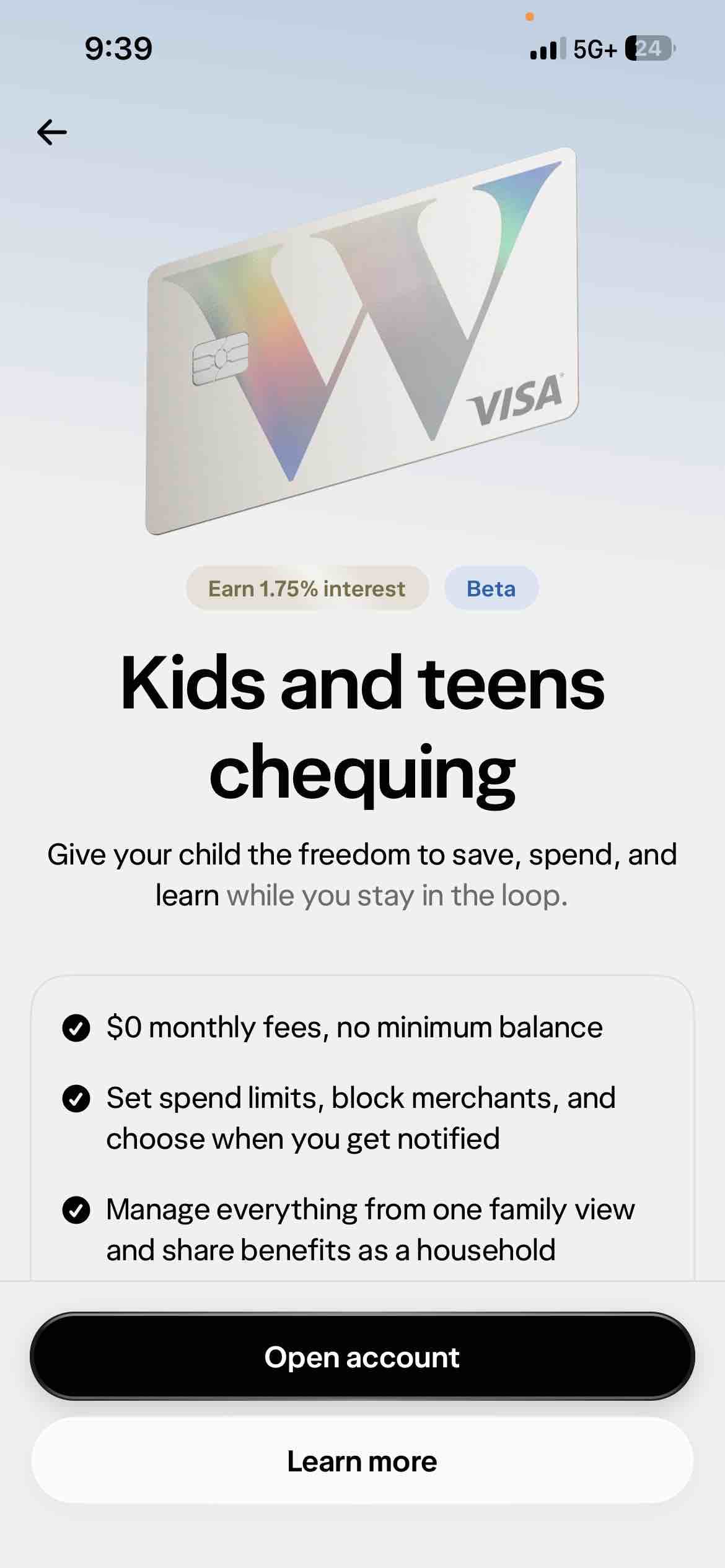
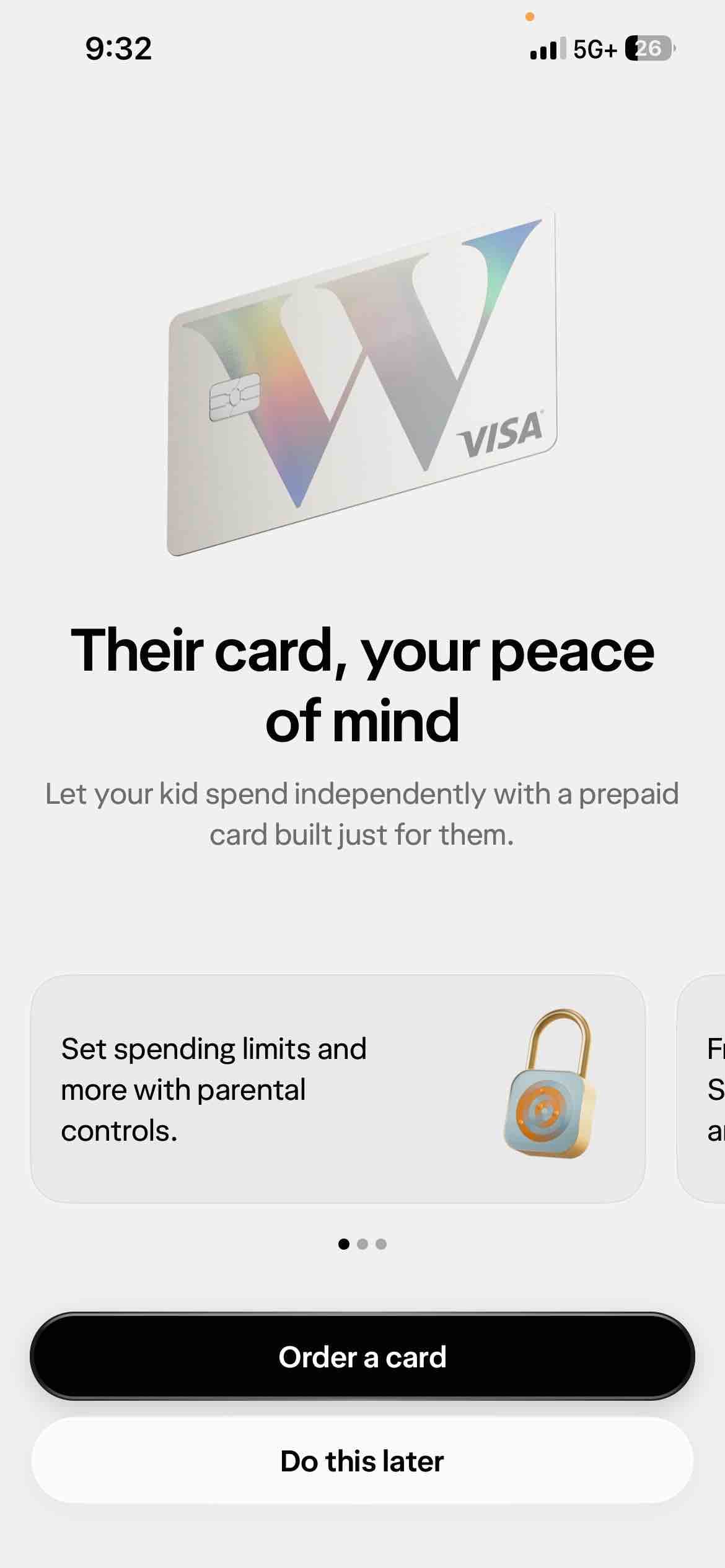
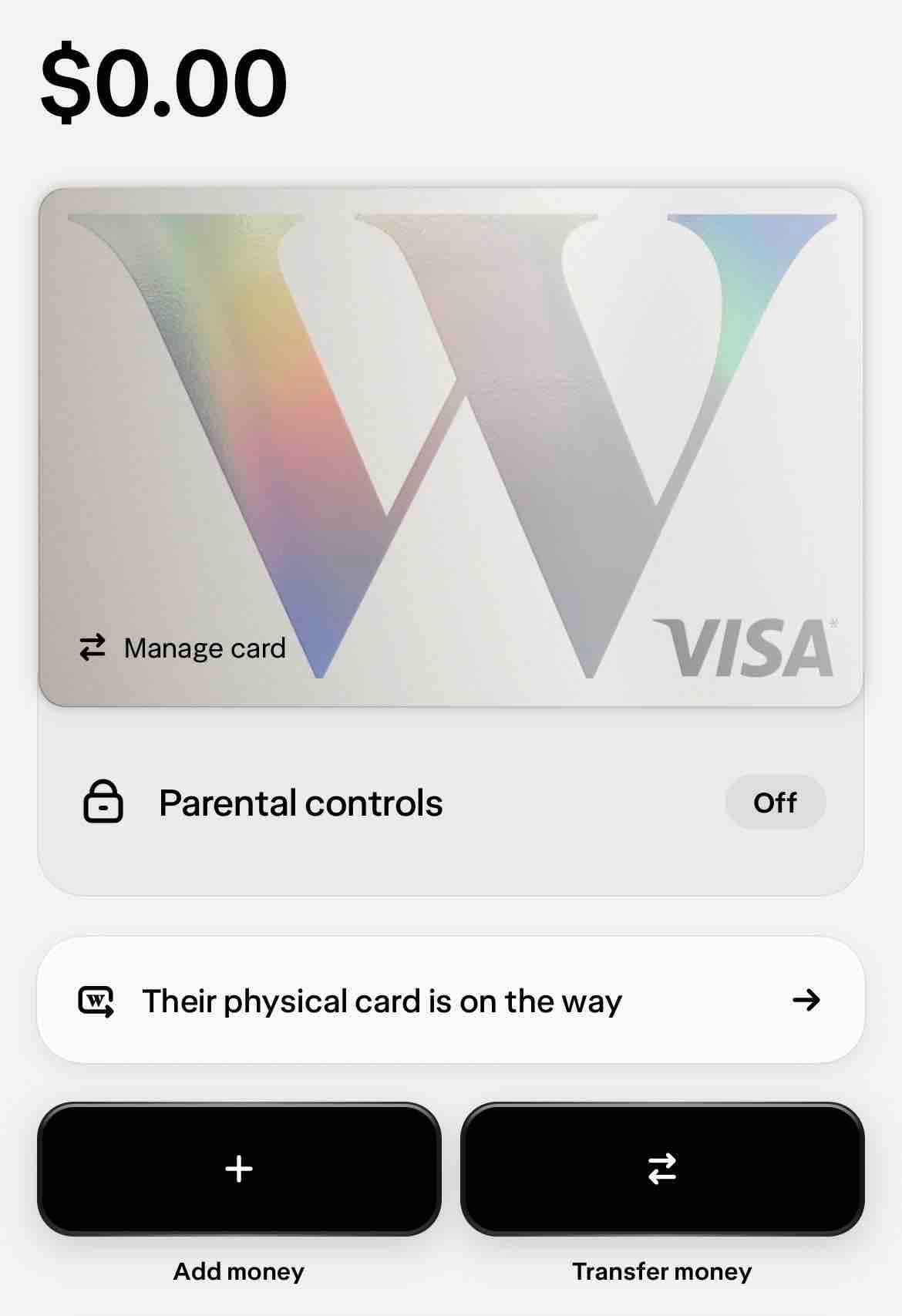
Wealthsimple has introduced a new Kids & Teens account, giving Canadian parents a way to help their children learn about spending and money management — while keeping parental controls in place. But how exactly does it work? In this video, I break down Wealthsimple's new Kids & Teens account and explain what parents need to know before opening one. We'll cover: 💳 How the Kids & Teens prepaid Visa card works 👨👩👧 What parents can control 💰 How allowances and money transfers work 📱 What kids can see and do in the Wealthsimple app 🔒 Spending limits and purchase restrictions 🌎 International spending and ATM withdrawals 🤑 Apple Pay and Google Pay eligibility 💵 How the account earns interest 🧾 Important ownership and tax considerations 🎓 Why this account is NOT an RESP 🔄 What happens when your child reaches the age of majority ⚠️ Important limitations parents should know about One of the biggest questions I address is: Is Wealthsimple's Kids & Teens account basically a kids' RESP? The answer is no — these accounts serve very different purposes. The Kids & Teens account is designed for everyday spending with a prepaid card, while an RESP is designed for long-term education savings. The Kids & Teens account is currently in beta and isn't available to all Wealthsimple clients yet. During the beta period, it's available for children aged 16 and under. The account is also currently unavailable to Quebec residents. This video is based on information provided by Wealthsimple about its Kids & Teens account. Product availability, features, terms and eligibility may change, so always check Wealthsimple's current information before opening an account. I would love to hear from you: Would you give your child a prepaid spending card like this? And what age do you think kids should start managing their own money? https://youtu.be/ZzqX6VTr6AIread more
I borrowed $35,000 to invest in XEQT using a Wealthsimple Portfolio Line of Credit (PLOC) — and after about one month, here's exactly how it's going. 📈💰 In this video, I share my real experience with borrowing to invest, including my current XEQT return of +1.85%, approximately $92 in accrued interest, and my plan to pay the accrued interest at the beginning of every month. I also break down what my estimated ~$120 monthly interest cost could look like if I keep the full $35,000 borrowed. But this isn't a video about saying that borrowing to invest is a good idea for everyone. Quite the opposite.🙂 I talk about the risks of using leverage, what happens when markets fall while your debt remains, how a Portfolio Line of Credit works, how borrowing limits are calculated, and why having a long time horizon, strong cash flow, and a high tolerance for risk is so important. I also discuss one potential advantage for Canadian investors: the possibility of deducting investment-loan interest for tax purposes when CRA requirements are met. Tax deductibility depends on how the borrowed funds are used and other CRA rules, so always consult a qualified tax professional about your own situation. My $35K PLOC investment is essentially an ongoing experiment that I'll be documenting on Moementum Finance. I'll share the good, the bad, the interest costs, the market downturns, and ultimately whether borrowing to invest was worth the risk. ⚠️ DISCLAIMER: This video is for educational and entertainment purposes only and is based on my personal experience. It is not financial, investment, tax, or legal advice. Borrowing to invest involves significant risk, including the possibility of losing money while still owing the borrowed amount. Do your own research and consult a qualified professional before making financial decisions. 💬 I'd love to hear from you: Would you ever borrow through a Portfolio Line of Credit or a Margin account to invest in the stock market — or is the risk simply not worth it for you? https://youtu.be/wYpIrbwtJ5kread more
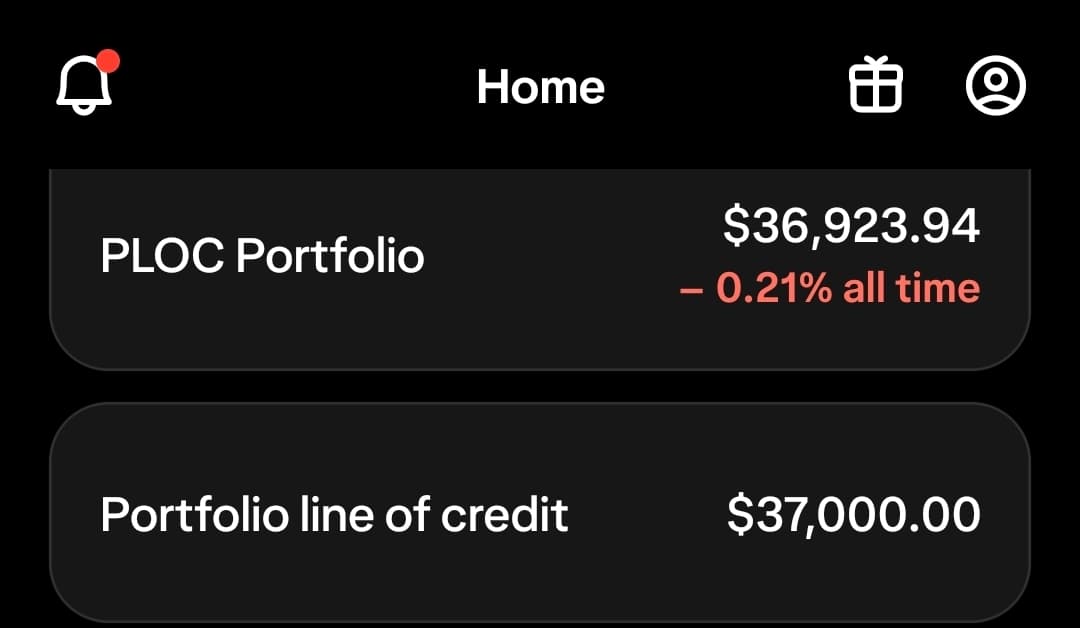
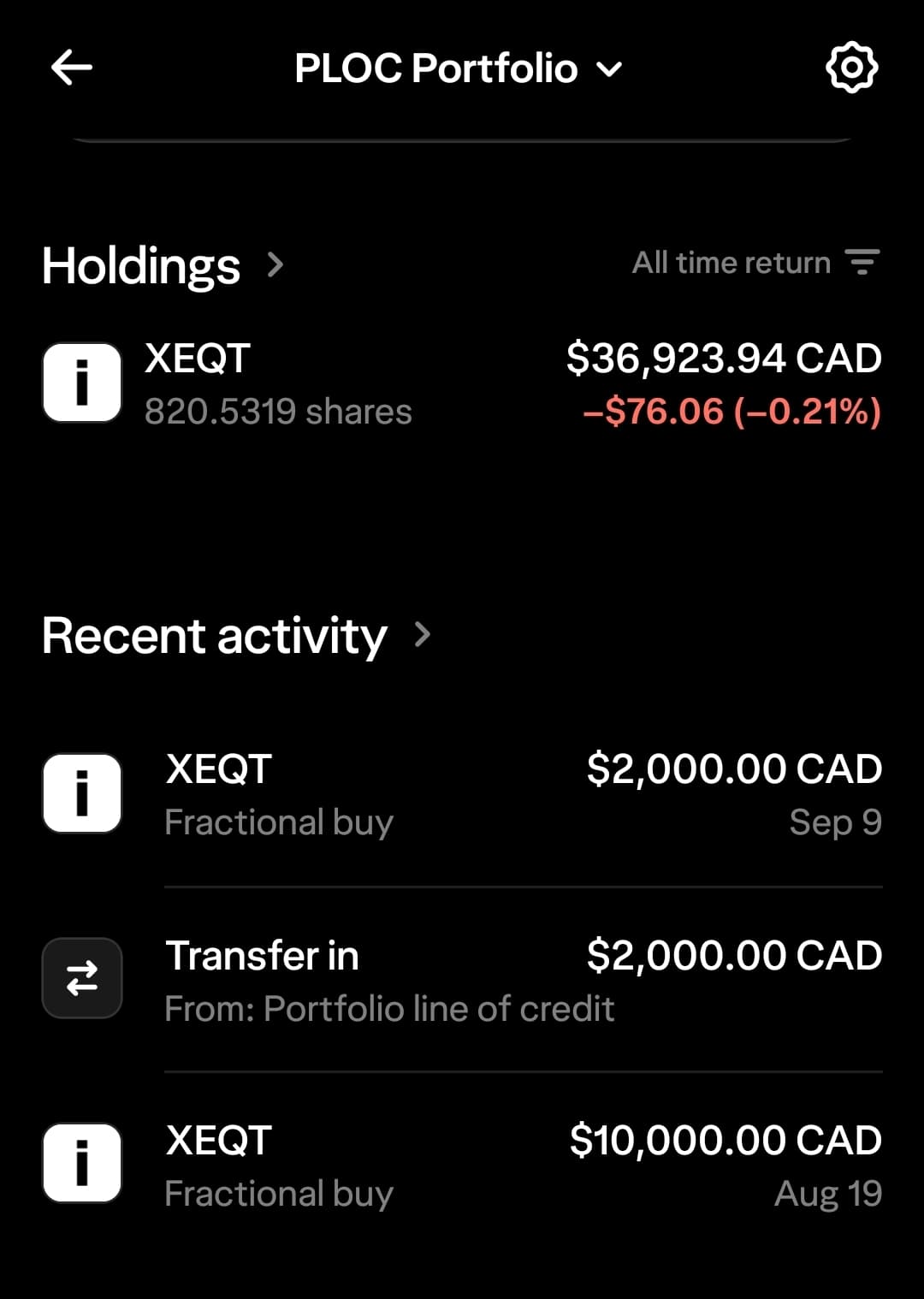
Good reminder that Borrowing to invest is risky and not for short-term timeline. In short term, things can change quickly! To depict it, see example from my last video update end of August: https://youtu.be/wYpIrbwtJ5k Versus today's value shown in the image. 😬 So far I have borrowed $37,000 to invest in $XEQT using a Wealthsimple Portfolio Line of Credit (PLOC). Over the past 1.5 months, the interest accrued/paid is $158.22. ⚠️