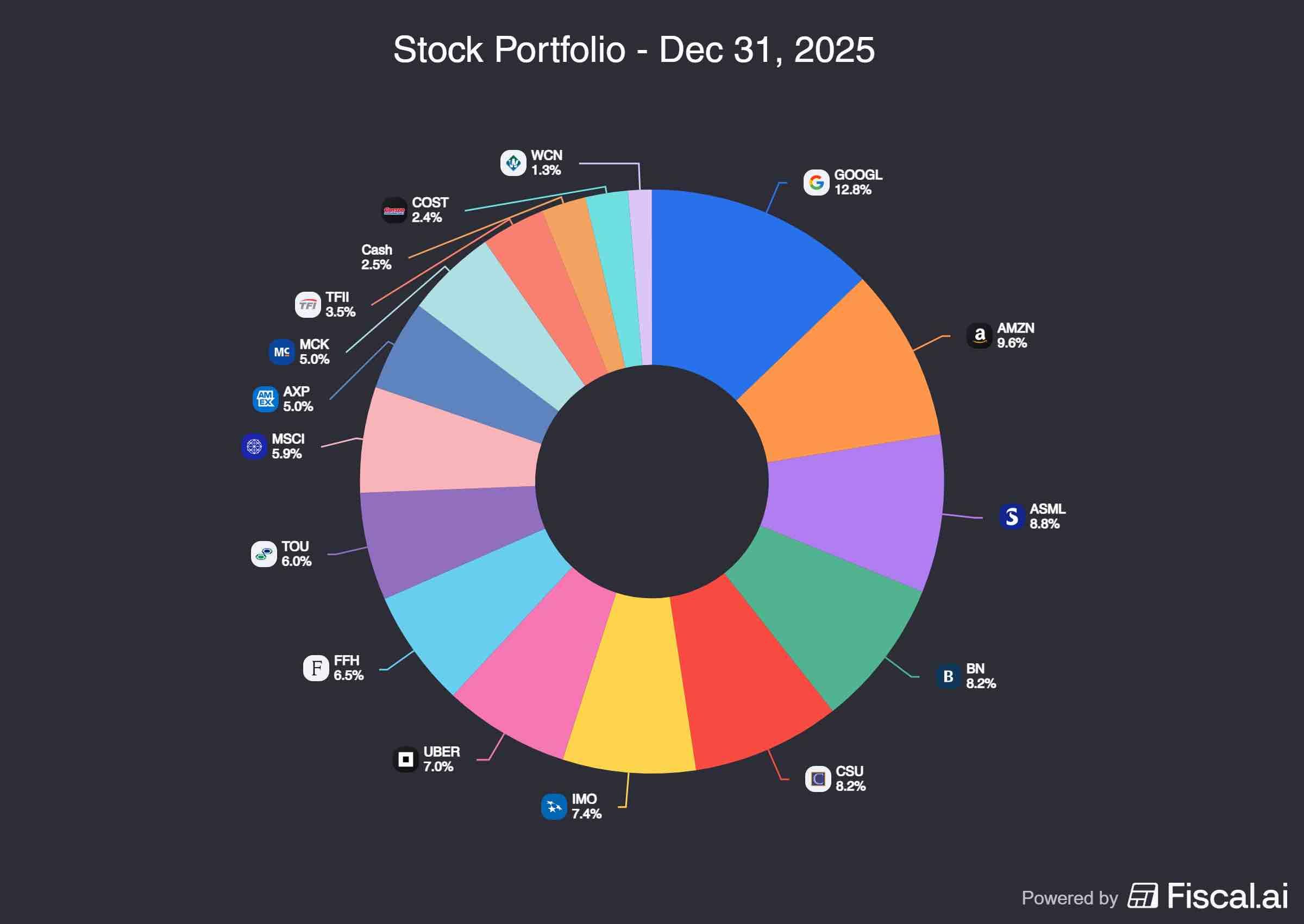
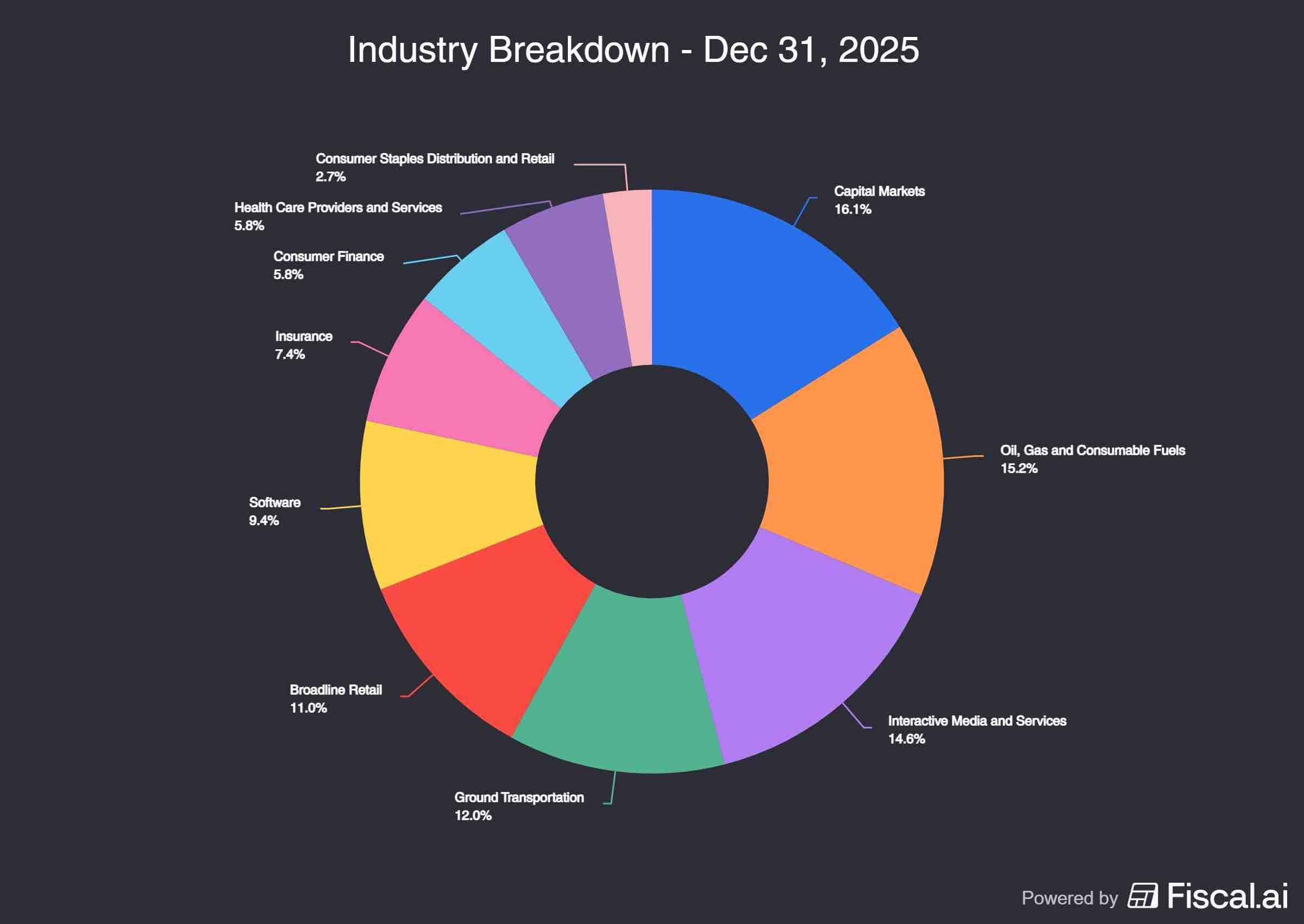
📊 Weighted Portfolio Metrics: 2025 performance: +21.3% ➤ vs. $VFV (S&P 500): +12.3% ➤ vs. $XIU (S&P/TSX 60): +28.1% ➤ vs. $VEQT (All-Equity): +20.3% ➤ 3Y performance (CAGR): +29.8% ROIC: 16.8% Net profit margin: 18.0% Forward FCF yield: 3.8% Forward P/E: 25.0x Forward P/FCF: 36.0x 1️⃣ Strategic Activity: No new positions were initiated this quarter. Instead, I added to existing high-conviction positions: Brookfield ($BN), Constellation Software ($CSU), Imperial Oil ($IMO), MSCI ($MSCI), Tourmaline Oil ($TOU), TFI International ($TFII), and Uber ($UBER). I did, however, sell out of 2 positions in the quarter: Pinetree Capital ($PNP), and Strathcona Resources ($SCR). Pinetree Capital (“Pinetree”) was sold at a 35% loss. Despite the position making up only 1% of the portfolio and only being held for a mere 6 months, I’d be lying if I said I wasn’t disappointed with the performance since starting a position. While I understand that you don’t have to make your money back the same way you lost it, poor short-term results are still a useful reminder of the impact of opportunity cost and the importance of conviction. The investment in Pinetree was primarily made as a proxy for obtaining more exposure to the ecosystem of Constellation Software (“Constellation”) and its spinoffs, Topicus and Lumine, at a cheaper valuation. Given that Constellation’s valuation has contracted in recent weeks amid fears of AI disruption and a shock leadership change, it just made more sense for me to reallocate the capital back to the parent company – and that’s exactly what I did. I don’t think anyone could have predicted Mark Leonard stepping down this year due to health reasons, but with long-time COO Mark Miller now at the helm, I still remain fairly confident that the management team will find creative ways to deploy capital and continue to compound the business at a high rate of return...perhaps not at the 25-30% that it has historically, but above-average for years to come. As the investment was made in a non-registered account, the capital loss will be used to offset some capital gains realized earlier in the year. – Purchased at the beginning of July, Strathcona Resources (“Strathcona”) was the other stock I sold this quarter at a 42% gain. This was a tactical decision based on their 2026 budget and its sensitivity to the price of crude oil (WTI). As per their 2025 Corporate Presentation, Strathcona requires WTI to be priced at ~US$58 to fully fund its capex and base dividend. With WTI currently hovering around US$58, I suspect that Strathcona could be faced with tighter FCF constraints. Should WTI fall further in 2026, Strathcona may have to draw on its credit facilities (i.e. take on more debt) to help fund its capex and base dividend. Should WTI stay flat, Strathcona won’t generate any meaningful excess FCF without altering its budget. If WTI were to rise, only then does Strathcona generate the excess FCF to provide profound shareholder returns via debt repayment, dividend raises, M&A, etc. Excess FCF is often a pillar of why I invest in Canadian O&G; without it, the thesis begins to fall apart. I still believe that Adam Waterous is a very intelligent CEO. I’m not questioning his ability to create shareholder value, but given the economic uncertainty (especially with O&G prices) in the first half of 2026, I feel more comfortable falling back on a name like Imperial Oil, which covers its capex and base dividend down to about US$35 WTI. With all that has unfolded from its bidding war with Cenovus Energy ($CVE) for MEG Energy (“MEG”), and that it walked away as a winner regardless of whether it won the bid for MEG, I’m pleased to exit Strathcona with a 42% return in just 5 months. I plan to revisit this founder-led business again at a later date. Proceeds from the sale were used to boost positions in $BN, $IMO, $TFII, and $TOU. 2️⃣ Performance: Performance-wise, the portfolio increased its return from +17.0% at the end of Q3/25 to finish the year +21.3%, down from the +32.07% achieved in 2024. Top performers include $GOOGL (+65.9%), $MCK (+45.5%), and $IMO (+35.4%), while $CSU (-25.5%), $TFII (-23.8%), and $COST (-4.7%) were the worst. This year, I outperformed the S&P 500, marginally outperformed the All-Equity portfolio, and underperformed the S&P/TSX 60. Although investing is a long-term game and these numbers don’t really matter (that much) in the grand scheme of things, it’d be wrong to not include them in a portfolio update. 3️⃣ Looking Back: Year-over-year, I reduced the number of positions in my portfolio from 20 to 15, marked notably by the sale of names like $ADBE, $ATD, $CNQ, $EQB, $L, $MEG, and $SYK, while adding new names like $FFH and $WCN. I continue to believe that the key to meaningful outperformance is to own a small number of high-quality businesses capable of compounding at high rates of return, and I continue to stick to this philosophy by adding names like Fairfax and Waste Connections to the portfolio. Of course, making concentrated bets (or “stocking picking” if you will) isn’t a strategy meant for everyone as there’s a lot of psychological hurdles, especially over the short-term, as well as lot of time and work that has to be invested behind-the-scenes to amass the conviction required to build a thesis that you can stick to. Ultimately, it has been another good year for me. 4️⃣ Looking Ahead: Looking ahead, the goal remains simple: own businesses with the balance sheets and competitive moats to emerge stronger through periods of immense volatility and uncertainty. In these instances, the market tends to rewards patience, not activity. My portfolio's overall valuation is higher year-over-year, but fundamentals continue to remain strong. So far, I don’t have a lot planned for 2026 (I’ll be busy with school for the most part, so perhaps expect a dip in activity), but in the time that I can spare, I’ll continue to look for opportunities to add throughout the year while letting long-term compounding do its magic. Happy New Year, and wishing everyone a healthy and prosperous 2026. Data was obtained using Fiscal.ai. read more
$VFV, $XUS, & $ZSP are the most widely held S&P 500 Index ETFs on Blossom (and for good reason). These ETFs are often put head-to-head against one another across many investing forums and social platforms. However, what some investors don’t realize is that overanalyzing these ETFs in search for an “edge” is, more often than not, a complete waste of time. Any type of “edge” an investor finds between the trio are largely subjective in nature (based on personal preference), too irrelevant to consider meaningful, or lack evidence to support a claim favoring one ETF over the other. One notable difference between the trio is that VFV and XUS both hold their US-domiciled ETFs, VOO and IVV, respectively, whereas ZSP elects to purchase all 500 companies listed in the S&P 500 directly as its underlying. Does this difference affect the performance between these ETFs? — No, these products are functionally identical regardless of how the fund manager attempts to replicate the index. If you were to backtest the performance between the trio, you would find that it is near identical (+/- tracking error, differences in fees/expenses, etc.) ❓How should I approach picking which S&P 500 ETF to own? For investors who want exposure to the S&P 500, I think a more productive way to think about this is by considering a) the strategy utilized by the asset manager, b) the currency in which the ETF is domiciled, and c) the differences in fees/expenses — that’s where you’ll see meaningful differences in performance. For instance, a market cap-weighted strategy has historically outperformed an equal-weighted strategy, an unhedged strategy has outperformed a hedged strategy, and a leveraged strategy has outperformed a non-leveraged strategy. Despite the differences in performance, it is important to remember that markets are FORWARD looking and performance is BACKWARD looking. There is no guarantee that one particular strategy will continue to outperform the other. 🇺🇸 Common S&P 500 Strategies • Market cap, unhedged: $VFV, $XUS, $ZSP • Market cap, hedged: $VSP, $XSP, $ZUE • Equal-weight, unhedged: $EQL • Equal-weight, hedged: $EQL-F • Total return, corporate class: $HXS • 2x leverage: $HSU • Covered call: $ESPX, $USCC • US-domiciled: $VOO, $IVV, $SPLG ❓Which S&P 500 ETF should I choose? What product you end up choosing is largely dependent on your own convictions, your own research and due diligence, your own personal preferences, etc. For example, if you were deciding between a hedged vs. unhedged S&P 500 strategy, would it not make sense to first make an effort to understand the differences between each strategy? When you understand a strategy, you are then in a better position to make an informed decision based on what you know. You can certainly gather thoughts and opinions from other people, however, you cannot expect someone to do the work for you and tell you what’s “best” to buy; that’s not responsible DIY-investing. Best is subjective, therefore, there is no consensus “best” S&P 500 ETF. If I had to pick an S&P 500 Index ETF or similar equivalent, low fees would be a priority. Share price is irrelevant. Yield is irrelevant. Distribution frequency is irrelevant. If I had access to USD, I would choose $SPLG because it offers exposure to the index at a MER of just 2 basis points (0.02%). There are minor optimization benefits from selecting a US-domiciled ETF, particularly in an RRSP, as well as currency diversification, but that is not the focus of this post. If I wanted to stick to the Canadian Dollar, I would use $HULC. HULC tracks the Solactive US Large Cap Index and utilizes a corporate class structure to reduce tracking error and provide tax efficient returns. The fund manager does all of this at an attractive MER of just 9 basis points (0.09%), which is competitive with the likes of VFV, XUS, and ZSP. 🤔 What do you do, John? Personally, I do not own an S&P 500 Index ETF. Why? — Because the S&P 500 is largely constrained to the United States. As a value investor who wants to own the best businesses in the world at a reasonable (or even attractive) valuation, I simply don’t get that by owning an S&P 500 ETF. For instance: • If I wanted to own Novo Nordisk, one of the largest pharmaceutical companies out of Denmark, I wouldn’t get that by owning the S&P 500. • If I wanted to own ASML, one of the premier semiconductor giants from the Netherlands, I wouldn’t get that by owning the S&P 500. • If I wanted to own Canadian Natural Resources, one of the most well-run oil and gas producers in Canada, I wouldn’t get that by owning the S&P 500. With the way the S&P 500 is structured, these names would never be put in the index, and thus, justifies why I don’t own it.read more
0 views
See all of @iamjohn_d posts! 👀Sign up for the full Blossom experience!