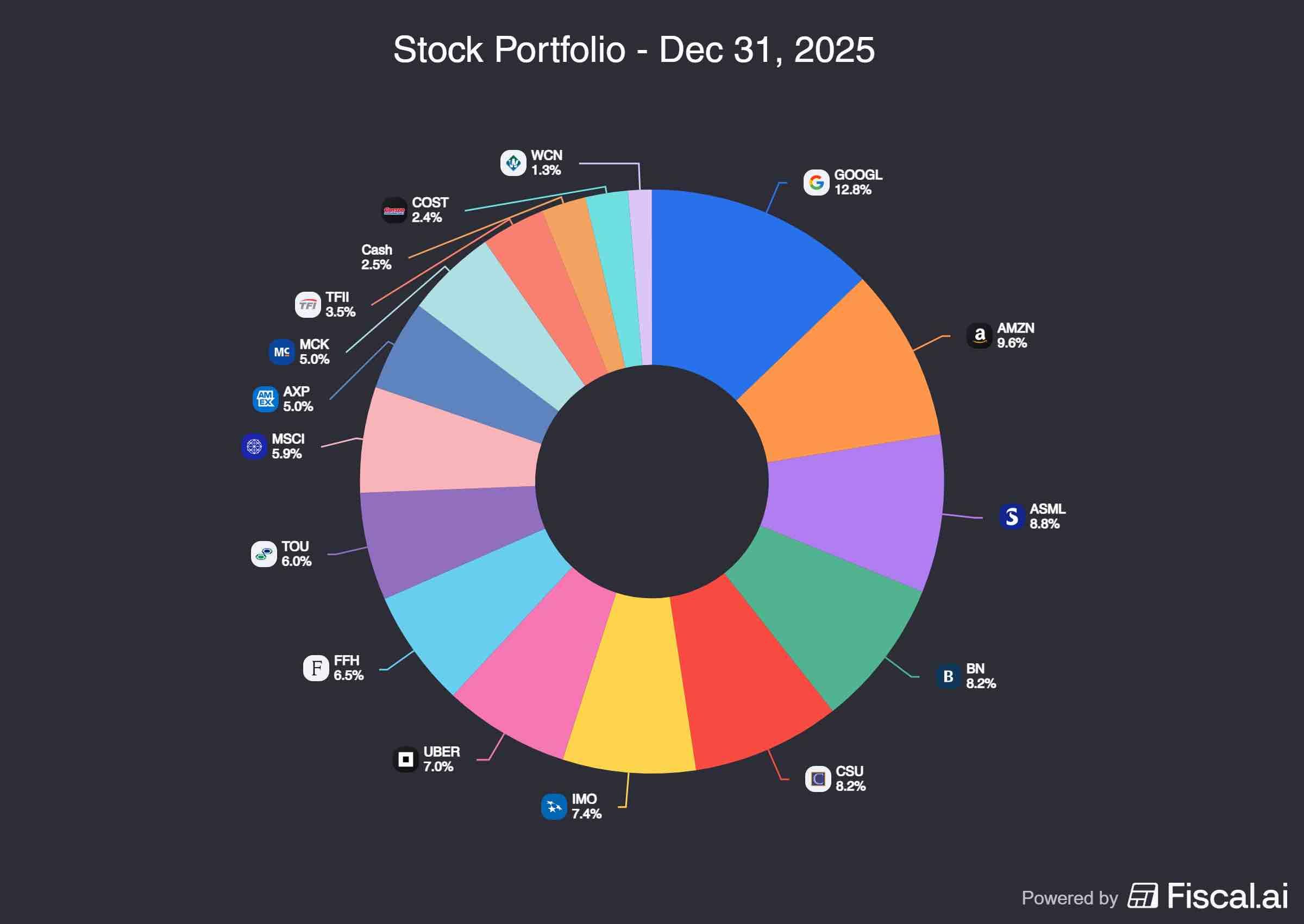
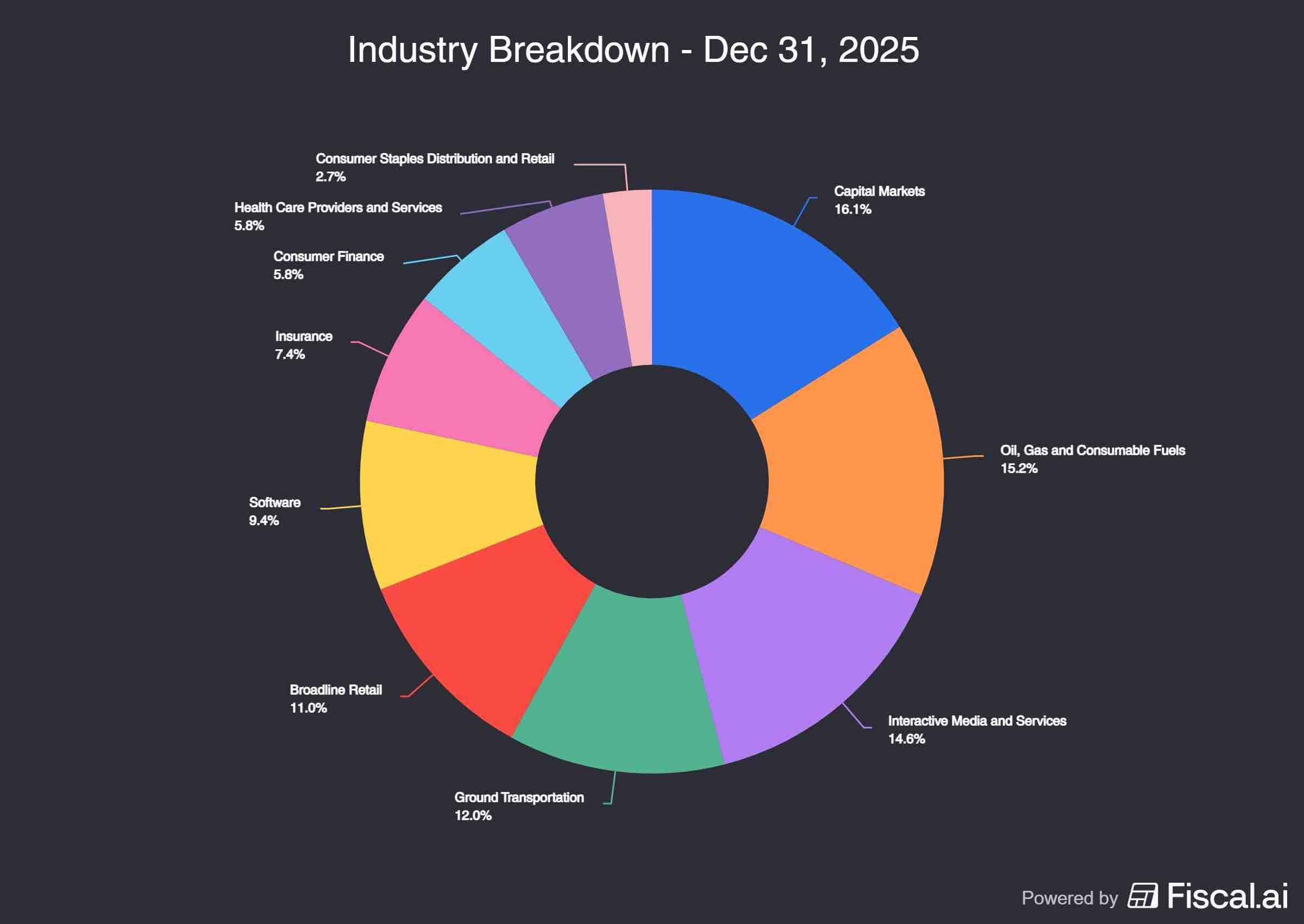
📊 Weighted Portfolio Metrics: 2025 performance: +21.3% ➤ vs. $VFV (S&P 500): +12.3% ➤ vs. $XIU (S&P/TSX 60): +28.1% ➤ vs. $VEQT (All-Equity): +20.3% ➤ 3Y performance (CAGR): +29.8% ROIC: 16.8% Net profit margin: 18.0% Forward FCF yield: 3.8% Forward P/E: 25.0x Forward P/FCF: 36.0x 1️⃣ Strategic Activity: No new positions were initiated this quarter. Instead, I added to existing high-conviction positions: Brookfield ($BN), Constellation Software ($CSU), Imperial Oil ($IMO), MSCI ($MSCI), Tourmaline Oil ($TOU), TFI International ($TFII), and Uber ($UBER). I did, however, sell out of 2 positions in the quarter: Pinetree Capital ($PNP), and Strathcona Resources ($SCR). Pinetree Capital (“Pinetree”) was sold at a 35% loss. Despite the position making up only 1% of the portfolio and only being held for a mere 6 months, I’d be lying if I said I wasn’t disappointed with the performance since starting a position. While I understand that you don’t have to make your money back the same way you lost it, poor short-term results are still a useful reminder of the impact of opportunity cost and the importance of conviction. The investment in Pinetree was primarily made as a proxy for obtaining more exposure to the ecosystem of Constellation Software (“Constellation”) and its spinoffs, Topicus and Lumine, at a cheaper valuation. Given that Constellation’s valuation has contracted in recent weeks amid fears of AI disruption and a shock leadership change, it just made more sense for me to reallocate the capital back to the parent company – and that’s exactly what I did. I don’t think anyone could have predicted Mark Leonard stepping down this year due to health reasons, but with long-time COO Mark Miller now at the helm, I still remain fairly confident that the management team will find creative ways to deploy capital and continue to compound the business at a high rate of return...perhaps not at the 25-30% that it has historically, but above-average for years to come. As the investment was made in a non-registered account, the capital loss will be used to offset some capital gains realized earlier in the year. – Purchased at the beginning of July, Strathcona Resources (“Strathcona”) was the other stock I sold this quarter at a 42% gain. This was a tactical decision based on their 2026 budget and its sensitivity to the price of crude oil (WTI). As per their 2025 Corporate Presentation, Strathcona requires WTI to be priced at ~US$58 to fully fund its capex and base dividend. With WTI currently hovering around US$58, I suspect that Strathcona could be faced with tighter FCF constraints. Should WTI fall further in 2026, Strathcona may have to draw on its credit facilities (i.e. take on more debt) to help fund its capex and base dividend. Should WTI stay flat, Strathcona won’t generate any meaningful excess FCF without altering its budget. If WTI were to rise, only then does Strathcona generate the excess FCF to provide profound shareholder returns via debt repayment, dividend raises, M&A, etc. Excess FCF is often a pillar of why I invest in Canadian O&G; without it, the thesis begins to fall apart. I still believe that Adam Waterous is a very intelligent CEO. I’m not questioning his ability to create shareholder value, but given the economic uncertainty (especially with O&G prices) in the first half of 2026, I feel more comfortable falling back on a name like Imperial Oil, which covers its capex and base dividend down to about US$35 WTI. With all that has unfolded from its bidding war with Cenovus Energy ($CVE) for MEG Energy (“MEG”), and that it walked away as a winner regardless of whether it won the bid for MEG, I’m pleased to exit Strathcona with a 42% return in just 5 months. I plan to revisit this founder-led business again at a later date. Proceeds from the sale were used to boost positions in $BN, $IMO, $TFII, and $TOU. 2️⃣ Performance: Performance-wise, the portfolio increased its return from +17.0% at the end of Q3/25 to finish the year +21.3%, down from the +32.07% achieved in 2024. Top performers include $GOOGL (+65.9%), $MCK (+45.5%), and $IMO (+35.4%), while $CSU (-25.5%), $TFII (-23.8%), and $COST (-4.7%) were the worst. This year, I outperformed the S&P 500, marginally outperformed the All-Equity portfolio, and underperformed the S&P/TSX 60. Although investing is a long-term game and these numbers don’t really matter (that much) in the grand scheme of things, it’d be wrong to not include them in a portfolio update. 3️⃣ Looking Back: Year-over-year, I reduced the number of positions in my portfolio from 20 to 15, marked notably by the sale of names like $ADBE, $ATD, $CNQ, $EQB, $L, $MEG, and $SYK, while adding new names like $FFH and $WCN. I continue to believe that the key to meaningful outperformance is to own a small number of high-quality businesses capable of compounding at high rates of return, and I continue to stick to this philosophy by adding names like Fairfax and Waste Connections to the portfolio. Of course, making concentrated bets (or “stocking picking” if you will) isn’t a strategy meant for everyone as there’s a lot of psychological hurdles, especially over the short-term, as well as lot of time and work that has to be invested behind-the-scenes to amass the conviction required to build a thesis that you can stick to. Ultimately, it has been another good year for me. 4️⃣ Looking Ahead: Looking ahead, the goal remains simple: own businesses with the balance sheets and competitive moats to emerge stronger through periods of immense volatility and uncertainty. In these instances, the market tends to rewards patience, not activity. My portfolio's overall valuation is higher year-over-year, but fundamentals continue to remain strong. So far, I don’t have a lot planned for 2026 (I’ll be busy with school for the most part, so perhaps expect a dip in activity), but in the time that I can spare, I’ll continue to look for opportunities to add throughout the year while letting long-term compounding do its magic. Happy New Year, and wishing everyone a healthy and prosperous 2026. Data was obtained using Fiscal.ai.
1,086 views
6 Comments
Jojo Wang
@jojo84072 · 10moEdited
So inspiring! Thank you John for sharing. Keep up the great work! 😊💪
Mr Financial
@mr.financial · 10mo
Well done young man! You got a bright, beautiful future in store on the investing front! I like the thoughtfulness that goes into your updates as well. You pivot when you need to and it's worked out. Have you ever considered holding a portion of your portfolio as a broad market index and use your other positions and satellites to minimize/reduce out/underperformance, essentially narrowing your personal skewness of return?
Michael Conroy
@conroy119 · 10mo
Great summary! Thanks for sharing
MissG
@let_it_ride · 10mo
Really great post John! Thanks for sharing! Excellent returns on Strathcona! I sold much too soon. I always enjoy and appreciate reading through your thought process.
See the full comment section 👀Sign up for the full Blossom experience!