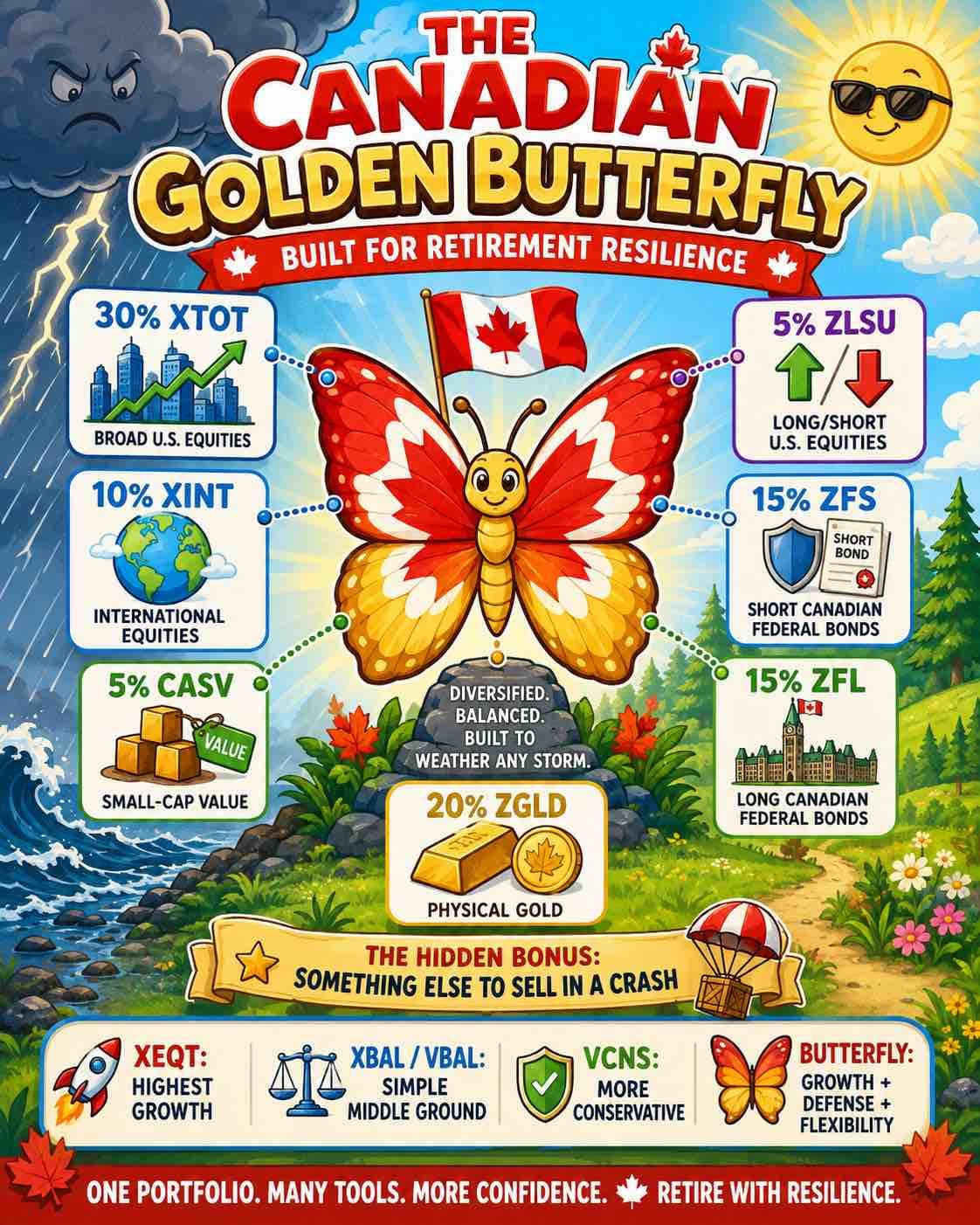
🦋 The Canadian Golden Butterfly: Built for Retirement Resilience: -Beta = 0.5 -Purpose = Sell Least Impaired Capital First -Goal = Survive, Fly, Heal -Estimated Return = 6.5-7.5%, beat inflation. Most portfolios assume stocks will rise over time. Historically reasonable — but near retirement, maximizing return stops being the only goal. A 40% crash at 35 hurts. A 40% crash at 64, just before withdrawals begin, can permanently damage retirement. That’s where the Golden Butterfly comes in. Its biggest advantage isn’t that every asset goes up during a crisis. It’s that different assets fail at different times. Ideally, when one sleeve is getting crushed, another is holding up — giving you something else to sell. ⸻ 🇨🇦 The Canadian Golden Butterfly For a Canadian investor within 3-5 years of retirement: 🇺🇸 30% XTOT — broad U.S. equities 🌎 10% XINT — international equities 🔍 5% CASV — small-cap value ⚖️ 5% ZLSU — long/short U.S. equities 🏦 15% ZFS — short Canadian federal bonds 🏛️ 15% ZFL — long Canadian federal bonds 🥇 20% ZGLD — physical gold That’s roughly: 45% traditional equities 5% long/short equity 30% federal bonds 20% physical gold ⸻ 🔧 What Each Piece Does $XTOT — Growth Engine. Broad U.S. exposure from mega-cap to micro-cap. Retirement can last decades, so becoming too defensive creates its own risk. $XINT — Geographic Diversification. Developed and emerging markets outside North America. Its job is to keep the portfolio from depending entirely on America. $CASV — Small-Cap Value. Adds smaller value/profitability companies that can behave very differently from mega-cap growth. $ZLSU — Long/Short Diversifier. Goes long companies expected to outperform and shorts expected laggards. At 5%, it’s another return source rather than the core portfolio. $ZFS — Stability Bucket. Short federal bonds with relatively low interest-rate sensitivity. Useful for liquidity and spending during market stress. $ZFL — Recession Defender. Long federal bonds can benefit when recessions push interest rates lower. Their weakness is inflation and sharply rising yields. $ZGLD — Inflation/Crisis Diversifier. Physical gold. Its job isn’t to beat stocks; it’s to behave differently when stocks or bonds are struggling. ⸻ 💰 The Hidden Retirement Bonus: Something Else to Sell Imagine stocks fall 40% and you need money for living expenses. In an all-equity portfolio, you may have to sell stocks after they’ve already collapsed. Those shares are gone forever and cannot participate in the recovery. With the Canadian Golden Butterfly, you can ask: What is holding up? Maybe ZFS is stable. Maybe ZFL rallied. Maybe gold is up. Maybe ZLSU fell much less. You can potentially sell the strongest or least-damaged sleeve instead of locking in the largest loss. That turns diversification into a withdrawal strategy. ⸻ 💻 Dot-Com Bust: 2000–2002 The dot-com collapse was brutal for growth stocks and lasted several years. Likely Canadian Butterfly behaviour: 🇺🇸 XTOT — 🔴 Weak Broad U.S. equities suffer. Avoid selling if possible. 🌎 XINT — 🔴 Weak International equities also struggle. 🔍 CASV — 🟢/🟡 Better relative performance Small/value companies historically held up much better than expensive growth during parts of this period. ⚖️ ZLSU — 🟡 Potentially useful The ETF didn’t exist, but a long/short structure could potentially benefit from large gaps between winners and losers. 🏦 ZFS — 🟢 Stable Useful spending reserve. 🏛️ ZFL — 🟢 Strong candidate Falling rates and recessionary conditions can favour long government bonds. 🥇 ZGLD — 🟢 Strong later in the crash Gold performed especially well by 2002. What would I sell first? 1. ZFL if it had rallied 2. ZGLD if overweight 3. ZFS for spending Try not to sell depressed XTOT or XINT. ⸻ 🏦 2008 Financial Crisis This is probably the cleanest Golden Butterfly example. Equities collapsed while high-quality government bonds performed extremely well. Likely behaviour: 🇺🇸 XTOT — 🔴 Crushed 🌎 XINT — 🔴 Crushed 🔍 CASV — 🔴 Very weak Small companies can suffer even more in deep credit crises. ⚖️ ZLSU — 🟡 Unknown Long/short could potentially reduce market sensitivity, but it isn’t guaranteed to profit. 🏦 ZFS — 🟢 Stable 🏛️ ZFL — 🟢 Potential hero Falling rates and a flight to safety can drive long government bonds sharply higher. 🥇 ZGLD — 🟢 Held up What would I sell first? 1. ZFL 2. ZGLD if above target 3. ZFS And if rebalancing, some of those proceeds could be redirected into cheap equities. The key is avoiding forced sales of assets that are already down 30–50%. ⸻ 🦠 COVID Crash: 2020 COVID was different because the collapse happened incredibly fast. Stocks fell roughly one-third in weeks, then recovered rapidly. Likely behaviour: 🇺🇸 XTOT — 🔴 then 🟢 Selling during the panic could have been especially damaging. 🌎 XINT — 🔴 then recovery 🔍 CASV — 🔴 Severe initial drop ⚖️ ZLSU — 🟡 Depends on positioning 🏦 ZFS — 🟢 Stable 🏛️ ZFL — 🟢 Strong during falling-rate panic 🥇 ZGLD — 🟢 Strong overall What would I sell first? 1. ZFS for immediate spending 2. ZFL after a bond rally 3. ZGLD if overweight Avoid panic-selling XTOT after a sudden 30% decline. COVID showed why having another source of liquidity matters: stocks recovered before many investors expected. ⸻ 🔥 2022: The Butterfly’s Tougher Test Not every crisis helps bonds. In 2022, inflation surged and rates rose rapidly. Stocks fell and long bonds fell. Likely behaviour: 🇺🇸 XTOT — 🔴 🌎 XINT — 🔴 🔍 CASV — 🟡/🔴 ⚖️ ZLSU — 🟡 Potentially useful depending on stock selection 🏦 ZFS — 🟢/🟡 Much more resilient than long bonds 🏛️ ZFL — 🔴 Hurt badly by rising yields 🥇 ZGLD — 🟢/🟡 Diversifier, but not guaranteed to rise What would I sell first? 1. ZFS 2. Whichever of ZGLD or ZLSU held up best Avoid selling deeply depressed stocks and long bonds unless necessary. This is important: There is no perfect hedge. The goal is not to have everything win. The goal is to have something still standing. ⸻ ⚠️ Sequence-of-Returns Risk Retire with $1 million. A 40% decline leaves: $600,000 You need a 66.7% gain to recover. If a diversified portfolio fell 18% instead: $820,000 You need only about 22% to recover. And once withdrawals begin, the difference becomes even more important. ⸻ 📉 Beta I’d use roughly: 0.45–0.55 with about: 0.50 as a planning estimate. That doesn’t mean the portfolio always moves half as much as stocks. Gold and long bonds can move independently. That independence is the point. ⸻ 🆚 $VCNS, $XBAL, $VBAL and $XEQT VCNS is roughly a conservative 40/60 stock-bond portfolio. XBAL/VBAL are roughly traditional 60/40 portfolios. XEQT is essentially 100% equity. The Canadian Golden Butterfly is different because it uses: 🥇 physical gold ⚖️ long/short equity 🏦 short federal bonds 🏛️ long federal bonds That creates more distinct return sources. ⸻ 📊 Return, Beta & Cost Summary Forward-looking planning estimates, not guarantees. 🦋 Canadian Golden Butterfly Estimated return: 6.5–7.5% Estimated beta: ~0.50 Estimated weighted cost: ~0.20–0.25% 🛡️ VCNS Estimated return: 5–6% Estimated beta: ~0.35–0.45 MER: ~0.22% ⚖️ XBAL Estimated return: 6–7% Estimated beta: ~0.55–0.65 MER: ~0.19% ⚖️ VBAL Estimated return: 6–7% Estimated beta: ~0.55–0.65 MER: ~0.22% 🚀 XEQT Estimated return: 8–9% Estimated beta: ~0.95–1.00 MER: ~0.20% By expected return alone: XEQT > Canadian Golden Butterfly ≈ XBAL/VBAL > VCNS But near retirement, expected return is only part of the story. XEQT has the strongest growth potential but the highest equity sensitivity. XBAL and VBAL offer a traditional middle ground with roughly 60% equities and 40% bonds. VCNS is more conservative and bond-heavy. The Canadian Golden Butterfly is designed to target roughly 7% long-term return with about half the equity-market sensitivity of XEQT, while also giving you several different assets to potentially sell during a crisis. ⸻ 🏁 Bottom Line The Canadian Golden Butterfly asks one question: When the next disaster arrives, what will I have available to sell? Dot-com crash? Potentially bonds, gold or value stocks. 2008? Long bonds, short bonds and gold. COVID panic? Short bonds, long bonds and gold. Inflation/rising-rate shock? Short bonds, potentially gold and long/short. You don’t need to know which crisis comes next. You don’t need every asset to win. You simply want one or two assets still standing when another part of the portfolio is bleeding. Then you sell from strength, rebalance into weakness, and give the damaged assets time to recover. 🦋 Canadian Golden Butterfly 30% XTOT · 10% XINT · 5% CASV · 5% ZLSU · 15% ZFS · 15% ZFL · 20% ZGLD Expected return: ~7% Estimated beta: ~0.50 Weighted cost: ~0.20–0.25% For someone approaching retirement, that may be the real magic of the Butterfly: not avoiding every loss — but avoiding being forced to sell the wrong thing at the worst possible time. “Historical crisis discussion uses representative asset classes because several ETFs in this portfolio did not exist during the dot-com crash, 2008 or COVID. Return, beta and fee figures for the complete Canadian portfolio are illustrative planning estimates, not guarantees or a historical backtest.” ** Bonus Tip: use 10% $PTLC with XTOT for further defence Survive - Fly - Heal
652 views
0 Comments
Join the conversation with 500,000+ other investors 💸
Create an account to get access to everything Blossom has to offer!
📊 Personalized algorithm based on your investing style, experience level and interests
📈 Powerful portfolio and dividend tracking tools
👀 See what top creators and others in the community are investing in