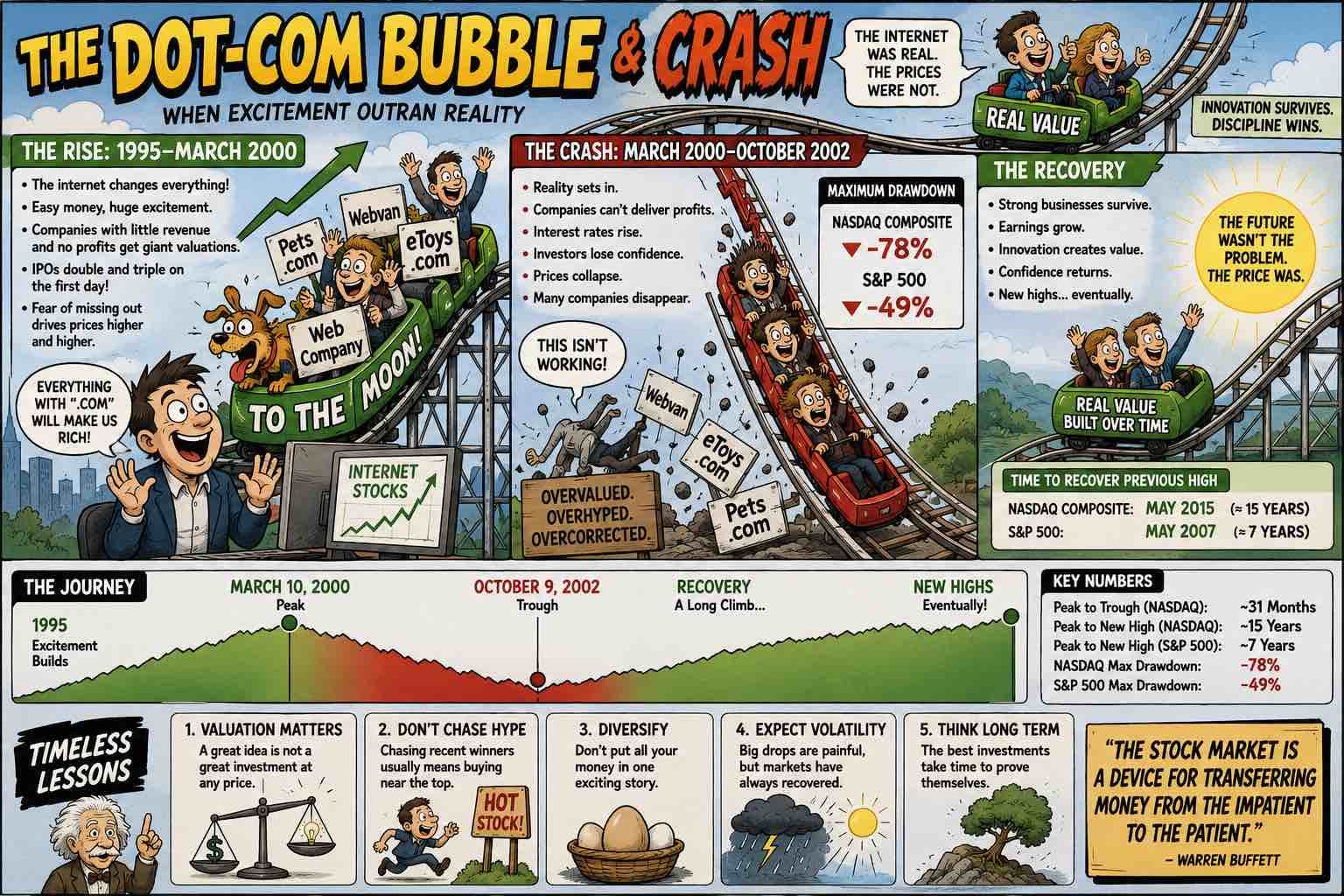
@canadianinvestor The Dot-Com Bubble (2000–2002): When Excitement Outran Reality The dot-com crash remains one of history’s greatest investment lessons. It demonstrated that even revolutionary technology can become a poor investment when investors pay unrealistic prices. The internet truly was changing the world, but during the late 1990s many investors forgot one important rule: A great company is not always a great investment at any price. ⸻ The Rise of the Internet During the mid-to-late 1990s, the commercial internet exploded. Investors believed nearly every company ending in “.com” would become the next global giant. Many technology companies: * had little or no revenue; * had no profits; * had unproven business models; * were valued based on website traffic or future expectations rather than earnings. Traditional valuation metrics were dismissed as “old economy thinking.” Initial Public Offerings (IPOs) routinely doubled or tripled on their first day of trading. Investors feared missing out more than they feared losing money. ⸻ Maximum Drawdown The technology-heavy NASDAQ Composite reached its peak on March 10, 2000. It then fell approximately 78%, one of the largest declines ever experienced by a major U.S. stock index. The broader S&P 500 declined approximately 49%. Timeline * Peak: March 10, 2000 * Bottom: October 9, 2002 * Peak to trough: approximately 31 months * NASDAQ recovery to previous high: May 2015 (about 15 years) * S&P 500 recovery: May 2007 (about 7 years) The NASDAQ’s recovery illustrates an important lesson: even when the economy recovers, sectors that become wildly overvalued can take much longer to regain previous highs. ⸻ What Caused the Crash? Several forces combined to inflate—and ultimately burst—the bubble. 1. Speculation Investors purchased companies simply because they were internet-related, believing prices could only continue rising. 2. Unrealistic Valuations Many firms were valued in the billions despite having little revenue and no profits. 3. Easy Capital Venture capital and public markets poured money into almost any technology startup, allowing weak businesses to survive longer than fundamentals justified. 4. Rising Interest Rates The Federal Reserve raised interest rates several times in 1999 and 2000. Higher rates reduced the present value of future earnings and made speculative growth stocks less attractive. 5. Reality Arrived As companies failed to generate profits, investors began questioning whether future expectations were achievable. Confidence evaporated, and valuations collapsed. ⸻ Why Did the Market Recover? The internet itself was never the problem. The problem was paying too much for companies that could not deliver the profits investors expected. As weaker companies disappeared: * capital shifted to stronger businesses; * surviving companies became profitable; * productivity increased; * corporate earnings improved; * investor confidence gradually returned. Many household names—including Amazon, Microsoft, and Apple—survived the crash and eventually became some of the world’s most valuable companies. The technology revolution was real; the bubble was the price investors were willing to pay for it. ⸻ Lessons for Investors The dot-com crash teaches several timeless lessons: * Revolutionary technology does not eliminate the need for reasonable valuations. * Markets can remain irrational longer than investors expect, but fundamentals eventually matter. * Diversification protects investors when one sector becomes excessively popular. * Chasing recent winners often leads to buying near market peaks. * Even after devastating crashes, innovation continues and markets eventually recover. Perhaps the most important lesson is this: The future can be bright while an investment is still overpriced. Successful investing is not only about identifying tomorrow’s winning industries—it is also about paying a sensible price and having the patience to hold through periods of extreme volatility. The dot-com crash reminds us that excitement creates bubbles, fundamentals eventually prevail, and disciplined investors who remain diversified are better positioned to benefit when optimism returns to reality.
388 views
8 Comments
Scott S@scottsinvesting · 2dEdited
Big post Richard! Newer investors today can/should learn so much from the DotCom era, but sure seems like few have any interest in doing so... I'm not suggesting 1999-2002 was a carbon copy of today, but there are similarities should be paid attention to IMO.
Canadian Investor@canadianinvestor · 2d
I can confirm this was a very trying time in the markets
Mike L@noviceadvisor · 2d
Nvidia is the Cisco of the dot-com era. Tech is going to crash, maybe not as bad as dot-com but all that private capital lending, all that bond issuance, it'll come calling
Ed @edsam · 2d
I remember losing money on broadvision
Join the conversation with 500,000+ other investors 💸
Create an account to get access to everything Blossom has to offer!
📊 Personalized algorithm based on your investing style, experience level and interests
📈 Powerful portfolio and dividend tracking tools
👀 See what top creators and others in the community are investing in