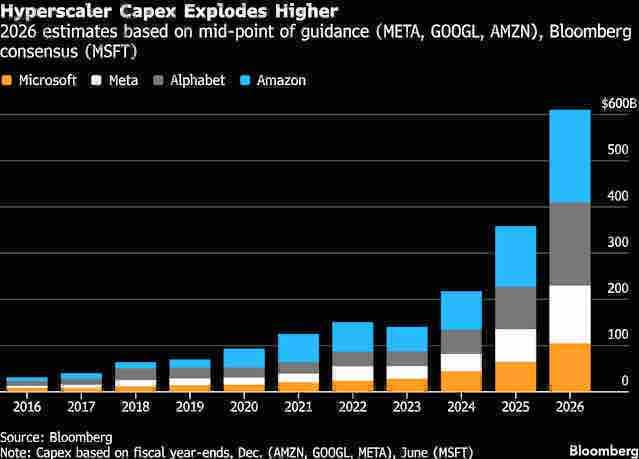
For the past couple of years, some of my largest positions have been in Big Tech companies. $AMZN and $GOOGL to be precise. And to preface this post, I’m still bullish on both of these companies. At the time I bought, spend was around $50 billion and $70 billion a year for Amazon and Google respectively, and this was the main concern floating around. “That’s a lot of money!” “Is it worth the investment?” — said some investors I personally thought that this AI spend will materialize eventually, and that $50-70 billion in the grand scheme of things isn’t a lot of money for these companies long-term. It was a lot of money, but free cash flow (FCF) was still positive by tens of billions of dollars despite rising CapEx spend, plus continuing to grow over time. So I thought: “Well, these investments are just natural to continue meeting large AI demand.” Data centre buildout, more GPUs… the whole package. Lo and behold, that ended up being true. At least it *has* been. Growth in AWS and Google Cloud has expanded ever since, and I’m up well on these investments so far. And like 2023, I share the same thesis on AI CapEx right now in 2026. The only difference is that I now believe the way we should understand this CapEx needs to change from “precisely bullish,” to “bullishly cautious.” Last week, in Google and Amazon’s Q4 2025 earnings, both companies projected to now spend upwards of $185b and $200b respectively in FY2026. This was quite exciting, because according to my existing thesis, this would translate to bigger, more powerful profits. Even in the earnings calls, CEOs Jassy and Sundar mentioned that “AI profits are starting to realize,” so if anything, this quarter proved AI CapEx spend is worth it, and the new CapEx should be bullish. We can see this AI spend realizing by looking at AWS growth accelerating to the highest in 13 quarters, or GCP hitting a massive 47% growth rate, and more interestingly Google’s ads services yielding higher profits thanks to AI optimization. This is all great news. But it’s worth noting that these profits have realized from past investments, and going forward (with new investments) I believe the AI CapEx environment has changed. Especially in the numbers: As some of you know, FCF is the metric I use to value all of my stocks. But for Big Tech, I prefer operating cash flow (OCF) due to AI CapEx (which I treat as short-term investment). (Simply, CapEx lowers FCF, and I find it cleaner to use OCF in this specific situation to paint a fairer picture of the overall “cash printing ability” of the business.) Big Tech CapEx for the past couple of years has mainly been spent using internal means like cash flow and/or cash on hand, and I considered that the best option to carry out such investments. If investments failed using internal cash, there wasn’t any added tangible risk aside from cash loss in the short term. The business could just carry on. But with the new CapEx announcements for 2026, this is changing. Amazon in 2025 produced $140 billion in OCF (22% YoY growth), with $132 billion in CapEx spend for the year. Google on the other hand produced $165 billion in OCF (31% YoY growth), ending the year having spent $91 billion in CapEx. If we assume that both Amazon and Google will produce similar OCF growth for 2026 as in 2025, we can estimate the following: • Amazon’s 2026 OCF: ~$170 billion • Google’s 2026 OCF: ~$215 billion This is assuming OCF growth doesn’t decelerate in 2026 and these companies grow cash flow at 20-30%+ again for 2026. Something I deem quite optimistic. But even using these numbers as an optimistic scenario, that places Amazon for 2026 with a projected cash flow deficit of -$30 billion ($170b OCF - $200b CapEx), and that’s only accounting for CapEx costs, which of course, are not the only costs of a business, meaning this deficit could/would be higher. (Big Tech’s cash flow for 2026-27 is already projected to turn negative according to Barclays.) This is why we’re seeing Amazon filing with the SEC to potentially issue bonds and other forms of debt, and Google already having raised ~$37b in bonds in 2025, with another ~$25b in 2026 to-date. (Google would stay cash flow positive for 2026 in my scenario here, yet they’re planning for a different direction.) In fact, total debt for Amazon rose to $153 billion in 2025, with Google at $50 billion. (Which translates to debt-to-OCF ratios of less than 1, so both companies could theoretically pay off their debt within less than a year. It’s not a problem as of now.) But technically, if massive spending like this continues for another few years, rising debt could negatively impact these businesses’ ability to invest in other means. But that’s an extreme scenario. As it stands today, the high OCF growth for Amazon and Google we saw in 2025 likely came from AI-related investments that led to higher revenue growth, which led to more OCF. And if investments continue for the next few years, advertising platform optimization, potential robotaxi gains (Google Waymo), satellite services gains (Amazon), and higher cloud growth will follow. Or **should follow. Now, we’re seeing this start to happen, and management of both companies see further growth and an insatiable opportunity, and one thing I do know is that these companies aren’t going anywhere. And if growth in its high-margin segments continues due to AI investments, then so will OCF, which gives them larger ability to take on debt in a feasible way if it comes to it (like now). So it’s still playing out, but there are questions we should be asking. We should all be cautious and monitor Big Tech’s cash flow and debt situation throughout 2026, as well as any AI-related growth benefits. That’s really all that’s required as of now. Not panic selling, because nothing has changed yet. I’m staying cautious on Big Tech. Bullish, but cautious, monitoring whether or not things get financially worse. It’s only a measure, but I think you should do the same. (PS: $META and $MSFT also did the same as Google and Amazon, but I don’t own those companies, though the logic applies to them as well.) That’s it. Happy investing.
3,650 views
21 Comments
Jacob B
@jacobb · 8mo
Work has begun on my second stock analysis of 2026. As requested by the great @nguy1320. A little Australian company with high-growth and some interesting attributes. Happy Tuesday everyone.
Stefan
@herosjourneyhub · 8mo
Honestly this spending is what I want from these companies honestly. This is the price to stay on top and secure the future, what exactly that future is I’m not sure but I feel it will reward shareholders eventually. I think it could take a few years at least to see the spoils of that spending though.
Nick
@nick3 · 8mo
High quality post as usual. Love it
Jeremy
@j.noah · 8mo
Good post.
See the full comment section 👀Sign up for the full Blossom experience!