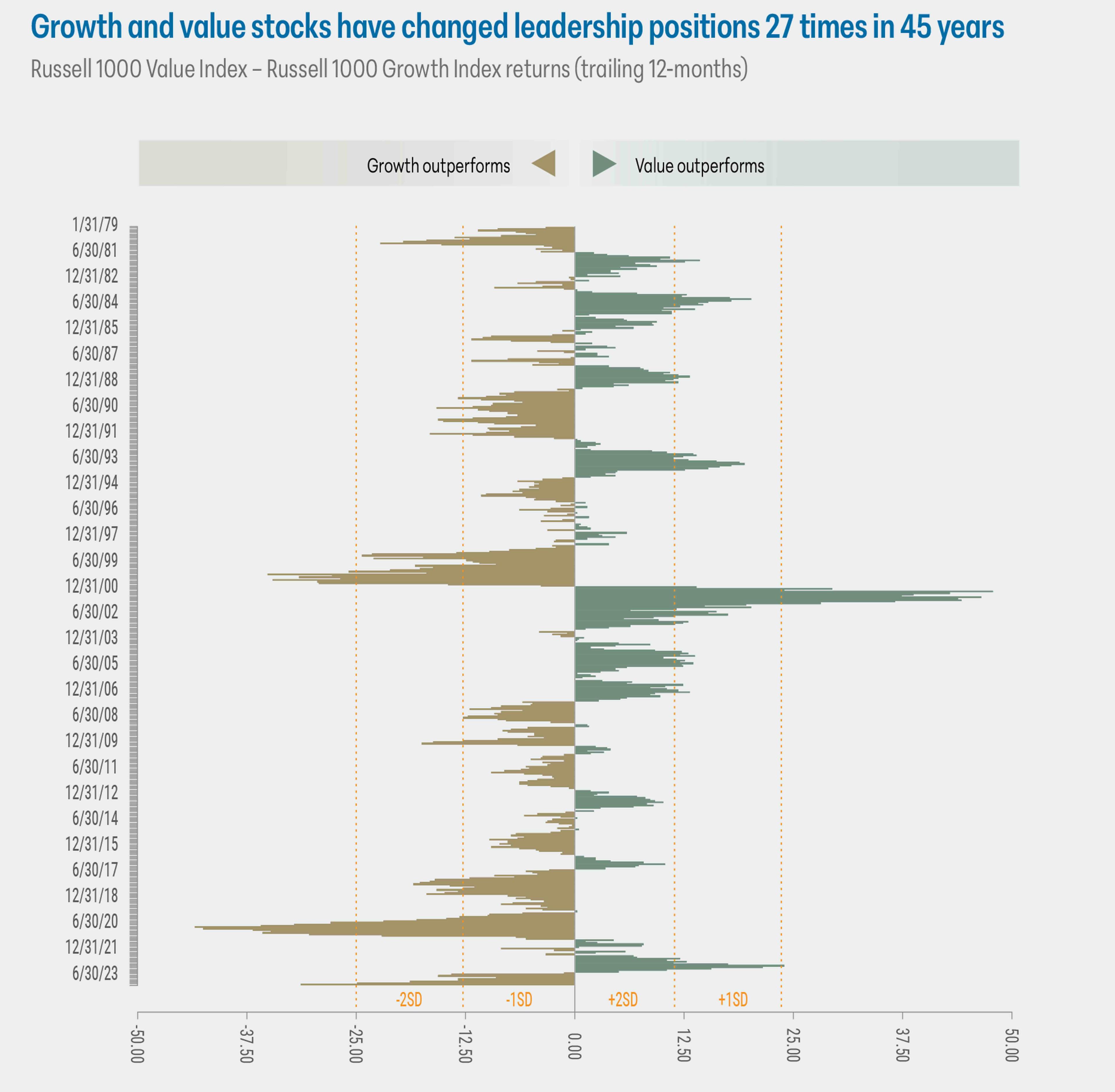
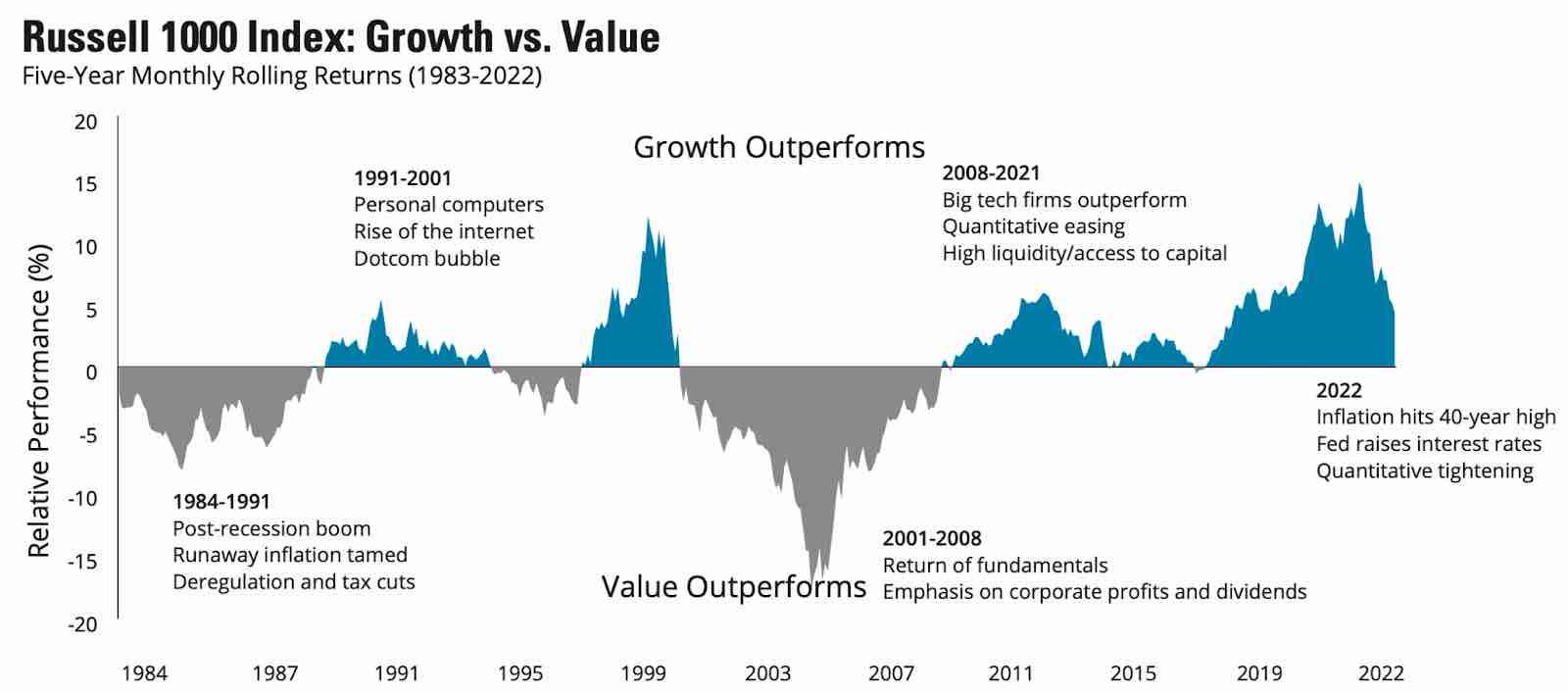
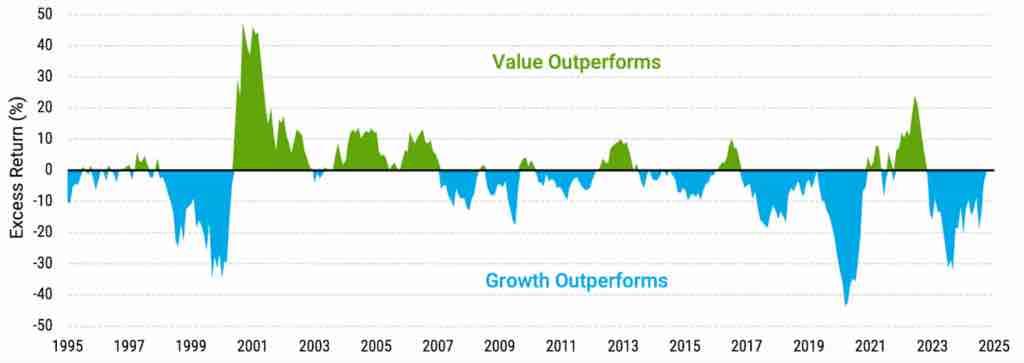
Growth vs Value is a pendulum
As a long term, mature investor, and business leader my core investing thesis and strategy is architected around the reversion to the mean.
I invest and position my family portfolio holdings to leverage, capitalize and compound based on the “natural” pendulum of the market cycle. This is hard to do without the hindsight of three decades of market and macroeconomic observation, experience and business knowledge.
I essentially time the market in years - 1, 3, 5, 10, 20, 30. Not time exact tops or bottom of the market or stocks with any precision. I’ve learned the hard way you cannot do this with any repeatable success, but you can get close “enough”. Enough being 80/20.
I see on Blossom, the overly wilful investing in absolutes and singularity of thinking without recognizing and being self aware of their place in history and historical averages.
It is not difficult to be on the “right” side of history, if you give yourself enough room to see the forest from the trees.
Below is an article that would be useful to bookmark and read again in a decade from now.
- - -
Low-volatility and higher-dividend stocks are primed to come back with a vengeance
Noah Solomon: Over the long-term, less volatile stocks have outperformed their more volatile counterparts
By Noah Solomon
“Eugene Fama, an American economist and Nobel Laureate, is recognized for his work on portfolio theory.
The Fama-French Three Factor model, an asset pricing model developed by Fama and financial economist Kenneth French, demonstrated that smaller companies tend to outperform larger ones, and that stocks with lower valuations tend to outperform those with higher ones. ”
Since Fama and French’s original findings, academic research has demonstrated that over the long-term, less volatile stocks have outperformed their more volatile counterparts and stocks with higher dividend yields have outperformed those with no or lower ones.
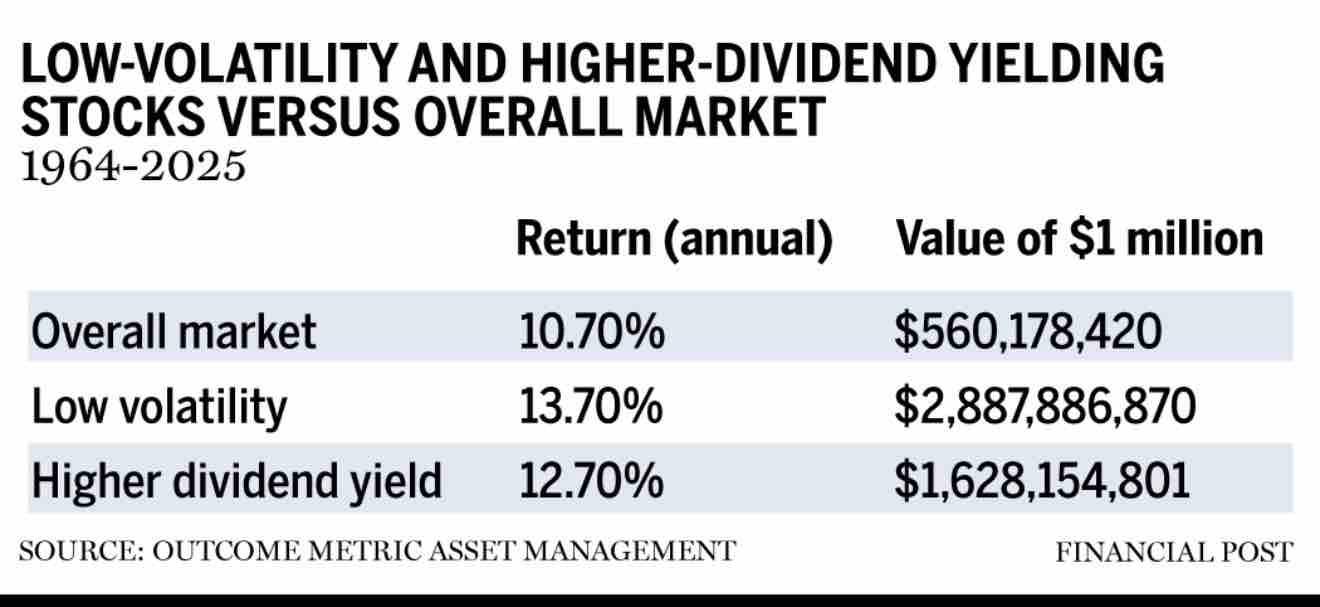
“According to our calculations at Outcome Metric Asset Management, from 1964 to 2025, low-volatility stocks returned an annualized 13.7 per cent, compared with overall market annualized returns of 10.7 per cent. And higher-dividend-yield stocks returned an annualized 12.7 per cent. If you started with $1 million, this would have resulted in $2,887,886,870 gained from lower volatility stocks, $560,178,420 from investments in the overall market and $1,628,154,801 from higher-dividend-yield stocks.”
“If only life were so simple
Although stocks with these characteristics have delivered impressive long-term performance, that ride has entailed some painful bumps in the road.
In times when speculative fervour is widespread, markets underprice risk, leading to a relative undervaluation of companies with defensive attributes versus their more speculative peers.”
“Such was the case in the dot-com fuelled bull market of the 1990s, when both low volatility and higher-dividend-yield stocks materially underperformed their more speculative counterparts. Fear of missing out (FOMO) is a powerful force that can have perverse effects on behaviour. None other than J.P. Morgan himself is said to have stated, “Nothing so undermines your financial judgement as the sight of your neighbor getting rich.” Relatedly, many investors found it excruciatingly painful sitting with these holdings as they lagged the high-flying darlings of the day.”
“From 1990–1999, low-volatility and high-dividend-yield stocks had annualized returns of 13.2 to 13.8 per cent, compared with the overall market’s 18 per cent.
Notwithstanding the interim pain of underperformance, those who had the fortitude to stick with their low-volatility and higher-dividend-yield holdings would have reaped significant rewards over the ensuing decade.
Investors who remained steadfast in the 1990s as their “boring” portfolios underperformed were more than made whole for their patience, as demonstrated by their outperformance over the entire two-decade period to 2009. Importantly, the relative performance of stocks with these low-volatility and higher-dividend-yield characteristics is strongest in periods of market stress – they deliver outperformance and portfolio diversification when it is most needed.”
“The underperformance of low volatility and higher-dividend-yield stocks over the past 10 years is highly anomalous. The only other 10-year period that witnessed this phenomenon was the dot-com-based bull market of the 1990s, which was followed by an unusually strong period of outperformance for low-volatility and higher-dividend-yield stocks.
Since markets bottomed in March 2009 following the global financial crisis, the S&P 500 has delivered an annualized return of 16.4 per cent, as compared to its long-term average of 10.2 per cent.
Importantly, this impressive streak was achieved with uncharacteristic consistency. As we approach the end of 2026, U.S. stocks are poised to have delivered negative returns in only two of the 18 years beginning in 2009. The only comparable period in terms of both consistency and magnitude is that which preceded the peak of the dot-com bubble in early 2000.”
“Legendary investor Sir John Templeton famously said that the four most dangerous words in investing are “This time it’s different,” which nicely summarizes that extended periods of above-average returns have historically been followed by ones of below-average returns, and vice versa. If historical patterns prevail (which they tend to do), then a return to long-run average returns would necessitate a period of below-average returns.
In a benign scenario, this would entail an extended period during which stocks consistently deliver below-average yet positive returns. A more painful outcome would involve a decade of mostly average returns marred by a bear market. Regardless of the path, it is likely that markets will prove disappointing for investors who have grown accustomed to uncharacteristically high returns.”
“As Warren Buffett wrote in Berkshire Hathaway’s 2000 annual letter to shareholders, “The line separating investment and speculation, which is never bright and clear, becomes blurred still further when most market participants have recently enjoyed triumphs. Nothing sedates rationality like large doses of effortless money.”
History doesn’t repeat itself, but it often rhymes. Although I have no idea of the precise timing, low-volatility and higher-dividend stocks are primed to come back with a vengeance, with well-above market average performance over the next 10 years. Against this backdrop, Outcome’s algorithmic approach to investing in dividend-yielding, low-volatility stocks, both in Canada and internationally, is aiming to deliver meaningful outperformance when it will be most needed.”
Excerpt From
“Low-volatility and higher-dividend stocks are primed to come back with a vengeance”
Noah Solomon
Financial Post