Is Ethereum Being Mispriced?
There are a lot of individual Ethereum headlines right now that may not seem especially important on their own. But when you start putting them together, I think they’re starting to paint a pretty interesting picture.
For most of its history, ETH has largely been viewed as a volatile cryptocurrency whose value ultimately depends on whether someone is willing to pay more for it later. Ethereum became the dominant smart-contract platform, and the network has maintained continuous operation since launching.
But I think a different investment thesis is beginning to emerge.
Traditional finance is slowly moving on-chain. Stablecoins are growing, real-world assets are being tokenized, financial applications are being built on public blockchains, and major financial institutions are increasingly offering products that give investors exposure not only to ETH itself, but also to staking rewards.
This is where BitMine’s thesis becomes interesting.
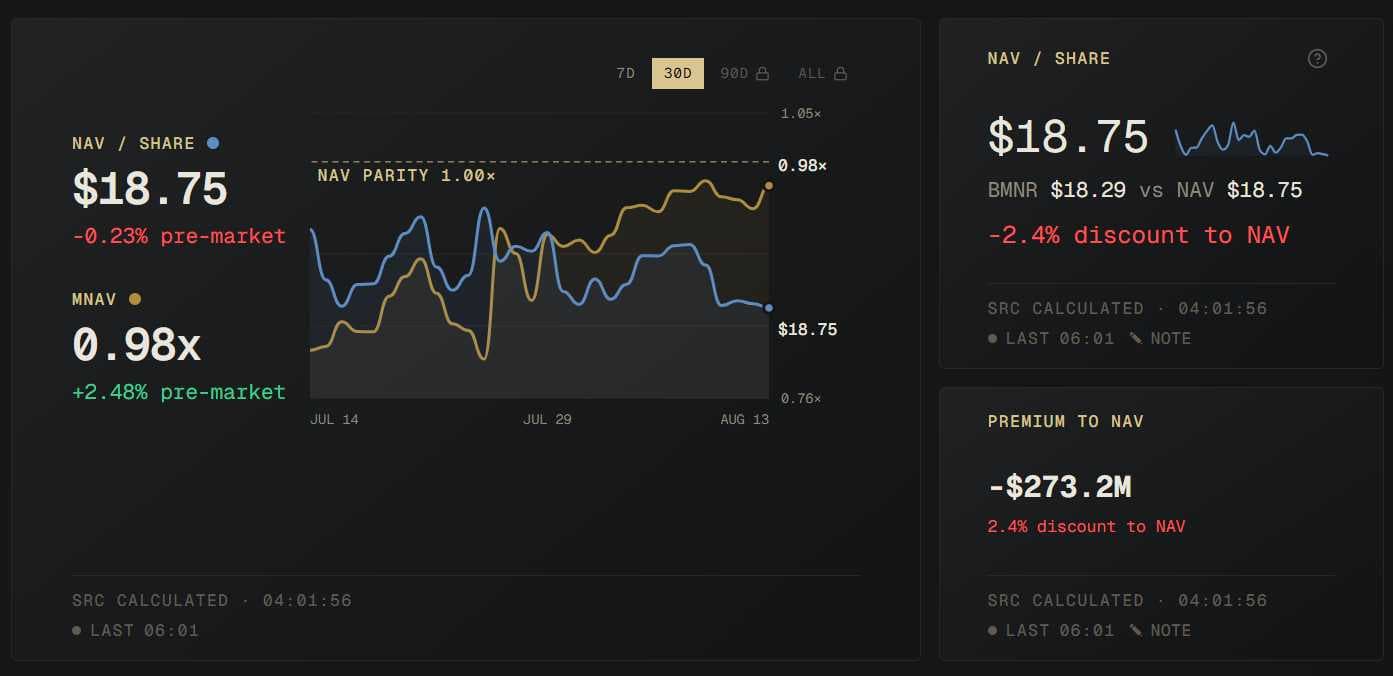
BitMine is the largest publicly traded corporate holder of Ethereum, with an ETH treasury strategy built around accumulating and staking ETH. BMNR’s thesis is that Ethereum could become one of the primary settlement layers for the future financial system.
That doesn’t mean Ethereum has to become the only settlement network, and it doesn’t have to replace the traditional financial system. It simply has to capture a meaningful share of future activity around stablecoins, tokenized assets, smart contracts, collateral, payments and financial settlement.
If that happens, ETH starts to look somewhat different. It isn't simply a token used to pay transaction fees. ETH is the native asset used to economically secure Ethereum through proof-of-stake.
And we are starting to see some interesting developments around that idea.
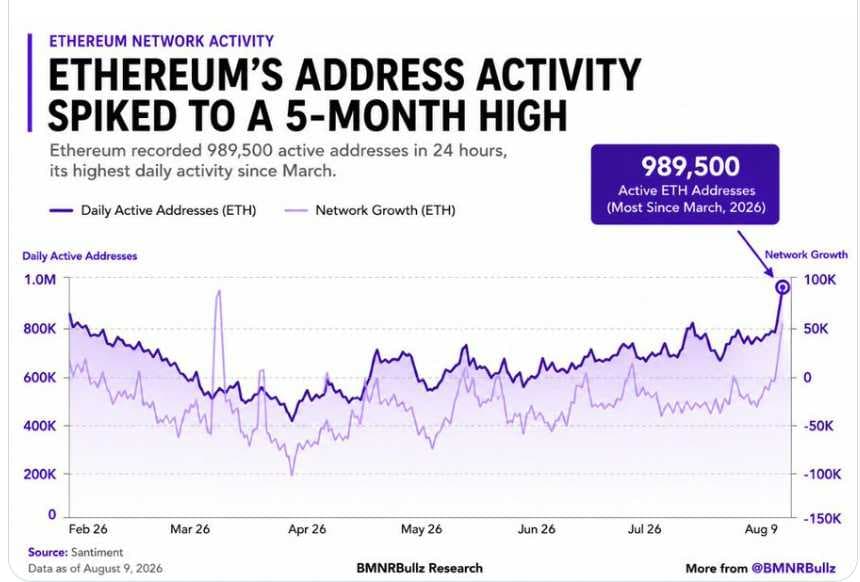
Ethereum network activity has recently climbed to a five-month high. Fidelity, which manages roughly $7.8 trillion in assets, has filed to add staking to its Fidelity Ethereum Fund, FETH. The proposal would potentially allow Fidelity to stake up to 100% of the ETH held by the fund.
This follows BlackRock and Morgan Stanley introducing Ethereum investment products that incorporate staking, another sign that staking is increasingly moving from crypto-native infrastructure into traditional financial products.
Under Fidelity’s proposed structure, FETH would retain 85% of the gross staking rewards for shareholders, while roughly 15% would go toward staking-related fees. After fund expenses, the remaining net staking rewards would be distributed to investors in cash, at least quarterly.
Then you have SharpLink, the second-largest corporate holder of Ethereum and the second-largest publicly traded corporate ETH treasury. SharpLink recently announced that it was putting approximately $200 million of ETH through Lido, Ethereum’s largest liquid-staking protocol.
Instead of simply holding ETH on its balance sheet, SharpLink can stake that ETH through Lido and receive wstETH, a liquid token representing a staked-ETH position.
The underlying staked ETH continues earning staking rewards, while wstETH can potentially be used elsewhere within Ethereum’s financial ecosystem. It can be used as collateral or deployed into other DeFi strategies to potentially generate additional yield. SharpLink described this as making its Ethereum more productive.
BitMine and SharpLink are also both heavily institutionally owned. Fintel shows hundreds of institutional investors holding positions in the two companies, with institutional ownership representing a significant portion of each company’s outstanding shares.
One of the latest notable additions is Norway’s Government Pension Fund Global, the world’s largest sovereign wealth fund, which disclosed a position of approximately 6.15 million shares of BitMine Immersion Technologies, valued at roughly $81.9 million.
This shows that publicly traded Ethereum treasury companies are increasingly finding their way into traditional institutional portfolios. The ethereum investment thesis itself appears to be changing. The older thesis was fairly straightforward.
More activity on Ethereum meant more demand for blockspace, which generally meant higher transaction fees. Since Ethereum burns the base portion of transaction fees, increased activity could lead to more ETH being destroyed.
Whether ETH supply actually grows or shrinks depends on the balance between new ETH issued to validators and ETH burned through transaction fees, but the burn mechanism became an important part of the bullish argument.
Ethereum's scaling strategy has complicated that thesis.
Ethereum has deliberately moved toward a rollup-centric architecture, where Layer 2 networks process large numbers of transactions and then settle or post data back to Ethereum.
At the same time, upgrades have dramatically reduced the cost for Layer 2 networks to use Ethereum.That's great if the goal is to build infrastructure capable of supporting dramatically more economic activity. But it also means more transactions do not necessarily translate into proportionally more fees or more ETH being burned.
That creates a different valuation question. Instead of only asking: How much fee revenue does Ethereum generate? The emerging thesis asks: What is the economic value of ETH if Ethereum becomes an important settlement and security layer for very large amounts of on-chain assets?
Imagine a future where hundreds of billions or eventually trillions of dollars of stablecoins, tokenized securities, real-world assets and other financial instruments use Ethereum or Ethereum-based Layer 2 networks.
Staked ETH would be part of the economic security protecting Ethereum's consensus layer, while ETH would continue serving as the network's native asset for staking, transaction fees and collateral throughout parts of the broader Ethereum ecosystem. That could create a very different way of thinking about its value.
If ETFs, treasury companies, institutions and long-term investors increasingly acquire ETH and then stake it, that ETH is not permanently removed from circulation. Staked ETH can eventually be withdrawn, and liquid-staking products such as wstETH can make staked positions transferable.
But staking can reduce the amount of ETH that is immediately liquid and available for sale at any particular moment. At the same time, those holders receive staking rewards for helping secure the network.
So you could potentially have two trends developing at the same time: More economic activity relying on Ethereum for settlement and security, while a larger amount of ETH is being held or staked by longer-term owners. If demand for ETH accelerates again, that supply structure could matter.
There may also be another source of future activity that is starting to gain some attention: AI agents.
The idea is that stablecoins and smart contracts could eventually allow autonomous software to make payments, interact with financial applications and settle transactions without a person manually approving every transaction.
An AI agent could potentially receive stablecoins, pay for services, interact with smart contracts and settle transactions automatically. If that type of activity grows, the number of economic actors using blockchain networks could expand beyond people and financial institutions to include software itself.
Again, none of this guarantees Ethereum wins that market, and it doesn't mean ETH is mispriced today. Ethereum still has to prove that growing usage and settlement activity ultimately creates enough economic value for ETH itself. And that brings me back to the question in the title.
Is Ethereum being priced correctly today, or is the market still valuing ETH primarily as another volatile cryptocurrency?
Because if the current crypto bear market eventually ends at the same time that traditional finance continues moving on-chain, institutional staking continues growing, more ETH is accumulated by long-term holders and Ethereum increasingly becomes infrastructure for stablecoins, tokenized assets and financial settlement, then the next cycle could look different.
It may not simply be another crypto rally. The market could eventually begin asking a different question: What is the native asset securing and supporting a financial network handling trillions of dollars of economic activity actually worth? We don't know the answer yet. But if Ethereum gets anywhere close to fulfilling that thesis, ETH may eventually be valued very differently than it is today.