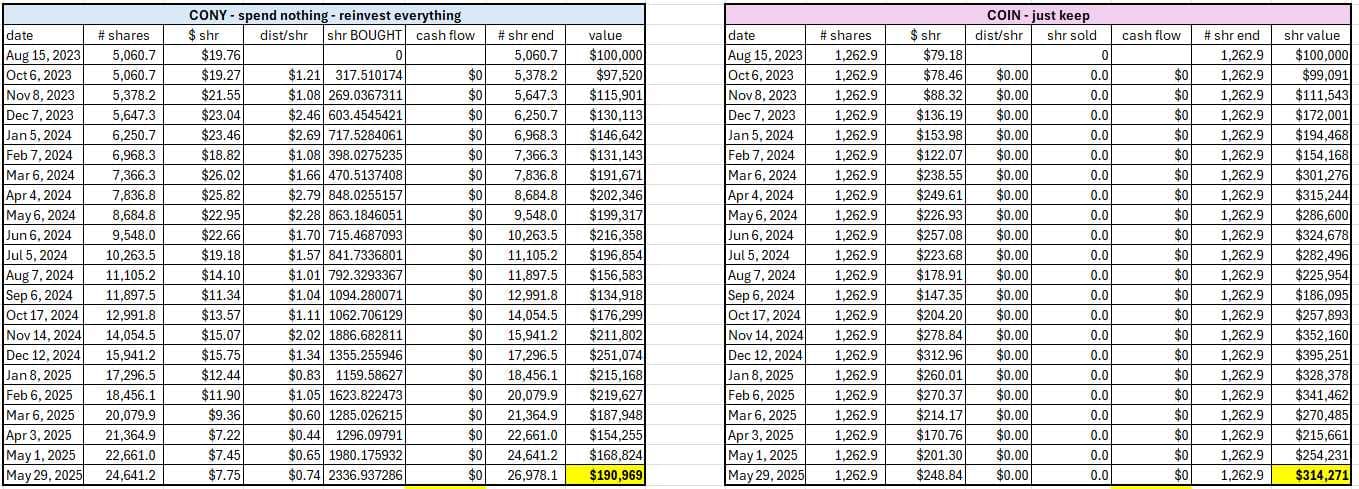
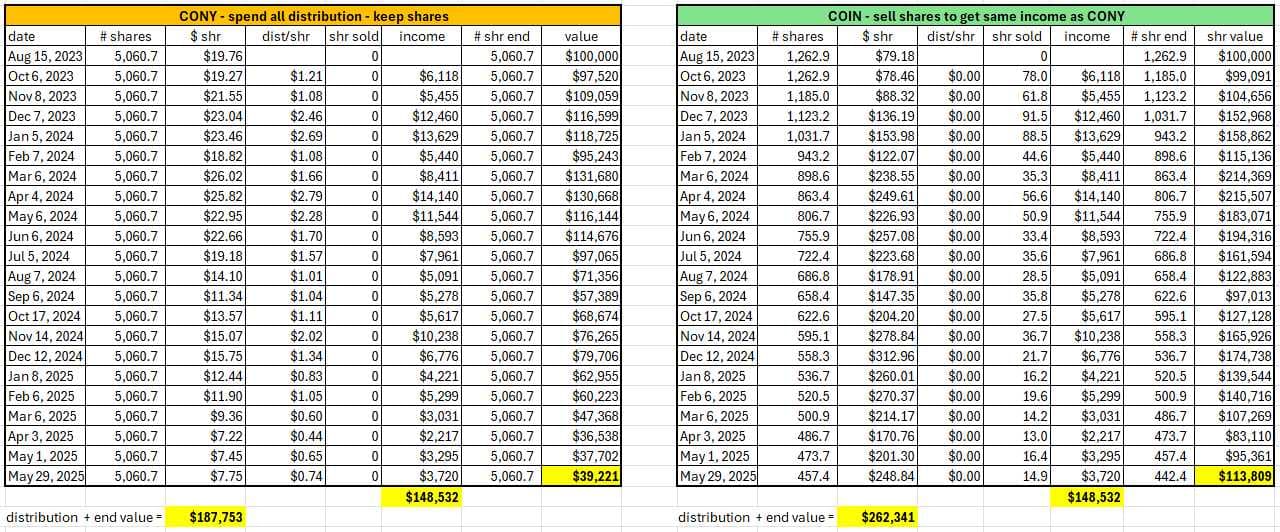
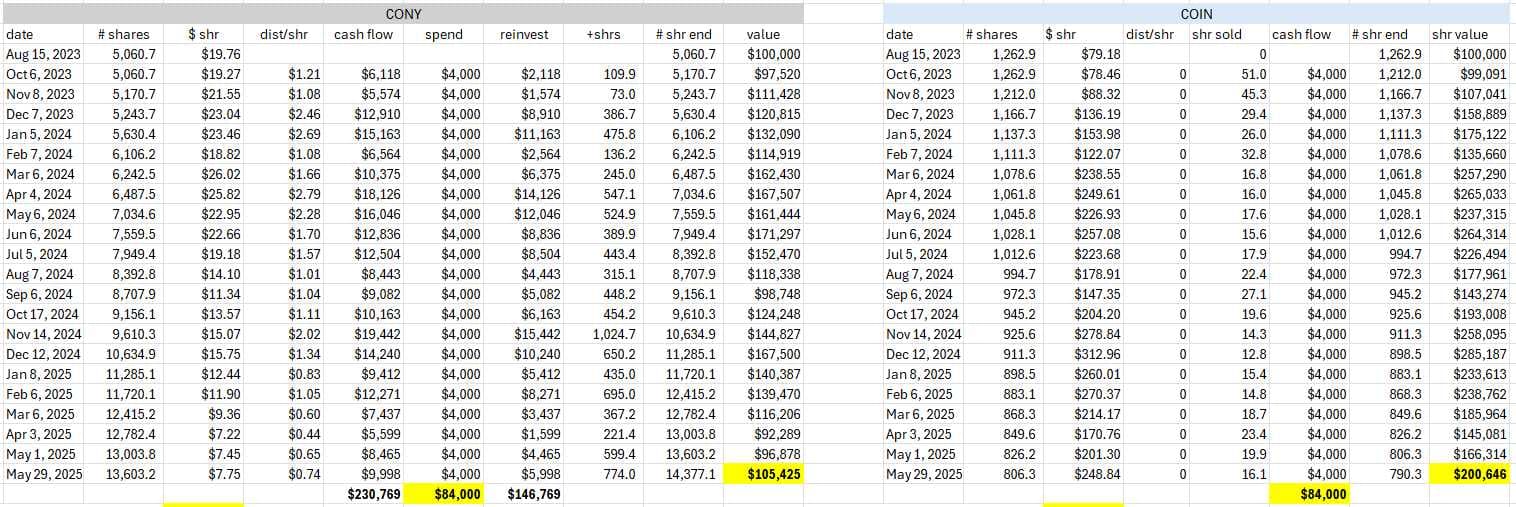
I was prompted by @perryf to compare $CONY vs $COIN with exact data. Include all money received from $CONY into the calculation + share accrued vs selling shares of $COIN and take into account number of shares declining. So I got the data and made scenarios with exact dates, distribution and share price. SCENARIO A (orange and green tables) - $CONY : Spend all money from distribution and keep all shares vs - $COIN : sell shares to generate same income as $CONY's distributions each month. RESULTS : As seen on Excel tables attached, if you started with $100K in each you would have had 5,060 shares of $CONY and 1,263 shares of $COIN . First distribution of $CONY would have paid $1.21/shr so $6,118. You keep your 5,060 shares of CONY. To generate $6,118 on Oct 6 2023, you would have had to sell 78 shares of COIN. You are down to 1,185 shares. Repeat that 20 more montsh with exact data (see table), you end up: - Both generated $148,532 that you spent - You are left with 5,060 shares of $CONY that are worth $39,221 - You are left with 442 shares of $COIN that are worth $113,089 So both strategies provided you with $148K of income over the period but investing in $COIN and selling shares would have left you with 2.9 times more value at the end or $74K more ! SCENARIO B: (blue and purple tables) - $CONY : Spend no cash and reinvest all distribution into new shares - $COIN : Just hold Results : - $CONY : You end up being able to buy 21,917 more shares The end value of these 26,978 shares is $190,696 - $COIN : Your 1,269 shares are now worth $314,271 So you would have ended up $123.6K richer just holding $COIN vs buying $CONY and reinvesting everything. SCENARIO C (grey / blue): - $CONY : You keep $4,000 each month and reinvest the rest - $COIN : You sell shares to generate $4,000/mo RESULTS: - For both, you spend $84K - $CONY : you end up with 14,377 shares worth $105,425 - $COIN : you had to sell 473 shares and your 790 shares left are worth $200,646 So both provided $84,000 of spend money, but at the end you have 2x more value left with $COIN than $CONY Hope this helps visualizing with real data. EDIT: Also made a post about $TSLY vs $TSLA that I didn't tag properly: https://link.blossomsocial.com/7uYa/v08yk5ux
12K views
95 Comments
Perry's PIIverse
@piiverse · 1yr
So in 1.5 yrs you have already lost more than half your entire portfolio. By selling your coin shares. Extrapolate that to 5 or 6 years. And it is assured your strategy will eventually have ZERO SHARES. what gains do you get with zero remaining shares in your portfolio? Don't tell me you honestly think COIN stock price will keep rising to $1000s per share. Can't have ROI ON ZERO SHARES. That my friend is hard fact. Basically you GROWTH strategy on underlyings investment is not a long term strategy when you end up with zero shares. That is 100% assured. Thanks for proving my point. That is why we income investors invest in these derivative based income generating etfs. Now stop the repeated theory attacks on an investment strategy everyone in blossom knows you hate. Hammers stick to nails.
ETF Go
@etf.go · 1yr
Great summary. 👍 Let’s see who actually pays attention. My guess is many will find a reason to dispute. 🤷♂️ Hope your effort saves at least a few. Good on you for continuing to share facts. 🫡
EVID Wealth@evidwealth · 1yr
This is a fantastic deep dive, and I genuinely appreciate the time and transparency you put into this analysis 🙌📊 The real numbers speak volumes here. It’s not about opinions or preferences; it’s about what the math shows. Whether it’s Scenario A, B, or C, the core message is clear: total return matters more than the yield alone. Many investors focus heavily on distributions for psychological or behavioral reasons (and that’s valid!), but it’s important not to let that preference cloud the bigger picture. A high yield can feel satisfying, but if it’s dragging on total portfolio value over time, that “income” is coming at a cost 💸📉 Selling shares to generate cashflow, especially in a rising market, is simply a withdrawal strategy, no different than taking dividends. The only difference is control and efficiency. ✅ Greater compounding potential ✅ Less reliance on market timing ✅ Often more tax-efficient (especially in taxable accounts) ✅ Leaves you with more value over time To those feeling defensive: this isn’t an attack on dividends or covered calls. They can still have a role in a portfolio depending on your goals. But when it comes to long-term wealth preservation and income generation, the evidence here makes a compelling case for rethinking the “income-first” mindset. Thanks again for elevating the conversation with facts, not feelings 👏
Ronan @ronan · 1yr
Fantastic demonstration, very good visualization for those considering. Capped upside, more downside, more risk and those investors will still tell you they made a smart choice. You can lead a horse to water but can’t make it drink 😉
See the full comment section 👀Sign up for the full Blossom experience!