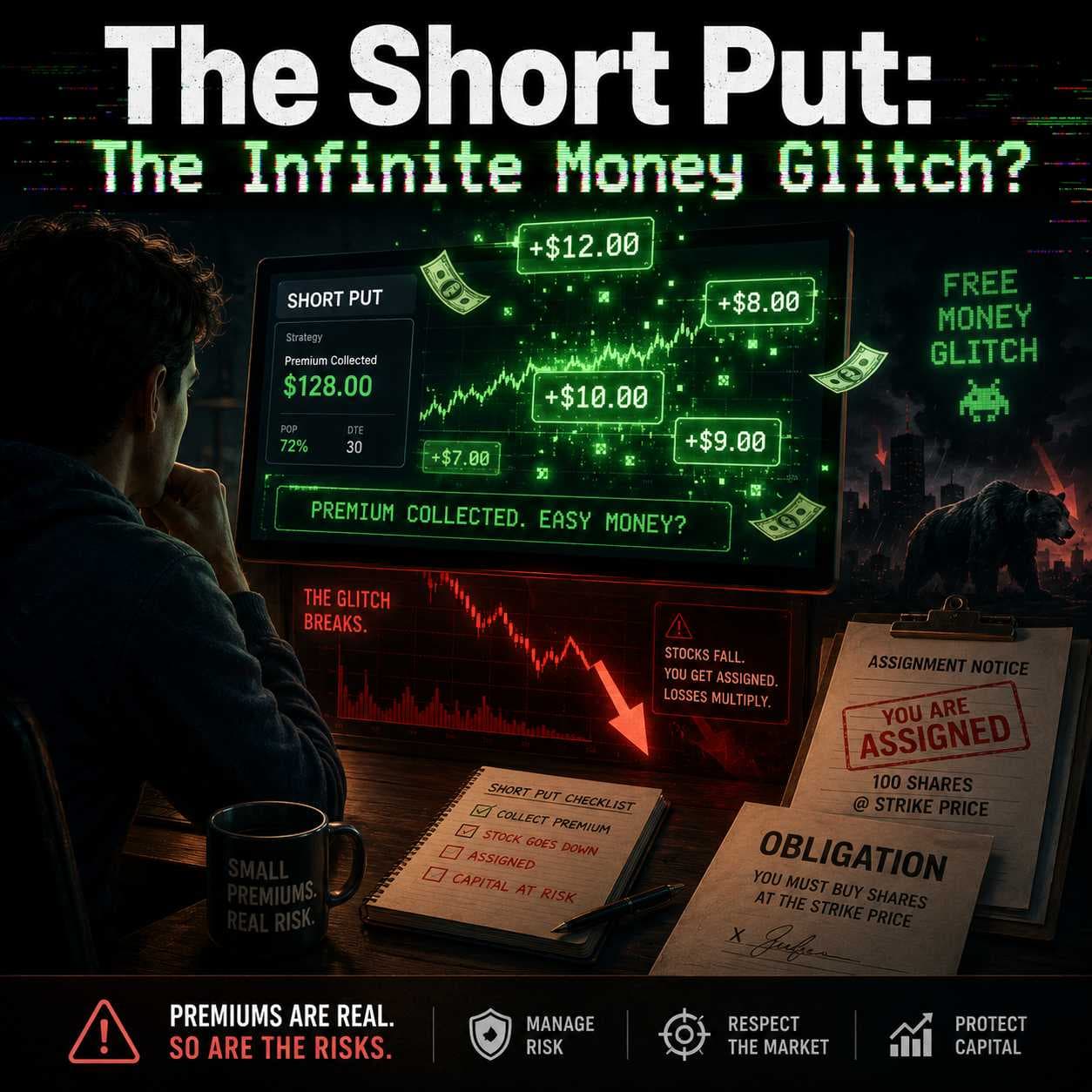
The Short Put: The Infinite Money Glitch?
When income investors first begin exploring options, they often stumble onto selling puts, and the way the strategy is marketed can make it sound like an incredible way to generate income.
It is often described as a high-probability trade where you can make money if the stock goes up, stays flat or even falls a little. It can sound like someone discovered a magic bean that leads directly to a goose laying golden eggs.
Your broker is also unlikely to discourage you from selling options. Even the low-cost, “we don’t charge commissions” brokers can make money from the activity generated by those trades. Options are often shorter-term positions, which can lead people to trade more frequently and use multiple contracts.
Robinhood, one of the largest commission-free brokers, recently reported earning $342 million in quarterly options revenue. The trade may feel free to the person placing it, but that does not mean the broker is providing the service out of the goodness of its heart.
That does not make selling puts a bad strategy. It just means we should separate the sales pitch from what the trade is actually designed to do. The basic explanation sounds simple. You sell a put option on a company you would be comfortable owning, choose the price where you would be willing to buy it and collect a premium upfront for accepting that obligation. Once you sell the put, the money immediately hits your account. If the option expires above the strike price, you keep the premium and do not purchase the shares. If you are assigned, you must purchase 100 shares for every contract sold at the strike price.
Suppose a company is trading at $65 and you sell one put with a $50 strike. You are agreeing to purchase 100 shares for $50 each if assigned, creating a potential $5,000 obligation. In exchange for accepting that obligation, you receive a premium. That is the basic premise. It is not overly complicated, and it is often the first part of the popular wheel strategy. What tends to be underemphasized is what happens when the stock falls much farther than you expected.
The first question is whether you genuinely want to own the shares or whether you are simply telling yourself that you would be comfortable owning them. The true answer often becomes clear only after the stock starts falling.
This is when you see investors rolling the put farther and farther into the future because they are trying to avoid assignment. They originally said they wanted the shares, but once assignment becomes a real possibility, the goal of the trade suddenly changes.
It is easy to say you would happily purchase a company at $50 when it is trading at $65. It can feel very different when the shares fall to $40 or lower, negative headlines are everywhere and you are still obligated to purchase them for $50.
A recent example was Intuitive Machines, ticker LUNR. During the excitement surrounding the SpaceX IPO, investors piled into other space-related companies. On May 28, 2026, LUNR was trading above $45. At the time, selling a $30 put may have felt relatively safe. The strike was more than 30% below the current share price, so an investor could tell themselves they were collecting a nice premium while leaving plenty of room for the stock to fall.
One week later, on June 5, LUNR closed at $29.36, already below the strike price. Fast-forward to today and the shares are trading around $14. Someone assigned on that $30 put would still have to purchase 100 shares for $3,000, even though those shares are now worth roughly $1,400. Collecting $100 to $150 in premium probably felt great when the trade was opened. Being down roughly $1,450 to $1,500 a couple of months later probably does not.
And if you think you can simply buy the stock at $30, watch it fall to $14 and then sell covered calls above your purchase price to generate income, that may not work nearly as well as it sounds. A $30 call would now be so far above the current share price that the premium would likely be very small unless you sold a call many months into the future.
You could collect more premium by selling a call closer to the current share price, but then you risk having the shares called away well below what you paid. The covered call may help reduce the loss over time, but it does not magically repair a stock that has fallen more than 50%.
That is the thing about selling a put. For the stock to reach your strike price, it usually has to be falling, and a falling share price often does not happen in isolation. The company may have reported weak earnings, lowered its guidance, lost an important customer or run into some other problem. Investors begin questioning the business, negative headlines start piling up, and the price that once looked like an obvious bargain may no longer feel nearly as attractive.
This is also why short puts can produce a lot of small wins followed by one very large loss.
When the stock stays comfortably above the strike, the option expires worthless and you keep the premium. You might collect $75 here, $100 there and another $150 the following month. After enough successful trades, the strategy begins to feel predictable. But your maximum profit is limited to the premium collected, while your potential loss can be much larger if the stock falls far below the strike. A high win rate does not automatically make something a safe or profitable strategy. Winning frequently is not the same as making money over the long term. The size of the wins and losses also matters.
This is where the reason you sold the put becomes important, because investors generally use the strategy in one of two ways.
The first is share accumulation. You genuinely want to own the company and are using the put to potentially purchase the shares at a lower price. Suppose a company is trading at $65, but you believe $50 would be a more attractive purchase price. Instead of buying the shares today, you could sell a $50 put and set aside the $5,000 required to purchase 100 shares. If you collect $1.50 per share, you receive $150 upfront. If assigned, you purchase the shares for $50 each, but because you already collected $1.50 per share, your effective purchase price becomes $48.50 before commissions and taxes. If the stock remains above $50, you keep the $150 and do not receive the shares. You can then decide whether to sell another put or move on to another opportunity.
This is why a cash-secured put is sometimes compared with a limit order that pays you while you wait. Though a limit order can normally be cancelled without a cost. Once you sell a put, you have created an obligation. To remove that obligation before expiration, you must buy the option back, and it may cost more than you originally collected.
The important point is that when your genuine goal is accumulation, assignment is not necessarily a failed trade. It is one of the outcomes you accepted when you opened the position. You either collect the premium without purchasing the shares, or you purchase the shares near a price you previously decided was attractive.
The second use is premium harvesting.
In this case, your main objective is not to purchase the shares. You want to sell the option and later buy it back for less, keeping the difference. Suppose the same stock is trading at $65 and you sell a $50 put for $150. The $150 immediately appears in your account, but the trade is not finished. You still have an open obligation, and the price of the option will continue moving.
If the stock stays comfortably above $50 and the put falls in value to $75, you could buy it back and close the trade. You collected $150 and paid $75 to exit, leaving you with a $75 profit before commissions and taxes. This is where the strategy can begin to look like easy, repeatable income.
A person might look at the return from one successful trade, annualize it and imagine earning something similar throughout the year. The numbers can look even more attractive when margin is involved because the broker may only reduce your available buying power by a portion of the full purchase amount. But the contract itself does not change.
If you sell a $50 put, you are still accepting the potential obligation to purchase 100 shares for $5,000. The broker may only reserve part of that money today, but the full obligation is still sitting underneath the trade. Premium harvesting also becomes more complicated when the stock starts falling toward or below the strike price. You can close the put and accept the loss, continue holding it, roll it into another contract or accept assignment and purchase the shares.
This is why someone selling puts strictly for premium still needs a plan for assignment. Saying that you have no intention of owning the shares does not prevent assignment from happening.
The premium is not free income. It is compensation for accepting a specific risk. The put buyer is paying for the right to sell shares at the strike price. The put seller accepts the other side of that agreement. In exchange for the premium, you agree to purchase the shares at the strike price even if their market value falls considerably lower. You collect a relatively small and known amount upfront in exchange for accepting a larger and uncertain downside risk.
That does not make selling puts a bad strategy. It simply means the income cannot be separated from the obligation used to generate it. For many income investors, the short put is one of their first option trades. It can be an effective way to accumulate shares, generate premium or combine both objectives. But it is not free money, and it is certainly not an infinite money glitch.
Before selling the option, you should be able to answer one question honestly: Am I trying to buy the stock, or am I trying to avoid buying it?
That answer should influence the company you select, the strike price you choose, the amount of capital you reserve and the plan you make if the stock moves sharply lower. Because selling puts when everything is going well is easy, and it can begin to feel like free money. The real risk often becomes clear only when the market drops, several stocks fall at the same time and multiple puts are assigned. Suddenly, the investor must come up with the money to purchase all the shares they agreed to buy, often after those shares have already fallen well below the strike prices. By the time many investors fully understand the risk they accepted, it has already happened.