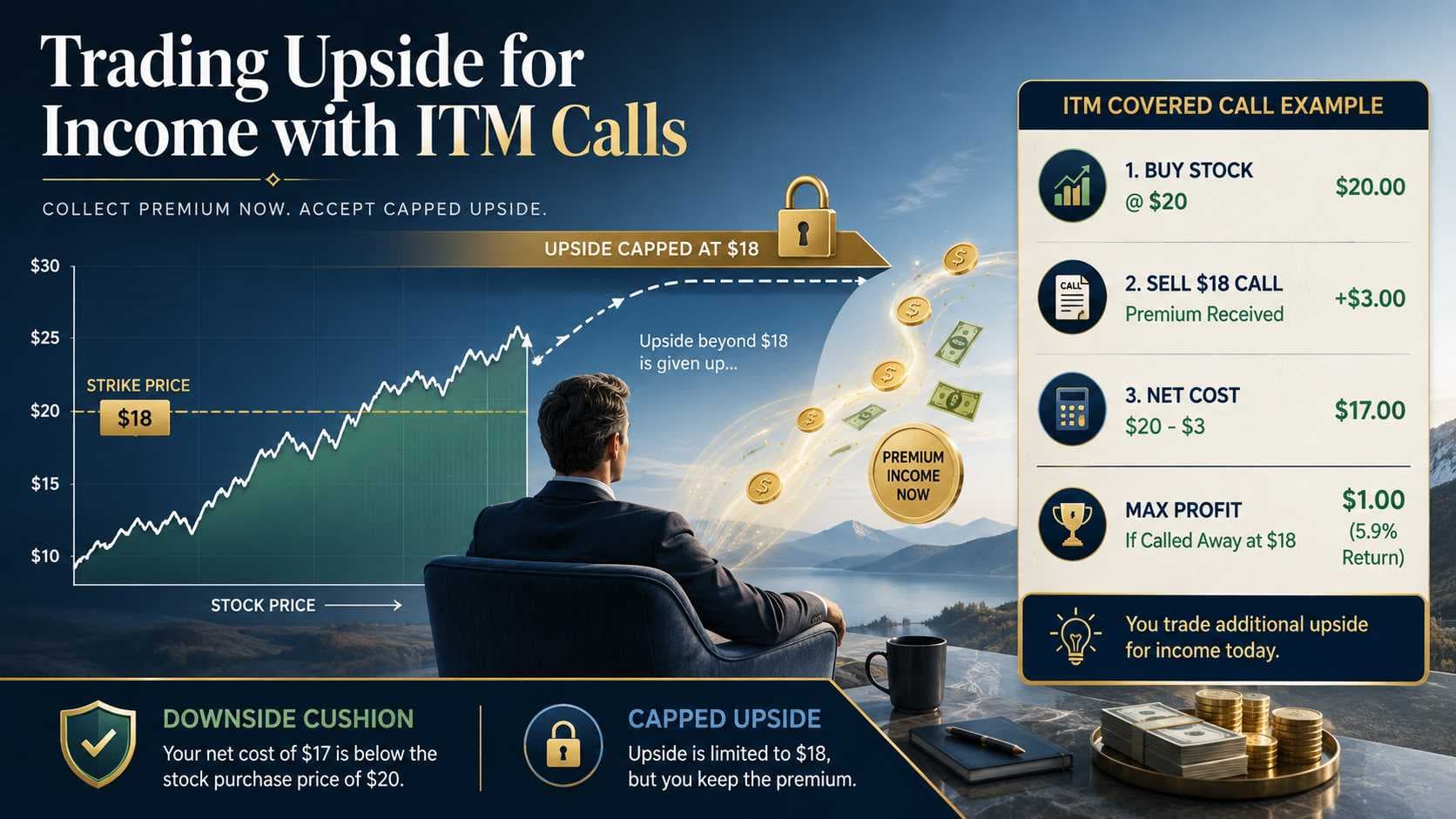
Trading Upside for Income with ITM Calls
This is usually described as a defensive buy-write strategy. It is generally not something you would use on a stock you have high conviction in or one you expect to make a significant move higher, because you are intentionally giving up most of the upside.
An in-the-money covered call is often used as a short-term income trade with a defined maximum return and a lower break-even price. Some investors also use the strategy in an attempt to capture dividends, although early assignment can cause the shares to be called away before the ex-dividend date. For that reason, I would not typically recommend dividend capture as the primary reason for entering the trade.
How It Works
Imagine you:
Buy 100 shares of a stock for $20 = $2000.00 cost
Sell one $18 call for $3 = $300.00 in premium received
The option expires in one month, although the trader can choose a shorter or longer expiration date.
It costs $2,000 to purchase the shares, but you immediately receive $300 in option premium.
By selling the $18 call, you have agreed to sell the shares for $1,800 if the option is exercised. Because the call is already in the money, the shares will likely be called away at expiration if the stock remains above $18.
Your net investment is:
$20 purchase price − $3 premium = $17 per share
Your maximum profit is:
$18 strike price − $17 net cost = $1 per share
Another way to look at it is that you lose $2 per share when the stock is sold for $18 after buying it for $20, but you collected $3 per share in option premium. That leaves you with a net profit of $1 per share, or $100 on the trade.
It is important to understand that the entire $3 premium is not additional profit. Because the call is already $2 in the money, approximately $2 of the premium represents intrinsic value. That portion compensates you for agreeing to sell a $20 stock for $18. The remaining $1 represents time value and the trade’s maximum potential profit.
That represents a return of approximately 5.9% on the $1,700 of net capital at risk over the one month period, assuming the stock remains above $18 and the shares are called away at expiration.
Annualizing that one month result on a simple basis produces a theoretical return of approximately 70.6%. However, that assumes the same trade could be repeated every month for 12 months at the same return, without losses, trading costs, taxes, gaps between trades, or changing market conditions. That is unlikely to be realistic.
So the question some investors may have is: why would someone use this strategy?
Selling an ITM covered call is often used as a shorter-term, defined-return trade. Much like a trader who buys a stock intending to sell after a modest price increase, the investor enters the position with a predetermined maximum return and expected exit price.
It provides a larger downside cushion than simply buying the stock. Its payoff can also resemble selling a cash-secured put, since both strategies collect option premium and establish an effective purchase price below the stock’s current market price.
It has a higher probability of earning the maximum return because the stock does not need to increase in price. It only needs to remain above the in-the-money strike price at expiration. The strategy can therefore appeal to someone who is neutral or only moderately bullish on the stock. They may not expect a large move higher, but they are comfortable owning the shares and would be satisfied with a smaller, more defined return.
However, premium is not free money, and this is not a risk-free trade. The downside risk is still similar to owning the stock outright. The option premium provides some protection, but if the share price declines significantly, the investor is still exposed to most of the downside.
There is also a major asymmetry between the potential profit and loss. If the stock increases from $20 to $30, the maximum profit remains only $1 per share. The investor does not participate in the additional increase because they have already agreed to sell the shares for $18. However, if the stock falls to $10, the investor would still lose $7 per share based on the $17 net cost.
ITM covered calls are one tool investors can use to generate immediate cash flow and create a larger downside cushion. However, that income comes at the cost of capped upside, and the investor remains exposed to substantial losses if the underlying stock declines. The strategy is therefore best viewed as a defined-return trade rather than a risk-free source of passive income.
Investors who use margin may look for trades that generate enough cash flow to cover their borrowing costs while also producing additional capital to deploy.
Using the example above, assume the investor borrows the full $1,700 at an annual interest rate of 5%. Holding the position for one month would cost approximately $7.08 in interest.
If the trade earns its maximum $100 profit, the investor would retain approximately $92.92 after interest, before commissions and taxes. That equals a net return of approximately 5.5% on the $1,700 deployed.
Because the position was financed entirely with borrowed money, the investor did not contribute new cash directly to the trade. This magnifies the return relative to the cash contributed, although the margin loan is still supported by other assets in the account. This is one of several strategies margin traders may use to generate short-term cash flow.