Terry Crapper@glamorousglue · 15h ‘The Shining’
Room 2570
A tale of financial horror, compound interest, questionable real estate, and one exceptionally stubborn landlord.
An original financial horror story inspired by the chilling atmosphere of Stephen King’s The Shining, featuring an army of industrious ants and a rather disturbing monthly income statement.
Chapter One: The Caretaker
The hotel stood alone on a mountain, surrounded by a forest of dead investments.
Its name was HHIS.
Nobody remembered exactly when the building had first acquired its peculiar reputation. Some said the previous owners had become fabulously wealthy. Others claimed they had simply mistaken their own money being handed back to them for profit.
The new caretaker was a practical fellow.
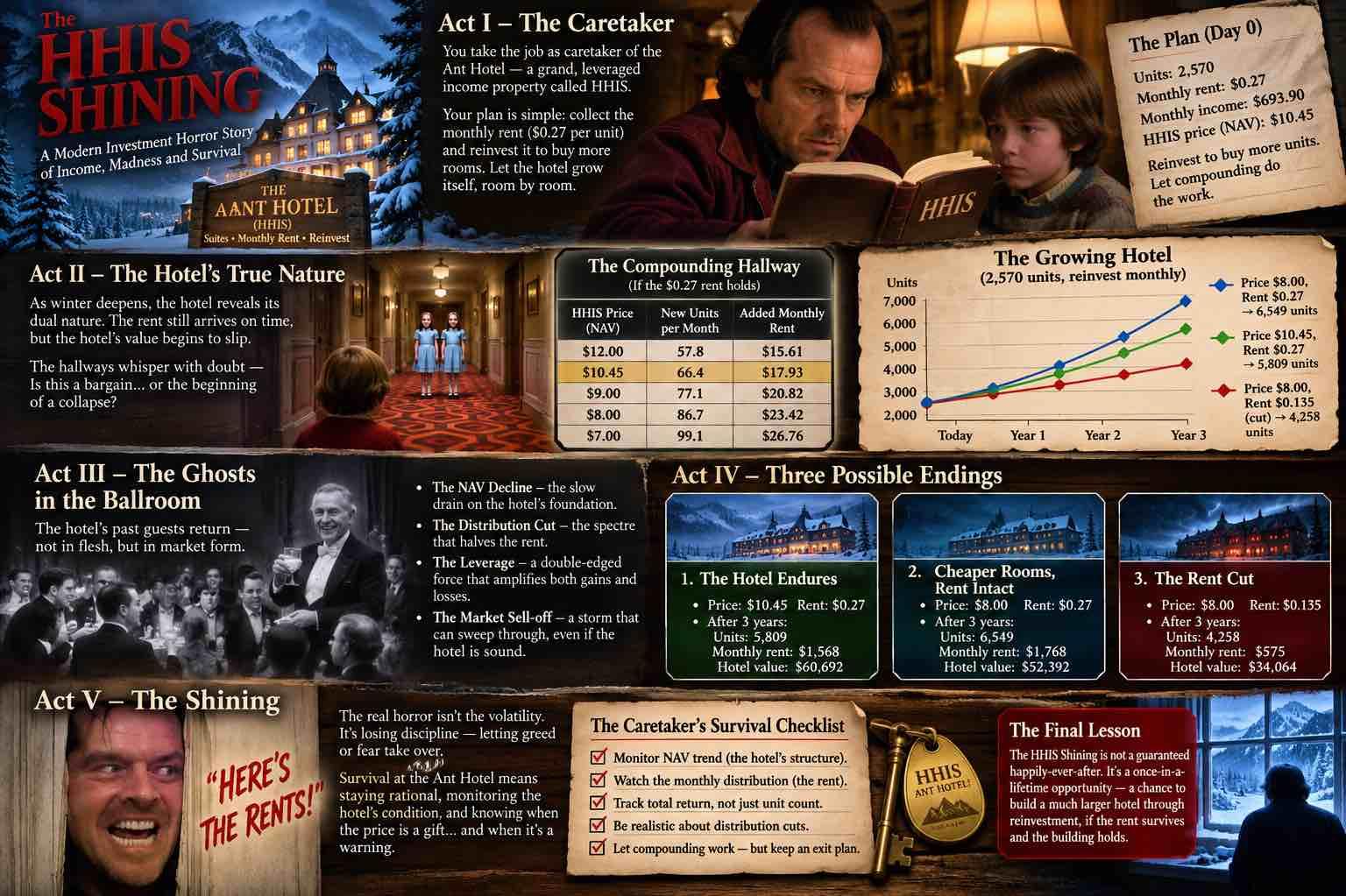
He owned 2,570 rooms.
Each room was occupied by a small, hardworking ant who paid precisely twenty seven cents in rent every month.
There were no vacancies.
No troublesome tenants.
No complaints about the plumbing.
And every month, precisely $693.90 arrived at the caretaker’s desk.
He had a rather unusual business plan.
Instead of spending the rent, he would purchase additional rooms.
And the new rooms would produce additional rent.
And that rent would purchase still more rooms.
He called it the Swing Hammer.
The ants called it the future.
The bank called it a high risk investment.
Nobody paid much attention to the bank.
Chapter Two: The Falling Price of Rooms
One November evening, the caretaker discovered something peculiar.
The price of rooms had begun to fall.
At first, he was alarmed.
Then he took out his calculator.
At $10.45 per room, his monthly rental income could purchase approximately 66 additional rooms.
But at $8, it could purchase almost 87.
At $7, nearly 100.
He smiled.
Outside, the wind began to howl.
Inside, somewhere deep within the hotel, a door slammed shut.
The caretaker barely noticed.
“Good heavens,” he whispered. “The cheaper these rooms become, the faster I can buy them.”
He opened another spreadsheet.
And another.
The numbers grew.
The rooms multiplied.
The ants were breeding financially.
It was magnificent.
There was only one small problem.
Nobody had explained why the rooms were becoming cheaper.
Chapter Three: The Ghost in the Balance Sheet
The caretaker descended into the basement, where the hotel’s oldest financial records were kept.
There, seated behind a dusty mahogany desk, was the former accountant.
He had been dead for thirty years.
“Good evening,” said the accountant.
“Good evening,” replied the caretaker, who was becoming accustomed to unusual things.
“I understand you’ve been buying more rooms.”
“Indeed. Business is booming.”
“And how much are the rooms worth?”
“Less than last month.”
“And your rental income?”
“Still twenty seven cents.”
The accountant leaned forward.
“Tell me something. Are your ants producing new wealth, or are you simply collecting pieces of the building and calling them rent?”
The caretaker hesitated.
“Does it matter?”
The accountant smiled.
“Only if you intend to survive the winter.”
For the first time, the caretaker understood the question.
The hotel’s distribution was not necessarily its profit.
Some of the money might come from genuine investment returns. Some might represent capital being returned. And the hotel itself was exposed to leveraged investments and covered call strategies.
A monthly distribution could continue even while the underlying property deteriorated.
The caretaker looked at his calculator.
It had never seemed quite so frightening.
Chapter Four: Thirty Six Months of Winter
On the wall of the abandoned ballroom hung three enormous paintings.
Each depicted the same hotel, three years into the future.
Each told a different story.
THE THREE POSSIBLE FUTURES
The caretaker began with 2,570 rooms, reinvesting every monthly distribution and adding no new money.
Painting One: The Hotel Endures
The room price remained at $10.45.
Monthly rent remained at $0.27 per room.
After thirty six months, the caretaker owned approximately 6,438 rooms.
His monthly rental income had grown to approximately $1,738.
His hotel was worth approximately $67,278.
Painting Two: Cheap Rooms, Faithful Tenants
The room price fell to $8 and stayed there.
But the ants continued paying $0.27 every month.
After thirty six months, the caretaker owned approximately 8,490 rooms.
Monthly rental income had grown to approximately $2,292.
The hotel was worth approximately $67,918.
He had acquired substantially more rooms because they were cheaper.
Painting Three: The Rent Cut
The room price fell to $8.
Then the rent was immediately cut in half, to $0.135.
After thirty six months, the caretaker owned approximately 4,694 rooms.
His monthly rental income was approximately $634.
The hotel was worth approximately $37,554.
These were mathematical illustrations, not forecasts. They assumed fixed prices, fixed distributions, fractional reinvestment and no additional contributions.
The caretaker studied the paintings.
In the first, the hotel prospered quietly.
In the second, the property market collapsed, but the rents held firm. The caretaker acquired rooms at bargain prices, and the hotel grew enormously.
In the third, something dreadful happened.
The rent was cut in half.
The ants continued paying.
The caretaker continued buying.
But the Swing Hammer had lost much of its force.
And although he owned more rooms than when he began, the enterprise was worth considerably less.
The caretaker finally understood.
The number of rooms was not the same thing as the value of the hotel.
Chapter Five: The Shining
That night, the caretaker dreamed.
He stood at the end of an impossibly long hallway.
Thousands of doors stretched into darkness.
Behind every door sat a tiny ant.
Every ant held a twenty seven cent coin.
And every ant whispered the same thing.
“Reinvest.”
“Reinvest.”
“Reinvest.”
The sound became deafening.
The caretaker ran down the hallway, opening doors, counting rooms, multiplying distributions.
Three thousand rooms.
Four thousand.
Six thousand.
Eight thousand.
Then, at the very end of the corridor, he encountered a door without a number.
On it were three words.
NET ASSET VALUE.
He opened it.
Inside was a mirror.
And in the mirror he saw himself, surrounded by ten thousand rooms, clutching an enormous bundle of monthly distribution statements.
Behind him, the hotel’s foundations were crumbling.
The ants were still paying rent.
But the building was sinking into the mountain.
He awoke screaming.
Not because his investment had fallen.
But because he finally understood that an impressive income statement could coexist with a deteriorating investment.
Chapter Six: The Caretaker Who Survived
Spring eventually arrived.
The snow began to melt.
The markets recovered somewhat, although nobody knew whether the recovery would last.
The caretaker was still there.
He had not abandoned the hotel.
Nor had he blindly purchased every room offered at a discount.
Instead, he had become a more thoughtful landlord.
He watched the monthly rent.
He watched the underlying value of the building.
He examined the actual investment returns rather than merely counting the money passing through his hands.
And he understood that the hotel’s greatest advantage was not its extraordinarily high advertised yield.
It was the possibility that disciplined reinvestment, during periods of temporarily depressed prices, might allow him to accumulate a substantial ownership position before better days returned.
There were no guarantees.
The rent could fall.
The building could deteriorate.
The market could remain depressed for years.
But there was also the possibility that the building would survive, the distributions would remain meaningful, and his patient accumulation would eventually produce something extraordinary.
He walked outside.
The morning sun illuminated thousands of little windows.
Behind them, the ants were preparing their monthly payments.
The caretaker smiled.
He was no longer frightened by every falling room price.
But neither did he celebrate every decline.
He had learned the difference between a bargain and a warning.
And somewhere deep within the building, the ancient accountant closed his ledger.
For the first time in thirty years, the old ghost was satisfied.
Epilogue: The Last Entry in the Hotel Register
The caretaker wrote one final paragraph in his journal.
I have no certainty that my little enterprise will survive every winter. But I know that purchasing additional rooms with the rent collected from existing rooms is a sound mathematical proposition, provided those rooms continue to possess genuine economic value.
I do not require the market to love my hotel tomorrow.
I require the hotel to remain standing long enough for tomorrow to matter.
And should the rents survive, the foundations endure, and the sun eventually return, perhaps these inexpensive little apartments will prove to have been the opportunity of a lifetime.
He put down his pen.
From somewhere upstairs came the faint sound of a tiny hammer.
Then another.
Then ten thousand more.
The ants were renovating.
THE END
A fictional investment horror story. Its central lesson is real: compounding increases units, but long term wealth depends on sustainable distributions and total investment returns.