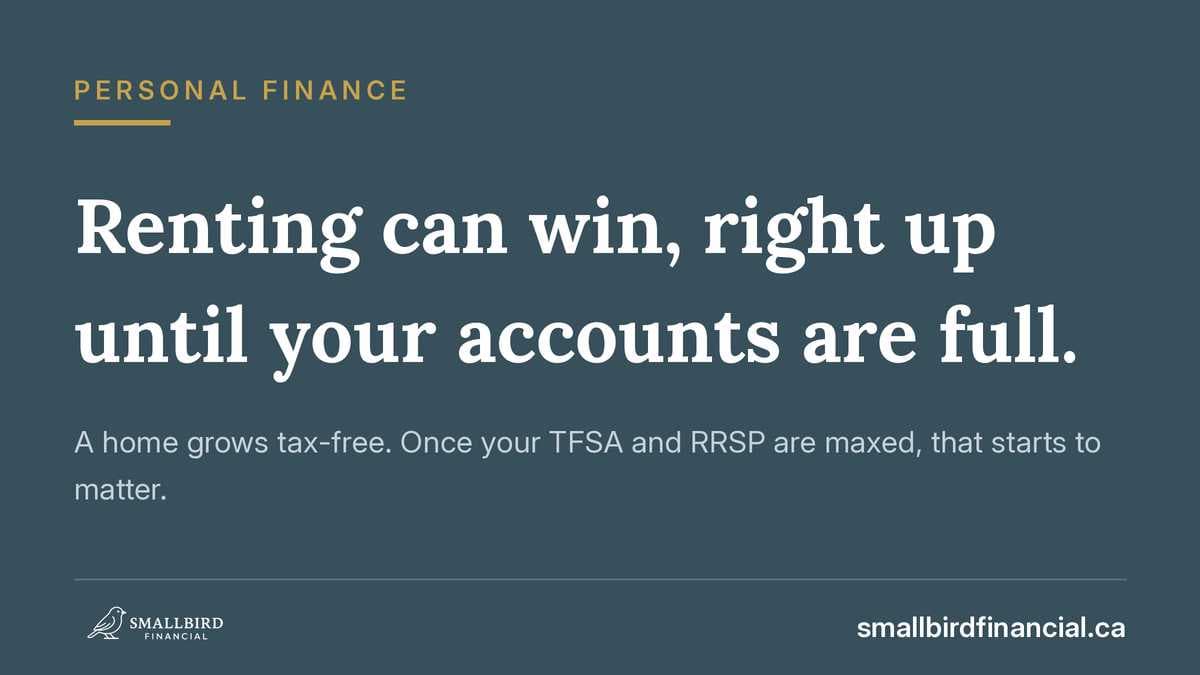
If you rent, you've probably heard your whole life that you're throwing money away and just paying your landlord's mortgage. As a pure money decision it can go the other way, and renting often comes out ahead, as long as you invest the gap between your rent and what owning the same place would cost. There's a point where that flips though, and it has nothing to do with what the housing market is doing. That flip comes when you run out of registered room to invest in. While you still have TFSA, RRSP, or FHSA space to fill, putting the difference there is hard to beat, because the money grows sheltered from tax. Once all of that room is maxed, your next dollar of investing goes into a regular taxable account, where the gains get taxed along the way. A home gets a tax treatment a regular investment account doesn't. When you sell your principal residence in Canada, the growth in its value comes out completely tax-free under the principal residence exemption. So once your registered accounts are full, buying stops competing with a sheltered account and starts competing with a taxable one. The tax-free growth on a home can pull ahead of that. None of this means you should buy the moment your TFSA is full. Owning still costs more than people expect once you add property tax, insurance, and upkeep, and renting keeps a flexibility that's worth real money if your life isn't settled yet. So "rent and invest the difference" is at its strongest while you still have tax-sheltered room to put that difference into. Personally, my wife and I are renters filling our registered accounts first, and we'll buy in the future when we know where we're going to live. If you want to see how it shakes out for your own rent and place, I built a rent vs buy calculator on my site: https://smallbirdfinancial.ca/tools/rent-vs-buy/. If you rent, have you thought about what changes once your TFSA, RRSP, and FHSA are all full?
5,486 views
43 Comments
DarkOctober @darkoctober · 6d
For me I focus on getting assets that put money in my pocket first. A house doesn't do that unless you rent and I don't wanna bother with tenants. Plus my rent is pre-covid in New Brunswick so very low. No reason for me to buy a house so I just invest hardcore.
Fraser McGuire@frasermcguire · 6d
The calculator looks great, Levi! I’ve always been confused by the debate. Most people either buy a detached home as their first property (52% of first time buyers) or end up in a detached home. There simply is not enough rental stock of detached single family homes to provide an option to rent and invest as a comparison. This is why the rent vs buy debate always comes back to the same 10% of homeowners that own an apartment as their primary residence and could theoretically rent and invest instead. And even among this sample, you need perfect investing behaviour in 100% equities for 25 years (without moving) to even make it a coin flip in Canada’s biggest cities (based on Ben Felix’s data).
Mr Financial@mr.financial · 6dEdited
This topic always has me scratching my head for a few reasons. I know some had tried to do limited studies on the topic, however, the scope is just so huge. Here's my two scents about the topic and why it's hard to have any definitive answer ever on the topic ..... RE is location, location, location. Within the country, within the province, within the city, within the neighborhood. Italy is different than England. Canada the us. Georgia than California or Washington. Seattle than Spokane. Then there are the supply demand metrics. To generalize, rural areas of a country are much cheaper to buy, but comparatively more expensive to rent because of the low supply. Whereas, in a densely populated city centre in the country, to generalize, buying is much more expensive and renting is cheaper l with higher supply. This is the only constant I've read about. Name the country, there will be big dense expensive cities and rural cheap ones. And lastly, land, build and maintenance costs vary drastically from country to country and even within a country. We see this within Canada. Toronto and Vancouver have high land, build and maintenance costs, and a place like Halifax is much less... About 30% or more less. All this to say, I believe the cost analysis must be done for the specific area one is moving to. And I mean specific. In Vancouver, prices can even double or more by location for similar lot size, sqft, and year build. And as you say, renting has its flexibility and next to no moving costs. Try selling a house in Vancouver.... 40-45k just in realtor fees alone for a 1.6 house. And about 30k in PTT. Plus all the extra costs.... That alone is over a year of free rent 😁 And for the investing the difference... If you are indexing, sure it works.... Active strategies yikes 😳
Will W@williamwang23 · 6d
Wife and I own. We bought 4.5yrs ago and our house is up 200k ish now. With that said upkeep can be costly. Since we moved into our place weve done renovations, new AC unit, new washer dryer, fixed the washing machine, called plumber probably too many times, fixed door bell, changed light fixtures, etc theres always something little that pops up every so often.
Clantosa @clantosa · 6d
I was thinking this exact thing. I'd buy a house then deposit money into all registered accounts. Once maxed I was thinking instead of using a non registered I'd simply put extra money down on the mortgage. Not sure if I'd have extra to begin with since maxing alone requires are a large sum. Looking at 7k for TFSA around 10k-12k for RRSP another 5k for the kids RESP. That's about 25k right there. Then add in regular expenses which have been about 60-65k annually and now you're looking at needing quite a high income to make over 90k TAKE HOME money to fund all this before extra money ever goes to the mortgage. Life is expensive and most people will never be able to max their registered accounts let alone anything else
You must have an account to viewCreate an account for the full Blossom experience!
Join the conversation with 500,000+ other investors 💸
Create an account to get access to everything Blossom has to offer!
📊 Personalized algorithm based on your investing style, experience level and interests
📈 Powerful portfolio and dividend tracking tools
👀 See what top creators and others in the community are investing in