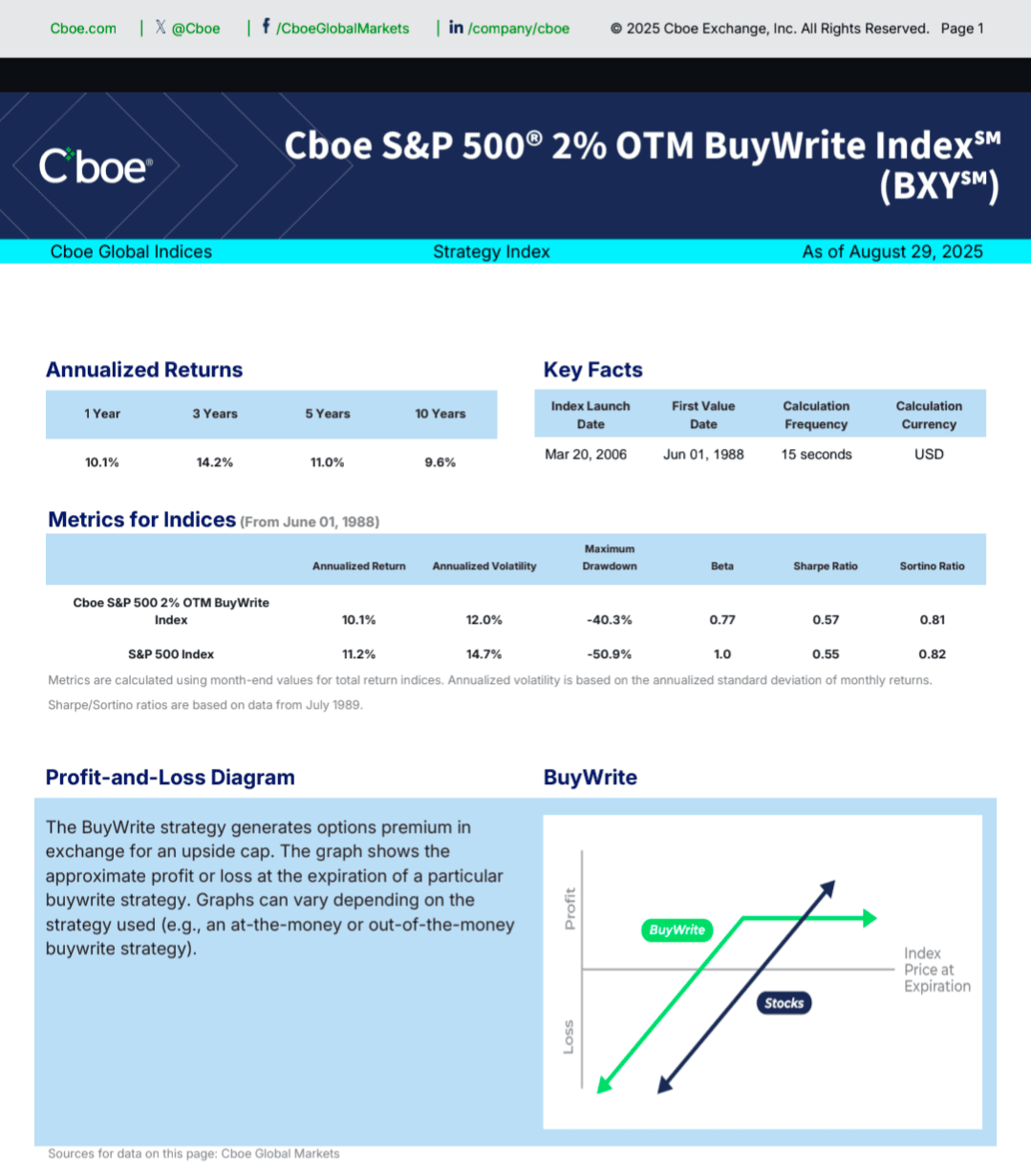
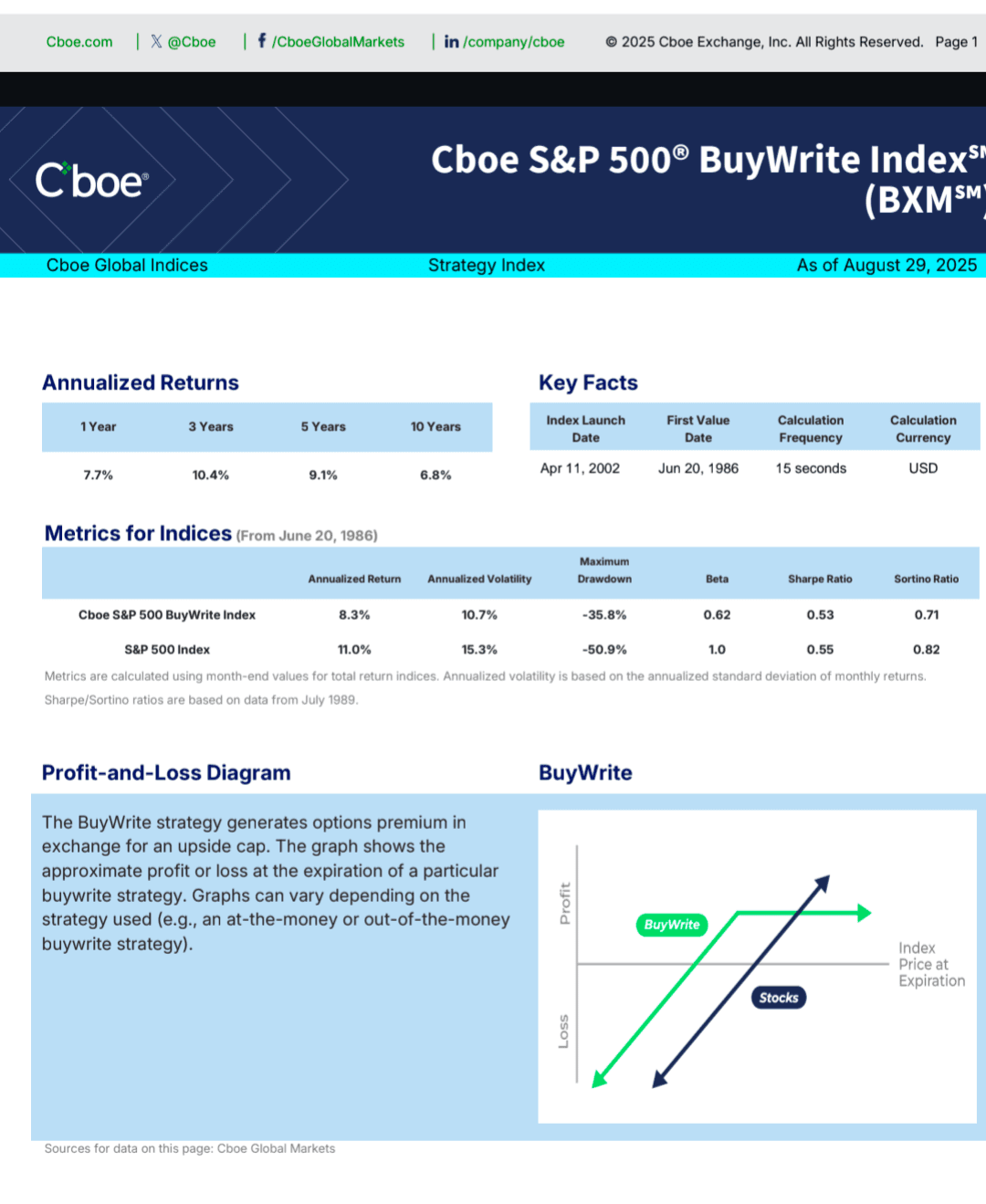
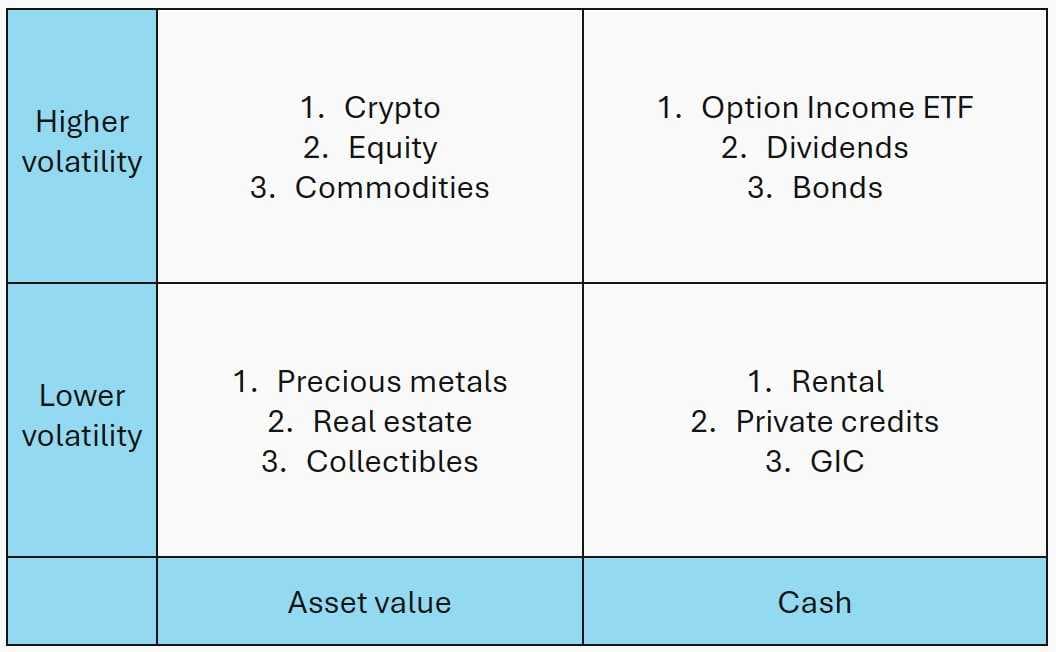
A price chart is the theoretical return. Your personal performance depends on how you buy and sell. For over 30 years, I have consistently invested in the high-volatility/asset-value quadrant. My nest egg blew up on $VTI$QQQ$XQQ . Once my net worth goal was met, the next challenge was regular cash flow. I cannot buy groceries with a theoretical return. After research, I moved my money into the high-volatility/cash quadrant. It had the right tool for me to monetize my equity. Most of my money is in $HHIS$BANK$HYLD$QDAY$HDIV$QQQY$BIGY$HBTE$SDAY$HHIC$BMAX$BLOX$CDAY . My pinned post has all the details on my money roadmap. Using https://cdn.cboe.com/resources/indices/factsheet/CboeGlobalIndices_BXY-Index.pdf as benchmark, $SPY has outperformed BXY by 0.9% since 1988. The flipside of this gap is the profit for the option buyer. This is the incentive needed for the option buyers to provide liquidity to the sellers who want to monetize their equity without selling. The sellers can also sell their equity position if they choose. I challenge the financial planners on Blossom for a more efficient monetization. I could not find one before jumping all-in on option income ETFs. How can you ensure you sell at the top of each month? If you do reverse dollar averaging (aka. fixed number of shares each month), how do you prove you leave less money on the table than $BXY? If you agree with the claim that option income is bullsh*t, the gap between $SPY and $BXY should be the easiest money to make. Option trades at Questrade are super affordable at $0.99 per contract. Please buy 2% OTM $SPY options and post your trades here. The rest of Blossom can learn from you on picking these low-hanging fruits.
3,462 views
51 Comments
Kar Yung Tom
@karyungtom · 1yr
@mr.financial@smallbird.financial I'm still genuinely trying to understand why @edsam has an issue with this quote. The idea that covered calls generate income is financial bulls***. These strategies are mechanically expected to underperform their underlying equity, and increasingly so at higher targeted levels of distributions." Is "underperform" the problem here because you think it's an attack on the purpose of CCs? It's not controversial to say stocks outperform bonds for a long-time investor. That doesn't mean bonds couldn't serve a purpose outside of long-term expected returns. And I think @mr.financial put together what I said already too. "The 0.9-1.1% lag does not reflect the cost of monetizing via that strategy because you still have to decide things like how much premium you're going to use, how much you're going to put back and when, etc." There's no data presented on Ed's side as to how costly it is to withdraw with either strategy because the data presented is on total returns only. You'd have to do it for both.
Mr Financial
@mr.financial · 1yrEdited
@smallbird.financial@karyungtom @edsam We had this discussion buddy. Bxy isn't an ETF. it's an index selling 2% OTM call options on the S&P 500. The UNDERperformance is 1.1% in theory according to the fact sheet. This is showing total returns of selling OTM calls on the index. With ATM calls, bxm, the UNDERperformance is 2.7%. The deeper ITM one goes, the lower the return. This has to do with how the option contract works. The pricing is complex, but the mechanics of extrinsic vs intrinsic value is pretty straightforward. Selling a call isn't monetization, it's opening a trade that carries RISK. If you look at an income statement for an ETF, you'll see options are considered a liability... You are compensated for that risk with option premium. The option buyer has only the risk of losing the premium he paid the seller. Technically, unlimited upside. The seller has unlimited DOWN side and a capped upside. They are opposite trades with very different risk profiles. Selling the call is just one half of the trade. I know I can sell 2% OTM monthly calls and get burned 30% of the time at currently deltas. What does that mean? I either buy back the call for a loss, 30% of the time or I let my shares get called away for the 2% gain plus the .33% approximately from the option premium. That mean only 70% of the time with current volatility will I keep my shares and collect the .33% on the monthly calls. Having to roll the option up or out or up and out can eat months worth of options premium. I know because it's happened to me many times this year alone. So now you want to track this index with a product... Your UNDERperformance will be greater than 1.1% because of fees. Most charge 0.39% management fee or more plus ter for a mer well over 0.5%. Also, along the way, all the option premium will be taxed as capital gains... Lastly, you claim one needs to sell the stock at the absolute peak... the same can be said for options contracts. This bxy index is trading once a month on 3rd Friday expiry... Like today. Take a look at the options prices. They jumped around wildly. Just today a 27dte jumped 28% in value... The opposite can be true on a down day. So to say one needs to sell at the top today to benefit from the index gains, the same is true for selling options. One would need to sell for the best premium today. So to me it's a mute point. A wash out. To sum it up as someone who literally sells calls on spy all the time. 1. Cc ETFs are expensive for what they do to sell monthly calls. 2. Not every trade is a win and many times you will have to roll the call for a major loss. This means I don't get to keep all the premiums I made. 3. It's important to know you can't sell for the best option premium each month nor can you sell the stock for the best price each month. Timing is impossible for both.
Kar Yung Tom
@karyungtom · 1yr
@edsam@smallbird.financial I feel like I've replied to a few items that were either related to the post or exact issues you had. BTW, the bulk of the post - amazing. It has me learning more and more about options this week. But I'm not just paraphrasing Ben. I talk to him regularly and he re-confirmed what I said on what he means in terms of financial BS. He agrees with: "While these strategies do produce cash flow, calling it 'income generation' is misleading because unlike dividends from profits or bond interest, option premiums aren't new value being created — they're compensation for giving up future upside, making it more accurately described as 'return conversion' rather than income generation." The point of his video was also not that the options market is mispriced. That would be the wrong interpretation of his latest video. You end these posts with a misrepresentation of what he is saying to try to knock it down with a challenge. You guys agree more than you think and you're just not a fan of the language.
Hostile Door
@hostiledoor · 11mo
Makes no sense, CC ETF fans keep finding excuses to justify their purchase.
See the full comment section 👀Sign up for the full Blossom experience!