Conviction: The Most Dangerous
Here's an observation for all investors to consider:
“Measure your conviction.”
What does this mean?
In investing, conviction is your degree of confidence and belief in a chosen stock, ETF, strategy, or approach. It's the internal force that keeps you holding through volatility or sizing up a position. At its best, conviction drives extraordinary returns. At its worst, it masquerades as knowledge and destroys wealth.
The difference between the two is rarely intelligence. It's “self-awareness”.
Why This Matters to Me Personally
I've spent a career developing high-value leadership talent and navigating the corporate world. Over that time, I've worked with more than a dozen executive coaches and mentors who dissected my cognitive processes and reflected them back to me. But the work that most profoundly changed my outlook was a decade spent with a highly trained psychotherapist examining my emotional states, responses, and awareness — understanding how feeling drives behaviour, often invisibly to me.
I share this not as a credential, but as a proof of concept:
“The examined mind performs better.”
And that principle applies directly to investing.
The Research Agrees
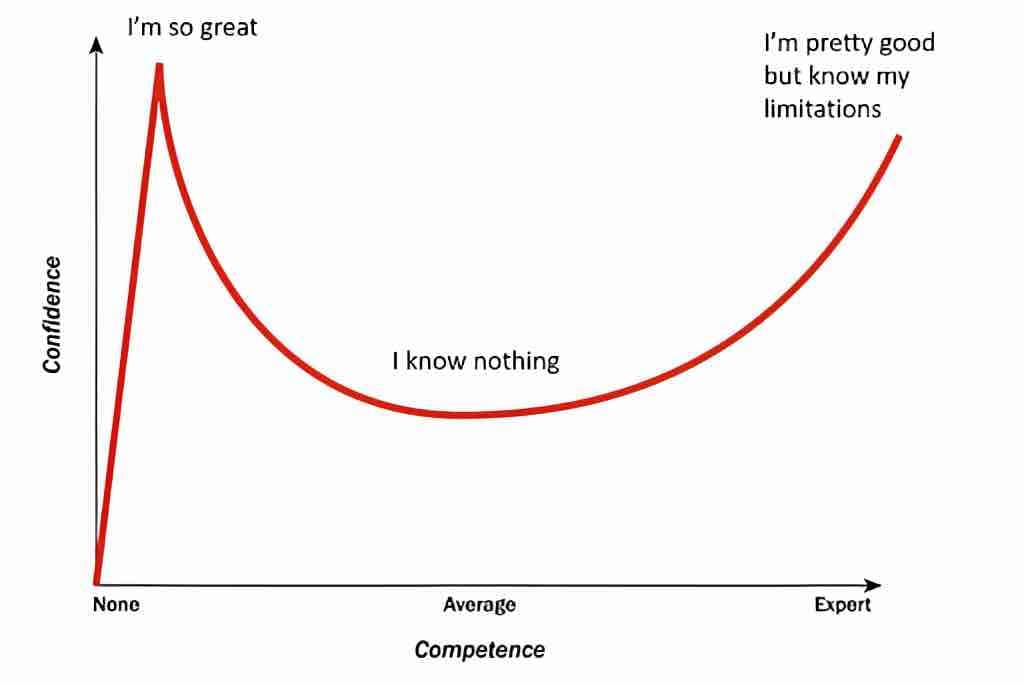
Behavioural finance has repeatedly demonstrated that unexamined confidence is one of the greatest destroyers of retail investor returns. I particularly like the last one below - the Dunning-Kruger effect I see so often in young men:
- Barber and Odean's landmark 2001 study, "Boys Will Be Boys," analysed over 35,000 brokerage accounts and found that the most frequent traders — those with the highest conviction in their ability to pick winners — underperformed the market by 6.5% annually. Overconfidence led to excessive trading, which led to losses.
- The DALBAR Quantitative Analysis of Investor Behaviour (2023) found that over the prior 30 years, the average equity investor earned 6.81% annually while the S&P 500 returned 10.13%. The gap is driven almost entirely by behavioural errors — panic selling, performance chasing, and misplaced conviction in timing decisions.
- A 2020 study by Chague, De-Losso, and Giovannetti at the São Paulo School of Economics found that 97% of day traders who persisted for more than 300 days lost money. Yet nearly all of them began with high conviction.
- The Dunning-Kruger effect (1999) established that individuals with the least competence in a domain consistently overestimate their ability, while true experts tend to underestimate theirs. Applied to investing, those with the least experience often carry the highest conviction.
Blind Faith vs. Measured Conviction
If you believe without question that your stock pick will succeed — that's blind faith. No institutional investor, no risk manager, and no credible banker would allocate capital on that basis. They would, however, happily take the other side of your trade.
Measured conviction is different. It means you've stress-tested your thesis, you understand both sides of the trade, you can articulate the conditions under which you're wrong, and you can assign a probability-weighted expected value to the outcome. You've examined not only the opportunity, but “your own emotional attachment to being right”.
A Challenge to This Community
To be direct: the majority of posts I've observed in this community sit far closer to blind faith on the conviction spectrum. Many investors here are what I'd call single-dimensional — high confidence, narrow information, and limited awareness of what they don't know. This isn't an insult; it's a description of a correctable condition.
Consider this: the universe of investing knowledge spans quantitative analysis, macroeconomics, behavioural psychology, risk management, options theory, market microstructure, and decades of pattern recognition developed through experience. If you've engaged with a fraction of that universe, how much conviction can you legitimately hold when competing against participants who've mastered it over 30, 40, or 50 years?
The Bottom Line
The most consistently successful investors — Buffett, Dalio, Howard Marks — are defined not by their confidence but by their rigorous awareness of what can go wrong. Marks has written extensively about the role of "second-level thinking" — understanding what's already priced in and what risks others are ignoring.
Conviction is not inherently good or bad.
Un-inspected conviction is where the danger lives.
Measure yours. Examine what's driving it — data or emotion, analysis or ego — and you'll meaningfully improve your probability of long-term success in investing, life and work.
Your life's savings deserves that discipline.