Did Canadian Housing Actually Beat Stocks?
Most Canadians grow up believing physical property is the only guaranteed path to building wealth.
The last 25 years of hard data paints a completely different picture.
📊 The Math (1999–2025)
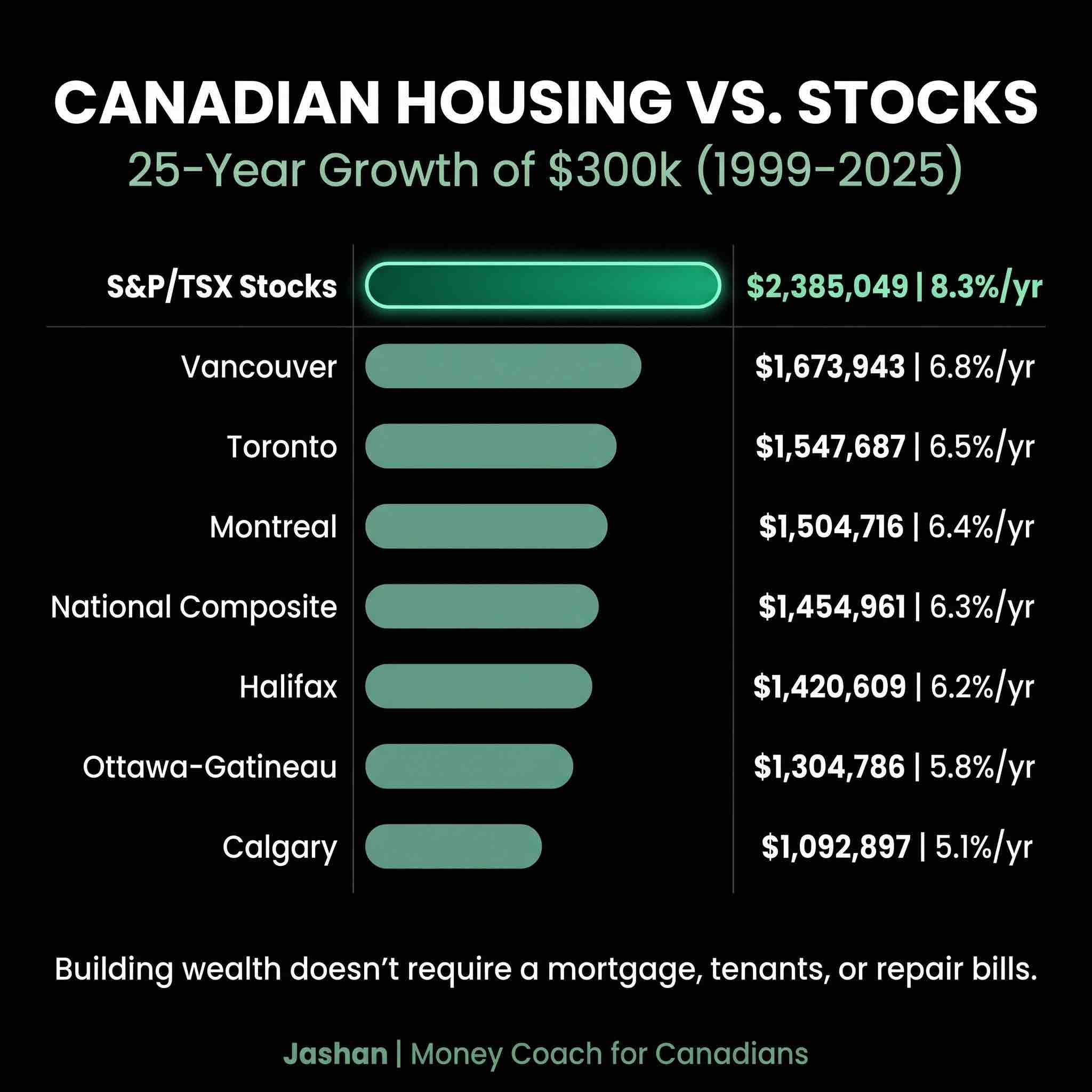
If you invested $300,000 in cash back in February 1999 with zero leverage, here is where it sits today:
• S&P/TSX Composite: $2,385,049 (8.3%/yr)
• Vancouver Real Estate: $1,673,943 (6.8%/yr)
• Toronto Real Estate: $1,547,687 (6.5%/yr)
• Montreal Real Estate: $1,504,716 (6.4%/yr)
• National Composite: $1,454,961 (6.3%/yr)
• Calgary Real Estate: $1,092,897 (5.1%/yr)
Canadian index funds outperformed every major real estate market in the country.
⚠️ The Friction Factor
Real estate returns look great on paper until you factor in:
• Property taxes and insurance
• Land transfer taxes and realtor fees
• Maintenance, aging roofs, and furnace replacements
• Tenant management headaches
A globally diversified index fund portfolio has zero maintenance fees, instant liquidity, and requires zero midnight repair calls.
💡 The Takeaway
Buying a home can make sense for lifestyle stability or raising a family.
Treating physical housing as your entire wealth strategy often just adds concentration risk and high carrying costs.
Wealth building does not have to be stressful or physical to be effective.
Boring index funds continue to do the heavy lifting.