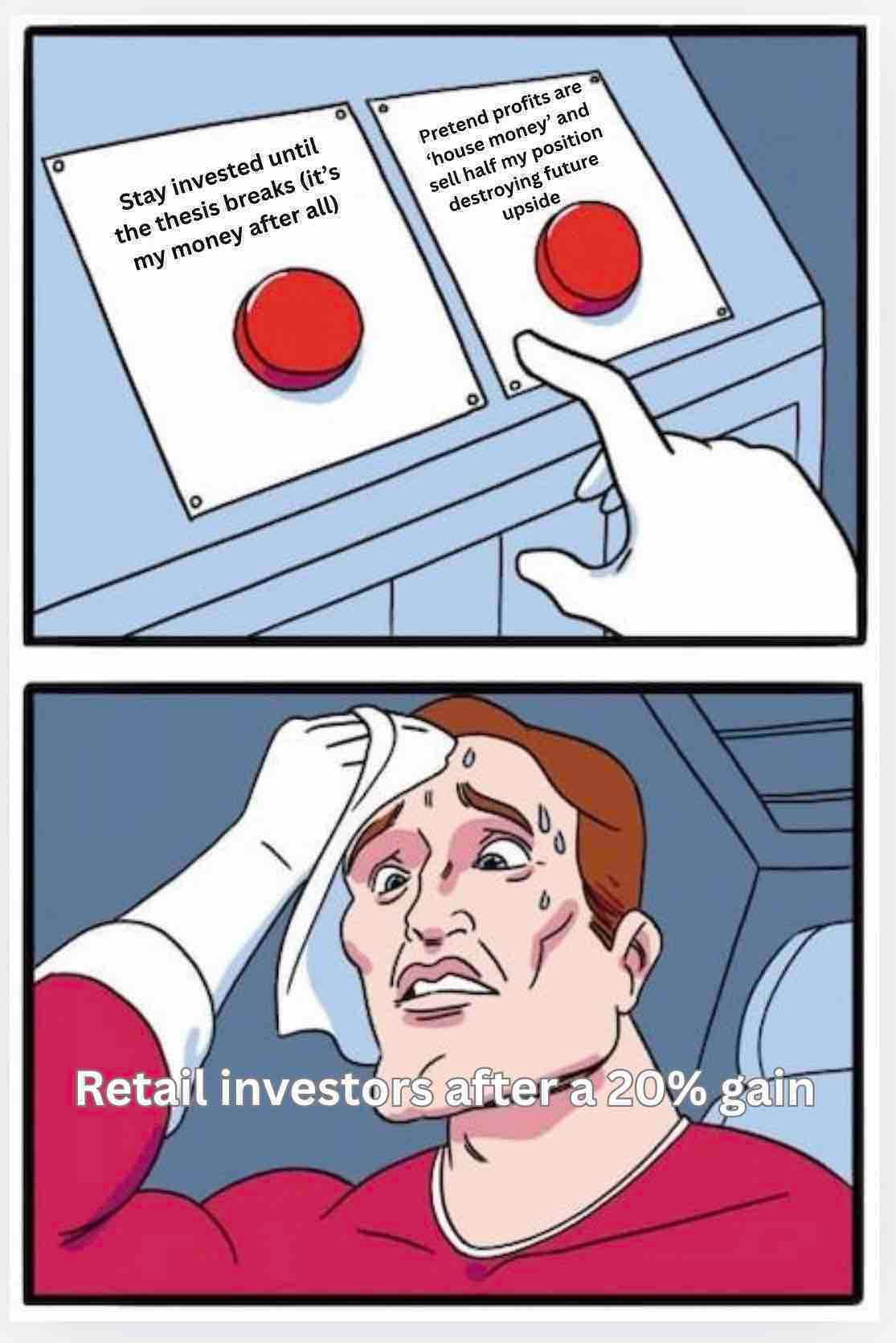
There’s only one thing in this world I hate more than Starbucks’ coffee prices, and that’s when retail investors say the words “house money.” Typically in trading, house money refers to the amount you profit off an investment. This sort of phrasing is taken verbatim from casino culture, where “playing with house money” refers to only playing with the money you made from your original bets. Logically this makes zero sense. Of course, if you bet $1,000 and win $1,000, you now have $2,000. That’s all your money. But saying “I’m going to carelessly play with the $1,000 I gained, because it’s house money,” is a mental comfort to take on more risk, and feel less pain if you lose. When it comes to the stock market, this bias is true as ever, and its effects might be worse than gambling if you don’t notice it. Oftentimes with individual stocks, it can be tempting to want to sell early. When you make gains and don’t sell, there’s no way to know if the prices will stay high. And if they don’t, well, there go your gains, right? The problem is, trimming your initial investment and “just leaving the gains” (the “house money”) does nothing but destroy future upside. I’m sure if you’re on Blossom, you already know this, but compound interest works best with a higher amount of money to compound. Your dollars make more dollars, when there are… more dollars. A $10,000 portfolio and a $100,000 portfolio both earning the same 10% return, are going to make different amounts of money. And you can imagine that by constantly massacring positions (lowering the total amount you have invested), you’re going to make less money in the future, because there’s less to compound. If you were to buy $1,000 worth of $GOOGL at $100 per share, and then it goes to $200, and then you decide to “only play with house money,” you’re selling off $1,000 that would have compounded your position faster over the course of years. Keeping most of your shares of your positions—assuming your thesis hasn’t changed and you’re comfortable with your investment long-term—means growing your portfolio faster. Even with a “mediocre” annual return. The “house money” mindset is as damaging to your portfolio as the “trim profits” mindset, just at a much larger scale because you’re cutting so much of your investments at a single time. Every dollar you earn in the market is YOUR money. There is no “house.” Just you, a phone with your brokerage app, and a bright future if you leave things alone. The best part about investing is that it’s simple, but just requires patience. And if you simply leave your portfolio alone and let compound interest do its thing, long-term you’ll thank yourself in hindsight. Thanks for reading. Happy investing.
6,300 views
38 Comments
Jacob B
@jacobb · 6mo
By the way, for those who follow on Substack, my analysis on Tasmea is still ongoing! I’ve been chatting back and forth over email with the CEO of the company this last week or so, and considering Australia is 12 hours ahead, it’s taken a day or so for responses. Soon to be out. So stay tuned.
ETF Go
@etf.go · 6moEdited
Now imagine you put what you think is ‘house money’ (gains) into riskier assets - or - maybe you even spending it - because you think you earned it… but in reality a big part of that ‘house money’ was just your own money being sent back to you. Yikes! 😬 😳 Unfortunately it seems to often be the same group. I guess stories do matter. 😂🤷♂️
James
@figuringitout · 6mo
I get the point, but this is a bit too absolute. “House money” as a mindset is definitely flawed. Gains are still your money, and treating them differently can lead to sloppy decisions. That said, trimming or reallocating isn’t inherently bad, it depends why you’re doing it. If you’re selling just to “lock in gains,” you’re probably hurting compounding. But if you’re rotating into higher conviction or better risk reward opportunities, I’d lean to say you’re actually optimizing it. IMO Compounding isn’t just about sitting still, it’s about consistently putting capital where it earns (or where you believe it will earn) the highest return. I agree don’t think in terms of “house money.” But also don’t be absolute and confuse discipline with doing nothing.
Connor
@connorj · 6mo
I guess it depends on what you do with the “house money” after and how much your initial investment was and how much it grew to the point you sell. For example $USA$BW are two stocks I hold and realized insane returns, USA started to take up a lot of % of my portfolio so pulling out my initial investment and even some more allowed me to sprinkle into multiple new opportunities in sectors that are breaking out. Just like I did with those stocks.. Beskar teaches this strategy and it is a winning strategy if you do the work to find the opportunities to recycle into, but maybe not if you’re inactive and just hold cash. It really depends on the investor just my opinion. But I understand what you’re saying aswell that’s why I think depends who you are!
See the full comment section 👀Sign up for the full Blossom experience!