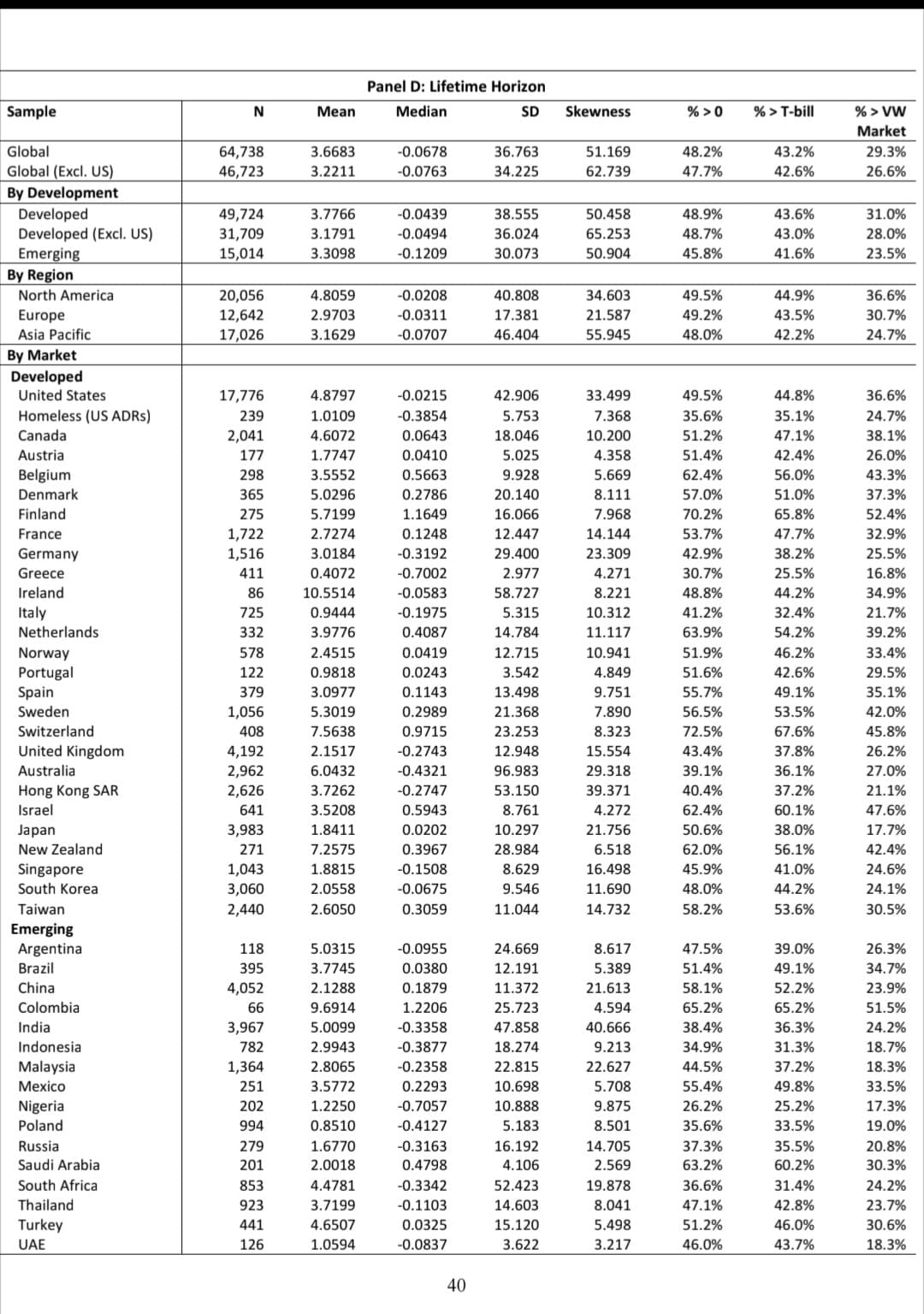
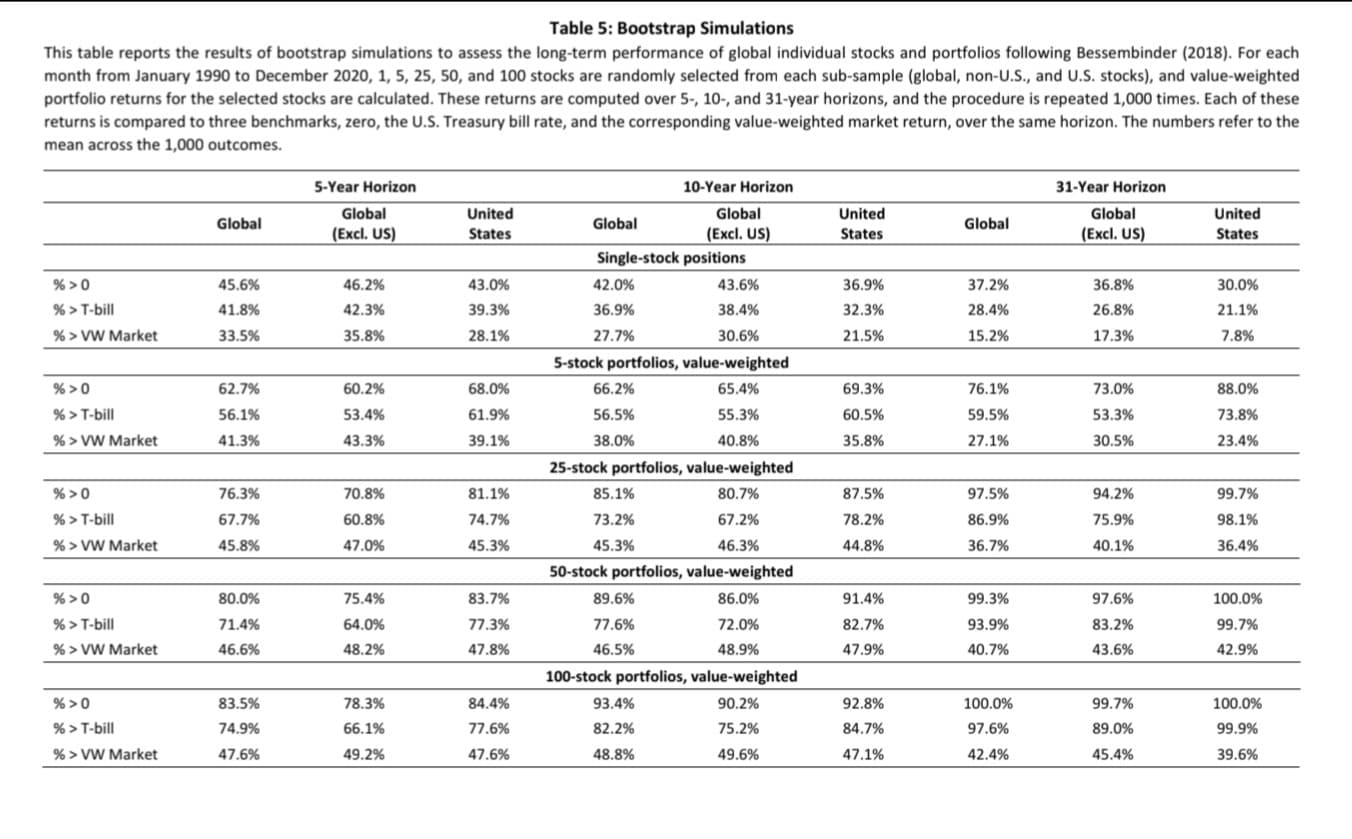
Boy oh boy, it is getting overwhelming with the sheer amount of stock picking fascinados on socials of all age groups and experience levels. How many posts have you seen on: why to buy this stock, why to not buy this other stock, here's my thesis on xyz, concentrated portfolios are the key, leveraged covered call single stock ETFs are high yield and safe, fair value of this stock? Think $TSLA$AMZN$NVDA$PLTR$SOFI$GOOG I made a post a while back after listening to one episode of The Rationale Reminder Podcast. I just had to read the paper that was discussed. This one finding was 🤯 "We measure for each sample firm the dollar amount by which the wealth of shareholders in aggregate was enhanced by their decision to take on the risk of stock investing rather than low-risk U.S. Treasury bills. Summing across the 63,785 firms that issued common stock contained in the January 1990 to December 2020 sample, we calculate net global stock market wealth creation of $US 75.7 trillion, measured as of December 2020. Wealth creation is highly concentrated. The five firms (0.008% of the total) with the largest wealth creation during the January 1990 to December 2020 period (Apple, Microsoft, Amazon, Alphabet, and Tencent) accounted for 10.3% of global net wealth creation. The best performing 159 firms (0.25% of total) accounted for half of global net wealth creation. The best performing 1,526 firms (2.39% of total) can account for all net global wealth creation." Let that sink in... ...5 companies accounted for 10% of global wealth creation ...159 companies account for 50% (of which 5 amounted to 10%) of global wealth creation ...ONLY 1526 firms accounted for ALL new global wealth creation (of which 159 accounted for half that That's out of 63,675 companies...over a 30 year time frame. Another interesting finding: "The majority, 55.2% of U.S. stocks and 57.4% of non-U.S. stocks, UNDERPERFORM one-month U.S. Treasury bills in terms of compound returns over the full sample." The reason goes back to the skewness of returns. Look at the median return in picture 1... It's negative for both us and global stocks! The mean or average, however, is positive. What this highlights for ordinary me, diversification is not just a good idea, but necessary to capture a decent return over many decades of time. In this study, it's 30 years of time. Diversification here didn't protect just the downside, it is what allowed skewness to work in our favor and give a good return. Some like skewness, and use it to "bet" on massive returns. Some also believe they have a competitive edge to make skewness work to their advantage. Ie. Identifying and Holding Apple, Microsoft, Amazon, Alphabet, and Tencent for the entirety of the 30 year sample. What did a concentrated portfolio look like in bootstrap simulations in picture 2? There's a clear statistical trend with a larger number of holdings. I prefer to have probability on my side... If you want to download the full paper or many other studies l, especially on skewness, here's the link: https://papers.ssrn.com/sol3/cf_dev/AbsByAuth.cfm?per_id=667 How do studies like this make you feel about selecting individual stocks? Calling all stock pickers 📢 I want to hear all the different perspectives!
17K views
85 Comments
Ronan @ronan · 1yrEdited
Every investor who decides to buy individual positions needs to understand this data and risk. Most investors don’t understand the severity that comes with single picks. Much more than is ever discussed on Blossom While I like the data we have on this, I’ll offer an alternate idea. My problem with the testing is that they pick a random selection of stocks in every test, actual investing does not involve a full 100% random selection. There is no secret, but I bet you could do these tests with more careful selecting and at least increase your chances. For example, if you exclude practically every biotech company, you’ve likely increased your chances already. I’d bet there practically close to 0 in that sector that can outperform for 5,10,20+ years. And if they have, they’re likely already an established healthcare company. I love the data and it’s important to see, I’d just argue you could increase your chances here and there by making smart and rational decisions. Just food for thought
Bradley @bradleytalksmoney · 1yr
I've seen this study a couple of times, and I've seen very smart investors debate it's validity. I believe one of the issues with this study, is that it only looks at the results from point A to point B. If you remember a few years ago at Berkshires AGM, Warren highlighted how the biggest stocks 20 years ago, and the biggest stocks today are very different lists. In this study you are referencing, those stocks from 20 years ago would all have underperformed, but that also assumes you've just held them the entire time. Another good example that comes to mind is a company like Blackberry. It surely would be classified as one of those businesses that underperformed bonds, but that doesn't mean that if you owned it you wouldn't have had the opportunity to vastly outperform. The study assumes that you wouldn't have sold at any time and just held to the bottom. So to me, the case study more highlights that the vast majority of businesses are not invincible. They will all have their rise and fall, and only the small small percentage are able to develop moats strong enough to allow them to survive over the long term.
le bib@le_bib · 1yr
Great post, thanks for it. I won't argue about how loud is average Blossomer vs its financial knowledge. It really reminds me at 20 years old picking stocks and having no clue about what I was doing: https://www.blossomsocial.com/posts/POST-1746286295981-Iho6UguJ_pUReiL9phonCe0Bu Fortunately for me I then went into mutual funds / index etf for the next 20 years and it served me well. I then recently started to choose individual stocks as I didn't like the concentration in the index. We now have 3 different companies with more than 6% weight in the S&P 500. I don't have one position above 6% currently in my portfolio. And I just prefer not having $AAPLAAPL, $NVDA and $TSLA to be responsible for $250K of my wealth at the moment. I'm all for diversification too: I made a post about being ok with a 25+ stock portfolio: https://link.blossomsocial.com/7uYa/x2hohfnx About the point that "159 stocks are responsible for 50% of wealth creation": while it's mathematically true, it's very skewed towards mega cap. Here is an example: A: $2T -> $2.1T for + $100B (+5%) B: $1.5T -> $1.5T (0%) C: $500M -> $2.5B for +$2B (+400%) Total wealth creation was +$102B and company A is "responsible for 98% of wealth creation". But company C still outperformed A but 5 folds. So one could still outperform even without picking the next $AMZN. That being said, managing seriously an individual stock portfolio appears easy, but it's hard to outperform long term due to a lot of factors, many being cognitive biases. And I can attest that many around here aren't much opened to learn fact, acknowledge mistakes and improve... unfortunately I doubt many will look at this data and move out of picking random stocks based on feelings :( I personally welcome the challenge, but if anyone ask me for advice, I only recommend low cost index etfs. And I think most on Blossom would be better served by indexing.
Chris K
@septerian · 1yr
Diversity is good, but I think it also matters how much you have invested. Is it really worth investing in 100 picks if you're only going to have $10 in each. Or is it better to build up a smaller portfolio to a decent size than focus on expanding holdings as the amount in the portfolio can afford to hold larger positions. I believe growth should be first, then stability through diversification
See the full comment section 👀Sign up for the full Blossom experience!