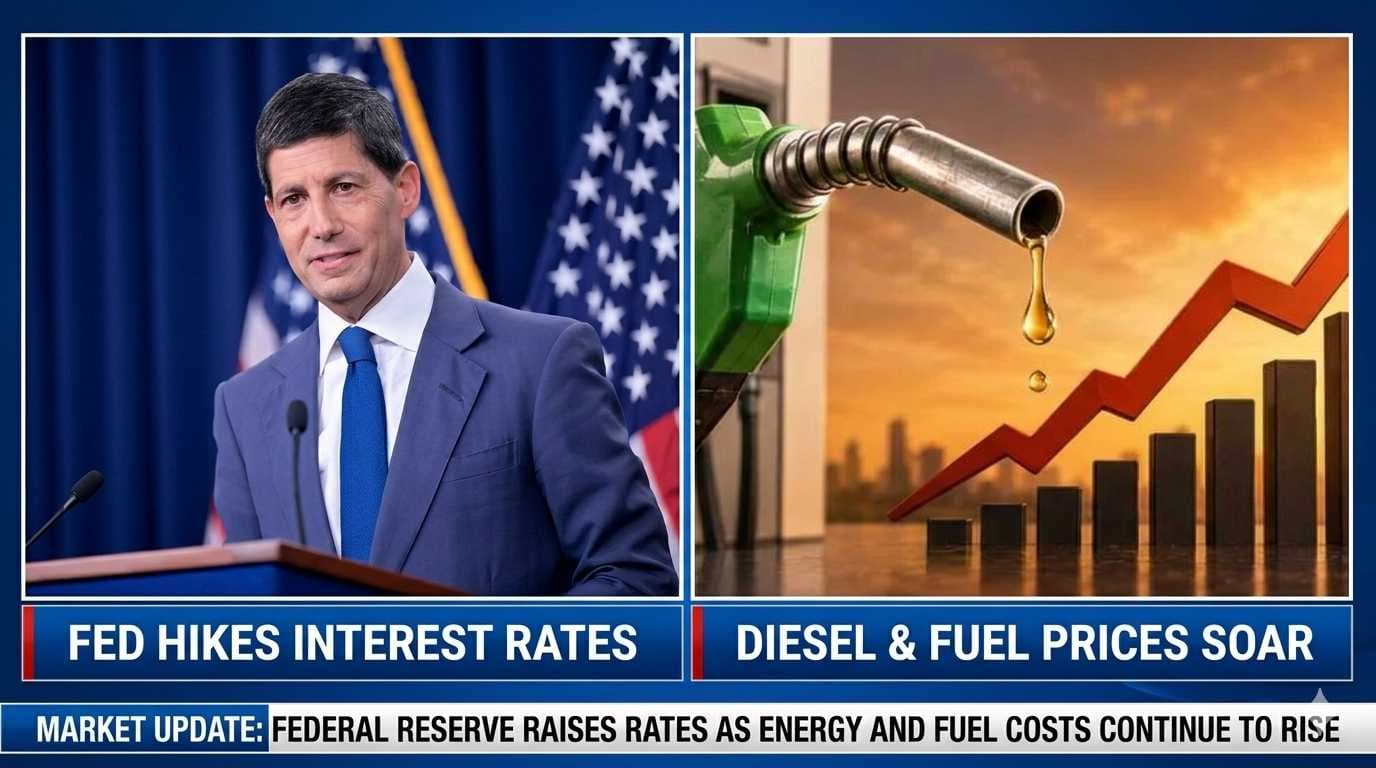
The Fed raised rates yesterday for the first time since 2023, a quarter point to 3.75-4.00%, and the vote was unanimous. Warsh opened his press conference with a line that left little room for interpretation. “The plain fact is that inflation is too high and has been for too long.” He said summer readings showed no meaningful improvement in underlying inflation and that the hike supports a timelier return to the 2% target. The dot plot did most of the work. Twelve of the eighteen members project an average rate of 4.125% for 2026, which is one more quarter point this year. Four see a full 50 basis points more. Two think the job is done. Beyond that, the committee expects to hold through 2027. About the reaction The Dow fell 1.07%, roughly 600 points. The S&P gave up 0.45%. The Nasdaq closed all but unchanged, down 0.06%, and the Russell 2000 finished slightly green. Underneath that, breadth was poor, with 60.8% of issues declining against 36.3% advancing. So this was not a calm session in which nothing happened. It was a session in which two things happened at once and roughly cancelled at the index level. Three reasons the headline damage stayed contained. The hike was 92% priced going in, so the decision itself carried no information. The dots then delivered exactly the one additional hike that futures had already discounted, which meant there was nothing to reprice at the front end. And the money that left equities went into the dollar rather than out of risk entirely, which is why the dollar hit a seven-week high and the euro slipped to $1.146. A dollar bid on a hawkish Fed is a rotation signal. A bid in gold and Treasuries at the same time would have been a fear signal, and that is not what happened. There is a fourth reason specific to this week. The AI de-rating from Monday has been quietly reversing since Huang and Zuckerberg refused the slowdown, and that reversal put a bid under the Nasdaq at the same moment rates were pressuring it. Two opposing forces, one flat index. Nebius is up almost 9% in premarket this morning at around $228 after closing at $209.37. I could not find a company-specific announcement behind that move, which if anything supports the reading that this is the sector unwinding a narrative rather than pricing news. What actually broke J.B. Hunt fell 12.6% yesterday, one of its worst sessions since the company listed in 1983. It warned that third quarter earnings will come in 5% to 10% below the second quarter. The reason was fuel. The national average diesel price has reached $6.31 a gallon, an all-time high and roughly 70% above a year ago, with California already above $8. The finance chief described it as some of the most radical and abnormal swings in fuel prices the company has ever seen. That is the number I would take away from yesterday, not the Dow. Two weeks ago diesel was $5.90 and I wrote that the pass-through into freight was the thing to watch. It took eleven days to show up in a profit warning from the largest name in the sector. The Dow Jones Transportation Average fell more than 2%. A Norfolk Southern executive said high diesel would be a drag on the consumer. Transport is over 6% of US output. Lennar reported after the close and told a version of the same story from the housing side. Revenue slipped to $8.0 billion. New orders fell 9%, deliveries fell 3%, and the average selling price dropped 3%. Gross margin compressed to 15.8% from 17.5%, which was the number I said to watch, and it came in below Q2’s 15.6% benchmark only in the sense that incentives are still doing the damage. Management cut full-year deliveries citing continued pressure on interest rates and deterioration in market conditions. Stuart Miller noted mortgage rates rose through the quarter and consumer confidence fell, while arguing the housing environment remains constructive given the structural shortage. So within six hours of the Fed raising the cost of capital, the two most rate-and-energy-sensitive parts of the physical economy both reported that the squeeze has arrived. The equity index did not reflect that. The companies did. This morning European markets opened higher, with the Stoxx 600 and Euro Stoxx 50 both up more than 0.6% and the FTSE leading at 1%. US futures rose overnight. The dollar is holding its seven-week high. The two-year has moved up to about 4.72% from 4.67% and the ten-year is sitting near 5%. Oil has come off. West Texas fell 1.8% to $103.90 and Brent 0.9% to $107.80 after Saudi Arabia offered additional crude through Oman, routing around the shut East-West pipeline and pushing more volume through Hormuz. That is a genuine de-escalation in crude supply. It does nothing for diesel, because the bottleneck there is refining capacity rather than barrels, and diesel is what is showing up in earnings. Today’s data comes at 7:30. Building permits are forecast at 1.400 million against 1.433 million prior, jobless claims at 207,000 against 206,000, and housing starts at 1.320 million against 1.239 million. The one to watch is the Philadelphia Fed manufacturing index, forecast at 31.3 after 47.4 last month. A drop of that size in a regional survey, if it lands, is the first real evidence of the industrial slowdown that higher fuel and higher rates together are supposed to produce. Pending home sales follow at 9:00. Trump, and the fight that matters more than the hike Trump’s response was immediate and not subtle. “Interest Rates in the United States should be 1%, or less, because we are the Best Credit in the World BY FAR,” followed by “LOWER THE INTEREST RATES FOR THE UNITED STATES OF AMERICA, AND FAST!” He said he had spoken to Warsh and told him “you might as well vote with the board because it’s not going to matter. The board is very hostile. They’re very political. They’re doing the wrong thing.” He also said he still has confidence in Warsh, whom he appointed this year. Warsh declined to discuss any contact with the President. The significant fact is what Warsh did rather than what Trump said. An appointee of this President, on his first genuine test, voted to hike, brought the entire committee with him unanimously, and signalled more. That is a stronger statement of independence than anything in the prepared remarks. It also sets up a confrontation that has more capacity to move the long end over the next year than any single meeting does. A market that believes the Fed is independent tolerates 5% on the ten-year. A market that starts to doubt it does not. The wider implications Domestically, the US is now applying two forms of pressure to the same economy simultaneously. Energy is taxing the physical economy through fuel and freight, and the Fed is raising the cost of capital on top of that. Housing and trucking have both reported the effect within a day of each other. The case for doing it anyway is the one I set out yesterday, that supply shocks become inflation regimes when policy accommodates them, but the transition is going to be visible in earnings before it is visible in the inflation data. Globally the transmission runs through the dollar, and that is the part most people will underweight. A seven-week high in the dollar makes oil, gas and every other dollar-priced commodity more expensive for everyone who does not earn dollars. Europe is importing an energy shock and a currency shock at the same time, which is precisely why the ECB has already hiked twice and markets price roughly 88 basis points more. The Bank of Japan is expected to raise to 1.25% tomorrow with the yen near 40-year lows. Three major central banks are therefore tightening into the same supply shock in the same week. That is unusual, and the risk is not any one of those decisions. It is that the combined withdrawal of liquidity meets Friday’s record options expiry with dealer gamma decaying into it. Micron on 30 September still settles the memory question. Between now and then, the thing to watch is whether more companies follow J.B. Hunt. One profit warning is a company. Three is a trend, and it would arrive well before the Fed’s next meeting. https://cycledesk.substack.com/p/fed-hiked-index-held-mix-changed?r=7unzzg&utm_campaign=post&utm_medium=web&showWelcomeOnShare=true
158 views
0 Comments
Join the conversation with 500,000+ other investors 💸
Create an account to get access to everything Blossom has to offer!
📊 Personalized algorithm based on your investing style, experience level and interests
📈 Powerful portfolio and dividend tracking tools
👀 See what top creators and others in the community are investing in