Misconceptions around 13F Filings from Big Names
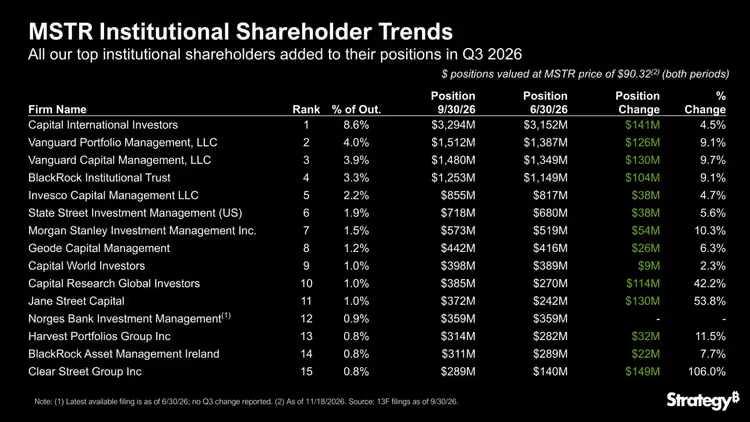
Seeing a lot of posts and comments lately pointing to Q3 13F filings as proof that "smart money" is loading up on $MSTR and others. Before you use institutional ownership charts to justify a bullish thesis, it helps to understand what those numbers actually represent.
SEC Form 13F filings aggregate every share held across an institution's funds, ETFs, and client accounts under one parent name. When you look at the top holders on that list, almost none of that buying is an analyst making a directional bet with house money:
1️⃣ Covered Call & Single-Stock ETFs (Harvest, Toroso, etc.): Harvest Portfolios Group is an ETF issuer, not a directional hedge fund. Their MSTR shares sit inside income ETFs like $MSTE and$MSTY. When retail investors buy units of MSTE on the TSX, Harvest is required by the fund's prospectus to take that cash, apply leverage, and buy MSTR shares to match the fund's mandate. Their share count going up just means retail investors bought more MSTE last quarter—not that Harvest's portfolio managers think MSTR is undervalued.
2️⃣ Passive Indexers (Vanguard, BlackRock, State Street): These firms run massive passive index funds and ETFs. Whenever Strategy issues new equity through at-the-market (ATM) offerings to buy Bitcoin, MSTR's share count and index weighting automatically increase. Passive funds are forced to buy more shares regardless of price or fundamentals just to avoid tracking error against their benchmarks.
3️⃣ Market Makers & Arbitrage Desks (Jane Street, Clear Street, Morgan Stanley): Quantitative market makers and prime brokers hold millions of MSTR shares to hedge options flow, facilitate ETF creation/redemption baskets, and run convertible bond arbitrage (buying Strategy's convertible notes while shorting or hedging with equity and options). In fact, 13F filings often show these firms holding massive put and call positions right alongside their shares.
The takeaway: 13F data is also backward-looking—Q3 filings reflect positions as of September 30 and come out up to 45 days later. Seeing institutional share counts rise on MSTR tells you that retail ETF inflows, share dilution, and derivatives hedging increased last quarter—it is not a signal that Wall Street analysts are piling into the stock.
Always check why an institution holds a stock before treating a 13F chart as a buy signal. 📉🔍