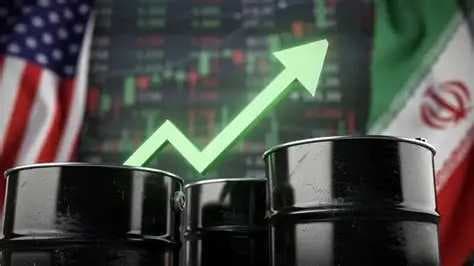
OIL TOOK THE DOW. THE NASDAQ BARELY NOTICED
The Dow lost 627 points yesterday, down 1.17% to 52,786. The Nasdaq finished within a rounding error of flat, off about two tenths. The S&P split the difference at 7,673, down 0.56%.
That gap is the whole session and it deserves more attention than the index number.
What did the damage was oil. Brent pushed above $99 and West Texas traded near $94, after Houthi attacks on Saudi energy facilities wounded more than seventy people and started fires, and Iran promised to act against any threat even before it materialises. Two months ago Brent was $72. It is now up nearly forty percent in that stretch. Add Canada's retaliatory tariffs on twenty billion dollars of American goods taking effect, at rates between fifteen and fifty percent, and the ten year sitting near 4.80%, and you have three separate taxes landing on the industrial economy at once.
Which is exactly who paid. Transport, manufacturing, consumer names, the whole old economy took it. Small business sentiment agreed, with the NFIB index falling 1.1 points to 98.7. Technology barely flinched.
Now to what actually moved, because the single stock story yesterday was better than the macro one.
Qualcomm signed a multi generation agreement to supply Amazon Web Services with custom silicon for artificial intelligence infrastructure, covering both inference accelerators and optical connectivity up to 1.6 terabits. No financial terms, no volume commitments and no deployment timeline were disclosed, and the relevant products sample in 2027 and reach commercial availability in 2028. So price it as a 2028 revenue event rather than a 2026 one. But the strategic read is immediate. This is Qualcomm's second such deal after Meta in June, it lands two weeks after Amazon committed to two million more Nvidia chips, and it means the largest cloud provider on earth is now simultaneously Nvidia's biggest customer and the sponsor of two competing silicon programmes. Everybody is hedging everybody.
Intel rose about nine percent on an upgrade and the same custom silicon enthusiasm. NuScale Power jumped nearly seventeen percent, which is the power bottleneck trade continuing to work. CoreWeave added almost twelve and DigitalOcean eleven. Nebius rose about eleven percent to around $254 after Palantir named it preferred sovereign artificial intelligence infrastructure partner, and at a Goldman fireside management said all four of the billion dollar client wins reported last quarter are now in extension talks for Vera Rubin capacity. Standing disclosure, that is my largest position.
The losers tell you more. Astera Labs fell 7.3%. Shopify fell 7.6%, Expedia 7.8%, Baidu 7%, GoPro 15%. And Salesforce and Intuit each dropped around four percent on renewed worry that frontier models eat application software.
Look carefully at that list, because the lazy version of yesterday is semis up and software down. That is not what happened. Intel gained nine percent while Astera Labs lost seven, and both are semiconductors. What actually separated winners from losers was proximity to custom silicon news. The names that benefit from hyperscalers designing their own chips went up. The names that sell into the incumbent architecture went down. This was a rotation inside the artificial intelligence trade rather than out of it, and if you were positioned by sector rather than by supply chain position, you got the wrong answer.
In healthcare, Novartis fell nearly thirteen percent on a trial failure and Amgen six percent on a downgrade, while Roivant rose almost nineteen on positive phase two data. And worth noting for anyone who follows insider activity, Uber's president and chief operating officer Andrew Macdonald bought seventy thousand shares for roughly $5.3 million at about $76. Executives sell for a hundred reasons and buy for one.
Today is light on data and heavy on theatre.
There are no scheduled economic releases. Apple holds its product event this afternoon with the iPhone 18 line expected, the first full launch cycle under John Ternus, and Treasury runs three year and ten year note auctions which will tell us more about actual demand for American paper than any commentary will. Watch whether the ten year holds 4.80%. Watch whether Brent takes $100, because that is a psychological level with a headline attached and it feeds straight into Friday's inflation print through gasoline.
Then the week turns serious.
Thursday brings producer prices, jobless claims and a European Central Bank decision, and after the close, Oracle. That report is the most important thing on the calendar this week and almost nobody is framing it properly. Oracle carries a backlog of roughly $638 billion, up 363% on the year, and guides fiscal 2027 revenue to about $90 billion. It also burned $23.7 billion of free cash flow last year building the data centres to service that backlog, and it has taken a credit downgrade for the trouble. Options price a move of roughly eleven percent. Every argument this market has had since August about whether the buildout is funded by customers or by lenders gets a very direct answer on Thursday night.
Friday is August consumer inflation, with consensus at 3.4% headline against a core rate currently running at 2.5%. Given oil has added nearly forty percent in two months and the services prices index just hit its highest since 2022, the risk on that print is asymmetric to the upside.
And then look at what sits immediately behind it. The Federal Reserve decides on the sixteenth with markets pricing a hike at roughly sixty percent. Two days later, the eighteenth brings the largest options expiry ever recorded, with about $9.6 trillion of exposure rolling off through that date and $6.2 trillion on the day itself, roughly thirty five percent of all outstanding American options exposure. Citadel Securities makes the point that matters, which is that the long gamma dealer positioning that has been suppressing volatility all summer decays alongside that expiry. Semiconductor implied volatility has already fallen forty percent in thirty sessions to below where it was before the run up. Their advice is to use strength to trim and to buy protection while it is cheap.
For balance, Ryan Detrick at Carson notes that when August closes green in a year already running strong, September has historically averaged a gain of one percent rather than the loss its reputation suggests. Seasonality is not destiny and the sample is small, but it is a fair corrective to the September doom that has been on everyone's timeline for a fortnight.
So here is where I come out. Yesterday was not a risk off day, it was an energy tax landing on the physical economy while the digital one carried on. That can continue for a while, and it has been continuing for a month. What changes it is either oil taking $100 and staying there, which starts feeding the inflation numbers directly, or Oracle telling us on Thursday that the buildout is harder to fund than the backlog implies.
Nine days from now we get a Federal Reserve decision, an inflation print, an Oracle report and the biggest expiry in history, and the market walks into all of it with volatility priced near the lows. That is not a forecast. It is just an unusually poor risk reward for complacency.