Price Action Trading Explained
Trade what's happening, not what you think is gonna happen." - Doug Gregory.
Price action trading is the process of reacting to the current price to make entry, exit, and holding decisions. It is replacing opinions and predictions with valid signals. A signal is a quantified reason to enter a trade, stay in a trade, and exit a trade. A signal should either be based on backtests of historical price data showing a past edge or on price-action trading, which can be used to create good risk/reward ratios by setting stop losses and profit targets at entry. Both approaches can be valid: backtested strategies tend to be more mechanical, while using risk/reward ratios tends to be more discretionary.
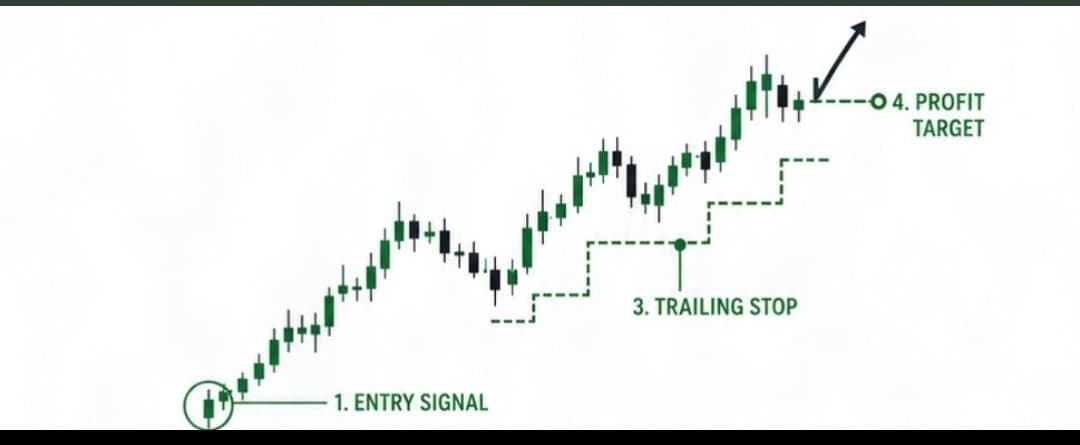
1. An entry signal can be based on price alone or a technical indicator. An entry signal should give you a better chance of making a profit than randomness. Where you get in should have an edge; whether you are buying a breakout or a dip, there should be a good reason for the entry.
2. A stop-loss should be placed at a price level that signals the trade is not going to work out. A stop-loss is a way to keep your losses small, so you have a better chance of being profitable. A stop-loss helps you assess the risk in your risk/reward ratio. The biggest cause of unprofitable trading is large losses; stop losses prevent them.
A trailing stop can be used to tell you when it may be time to take profits because a winning trade may be reversing against you. It is also useful to maximize gains. When a trade moves in your direction, you turn your initial stop-loss into a trailing stop by raising the price level you will exit at to a higher price, both to avoid giving back too many open profits and to have an exit strategy for when the trend bends.
3. A profit target can be the technical level at which your trade begins to have a bad risk/reward ratio due to the extension of price into overbought territory or an extension from a normal trading range. A profit target for price helps you determine if the risk is worth the potential reward.
Trading price action requires a quantified system that you create when the market is closed to use when the market is open. Your system has to be one you believe is profitable based on your data. It must align with your risk tolerance and potential return goals.