SWOT Analysis Keeps You from Wearing Clown Shoes
Before You Smash That Buy Button: Why a SWOT Analysis Keeps You from Wearing Financial Clown Shoes
By CryptoChad69
Listen up, fellow lab rats.
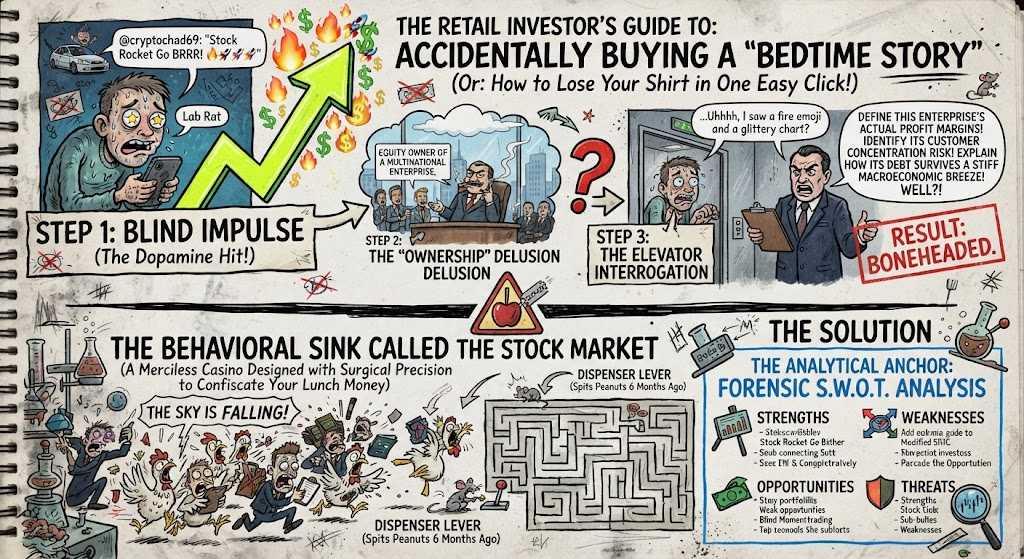
Look at yourself. It takes roughly three seconds to execute a stock trade on your greasy little smartphone. You stumble across a stock tip from a guy named @cryptochad69—a distinguished financial gentleman who vapes blue-raspberry exhaust fumes out of a modified Honda Civic. You see a neon-green line hockey-sticking straight into the stratosphere, spot an unbroken daisy chain of fire emojis, and feel that sweet, primal dopamine hit sledgehammer your skull.
Click.
Just like that, you are an equity owner of a multinational enterprise.
Or at least, that is what you are dreaming. If someone trapped you in an elevator and forced you to define that enterprise’s actual profit margins, identify its customer concentration risk, or explain how its debt survives a stiff macroeconomic breeze, what would you say? You can’t, because you didn’t buy a business. You bought a bedtime story wrapped in a glittery chart.
Falling for every shiny chart is boneheaded—it’s like accepting that candy apple from that vindictive coworker only to realize, three bites in, that there is a rusty razor blade wedged inside the caramel.
Welcome to the behavioral sink called the stonk market. It is a merciless casino designed with surgical precision to confiscate money from impatient simpletons and hand it to people who actually know how to read. If your investment research begins with momentum tickers and ends with blindly chanting “diamond hands!” into an echo chamber, you aren’t investing. You are just a rat in a maze slapping a dispenser lever because it spat out a peanut six months ago.
When things go wrong, you sprint around screaming that “the sky is falling!” like a flock of hysterical Chicken Littles. To keep from navigating your portfolio like tiptoeing through a minefield and inevitably watching your capital end up like a one-legged man in an ass-kicking contest, you require a real analytical anchor.
That weapon is a forensic SWOT Analysis (Strengths, Weaknesses, Opportunities, Threats).
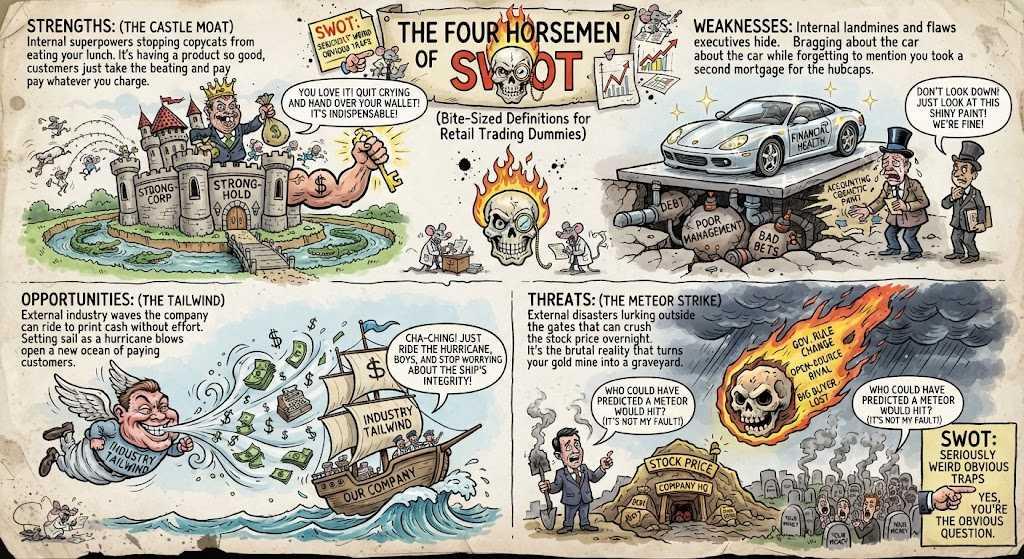
Part I: The Four Horsemen of SWOT (Bite-Sized Definitions)
Before we start gutting corporate balance sheets, let’s establish our taxonomy with definitions simple enough for an eighth-grade detention hall:
Strengths (The Castle Moat):
Definition: Internal superpowers a business owns that stop greedy copycat competitors from eating its lunch. It is having a product so indispensable that customers simply take the beating and pay whatever you charge.
Weaknesses (The Rotten Foundation):
Definition: Internal financial landmines and operational flaws that executives desperately hide under thick layers of accounting cosmetic paint. It is bragging about a fancy sports car while forgetting to mention you took out a second mortgage to pay for the hubcaps.
Opportunities (The Tailwind):
Definition: External industry waves the company can ride to print mountains of cash without setting fire to its own margins. It is setting sail just as a hurricane blows open an entirely new ocean of paying customers.
Threats (The Meteor Strike):
Definition: External disasters lurking outside the gates that can crush a company's stock price overnight. It is the brutal reality that a change in government rules, a new open-source software, or losing your only big buyer can turn your gold mine into a graveyard.
Part II: The Autopsy of a Company
1. Strengths: Confirming the Durable Moat
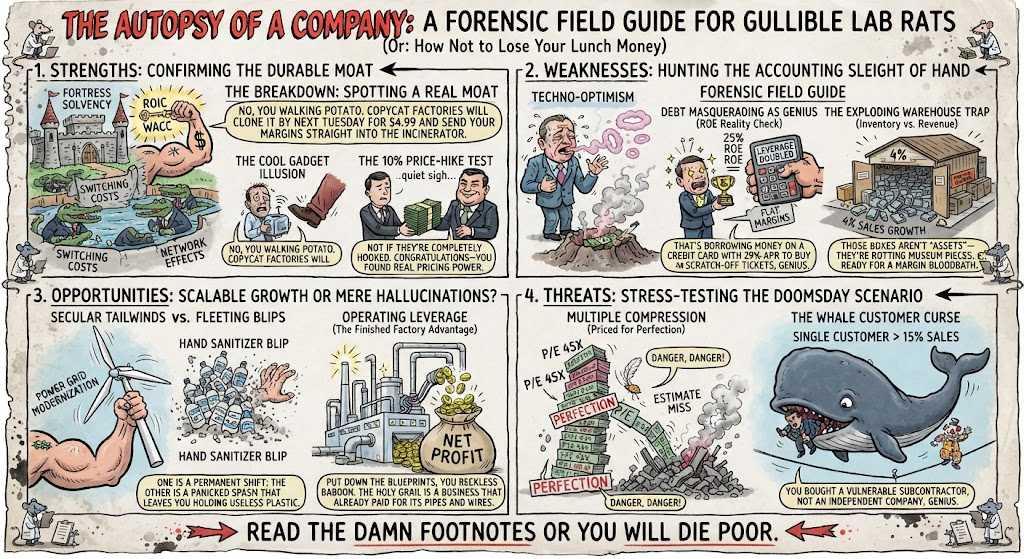
Saying a company has strength because "they make a cool gadget" is clown-shoe logic. A neat product without structural defenses gets copied by cut-rate rivals by next Thursday, sending profit margins down the incinerator chute. You need proof that the company earns returns on invested capital higher than its cost of capital (ROIC > WACC).
The 10% Price-Hike Test: If the company hikes prices by 10%, do customers pay up with quiet sighs, or do they immediately sprint across the street to buy generic knockoffs? Real pricing power shows up as rock-solid gross margins sustained across half a decade.
The Moat Engine: Identify why buyers stay trapped. Is it exorbitant switching costs (untangling enterprise software so miserable that companies will pay millions just to avoid changing it)? Or a genuine network effect (where scale breeds utility)?
The Balance Sheet Bunker: Seek genuine fortress characteristics: low debt-to-equity ratios and an interest coverage ratio (operating profit divided by interest costs) comfortably above 5x. That way, management doesn't need to dilute your shares during credit freezes.
The Breakdown: Spotting a Real Moat (Without Wearing Clown Shoes)
The Cool Gadget Illusion (ROIC>WACC):
Painfully Obvious Question: “Hey, they invented a toaster that connects to Wi-Fi! That's an economic moat, right?”
Literal Retort: “No, you walking potato. Copycat factories will clone it by next Tuesday for $4.99 and send your margins straight into the incinerator.”
The Rule: A shiny product is not a defense; sustained Return on Invested Capital well above the Weighted Average Cost of Capital is the only empirical proof that copycats haven't breached the walls.
The 10% Price-Hike Litmus Test:
Painfully Obvious Question: “If they raise prices, won’t customers just stop buying?”
Literal Retort: “Not if they’re completely hooked or cornered. If you hike prices by 10% and buyers merely sigh and hand over their wallets without fleeing across the street, congratulations—you found real pricing power.”
The Moat Engine (Trapped Customers & Sticky Architecture):
Painfully Obvious Question: “Why don’t companies just cancel their bloated enterprise software subscription?”
Literal Retort: “Because untangling twenty years of messy spaghetti databases would cost twenty million dollars and three CTOs their sanity. That agony is what keeps the cash register chiming.”
The Balance Sheet Bunker (Fortress Solvency):
Painfully Obvious Question: “Why care about debt if the hype is booming?”
Literal Retort: “Because when the credit cycle freezes over, interest costs don't accept rocket emojis as payment. An Interest Coverage Ratio safely north of 5 and low debt-to-equity means management doesn't have to dilute your stock down to pennies just to keep the lights on.”
2. Weaknesses: Hunting the Accounting Sleight of Hand
Management’s entire job during earnings calls is to blast techno-optimism and blow theatrical smoke across balance-sheet craters. Your job is to channel your inner forensic predator and identify the rot.
Debt Masquerading as Genius: Break down Return on Equity (ROE). If ROE jumped to 25%, but profit margins were totally flat while leverage doubled, that isn't operational brilliance. That’s management buying lottery tickets on credit.
The Exploding Warehouse Trap: Contrast revenue growth with inventory growth. If inventory grows at 18% while actual sales crawl at 4%, products are simply rotting on warehouse shelves. Expect massive markdowns, panicky firesales, and slaughtered margins very soon.
The Debt Maturity Guillotine: Peek at the footnotes in the 10-K filing to inspect when their debt comes due. If a mountain of corporate IOUs issued at near-zero rates must be rolled over at painful current interest rates, the interest payments will chew straight through earnings per share.
Forensic Field Guide: Spotting the Sleight of Hand Before You Lose Your Shirt
Theatrical Smoke vs. Forensic Truth:
Painfully Obvious Question: “The CEO said in the earnings call that their vision is an AI-powered synergy paradigm! Doesn't that mean we're going to the moon?”
Aggressively Literal Retort: “No, you gullible lab rat. His entire job description is blowing pink theatrical smoke rings over the crater where the cash flow used to be. Put down the vape and read the numbers.”
Debt Masquerading as Genius (The DuPont Reality Check):
Painfully Obvious Question: “Look, Return on Equity (ROE) jumped all the way to 25%! Aren’t these executives financial wizards?”
Aggressively Literal Retort: “Their profit margins were totally flat and their leverage doubled, genius. That isn't operational brilliance—that's borrowing money on a credit card with 29% APR to buy scratch-off tickets and bragging that your net worth spiked for ten minutes.”
The Exploding Warehouse Trap (Inventory vs. Revenue):
Painfully Obvious Question: “Inventory is up 18%! Does that mean business is booming and they're stockpiling for massive demand?”
Aggressively Literal Retort: “Sales only grew 4%, you sentient doorstop. Those boxes aren't 'strategic assets'—they're rotting museum pieces taking up expensive floor space. Get ready for desperate 80%-off clearance stickers and a bloodbath on gross margins.”
The Debt Maturity Guillotine (Refinancing Cliffs):
Painfully Obvious Question: “They owe billions, but they’ve paid their bills so far. Why should I bother reading the tiny footnotes in the 10-K?”
Aggressively Literal Retort: “Because those ultra-cheap 1% loans they took out five years ago are about to smash face-first into high interest rates. When that debt gets rolled over, the interest payments will slice straight through Earnings Per Share like a guillotine through hot butter.”
3. Opportunities: Scalable Growth or Mere Hallucinations?
Opportunities are macro tailwinds management can ride. But do not fall for the delusion of giant addressable markets if the underlying economics stink.
Secular Tailwinds vs. Fleeting Blips: Determine whether market growth is structural and permanent (such as modernizing the nation's electric power grid) or merely a temporary post-crisis restock bounce.
Operating Leverage: Prioritize businesses that built their infrastructure already. When extra revenue drops into an established system without needing new factories, every fresh dollar flows straight down into bottom-line profits.
Bottom-Feeding on Competitors: Can this company use its fortress balance sheet during recessions to swallow distressed rivals for pennies on the dollar, effectively hoovering up market share while competitors drown?
Cognitive Retention Guide: Auditing Opportunities (Before You Hallucinate Your Way to Zero)
Secular Tailwinds vs. Fleeting Blips:
Painfully Obvious Question: “Look, sales spiked 400% during the panic! Doesn’t that mean every human on Earth will buy three of these every year forever?”
Aggressively Literal Retort: “No, you walking sack of bad assumptions. That wasn't a permanent shift in human civilization—it was a frantic restock blip. Modernizing a power grid is a structural secular tailwind; hoarding hand sanitizer is just a panicked spasm that leaves you holding useless plastic.”
Operating Leverage (The Finished Factory Advantage):
Painfully Obvious Question: “If revenue is expanding, shouldn’t we borrow another $500 million to build ten more gigantic warehouses right now?”
Aggressively Literal Retort: “Put down the blueprints, you reckless baboon. The holy grail is a business that already paid for its pipes and wires. When incremental sales hit an existing machine, variable costs stay flat, and every fresh dollar flows straight down into net profit without setting your cash on fire.”
Bottom-Feeding on Competitors (Recession Cannibalism):
Painfully Obvious Question: “The economy is slowing down and interest rates are high! Isn’t this a tragedy for every single company in the market?”
Aggressively Literal Retort: “Only for the debt-choked clowns who forgot how to budget. For a fortress balance sheet, a brutal downturn is just happy hour at an all-you-can-eat buffet where you scoop up starving rivals for pennies on the dollar and conquer their market share.”
The Big TAM Delusion (Total Addressable Madness):
Painfully Obvious Question: “Their pitch deck says the Total Addressable Market is $10 Trillion! How could they possibly fail to make money?”
Aggressively Literal Retort: “Because they lose $4 on every $10 widget they ship, genius. Having an infinite ocean of prospective customers means absolutely nothing if your boat is built out of porous cardboard and incinerated capital.”
4. Threats: Stress-Testing the Doomsday Scenario
Threats are external wrecking balls that can permanently crush a company's multiple.
Multiple Compression (Priced for Perfection): When a stock trades at a sky-high forward Price-to-Earnings (P/E) ratio above 45x, the market assumes five consecutive years of flawless execution. The moment they miss a single quarterly estimate by half a penny, the valuation multiple contracts violently by 40%. Danger, Danger!
The Middleman Eviction: If new open-source code or automation can bypass this company’s tollbooth entirely, their revenue stream will vanish like a vapor trail.
The Whale Customer Curse: Review Item 1 of the annual 10-K. If a single customer makes up more than 10% to 15% of total sales, you haven't bought an independent company. You bought a vulnerable subcontractor wearing a clown suit, teetering on a high wire without a net.
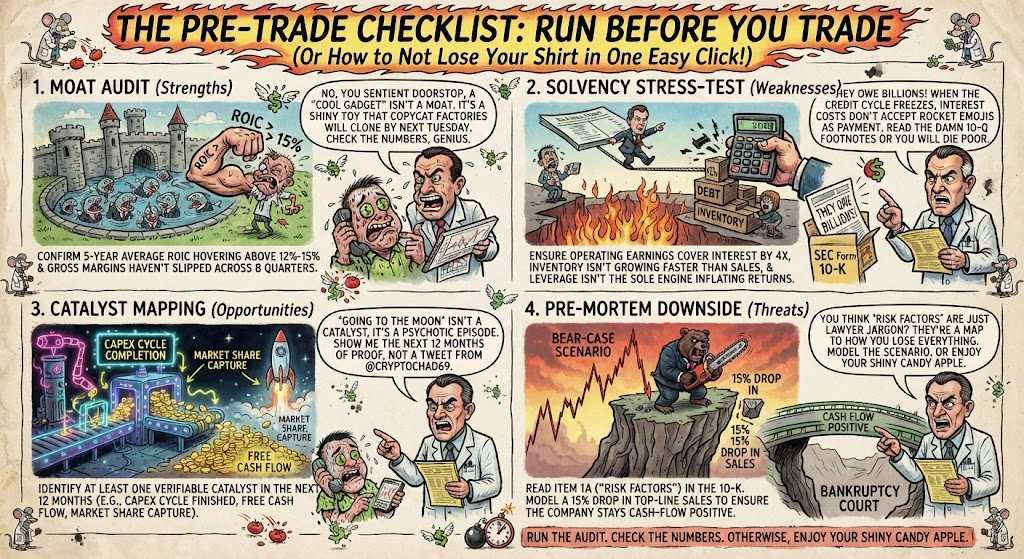
The Pre-Trade Checklist: Run Before You Trade
Before you hand over your hard-earned cash in this manic cross-play between Wall Street hype and retail gullibility, run this forensic routine using primary SEC reports (Form 10-K and 10-Q):
Moat Audit (Strengths): Confirm 5-year average Return on Invested Capital consistently hovers above 12% to 15%, and verify gross margins haven't slipped across the past 8 quarters.
Solvency Stress-Test (Weaknesses): Ensure operating earnings cover interest payments by at least 4x, verify inventory isn't expanding faster than sales, and check that leverage isn't the sole engine inflating returns.
Catalyst Mapping (Opportunities): Identify at least one verifiable catalyst in the next 12 months—like completed capital expenditure cycles turning into free cash flow, or clear market share capture.
Pre-Mortem Downside (Threats): Read Item 1A ("Risk Factors") in the latest 10-K. Model a bear-case scenario featuring a 15% drop in top-line sales to make sure the company stays cash-flow positive instead of cratering into bankruptcy court.
Run the audit. Check the numbers. Otherwise, enjoy your shiny candy apple.