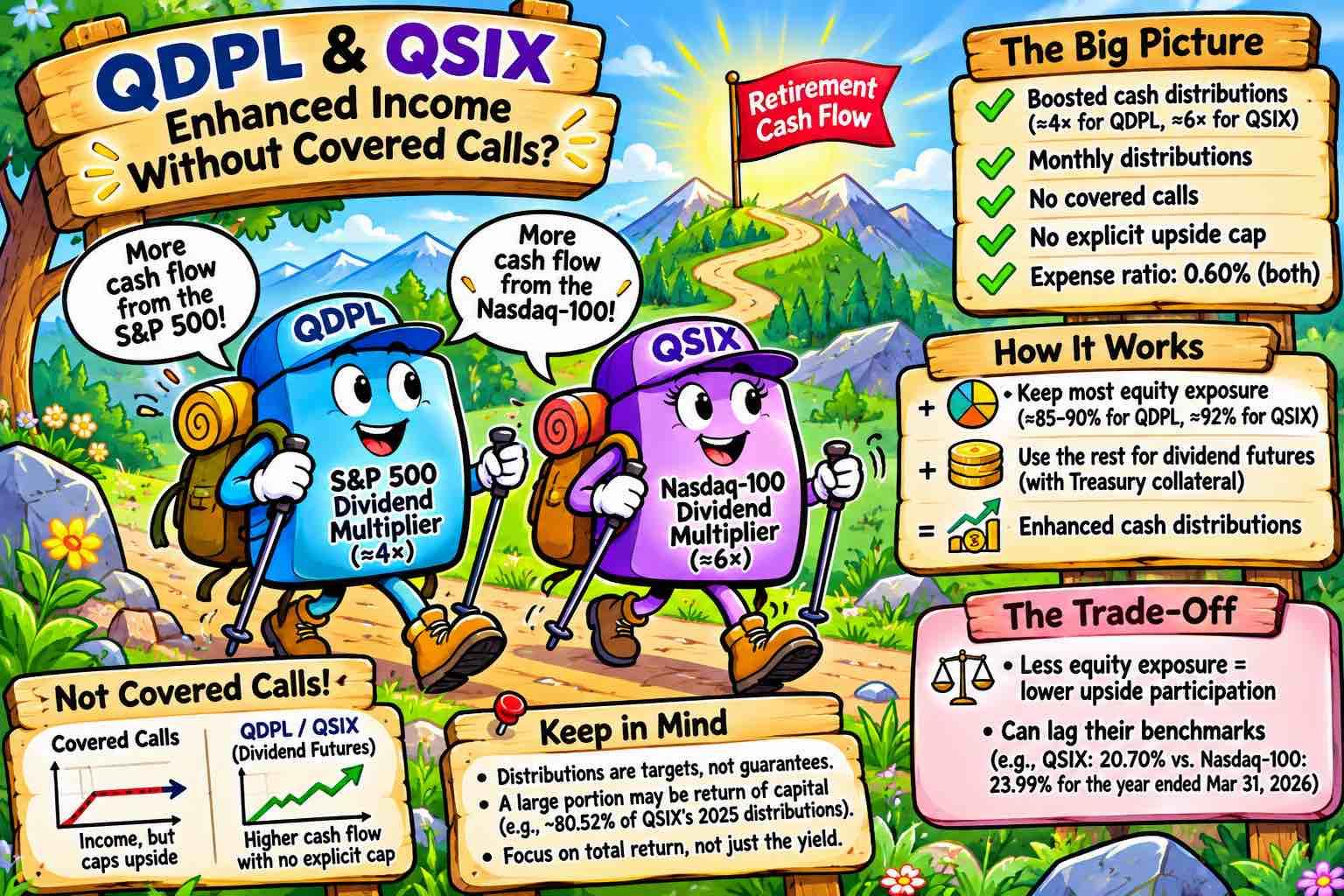
QDPL & QSIX: Enhanced Income Without Covered Calls? Most income investors are familiar with covered-call ETFs. But what if you could generate additional monthly cash flow without explicitly capping your upside? Pacer offers an interesting alternative: dividend futures. $QDPL – S&P 500 Dividend Multiplier Launched July 12, 2021. • Targets cash distributions approximately 4x the S&P 500’s ordinary dividend yield. • Roughly 85–90% S&P 500 price exposure. • Monthly distributions. • No covered calls. • No explicit upside cap. • Expense ratio: 0.60%. $QSIX – Nasdaq-100 Dividend Multiplier Launched September 23, 2024. • Targets cash distributions approximately 6x the Nasdaq-100’s ordinary dividend yield. • Approximately 92% equity exposure as of October 2025. • Monthly distributions. • No covered calls. • No explicit upside cap. • Expense ratio: 0.60%. How does this strategy work? Pacer effectively separates equity returns into two components: capital appreciation and dividends. Both funds reduce their direct equity exposure and allocate the remaining capital to dividend futures strategies supported by Treasury securities and cash equivalents. The underlying companies aren’t suddenly paying larger dividends. Instead, these ETFs obtain additional financial exposure to those dividends. How is this different from covered calls? Traditional covered-call ETFs generate additional income by selling options, potentially sacrificing capital appreciation above certain price levels. QDPL and QSIX take a different approach. They sacrifice a portion of their equity exposure to enhance cash distributions without imposing an explicit ceiling on capital appreciation. However, uncapped upside does not mean full upside participation. What’s the catch? Higher distributions do not necessarily translate into higher total returns. For the year ending March 31, 2026: • QSIX total return: +20.70% • Nasdaq-100 total return: +23.99% That’s underperformance of 3.29 percentage points, even with distributions reinvested. QDPL has also experienced periods of meaningful underperformance against the S&P 500. Investors should carefully consider whether the additional cash flow justifies the potential sacrifice in long-term capital appreciation. What about return of capital? Approximately 80.52% of QSIX’s 2025 distributions were classified as return of capital for U.S. tax purposes. Return of capital is not automatically destructive. It is a tax classification, but investors should monitor NAV performance, inflation-adjusted purchasing power and total returns. A large distribution is not necessarily a large investment return. Where could these ETFs fit into a portfolio? • $VOO – Broad-market capital accumulation. • $QQQM$QQQ$IQQ– Nasdaq-100 growth. • $SCHD – Dividend growth and quality. • $QDPL – Enhanced broad-market income. • $QSIX – Enhanced Nasdaq-100 income. For Canadian investors, directly holding U.S.-listed ETFs inside an RRSP generally provides favourable U.S. withholding-tax treatment on qualifying dividends, subject to distribution classifications and account structure. My thoughts I find both ETFs particularly interesting for investors approaching retirement who want enhanced monthly cash flow without the explicit upside limitations of traditional covered-call strategies. During the accumulation phase, however, simply owning the underlying index and reinvesting dividends may produce superior long-term results. Neither ETF eliminates market risk, and their targeted distributions are not guaranteed. These funds aren’t necessarily better than covered-call ETFs. They simply use a different financial mechanism to convert market exposure into cash flow. Income is a component of total return, not a substitute for it. Sources: Pacer ETFs fund fact sheets, Dividend Multiplier Strategy materials and 2025 distribution tax disclosures.
108 views
0 Comments
No comments available.
Join the conversation with 500,000+ other investors 💸
Create an account to get access to everything Blossom has to offer!
📊 Personalized algorithm based on your investing style, experience level and interests
📈 Powerful portfolio and dividend tracking tools
👀 See what top creators and others in the community are investing in