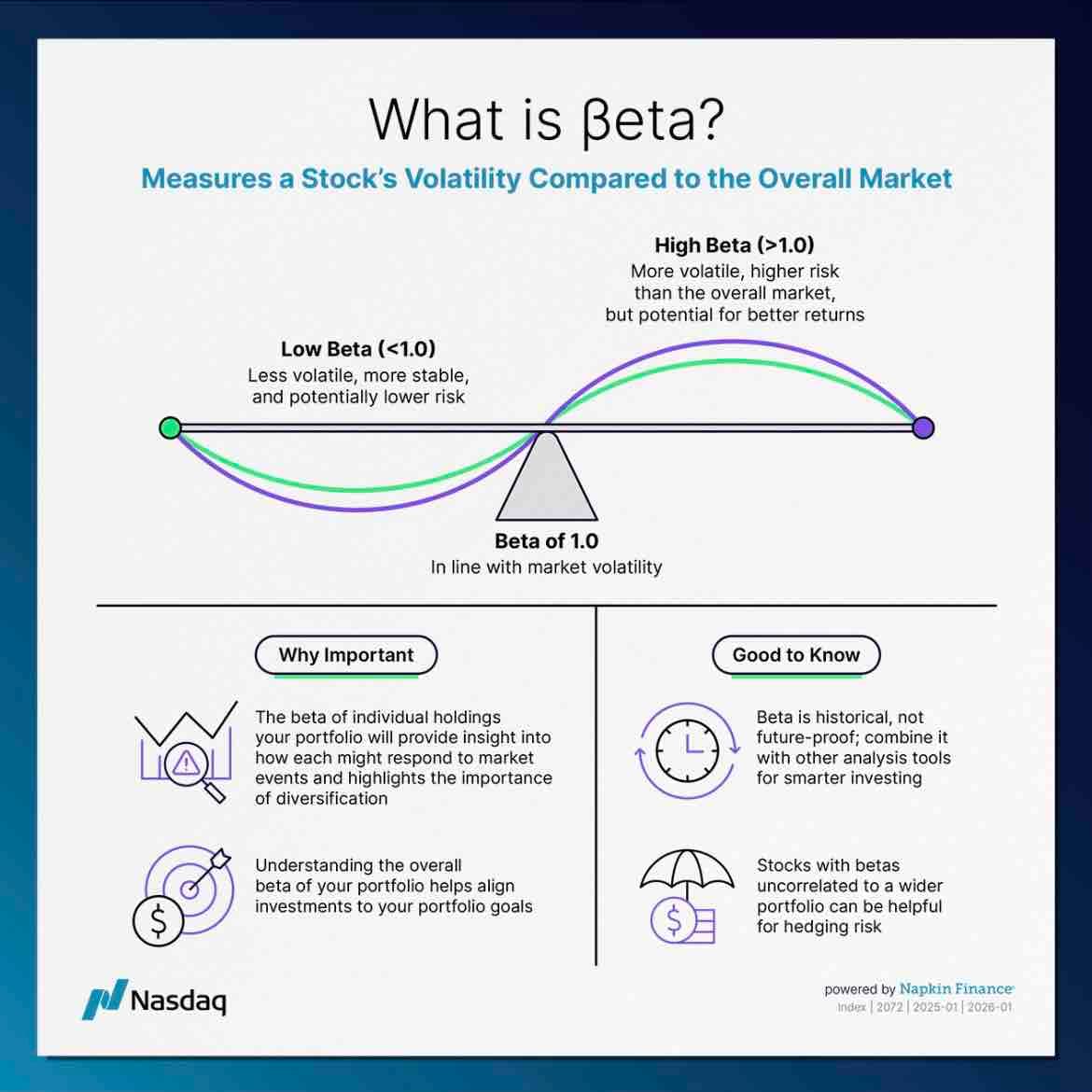
Ever wonder why tech stocks swing wildly on market news while utility stocks barely move? It all comes down to Beta, the metric that measures how sensitive a stock is relative to the overall market. Understanding Beta is essential for balancing your portfolio strategy: * High Beta (> 1.0): Bigger swings than the market. During bull runs, these lead the rally, but they drop harder in corrections. Examples include high-growth tech like Nvidia ($NVDA, Beta ~2.0) or Tesla ($TSLA, Beta ~1.8). * Beta of 1.0: Moves right in line with the broad market. Funds like $VOO (S&P 500) or $VFV / $XEQT anchor your portfolio right at 1.0. * Low Beta (< 1.0): Smoother, less volatile performance. Defensive staples like Johnson & Johnson ($JNJ), Procter & Gamble ($PG), or utility funds like $UTES help cushion your portfolio during downturns. Market Outlook & Strategy With interest rates adjusting and tech valuations stretched, market volatility isn't going away. If you expect a choppy market ahead, balancing high-beta growth holdings with defensive low-beta assets keeps your portfolio growing without subjecting you to unbearable pullbacks. Did You Know? 🧐 A stock can actually have a negative Beta! Assets with negative beta, like certain gold equities ($ABX) or inverse ETFs, often move in the opposite direction of the stock market, making them popular hedges during severe market panics. — This is for educational and informational purposes only and does not constitute financial or investment advice.
1,274 views
0 Comments
Join the conversation with 500,000+ other investors 💸
Create an account to get access to everything Blossom has to offer!
📊 Personalized algorithm based on your investing style, experience level and interests
📈 Powerful portfolio and dividend tracking tools
👀 See what top creators and others in the community are investing in