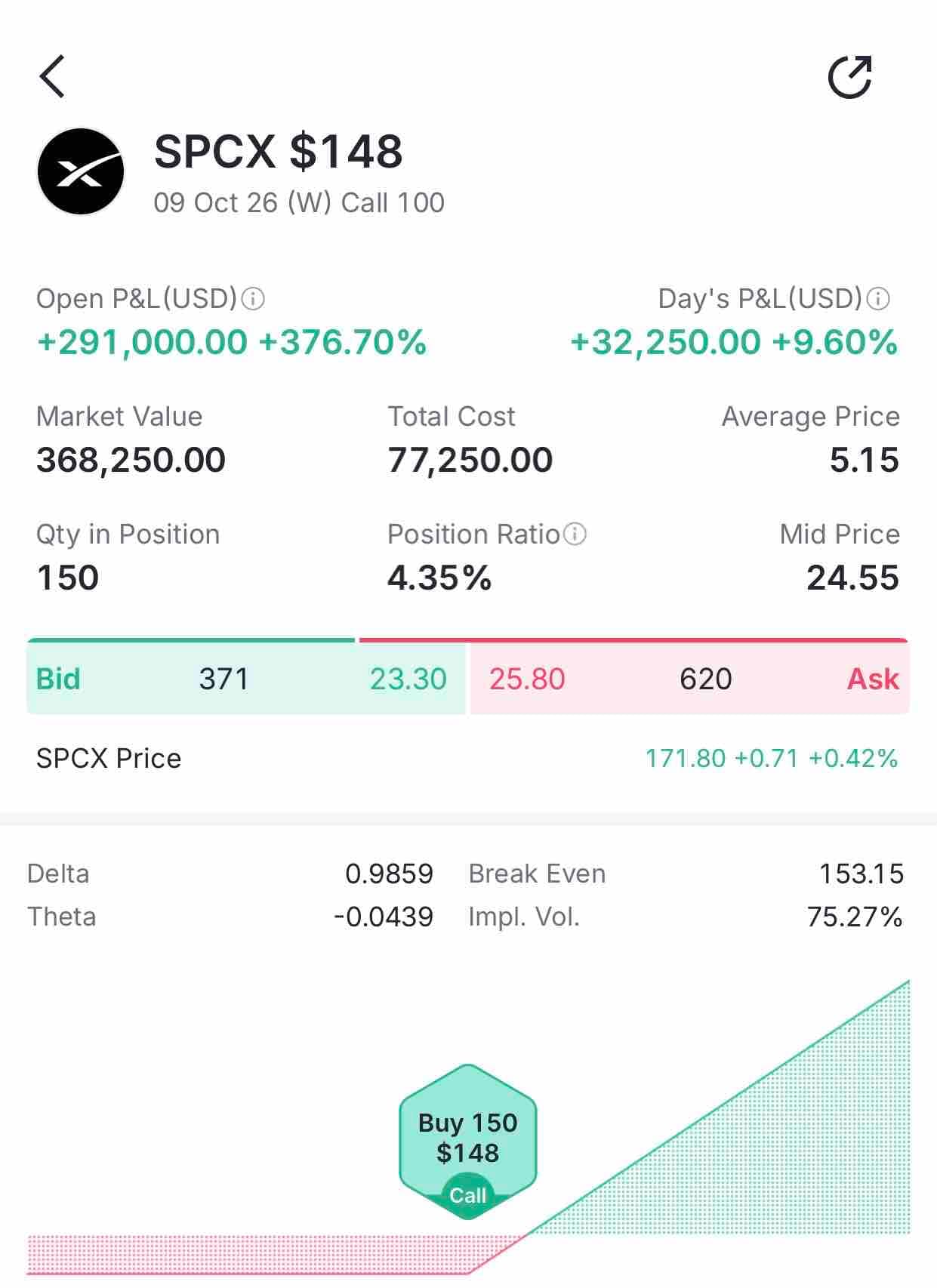
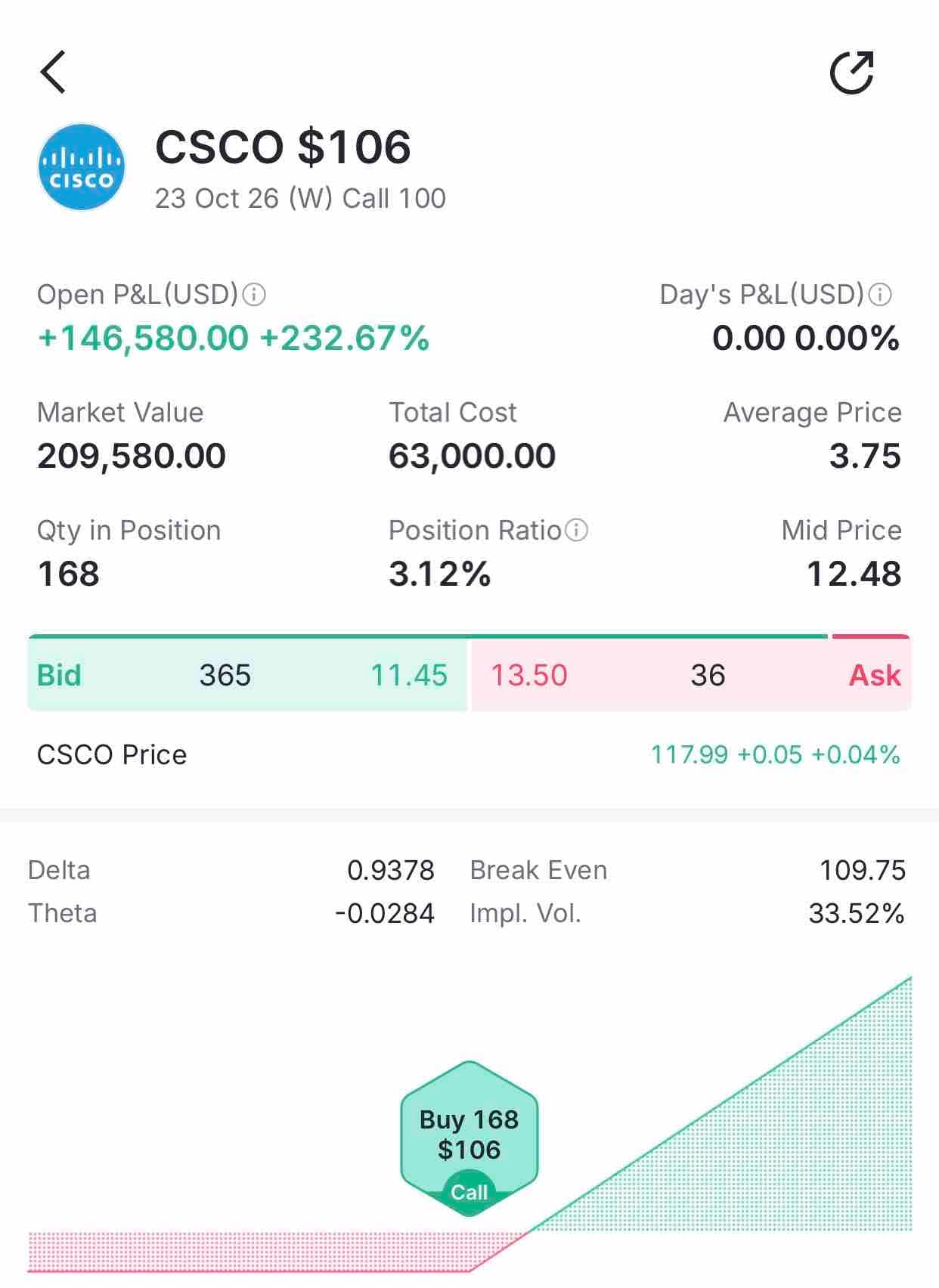
Yesterday was another good day with the trading community, and I wanted to share a little more than just the numbers. I think showing a position that’s up is one thing, but understanding why the option moved and what can happen to it when the stock moves, time passes, or volatility changes is much more important. With options, being right about the stock direction is only part of the trade. The strike, expiration, premium, volatility, liquidity, and position size all matter. So let me use two positions I had yesterday to break down a few things I think every options beginner should understand. $SPCX$148 CALL I had 150 contracts of the $SPCX$148 Call with an average entry of $5.15. Before I closed the position, it was showing a mid price of $24.55 while SPCX was around $171.80. Total cost: $77,250 Secured profit: +$291,000 🚀🚀🚀 The position showed a 0.9859 delta. A lot of beginners see a 0.98 delta and immediately think that means a 98% chance of making money. It doesn’t. Delta is mainly showing you how sensitive the option is to a $1 move in the underlying, all else being equal. So with a 0.9859 delta, a $1 move higher in SPCX would theoretically move the option by about $0.99. But delta doesn’t stay the same. That’s where gamma comes in. Gamma tells you how quickly delta can change as the stock moves. So the option can behave differently later than it did when you first bought it. If the stock keeps moving in your direction, delta can increase. If the stock reverses, delta can decrease. That’s why I don’t just look at delta and stop there. I want to understand how that option could behave if the stock keeps moving. The position also had a theta of -0.0439. Theta is basically the effect of time passing on the option’s value. All else being equal, time works against the option buyer. But theta isn’t a fixed amount that simply gets taken from your account every day. The stock price, IV, delta and other factors are constantly changing, so the actual P&L can be very different. The main thing to understand is that when you buy an option, time is part of your risk. A stock can sit sideways for several days, and your option can still lose value even though the stock hasn’t necessarily proven your original idea wrong. That’s one reason expiration matters so much. You want to give the trade enough time to work instead of choosing an expiration just because the premium looks cheaper. SPCX also had an IV of 75.27%. IV doesn’t tell you whether the stock is going up or down. It tells you how much future volatility is being priced into the option. And this is something beginners often miss: You can be right about the stock direction and still have the option underperform because IV drops. That’s where vega comes in. Vega shows how sensitive the option is to changes in implied volatility. So when I’m holding an option, I’m not only watching the stock price. I’m watching how the stock, delta, theta, IV and the premium are all working together. $CSCO$106 CALL I also have 168 contracts of the CSCO $106 Call with an average entry of $3.75. CSCO was trading around $117.99 when I checked the position after hours. Total cost: $63,000 Market value: $209,580 Current open profit: +$146,580 This one is still open, so that profit has not been secured yet. The position showed a 0.9378 delta and a theta of -0.0284. That means the call was theoretically responding to roughly $0.94 of option movement for every $1 move in CSCO, all else being equal. The -0.0284 theta means the option had a theoretical time-decay sensitivity of about $0.0284 per share per day, all else being equal. Again, that doesn’t mean the option is guaranteed to lose that exact amount every day. The Greeks change as the stock, IV, time and other factors change. Now look at the strike. $CSCO was around $117.99 and the strike was $106, so the call was already significantly in-the-money. At around $117.99, the call had roughly $11.99 of intrinsic value per share. The mid price was $12.48, which means roughly $0.49 of the premium was extrinsic value at that moment. That’s an important difference to understand. An option premium is made up of intrinsic value and extrinsic value. As an option moves further in-the-money, more of its value can come from intrinsic value instead of time value. The expiration breakeven on this call is $109.75 because the $106 strike plus the $3.75 premium paid equals $109.75. But that $109.75 is the breakeven at expiration. You don’t have to wait until expiration for an option to become profitable. Before expiration, the option can still have extrinsic value, and its premium can move based on the stock price, IV, time and other factors. This is why the strike you choose can change the whole trade. Two traders can be bullish on the exact same stock but choose different strikes and expirations, and their results can end up being completely different. The contract you choose is part of the trade. It’s not something to figure out after you’ve already decided you’re bullish. Now look at the IV difference. $CSCO had 33.52% IV compared with $SPCX at 75.27%. That’s a big difference. It means the market was pricing very different levels of future volatility in these two names. Higher IV doesn’t mean bullish. Lower IV doesn’t mean bearish. It simply means a different amount of future movement is being priced into the option. One thing I want beginners to start thinking about is: “How much movement am I already paying for?” If IV is very high, the premium can already reflect a lot of expected movement. That’s why you can sometimes get the direction right and still be disappointed with the option. The stock moved, but IV came down and took some of that premium with it. This is also why I pay attention to historical volatility versus implied volatility. Historical volatility tells you what the stock has actually been doing, while implied volatility tells you what level of future volatility is being priced into the options. 📊 LET’S USE A $1,000 ACCOUNT AS AN EXAMPLE I’m not saying someone with a $1,000 account should copy these trades. This is just to show how one options contract can affect a small account. A standard equity option contract represents 100 shares. EXAMPLE 1 $SPCX – ONE CONTRACT My average entry was $5.15. $5.15 × 100 = $515 So one contract would use 51.5% of a $1,000 account. At the $24.55 mid price shown in the position: $24.55 × 100 = $2,455 That would be a $1,940 gain compared with the $515 premium paid, or about 376.7% on the premium. But if the call expired worthless, the maximum loss would be the $515 premium, ignoring fees. That’s 51.5% of a $1,000 account. That’s the part I want beginners to understand. A trade can produce a huge percentage return, but what matters just as much is how much of your account you had to risk to make it. EXAMPLE 2 $CSCO – ONE CONTRACT My average entry is $3.75. $3.75 × 100 = $375 That’s 37.5% of a $1,000 account. At the $12.48 mid price shown on the position: $12.48 × 100 = $1,248 That would be an $873 gain compared with the $375 premium paid, or about 232.8% on the premium. But if the call expired worthless, the maximum loss would be the $375 premium, ignoring fees. That’s 37.5% of a $1,000 account. Now look at what happens if someone bought one contract of each: $SPCX: $515 $CSCO: $375 Total: $890 That would put 89% of a $1,000 account into two option premiums. So the lesson isn’t just how much an option can make. It’s also understanding how much of your account you’re putting at risk. Just because you have enough money to buy a contract doesn’t mean the position size makes sense for your account. Before thinking about the upside, know how much of your account you’re willing to risk. That’s where position sizing and risk management come in. ‼️ And this is exactly why every Wednesday and Friday, I go live with the beginners inside my trading community. I get on the whiteboard and break everything down step by step. After the lesson, we don’t just stop there. I have everyone open their paper trading account and take a few trades based on what we just learned. Then we watch those positions together as they develop. Because explaining something is one thing, but watching it happen live is completely different. You get to see how the option reacts when the stock moves, what happens when time passes, how the Greeks change, and how you actually manage the position. That’s how I want people to learn, not by trying to memorize everything in one day, but by learning the concepts and then seeing them play out in real time. And honestly, that’s one of the biggest reasons I believe many of the members in my community have been able to improve their trading. It’s not because they mastered options overnight. It’s because they started understanding what they were actually doing. They learned that not every setup fits every account, and just because I’m taking a certain position size doesn’t mean they should take the same size. That’s exactly why I used the $1,000 account example above. Today is Wednesday, so I’ll be live again teaching and working through everything with the community.
3,748 views
1 Comments
John HODLing
@hodltillidrop · 15d
Thanks for explaining 🚀
See the full comment section 👀Sign up for the full Blossom experience!