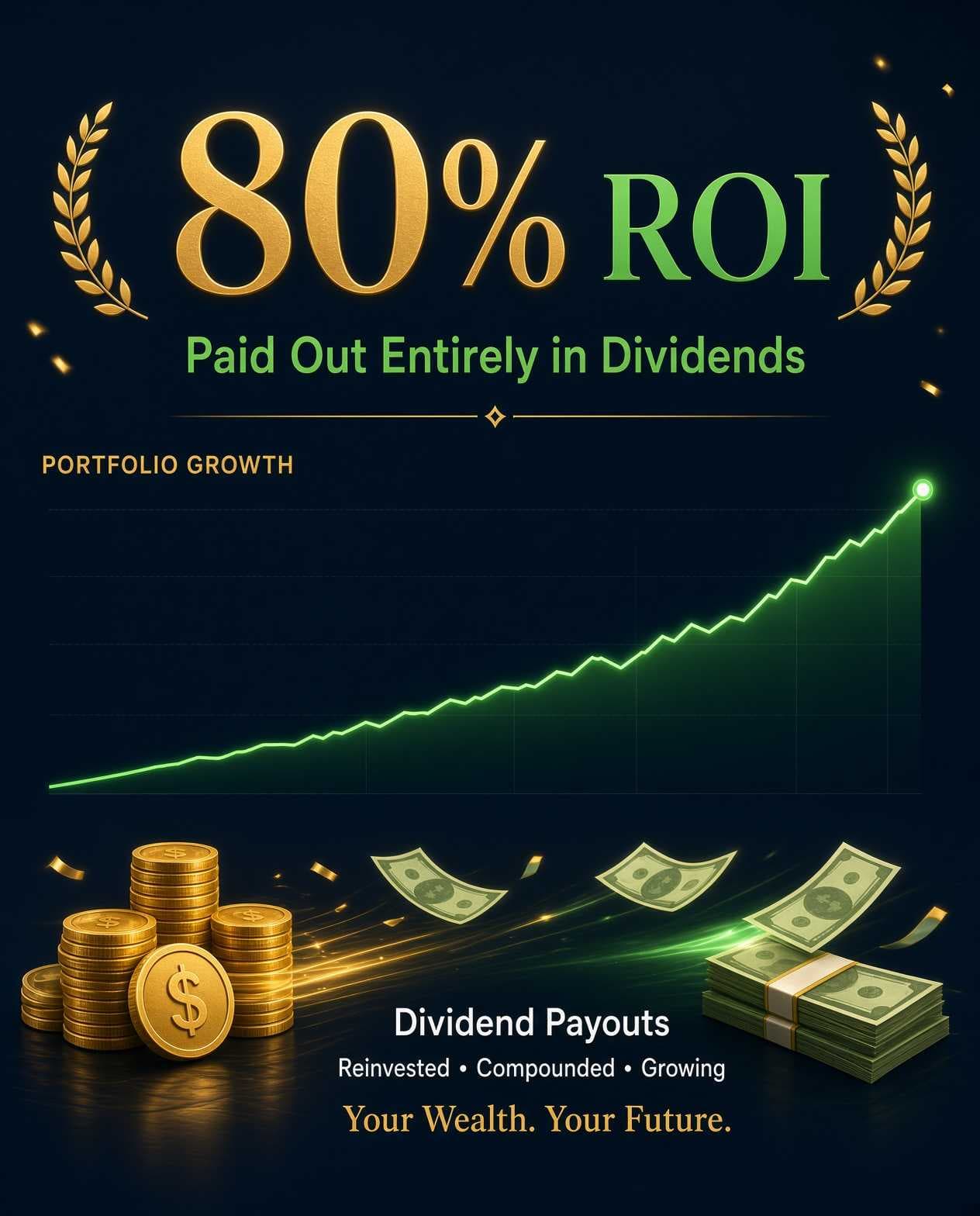
Ultra high yield investing isn't only a different investing strategy than dividend growth or growth investing. Rather it requires a different sort of investing philosophy than the typical investor has. It requires a different way of thinking about what a "return" is and when you get to count it. The core of the strategy is the ability to receive realized return through dividends due to great performance, because great performance makes dividends more sustainable, and that allows the "payoff" to happen more quickly. When the underlying holdings are performing well, the distributions flowing into your account aren't a depletion of the portfolio. They're a reflection of it. Performance funds the payout, and the payout is where your ROI becomes real. With a growth portfolio, you can get ROI too, but if you don't sell, it is unrealized. It exists on a screen. It's an effect you can look at but can't touch unless you want to lose exposure to the asset. Occasionally, a vocal minority of growth investors like to tell me my strategy is inferior to theirs. A favorite line goes something like this: "You would have had more liquidity if you bought growth equivalents like $SOXX and $DRAM because those investments outperformed yours in total return." My answer is, "Oh really? If I haven't sold shares and the gain is unrealized, it is not liquidity. It's unrealized liquidity. Could I potentially liquidate SOXX and DRAM? Sure. But if I do, I am losing exposure and if I want more exposure, I will have to buy more shares later on. There are many people who are okay with that, but that isn't the game I am playing." (And, if you are curious of what I am invested in, it's $CHPY, $DRMY, $GPTY, and $YRAM) That's the trap growth investors don't always acknowledge. If they do outperform, the returns sit in the share price, and the only way to convert it into spendable cash is to give up the very thing generating it. Sell shares, lose exposure. Keep the shares, keep the appreciation, but keep it unrealized. The dollar figure that makes them feel liquid is downstream of the shares. The shares are the cause; the dollars are the effect. For point of clarification, when a dividend is paid out, the value of the investment is reduced by it. Your dividend is depleting cash. This is why you need the underlying to perform well or else your dividend stream will shrink over time if you don't reinvest enough of it to keep your capital stable. When the underlying doesn't do well, even 100% reinvestment may not be enough to keep your capital stable during the downturn. Dividends are also paid out on a per share basis. The more shares you have, the more dividends you will get. And, if your investment is increasing in value, staying flat, or only going down moderately, the effects of the dividends can be quite nice. Psychologically, liquidating through distributions is easier. I don't have to make a sell decision. I don't have to forfeit a single share. The portfolio pays me out of its own performance, and my exposure stays exactly where it was. If I hold on to the shares long enough and my investment performs well, I will reach a return on investment where my paid out dividends exceed my initial cost basis. This is not theoretical as it would be if a growth investor's investments reached a value 2x their cost basis. Rather, it is a realized return on investment because returns from dividends are realized the moment they are paid out. Studies have shown that the majority of retirees feel more comfortable with collecting income from dividends than they do selling shares. None of this is to say growth investing is bad. It's a great strategy, and I'd never tell someone their approach is wrong for their goals. And, dividend investing is not objectively superior to growth investing. This is because the fruit of any investing strategy should be weighed by the goals of the investor. But since a vocal minority of growth are often quick to criticize mine, well, I enjoy counter punching. As a philosopher named Gordon Haddon Clark once said, "I love a good brawl." The two main considerations in my strategy are total returns and liquidity. I target outperforming sectors, and sometimes individual companies, so my portfolio can potentially outperform the market and give me the option to extract more liquidity without selling shares. Liquidity on demand, on a per share basis where exposure never shrinks. Many people who invest or advise others on investing think about the accumulation phase of investing and not the distribution phase of investing. I tend to think more about the latter than the former. The reason why is because I am thinking about what I can do with my money and how I can do whatever I want with it. I don't want millions in unrealized gains that I'll never touch in my life time. I'm not trying to win a contest. I'm trying to benefit from my investments in the easiest way I can while still meeting my investment goals. If I do well, I can get a return on investment in less than five years with ultra high yield funds (20% plus yields). In this case, When I say ROI, I mean distributions received versus cost basis, not price appreciation. By that measure, I'm currently at about 80% ROI since August of 2024: roughly 80 cents of every dollar I put in has already come back to me as cash distributions, while my shares, my exposure, remain fully intact (and have appreciated overall). That is a realized return. No selling required. And, the investing is still paying me despite me having taken more than my cost basis. It is house money at this point. I plan on adding $15,000 in November or December, so that statistic will likely change. That's the nature of the approach: it stays in motion, and the outlook that makes it work is the one that measures progress by what has actually been paid out, not by what could be, if only I were willing to sell the shares that generate it.
1,142 views
15 Comments
MATTHEW @edplaya · 3h
Great post, good way to look at things.
Peaky PII @peakyblinders · 5h
Very good post.
Dave @dave1970 · 2h
Excellent post 💯
Twenty-five And Invested@25andinvested · 4h
Total return is king. Money utility has an optimal strategy and this post is a book....
See the full comment section 👀Sign up for the full Blossom experience!