What if AI becoming cheaper is actually one of the most bullish things that could happen to AI infrastructure? It sounds backwards. If AI models become more efficient and require less computing power, shouldn't that be bad for companies like $NVDA? Not necessarily. There's an interesting economic concept called Jevons Paradox. In the 1800s, steam engines became significantly more efficient, requiring less coal to operate. You'd think coal consumption would go down. Instead, cheaper steam power made it economically viable for more industries to use it, contributing to an INCREASE in overall coal consumption. Now think about AI. Today, businesses have to consider whether using AI for certain tasks is economically worth it. But what happens when the cost of running AI drops by 90%? Suddenly, applications that were previously too expensive become viable. AI agents can operate continuously. Businesses can automate more complex workflows. Developers can build entirely new products. Millions of people can use AI more frequently. Here's a simple example: Imagine AI becomes 10x more compute-efficient, but usage increases 100x because of it. Despite each individual task requiring less compute, total compute demand actually increases 10x. That's where things get interesting for companies like: - $NVDA and $AMD — AI chips - $MU and $AVGO — memory and connectivity - $NBIS and $CRWV — AI cloud infrastructure - $VRT and $ETN — data centre infrastructure Of course, cheaper AI doesn't guarantee higher compute demand or bigger profits. Usage needs to grow fast enough to offset those efficiency gains, and competition could put pressure on margins. But I think there's an important distinction investors sometimes miss: The cost of using a technology and the total demand for that technology are two completely different things. The internet became cheaper, and we used more of it. Computing became cheaper, and we found more things to compute. What if AI follows the same pattern? Maybe the biggest opportunity in AI isn't making it more powerful. It's making it cheap enough to use everywhere. read more
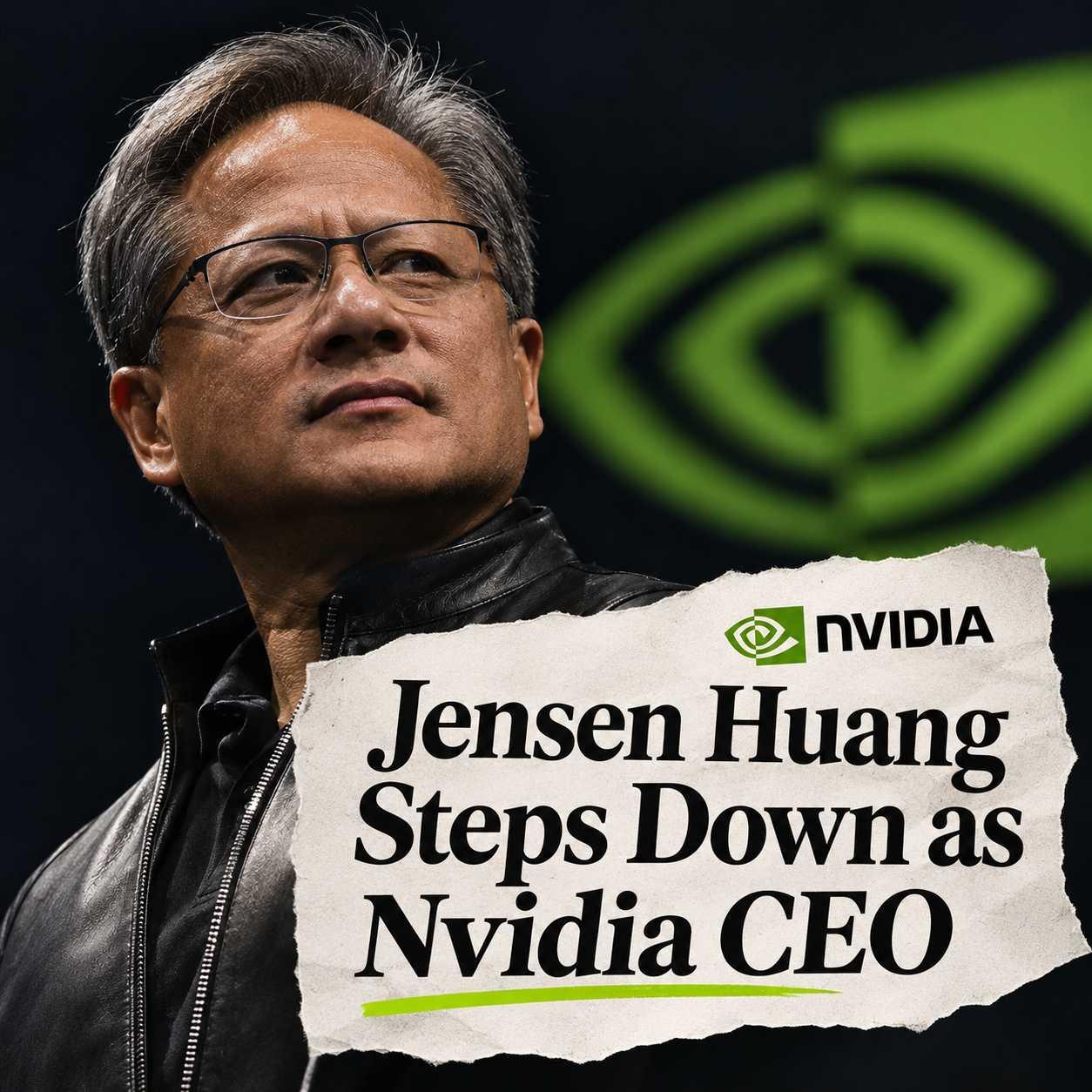
Imagine building a company for 33 years, turning it into one of the most valuable businesses in the world... Only to suddenly step down as CEO. That's exactly what just happened at $NVDA. Jensen Huang has officially resigned following reports of three extramarital affairs, including one involving a woman suspected by US intelligence of having ties to Chinese espionage. Those intelligence allegations remain unproven publicly, but the controversy has raised serious questions about corporate governance and national security. And just like that, one of the most influential figures in the AI boom is out. Nvidia's longtime CFO, Colette Kress, has taken over as interim CEO. But here's what I find most interesting: How much of Nvidia's success was actually Jensen Huang? Think about it. Nvidia still has its GPUs, CUDA ecosystem, engineers, and relationships with the biggest technology companies in the world. None of that disappeared overnight. But Jensen wasn't just another CEO. He spent three decades making bets that helped turn Nvidia from a graphics chip company into the backbone of the AI revolution. And now investors face something called key-person risk. When a company's vision, strategy, and investor confidence are so closely tied to one person, losing them can create enormous uncertainty. Especially when that person helped build the company from day one. With Nvidia reporting earnings tomorrow, investors will be watching more than just revenue and profits. They'll be watching whether Nvidia can maintain its momentum without the person who built it. And that's what makes this situation so fascinating. A great company can survive losing its CEO. But what happens when that CEO is the reason it became great?read more
1,608 views
See all of @timemino posts! 👀Sign up for the full Blossom experience!