How auto-callable ETFs actually work (ZACU)
BMO launched ZACU in late September, the BMO Strategic Autocallable Income US Large Cap ETF. I kept seeing "autocallable" and realized I couldn't explain it properly. So here's my attempt.
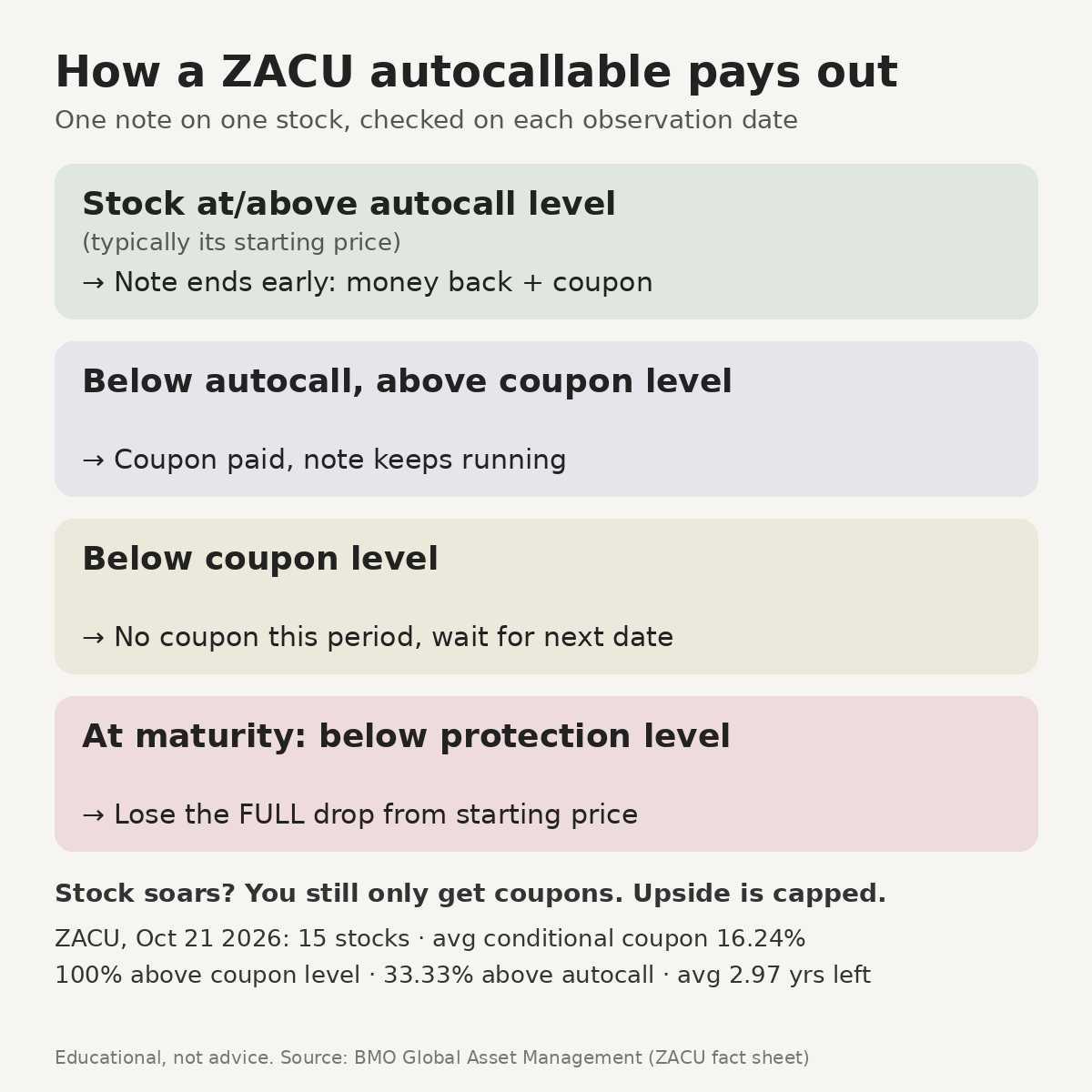
Start with one note. It's tied to a single stock, say Apple. On day one the stock's price is recorded. Then there are scheduled check-in dates, called observation dates, and three lines that matter: an autocall line, a coupon line, and a protection line.
On a check-in date, if the stock is at or above the autocall line, which BMO says is typically the starting price, the note ends early. You get your money back plus the coupon. Done.
If the stock is down a bit but still above the coupon line, you get paid the coupon and the note keeps going.
If it's down more than that, no coupon that period. You just wait for the next check-in.
The scary one is maturity. If the stock finishes below the protection line, you don't lose just the part below the line. You eat the whole drop from the starting price. Down 40%, you lose 40%.
And if the stock rips higher, you don't get any of that. Coupons are all you ever get.
BMO doesn't publish the exact line levels for each note, so I can't give you real percentages. They vary note by note.
What ZACU does is hold a bunch of these at once. Technically they're swaps that copy a note's payoff, not actual notes. As of Oct 21 it had 15 reference stocks at 6.67% each, things like Nvidia, Broadcom, Netflix, Walmart and Visa. The average conditional coupon was 16.24%. All of them were above their coupon line, a third were above their autocall line, and average time to maturity was 2.97 years. When one gets called, the manager rolls the money into a new one, which might pay less if markets have calmed down.
The cash behind it sits in bank bonds and T-bills, RBC, TD, JPMorgan, Morgan Stanley and others, so you're trusting those counterparties too. Management fee is 0.65%, estimated MER 0.73%, paid monthly.
Not telling anyone to buy this. I just like knowing what's under the hood.
Would you take capped upside for that kind of coupon, or does the full-drop rule below the barrier scare you off?