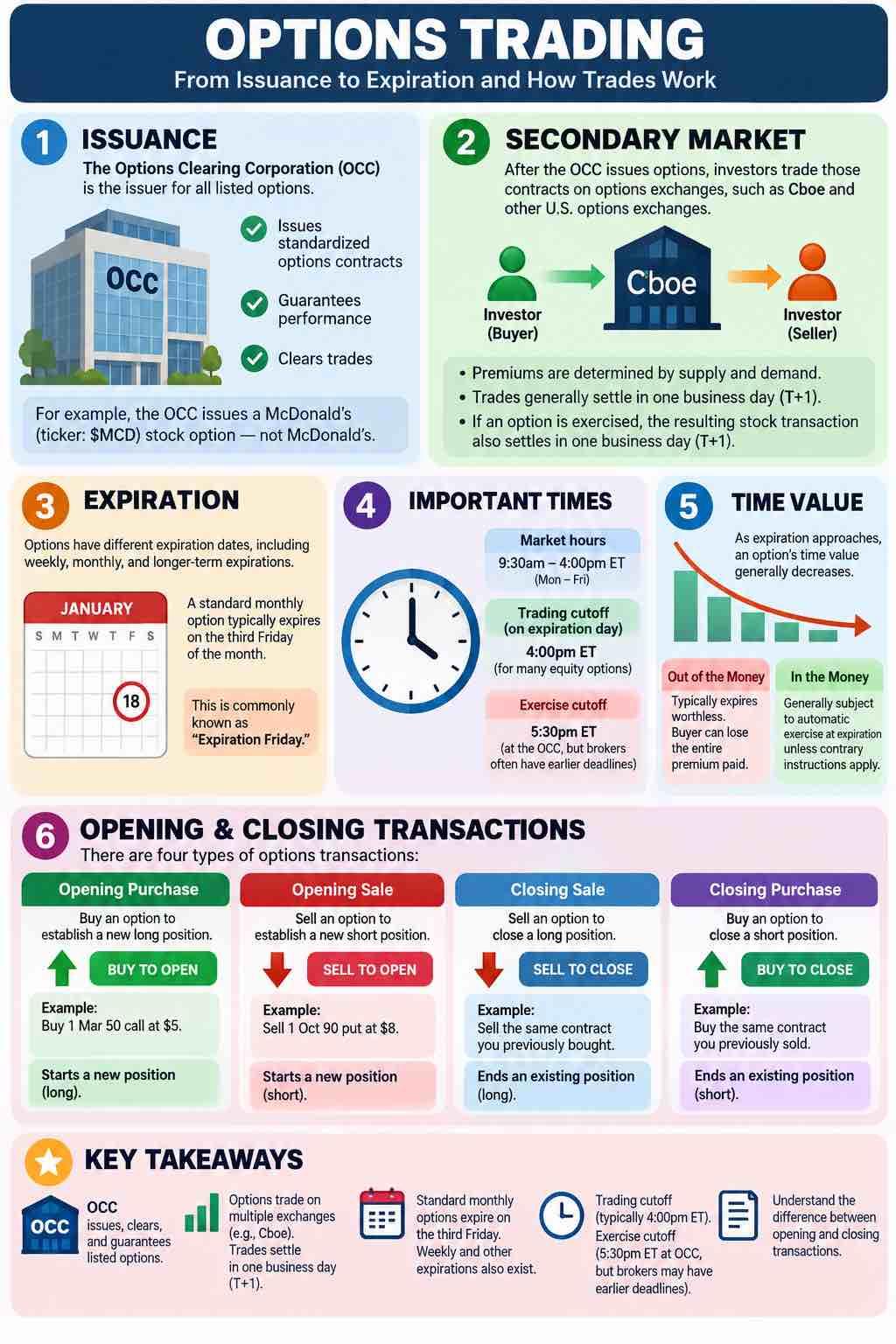
Like most securities we’ve discussed, options contracts are issued and then traded between investors in the secondary market. However, options have some unique features, especially when it comes to who issues the contracts, how trades are cleared, and how investors open and close their positions. Let’s break down how it works. 📊 ISSUANCE With most securities, the issuer is the organization directly associated with that security. Options are different. For standardized, exchange-listed options in the U.S., the Options Clearing Corporation (OCC) serves as the issuer and central clearinghouse. The OCC is responsible for issuing standardized options contracts, clearing transactions, and helping ensure that contractual obligations are fulfilled under its rules. Regardless of who issued the underlying stock, listed options on that stock are issued through the OCC, not the company itself. For example, the OCC issues standardized options contracts on McDonald’s Corporation (ticker: $MCD). McDonald’s does not issue those options contracts. Each standardized options contract has specific terms, such as its strike price, expiration date, and whether it is a call or a put. Standardization makes it easier for investors to trade the same contracts in the market without negotiating individual terms with every buyer or seller. The OCC also acts as a central counterparty in the clearing process. This helps manage the obligations between buyers and sellers after a trade is executed. In simple terms, the OCC helps keep the listed options market organized and ensures that trades and exercises are processed according to the applicable rules. 📊 SECONDARY MARKET After options are listed, investors can buy and sell them in the secondary market. Options trade on multiple exchanges, including Cboe and other U.S. options exchanges. Investors can trade contracts through their brokers, and market prices change according to supply and demand and other factors affecting an option’s value. For example, an option’s premium can be affected by the underlying stock price, strike price, time remaining until expiration, implied volatility, and market demand. When an investor buys or sells an exchange-listed options contract, the trade generally settles in one business day (T+1). For standard equity options, exercising a contract generally results in a stock transaction that also settles in one business day (T+1). Option holders can exercise their options before expiration, but it is not mandatory. They can also sell their options to close their positions, allowing them to take profits or limit losses without buying or selling the underlying shares. Options have different expiration dates, including weekly, monthly, and longer-term expirations. For example, a Coca-Cola Company (ticker: $KO) January stock option with a standard monthly expiration typically expires on the third Friday of January. This is commonly known as “Expiration Friday.” As expiration approaches, an option’s time value generally decreases. If an option expires out of the money, it typically expires worthless, and the buyer can lose the entire premium paid. In-the-money options are generally subject to automatic exercise under applicable procedures unless contrary instructions or other applicable rules apply. Always understand your broker’s expiration and exercise procedures to avoid unexpected outcomes. A FEW IMPORTANT TIMES TO KNOW Many standard equity options trade from 9:30 a.m. to 4:00 p.m. ET, Monday through Friday, during regular market hours. However, some index and ETF options have different trading hours, so always check the specifications for the contract you’re trading. On expiration day, the last trading time and the deadline for submitting exercise instructions are not necessarily the same. The OCC has a 5:30 p.m. ET deadline for receiving exercise notices from clearing members on expiration day, but individual brokers generally set earlier deadlines for their customers. Never assume you can wait until the last minute to decide whether to exercise an option. Check your broker’s deadline in advance. 📊 OPENING & CLOSING TRANSACTIONS When trading options, there are four basic types of transactions: • Opening purchase • Opening sale • Closing purchase • Closing sale Understanding the difference is important because it tells you whether you’re establishing a new position or exiting an existing one. 1️⃣ OPENING PURCHASE An opening purchase occurs when an investor buys an option to establish a new long position. Example: An investor opens an options account and buys one March $50 call for a premium of $5 per share. What type of options transaction is this? Do you know the answer? ⁉️ Answer: Opening purchase. Here’s why: First, the investor is establishing a new options position, making it an opening transaction. Second, the investor is buying the option, making it a purchase. Together, these make it an opening purchase. 2️⃣ OPENING SALE An opening sale occurs when an investor sells an option to establish a new short position. Example: An investor opens an options account and sells one October $90 put for a premium of $8 per share, establishing a short position. What type of options transaction is this? Do you know the answer? ⁉️ Answer: Opening sale. Here’s why: First, the investor is establishing a new options position, making it an opening transaction. Second, the investor is selling the option to establish a short position, making it a sale. Together, these make it an opening sale. Remember that selling an option to open a short position creates obligations and can involve substantial risk. 📊 HOW INVESTORS CLOSE OPTIONS POSITIONS Investors can close their options positions before expiration by entering an offsetting transaction in the market. There are two situations to understand: • Closing long options • Closing short options 3️⃣ CLOSING SALE: CLOSING A LONG POSITION When an investor buys an option to establish a long position, they can later sell that same option contract to close the position. For example, suppose you own a $50 put that gives you the right to sell 100 shares at $50 per share. If you decide to exit the position, you can sell the same option contract at its current market premium, provided there is a buyer and the order executes. This is called a closing sale. It’s a closing transaction because you’re exiting your existing position, and it’s a sale because you’re selling the option. 4️⃣ CLOSING PURCHASE: CLOSING A SHORT POSITION Now let’s look at the other side. Suppose you initially sell a $50 put to open a short position. This creates an obligation to buy the underlying shares at $50 per share if you’re assigned. If you want to exit that position before expiration, you can buy the same option contract to close it. This is called a closing purchase. It’s a closing transaction because you’re exiting your existing position, and it’s a purchase because you’re buying the option to offset your short position. The purchase closes your existing short position when the transaction is properly executed and processed. The easiest way to remember this: • Opening transactions establish a new position. • Closing transactions offset an existing position. • Long options are generally closed by selling. • Short options are generally closed by buying. Let’s practice with a couple more examples. 👉 EXAMPLE 1: CLOSING A SHORT CALL An investor opens an options account and sells one December $25 call to establish a short position. One week before expiration, the investor decides to exit the position. What options order must be submitted to close it? Do you know the answer? ⁉️ Answer: Closing purchase. Here’s why: The investor initially established the short call through an opening sale. Now the investor wants to exit that position. To close it, they must buy the same option contract. Therefore, the correct transaction is a closing purchase. 👉 EXAMPLE 2: CLOSING A LONG PUT An investor opens an options account and buys one June $65 put to establish a long position. One week before expiration, the investor decides to exit the position. What options order must be submitted to close it? Do you know the answer? ⁉️ Answer: Closing sale. Here’s why: The investor initially established the long put through an opening purchase. Now the investor wants to exit that position. To close it, they must sell the same option contract. Therefore, the correct transaction is a closing sale. 📊 KEY POINTS TO REMEMBER 1️⃣ Options Clearing Corporation (OCC) The OCC plays several important roles in the listed options market: • Issues standardized listed options contracts. • Clears and settles options transactions. • Acts as a central counterparty. • Helps ensure contractual obligations are fulfilled under its rules. 2️⃣ Options Trading • Options trade on multiple exchanges, including Cboe. • Premiums are influenced by supply and demand and other pricing factors. • Standard listed options trades generally settle in one business day (T+1). 3️⃣ Option Exercise • Exercising an equity option can result in a stock transaction. • Equity option exercise generally settles in one business day (T+1). • Exercise rules depend on the contract type. • Always check your broker’s exercise deadlines. 4️⃣ Option Expiration • Standard monthly equity options generally expire on the third Friday of the expiration month. • Weekly and other expiration schedules also exist. • Trading cutoffs depend on the specific option product. • Broker exercise deadlines may be earlier than the OCC’s deadline. 5️⃣ Opening Transactions Opening transactions establish new options positions. There are two types: • Opening purchases • Opening sales 6️⃣ Closing Transactions Closing transactions offset existing options positions. There are two types: • Closing purchases • Closing sales
1,364 views
0 Comments
No comments available.
Join the conversation with 500,000+ other investors 💸
Create an account to get access to everything Blossom has to offer!
📊 Personalized algorithm based on your investing style, experience level and interests
📈 Powerful portfolio and dividend tracking tools
👀 See what top creators and others in the community are investing in