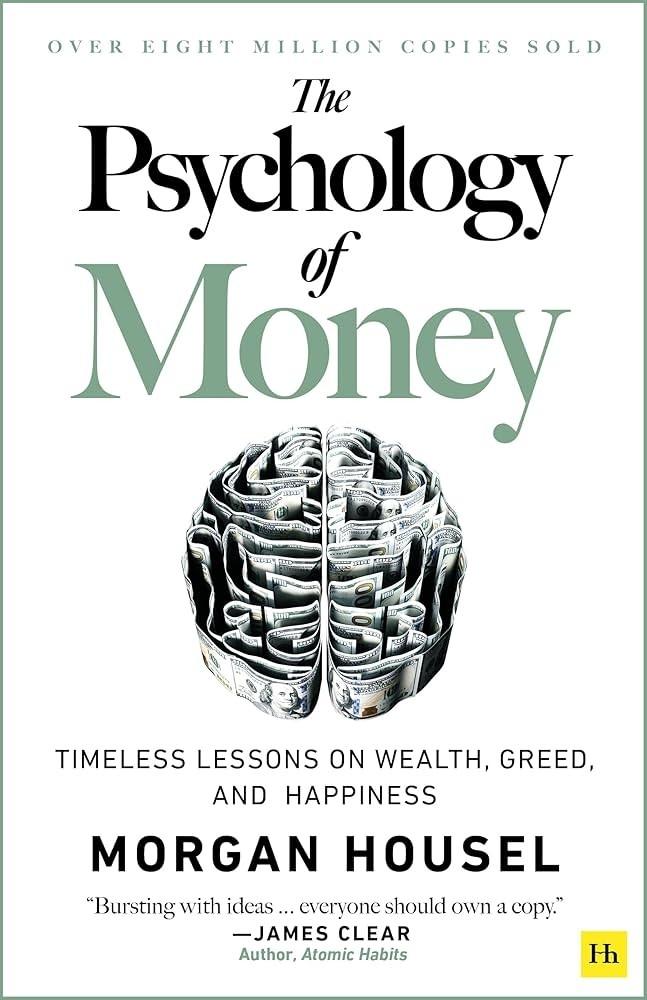
Part 1: The Psychology of Money by Morgan Housel
Book Summary : Part 1
The main premise of the book is that when it comes to personal finances, soft skills are more important than the technical aspects of money.
The book opens with Richard Fuscone, a Harward educated Merrill Lynch exc with an MNA in finance. Despite a sucessful career in Finance, Fuscone eventually declared bankruptcy due to his extravegant spending. This is contrasted with the story of Ronald Read, a gas station attendant and JC Penny janitor who died at 92 with a networth of 8 million dollars. His legacy upon death was philantropy, donating most of his fortune to the local hospital and public library.
Personal finance is one of the few areas where someone with no education or connections can vastly out preform someone with advanced credentials, connetions and vaste experience.
Money and health influence everyone. We have seen many advances in healthcare that have increased our life expentancy. However when it comes to finances, we aren't any better at managing money because we approch finance as a hard science, rather than an art. We need to appreciate the behavioral and psycological aspects of how we manage money.
Interest rates: greed optimism and insecurity
Observing history and human phsycology will make us understand money better than studying finance. Our personal upbriging and past experiences with money, especially early in adult life when we are young and impressionable, largely shape how we view money.
'Your personal experiences with money make up maybe 0.00000001% of what's happened in the world but 80% of how you think the world works.'
The ablity of investors to take on risks depends on their personal history from the generation they grew up in. If they grew up during times of high inflation, they were less likely to invest in bonds later in life. Whereas, those who grew up when the stock market was strong invested more heavily in stocks later in life vs those who grew up when stocks preformed poorly. Same goes with thoughts on unemployment.
No amount of studying or open mindedness can simulate the fear and uncertainty. Hence you can't assume people will think the same thing about inflation, unemployment or money in general.
People don't make financial decisions with spreadsheets, they make them at the kitchen table. Retirement in general is a new concept (only two generations old) as are retirement accounts. Before World War II, people typically worked until they died. For context the 401K account didn't exist until 1978 and the Roth IRA didn't exist until 1998! Moreover, index funds are less than 50 years old. With only 20-50 years of experience in the modern financial system its no surprise that we arent good at managing money.
Humility: The Roles of Luck and Risk
Understand the roles of luck and risk, nothing is as good or as bad as it seems. Both luck and risk affect every aspect of our lives. The world is too complicated for our actions to dictate 100% of our outcomes, just as the accidental impacts of life cirmstances beyond our control can be more consequential than the steps we consciously take. Give both factors their proper respect when evaluating your own or other people's financial sucess. It's hard to know the exact role of luck in successful outcomes, same goes with failure. Our brains look for easy stories explanation without nuance.
Focus less on specific individuals and more on the broad patterns of sucess. For example, avoid looking at the specific case of a successful billionaire, it's probably not applicable to your situation.
Overall people who have more control of their time tend to be happier in life. Be aware of this and be careful of who you admire and who you look down upon.
Whenever things go well, stay humbled. During good times realize that things aren't as good as you think and you aren't invicible. Conversely, when you are going through a rough time, forgive yourself, leave room for understanding. Don't blame yourself for the unforgiving realities of risk. Set up your financial situation such that a bad decision or missed financial goal won't derail your life. Nothing is ever as good or bad as it seems.
Never Enough: Rich People do Crazy Things
Bernie Madeoff had a legitamate and extremly lucrative securities firm that made between 25 to 50 million a year and yet that wasn't enough for him. Why do wealthy people worth hundreds of millions of dollars partake in criminal behavior that ruins their finaincial reputation? They made these reckless decisions because all the wealth and influence they had was never enough.
'There is no reason to risk what you have and need for you don't have an don't need.'
Another example is the hedge fund Long-Term Capital Management that took on so much risk that they managed to lose everything in 1998, in the middle of a bull market and the strongest economy!
It's a difficult financial skill to get the goal posts to stop moving. Happiness = results - expectations. Social comparison is a problem, the ceiling of comparison is so high that you will never meet it. If your expectations keep growing with income, you'll never get ahead. Modern Capitalism is good at two things, generating wealth and generating envy. Not knowing what's enought can push you to go beyond the point of regret. There are things not worth risking despite the potential gain. Knowing when you have enough is a powerful tool to build wealth.
The Counterintunitive Math of Compounding
Much of Warren Buffet's wealth didn't come from his business accument alone but rather it was built with compounding. Buffet started investing as a child and 82.5 billion out of his 84.5 billion networth was accumited after age 50! Had he started investing from age 30 until 60 his networth would have been in the millions not billions. We aren't good at conseptulizing the power of compound growth because counterintuitively, it isn't linear but rather exponential. Exponential growth is difficult for us to visualize. It's staggering the difference between starting investing at age 20 versus 30. Instead of compound growth we chase high investment returns which aren't repeatable for the longterm.
Making Money is a Different Skillset from Keeping Money!
There are a million ways to get rich but only one way to stay wealthy, a combination of frugality and paranoia. Jesse Livermore was a sucessful stock trader, who during the great depression in the worst month for the stock market in history, when a third of the stock market's value was wiped out, he became the richest man in history because he shorted the market. However, he continued to make big bets, leading him to financial ruin four years later.
Making money requires people to have high expectations, be bold and confident, take on risks and put themselves out there. On the otherhand, keeping money requires humility, frugality, fear and the acknowledgement that some of your sucess is due to luck. A survivors mentality is key to building wealth, staying out of debt, not relying too much on the money of other investors (since people can always pull all their money out in a panic!)
It helps to be paranoid. Survival is a game of longevity. Few gains are worth the risk of wiping yourself out. Compouding only works if you give your assets years to grow. While compounding doesn't require large returns, it needs good returns to be sustained overtime for uninterrupted growth over the longterm.
It's hard to hold cash during a bull market, but if it keeps you from selling your stocks during a bear markter than you'll be able to stick around long enough for compounding to work.